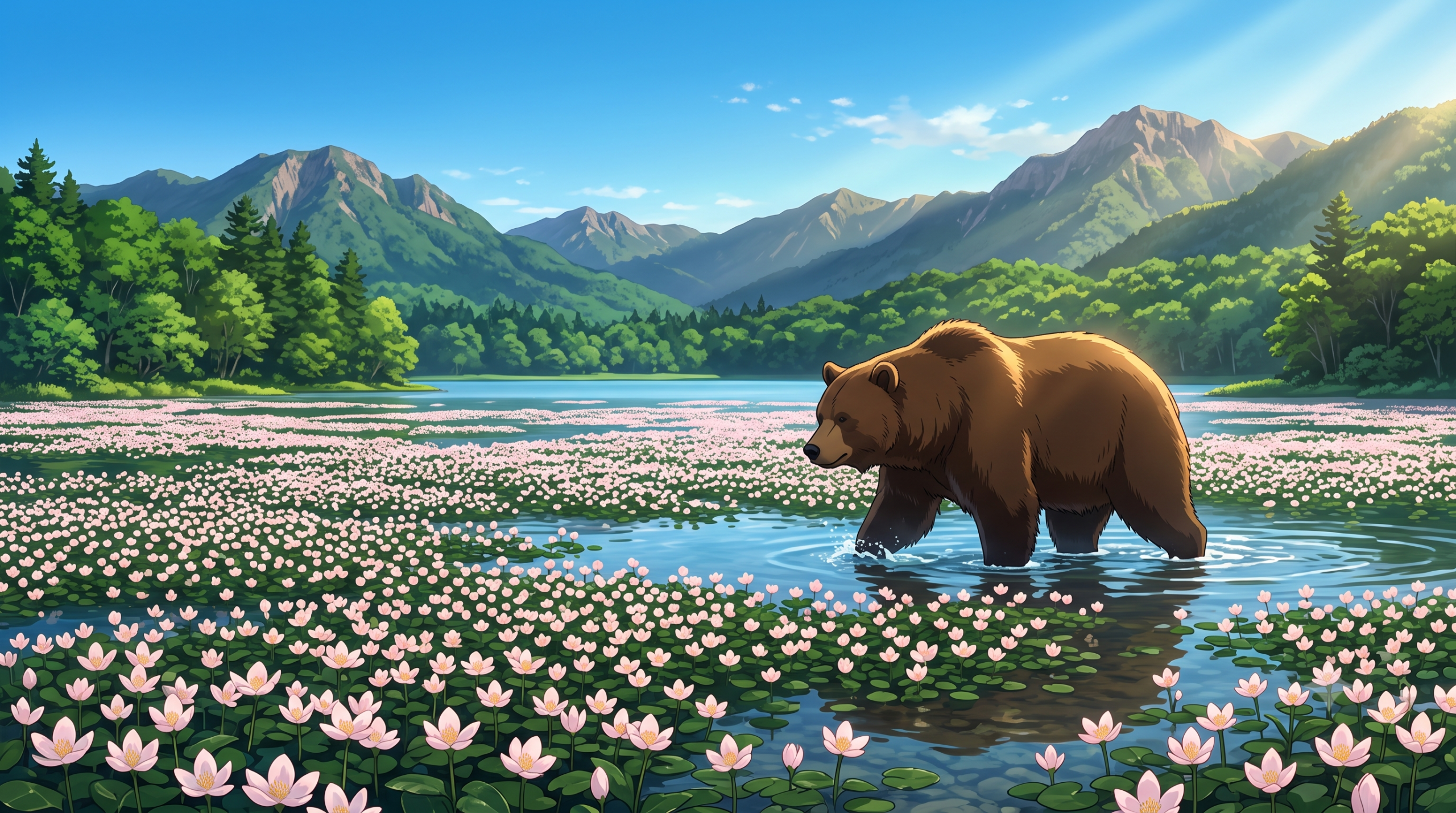
Long ago, nestled in the magnificent nature of Hokkaido, there was a peaceful Ainu *kotan* (village) on the shores of Lake Toro. This crystal-clear lake provided the villagers with an abundant blessing of fish. The deep surrounding forests were also overflowing with wild vegetables and nuts. The people lived quiet, peaceful lives without conflict, constantly thanking nature for its generosity.
However, one year, disaster struck. The sky was covered with thick, dark clouds, and relentless heavy rain poured down for days on end. The water level of the lake rose terrifyingly, turning into muddy rapids that made it impossible to catch fish or even launch a boat. The forest paths turned to deep mud, making it completely impossible to gather nuts or wild plants.
As the long rain continued, the food in the village’s storehouses began to run out. Children cried from hunger, and the faces of the adults were deeply shadowed with fatigue and absolute despair. At this rate, the entire village would starve to death. Driven by desperation, the hot-blooded young men of the village stormed to the wise, elderly chief and raised their voices.
“Chief! If we do nothing, everyone will die. Our only chance to survive is to attack the neighboring villages of Akkeshi and Hamanaka, and steal their food!”
The young men’s eyes were bloodshot with hunger and madness. However, the chief severely rebuked them.
“Do not speak such foolishness! Bloodshed between Ainu is absolutely forbidden. Even if we survive by taking the lives of others, the *Kamui* (gods) will never forgive us. All the prayers we have dedicated to the Kamui thus far would become meaningless!”
The chief’s strong words silenced the young men, but the cruel reality of the food shortage remained unresolved. Although the chief had disciplined the villagers, he was deeply despairing of his own helplessness, as he had no way to save them. Standing on the shores of Lake Toro in the darkness of the night, battered by the fierce rain, the chief finally made up his mind to end his own life. “A coward like me should just sink to the bottom of this lake,” he thought, and prepared to step into the dark water.
At that exact moment, a massive black shadow emerged from the forest, cutting through the roaring sound of the rain. It was a giant, majestic brown bear. Without glancing at the chief, the bear walked quietly but unhesitatingly into the raging waters of Lake Toro. Startled, the chief cried out, “Wait! You must not die!” but the bear did not look back and sank completely into the depths of the lake.
The instant the bear disappeared, an incredible miracle occurred. The heavy rain that had fallen for days stopped abruptly as if it were a lie. The thick clouds parted, and brilliant sunlight illuminated the surface of Lake Toro. The sky transformed into a boundless, clear blue.
The next morning, the villagers woke up to the sunlight and gasped when they looked at the lake. The entire surface of Lake Toro was covered in beautifully blooming, light-pink flowers. They were the flowers of the *Pekanbe* (water chestnut). The Pekanbe grew rapidly in the sunlight and produced countless large, highly nutritious nuts. The villagers shouted with joy, launched their boats, and frantically harvested the Pekanbe.
From that day on, Lake Toro yielded an abundance of Pekanbe every year, more than the villagers could ever eat. The chief realized the truth. That brown bear was an incarnation of *Kamui*, who had sacrificed its own life to save the villagers who chose peace over war. Ever since, during the Pekanbe harvest season, the villagers never failed to offer deep prayers of gratitude to the Kamui.
An In-Depth Analysis of the Hidden Messages in “Toroko no Pekanbe”
The folktale of “Toroko no Pekanbe” is not merely a story of salvation from famine. Hidden within it are profound insights into human ethics and the laws of nature.
The first point to note is the chief’s unwavering commitment to “pacifism.” When placed in an extreme state of starvation, humans are instinctively driven to attack others for self-preservation. The young men’s proposal to attack the neighboring village was a raw biological survival instinct. However, the chief firmly rejected “conflict between Ainu.” This is a result of valuing moral and spiritual purity over physical survival. He held a firm belief that prolonging life through plunder meant the death of the soul.
The second point is the self-sacrifice of the brown bear (Kamui). In Ainu belief, animals are temporary forms taken by gods (Kamui) when they visit the human world. The brown bear, in particular, holds the highest divine rank as “Kimun Kamui” (God of the Mountain). The Kamui bestowed the ultimate blessing upon the chief because he rejected moral corruption (war) and showed such an immense sense of responsibility that he was willing to take his own life. The act of the bear sinking into the lake is a metaphor for sacred self-sacrifice. It carries a powerful message that the gods grant their blessings (Pekanbe) only to humans with righteous hearts.
Coexistence with Nature: The Connection Between Ainu and Japanese Culture
The most important theme that can be read from this story is “complete coexistence with nature.” In Ainu culture, a soul dwells in everything in the natural world, and humans and Kamui (nature) have an equal and reciprocal relationship. When humans offer gratitude and respect (prayers) to the Kamui, the Kamui provide blessings to humans in the form of meat, fur, and plants like the Pekanbe.
Pekanbe (water chestnut) is rich in starch and was historically a vital preserved food for the Ainu people to ward off starvation. Even today, in Ainu culture, there is a sacred ritual called “Pekanpe Kamuinomi” (Prayer of the Water Chestnut), where the ceremony of gratitude for nature’s bounty is continuously passed down.
This “reverence for nature” and the animistic spirit that “gods dwell in all things” are deeply connected at their roots not only to Ainu culture but also to Japanese Shintoism and traditional views of nature, which believe in eight million gods. From this folktale, we can learn a humble philosophy unique to the East and Japan: that we are “kept alive as a part of nature”—a direct contrast to modern Western ideologies that seek to control nature.
What Would You Do? Choices in Extreme Situations
In the story, even in the extreme situation where the entire village could starve to death, the chief rejected the path of plundering and sacrificing others. His noble decision ultimately brought about a divine miracle.
We ask you, living in the modern world: If you or your loved ones were standing on the brink of life and death, would you choose the path of surviving even if it meant stepping on others? Or would you protect your morality and dignity to the very end, just like the chief?
In a modern society where efficiency and profit are often prioritized, the question posed by “Toroko no Pekanbe” sharply shakes the depths of our hearts. Please, try to find your own answer.
If you want to discover more philosophies hidden in traditional tales, explore our Japanese Folktale Series. To delve deeper into the history and spirituality of the Ainu culture introduced in this article, visit the Official Akan Ainu Kotan Website.
北海道アイヌの神秘的な昔話「トーロコのペカンベ」の物語
はるか昔、北海道の雄大な自然に抱かれたトーロコ(塘路湖)の岸辺に、アイヌの人々が暮らす平和なコタン(村)がありました。この湖は透き通るような美しい水を湛え、村人たちに豊かな魚の恵みをもたらしていました。また、周囲の深い森は山の幸に溢れ、人々は自然の恵みに感謝しながら、争いもなく穏やかな日々を送っていました。
しかし、ある年のことです。空は分厚い黒雲に覆われ、何日も何日も容赦ない大雨が降り続きました。湖の水位は恐ろしいほどに上がり、濁流となって魚を捕ることはおろか、舟を出すことすらできません。森の道も泥濘と化し、木の実や山菜を採りに行くことも完全に不可能となりました。
長雨が続く中、村の貯蔵庫にあった食料は底をつき始めました。子供たちは飢えに泣き、大人たちの顔にも深い疲労と絶望の色が濃くなっていきました。このままでは村全体が飢え死にしてしまいます。焦りを募らせた村の血気盛んな若者たちは、年老いた賢明な酋長の元へ押しかけ、声を荒げました。
「酋長!このままでは皆死んでしまう。アッケシ(厚岸)やハマナカ(浜中)のコタンに戦いを仕掛け、彼らの食料を奪い取るしか生き残る道はない!」
若者たちの目は飢えと狂気に血走っていました。しかし、酋長は彼らを厳しく一喝しました。
「愚かなことを言うな!アイヌ同士で血を流し合うなど、絶対に許されない。他者の命を奪って生き延びたとして、カムイ(神々)が我々を許すはずがない。これまでカムイに捧げてきた祈りがすべて無駄になるのだ!」
酋長の強い言葉に若者たちは押し黙りましたが、食料不足という残酷な現実は何一つ解決していません。酋長は村人たちを戒めたものの、彼らを救う術を持たない自身の無力さに深く絶望していました。夜の闇の中、激しい雨に打たれながらトーロコの湖畔に立った酋長は、ついに自らの命を絶つ決意を固めました。「意気地のない私など、この湖の底に沈んでしまえばいい」と、暗い水面へ足を踏み入れようとしました。
その瞬間です。轟くような雨音を切り裂き、巨大な黒い影が森から現れました。それは一頭の非常に大きく、威厳に満ちたヒグマでした。ヒグマは酋長を一瞥することもなく、静かに、しかし迷いのない足取りでトーロコの荒れ狂う湖水の中へと入っていきました。酋長は驚き、「待て!死んではいけない!」と叫び声を上げましたが、ヒグマは振り返ることなく、深い湖の底へと完全に沈んでいきました。
ヒグマの姿が見えなくなった次の瞬間、信じられない奇跡が起きました。何日も降り続いていた大雨が嘘のようにぴたりと止み、分厚い雲が割れ、眩い太陽の光がトーロコの湖面を照らし出したのです。空はどこまでも高く、澄み切った青空へと変わりました。
翌朝、太陽の光を浴びて目を覚ました村人たちは、湖を見て息を呑みました。トーロコの湖面一面に、薄紅色の美しい花が咲き乱れていたのです。それはペカンベ(ヒシ)という水草の花でした。ペカンベは太陽の光を浴びてまたたく間に成長し、栄養満点の大きな実を無数につけました。村人たちは歓喜の声を上げ、舟を出して夢中でペカンベの実を収穫しました。
その日から、トーロコには毎年、村人が食べきれないほどの豊かなペカンベが実るようになりました。酋長は悟りました。あのヒグマは、争いを避け、平和を貫こうとした村人たちを救うために自らの命を捧げたカムイの化身であったのだと。村人たちはそれ以来、ペカンベの収穫の時期には必ずカムイへの深い感謝の祈りを捧げるようになりました。
「トーロコのペカンベ」に隠された深いメッセージの考察
この「トーロコのペカンベ」という昔話は、単なる飢饉からの救済物語ではありません。ここには、人間の倫理観と自然の摂理についての深い洞察が隠されています。
第一に注目すべきは、酋長の揺るぎない「平和主義」です。極限の飢餓状態に置かれた時、人間は本能的に自己保存のために他者を攻撃する衝動に駆られます。若者たちが隣村を襲撃しようと提案したのは、生物としての生々しい生存本能です。しかし、酋長は「アイヌ同士の争い」を断固として拒絶しました。これは、物理的な生存よりも、道徳的・精神的な清廉さを重んじた結果です。略奪による延命は、魂の死を意味するという確固たる信念がそこにあります。
第二に、ヒグマ(カムイ)の自己犠牲です。アイヌの信仰において、動物は神(カムイ)が人間の世界を訪れる際の仮の姿です。特にヒグマは「キムンカムイ(山の神)」として最高位の神格を持ちます。カムイは、酋長が道徳的堕落(戦争)を拒み、自らの命を絶とうとするほどの責任感を示したことに対して、最大の恩恵を与えました。熊が湖に沈むという行為は、神聖な自己犠牲のメタファーです。神は正しい心を持つ人間にのみ、その恵み(ペカンベ)を与えるという強烈なメッセージが込められています。
自然との共生:アイヌ文化と日本文化の繋がり
この物語から読み解ける最も重要なテーマは「自然との完全なる共生」です。アイヌ文化において、自然界に存在するすべてのものには魂が宿り、人間とカムイ(自然)は対等で互恵的な関係にあります。人間がカムイに感謝と敬意(祈り)を捧げることで、カムイは肉や毛皮、そしてペカンベのような植物として人間に恵みを与えます。
ペカンベ(ヒシの実)は、でんぷん質を豊富に含み、実際にアイヌの人々にとって飢えをしのぐための極めて重要な保存食でした。現在でもアイヌ文化においては「ペカンペ・カムイノミ(ヒシの実の祈り)」という神事が存在し、自然の恵みに対する感謝の儀式が脈々と受け継がれています。
この「自然に対する畏敬の念」と「万物に神が宿る」というアニミズムの精神は、アイヌ文化のみならず、八百万の神々を信仰する日本の神道や伝統的な自然観と深く根底で繋がっています。私たちは、自然をコントロールしようとする西洋的な近代思想とは対極にある、「自然の一部として生かされている」という東洋・日本特有の謙虚な哲学を、この昔話から学ぶことができます。
あなたならどうしますか?極限状態での選択
物語の酋長は、村全体が餓死するかもしれないという極限状態においても、他者を犠牲にする略奪の道を退けました。その高潔な決断が、結果として神の奇跡を呼び込みました。
現代を生きるあなたに問いかけます。もし、あなたやあなたの愛する家族が生きるか死ぬかの瀬戸際に立たされた時、他者を踏み台にしてでも生き残る道を選びますか?それとも、酋長のように自身の道徳と尊厳を最後まで守り抜きますか?
効率や利益ばかりが優先されがちな現代社会において、この「トーロコのペカンベ」が投げかける問いは、私たちの心の奥底を鋭く揺さぶります。ぜひ、あなた自身の答えを見つけてみてください。
日本の昔話に込められた哲学をさらに深く知りたい方は、こちらの日本昔話シリーズをご覧ください。また、本記事で紹介したアイヌ文化の歴史や精神性については、阿寒湖アイヌコタン公式サイトにて詳細を学ぶことができます。
コメント