- Introduction
- The Complete Story of “Sentoku’s Gold”
- Analyzing the Folktale: Why Did the Gold Coin Return?
- Connection to Japanese Culture: The Spirit of Muyoku and En
- To You, the Reader: What Would You Do?
- はじめに
- 奇跡の連鎖:「せんとくの金」の完全なストーリー
- 昔話を深く読み解く:なぜ小判は持ち主のもとへ還ったのか?
- 日本文化とのつながり:無欲(Muyoku)と縁(En)の精神
- 読者のあなたへ:もしあなたならどうしますか?
Introduction
Japanese folktales hold deep life truths that go far beyond simple children’s fairy tales. Today, we introduce a masterpiece passed down in regions like Yamagata Prefecture, titled “Sentoku’s Gold” (Sentoku no Kane).
This story perfectly illustrates how beautifully fate operates when humans completely let go of their “greed” for wealth and money. What would you do if you found a large sum of money on the side of the road with someone else’s name on it? Let’s delve into the essence of Japanese culture through this tale packed with beautiful traditional values.
The Complete Story of “Sentoku’s Gold”
Once upon a time, there was a traveling pilgrim known as a “Rokubu” walking across Japan.
One autumn day, while trekking along a steep mountain path, the Rokubu became terribly thirsty. He climbed down to a valley stream to drink and noticed a small cloth bag lying on the ground.
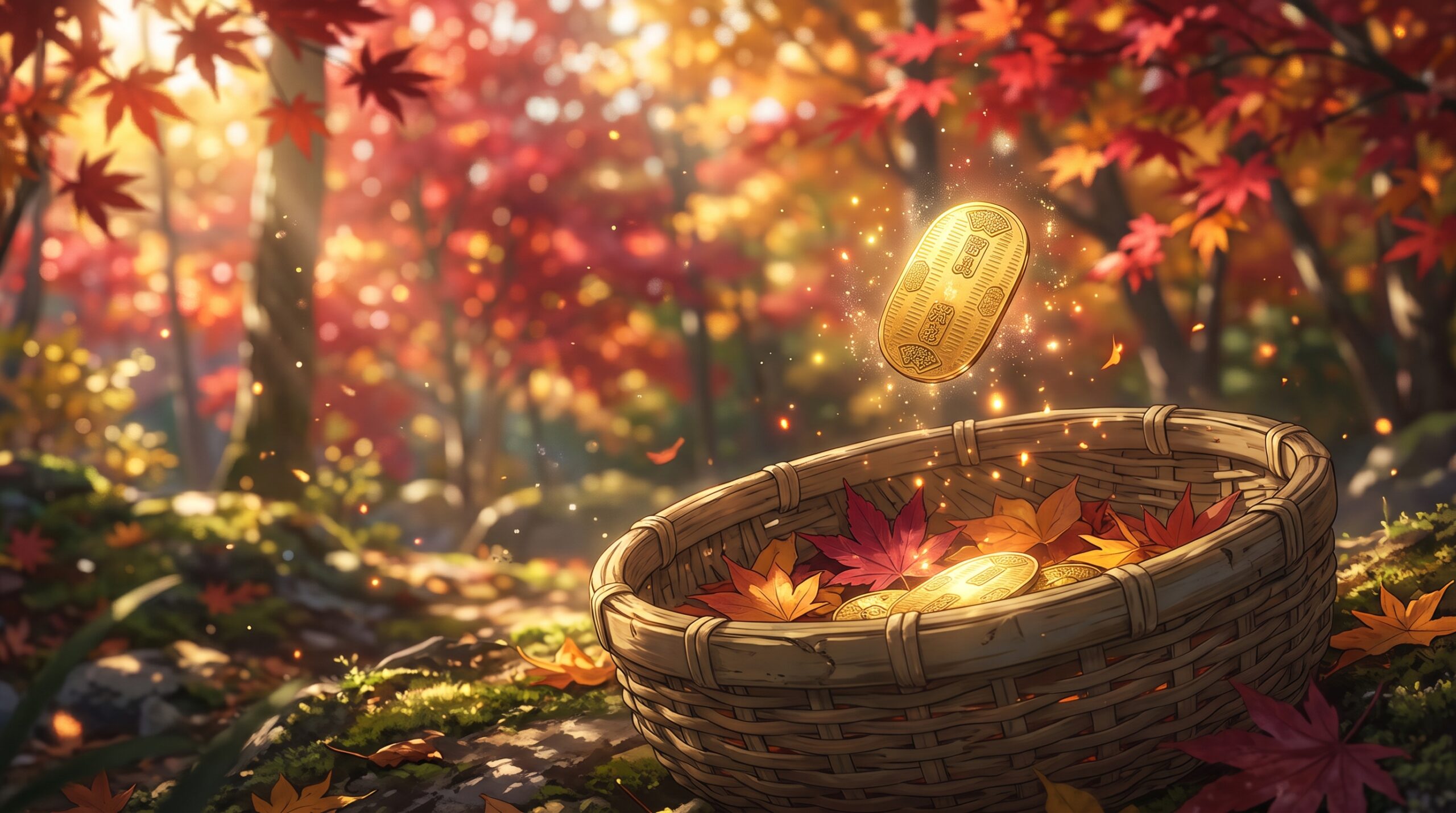
Picking it up and looking inside, he found a dazzling “Koban” (an oval gold coin). On the surface of the bag, it clearly said: “Money given to Sentoku.”
The Rokubu declared, “I have no idea who Sentoku is, but since it is written here, this belongs to a person named Sentoku.” Without a moment’s hesitation, he placed the bag back on the ground exactly where he found it.
Immediately after, an old man from a nearby village appeared, gathering fallen autumn leaves. Not noticing the bag with the gold coin, the old man raked it up along with the leaves into his basket and carried it away. The Rokubu watched and thought, “I wonder if that old man is Sentoku,” before continuing his journey.
However, the Rokubu lost his way on the mountain, and night fell. Spotting a light deep in the dark forest, he asked for a night’s lodging at the house. Surprisingly, it was the home of the very old man he had seen earlier. The old man lived with his wife and a pregnant daughter-in-law, whose husband was far away working to support the family. Though poor, the family warmly and generously hosted the Rokubu, a total stranger.
The next morning, a miracle occurred. The daughter-in-law safely gave birth to a healthy baby boy. Overjoyed, the grandfather and grandmother said:
“The grandmother’s name is ‘Osen’, and my name is ‘Tokuzou’. We decided to take one character from each of our names and name this child ‘Sentoku’.”
Hearing this, the Rokubu was utterly amazed. He told them about the bag of gold coin he found in the mountain yesterday with “Money given to Sentoku” written on it, and how the old man must have brought it home with the leaves.
The old man hurriedly dumped out his basket of leaves, and indeed, the bag rolled out. The Rokubu smiled and said, “Without a doubt, this is money granted by the heavens for this child (Sentoku).”
But the old man refused to accept it. “No, you were the one who found it first. This is yours,” he insisted. The Rokubu equally refused, saying, “I am merely a passing traveler. This gold, appearing through the strange fate of this land, absolutely belongs to this child.” Unwilling to take what wasn’t his, the Rokubu left the house and resumed his journey.
Desperate to give the money back to the Rokubu, the old couple prepared “Yakimeshi” (baked rice balls) for his journey and secretly hid the gold coin inside one of them.
As the Rokubu walked down the mountain, he crossed paths with a young man rushing up the trail, completely out of breath. The Rokubu said, “You look exhausted. Eat this and get some rest,” generously handing one of his baked rice balls to the young man.
In truth, this young man was the old man’s son—the father of the newborn “Sentoku”—hurrying home from his distant work. Arriving home and relieved to see his safely born son, the young man took a bite of the rice ball the traveler had given him.
To his shock, he bit into something hard. It was unmistakably the gold coin meant for “Sentoku.”
Circulating from hand to hand, the money that no one greedily claimed ultimately and perfectly reached its rightful owner, Sentoku.
Analyzing the Folktale: Why Did the Gold Coin Return?
The greatest charm of this story lies in the fact that absolutely none of the characters pursued their own self-interest.
In modern society, it might be common for someone to try and keep a found fortune or aggressively assert their right to it. Yet, the Rokubu let it go because “someone else’s name is on it,” and the old man refused it because “the one who found it first should have it.”
Their complete lack of attachment to wealth resulted in the most beautiful completion of destiny’s puzzle. The Rokubu’s compassionate act of sharing his food with a tired young man acted as the final piece. If even one person had prioritized their own greed, this chain of miracles would have broken, and the money would never have reached Sentoku. Few stories express the concept of karmic reward and the boomerang effect of goodwill so masterfully.
Connection to Japanese Culture: The Spirit of Muyoku and En
This folktale strongly reflects traditional Japanese spirituality. Two key concepts stand out: “Muyoku” (Selflessness/Lack of Greed) and “En” (Fate/Karma/Ties).
In Japanese culture, heavily influenced by Buddhism and Shintoism, “Muyoku”—letting go of worldly attachments—is considered a supreme virtue. It is the attitude of not trying to control the world with one’s ego, but rather surrendering to the flow of nature and divine providence. Furthermore, since ancient times, Japanese people have cherished “En”—the invisible ties and destined encounters between people.
Additionally, the old man’s family taking in a strange traveler free of charge and feeding him is the very root of “Omotenashi” (Japanese hospitality), which Japan proudly shares with the world. The ancient belief of treating a passing guest (Marebito) as a messenger of the gods flows deep within this narrative.
To You, the Reader: What Would You Do?
“Sentoku’s Gold” teaches us the truth that when we let go of our attachments and possess pure kindness toward others, the world responds in the most beautiful way possible.
Now, after reading this story, how do you feel?
If you were to find a large sum of money in the forest that didn’t have your name on it, could you leave it there and walk away like the Rokubu? Or would you try to yield it to someone else like the old man?
We invite you to use this story as an opportunity to reflect on the concepts of “selflessness” and “honesty” within your own heart.
If you want to discover more fascinating Japanese folktales, please check out this category:
Japanese Folktale Series
Reference Data Source:
Manga Nihon Mukashibanashi Database – Sentoku’s Gold
日本昔話「せんとくの金」:無欲と正直さが導く奇跡の物語
はじめに
日本の昔話には、単なる子供向けのおとぎ話を超えた、人生の深い真理が隠されています。今回ご紹介するのは、山形県などに伝わる名作「せんとくの金(せんとくのかね)」です。
この物語は、富やお金に対する人間の「欲」を完全に手放したとき、運命がどのように美しく機能するのかを完璧に描き出しています。あなたがもし、道端で名前の書かれた大金を見つけたらどうするでしょうか。この日本の美しい伝統的価値観が詰まった物語を通して、日本文化の真髄に触れてみましょう。
奇跡の連鎖:「せんとくの金」の完全なストーリー
むかしむかし、日本中を巡礼して歩く「六部(ろくぶ)」という旅の僧侶がいました。
ある秋の日、六部が険しい山道を歩いていると、ひどく喉が渇きました。谷川へ水を飲みに下りた六部は、足元に小さな布の袋が落ちているのを見つけます。
拾い上げて中を見ると、そこにはまばゆく光る「小判(金貨)」が入っており、袋の表面にははっきりと「せんとくに与える金」と書かれていました。
六部は「せんとくとは誰のことか分からないが、ここにある以上、これはせんとくという人物のものだ」と断言し、一切の迷いなく袋を元の地面に戻しました。
その直後、落ち葉を拾い集める一人の村のお爺さんが現れました。お爺さんは小判が入った袋に気づかず、落ち葉と一緒に自分のカゴへかき集めて持ち去ってしまいました。六部は「あのお爺さんが『せんとく』なのだろうか」と思いながら、再び歩き出しました。
しかし、六部は山道で迷ってしまい、日が暮れてしまいます。真っ暗な森の奥に一軒の家の明かりを見つけ、一夜の宿を頼むことにしました。驚いたことに、そこは昼間山で出会ったあのお爺さんの家でした。家にはお婆さんと、出産を間近に控えた身重のお嫁さんがおり、息子は遠くへ出稼ぎに出ていました。一家は貧しいながらも、見ず知らずの旅人である六部を心から温かくもてなしました。
翌朝、奇跡が起こります。お嫁さんが無事に元気な男の子を出産したのです。喜びに沸く中、お爺さんとお婆さんはこう言いました。
「婆さんの名前は『おせん』、私の名前は『とくぞう』だ。二人の名前から一文字ずつ取って、この子の名前は『せんとく』にしようと決めていたんだ」
これを聞いた六部は大変驚き、昨日山で「せんとくに与える金」と書かれた小判の袋を見つけたこと、そしてそれをお爺さんが落ち葉と一緒に持ち帰ったはずだという事実を伝えました。
お爺さんが慌てて落ち葉のカゴをひっくり返すと、見事にその袋が出てきました。六部は「これは間違いなく、天がこの子(せんとく)に授けたお金です」と言いました。
しかし、お爺さんはそれを受け取りません。「いや、最初に見つけたのは六部様です。これはあなたのものです」と固辞します。六部も「私は通りすがりの旅人。この土地の奇妙な縁で現れたこの金は、絶対にこの子のものです」と決して受け取らず、そのまま旅立ってしまいました。
どうしても六部にお金を受け取ってほしいお爺さんとお婆さんは、六部の旅の弁当として「焼きおにぎり」を作り、その中にこっそりとあの小判を隠して渡しました。
六部が山を下っていくと、息を切らして山を登ってくる一人の若者とすれ違います。六部は「随分と疲れているようだから、これを食べて休みなさい」と、持っていた焼きおにぎりを一つ若者に譲りました。
実は、この若者こそが出稼ぎから急いで帰ってきたお爺さんの息子、つまり生まれたばかりの「せんとく」の父親でした。家に帰り着き、無事に生まれた我が子を見て安堵した若者は、六部からもらった焼きおにぎりを頬張りました。
すると、中から硬いものが出てきました。それは紛れもなく、あの「せんとくに与える金」だったのです。
巡り巡って、誰も欲をかかなかったお金は、最終的に本来の持ち主である「せんとく」のもとへと完璧な形でたどり着いたのでした。
昔話を深く読み解く:なぜ小判は持ち主のもとへ還ったのか?
この物語の最大の魅力は、登場人物全員が「自分の利益を全く追求していない」という点にあります。
現代社会では、道端で大金を見つければ自分のものにしようとしたり、正当な権利を主張したりするのが一般的かもしれません。しかし、六部は「名前が書いてあるから他人のものだ」と手放し、お爺さんは「最初に見つけた人のものだ」と譲り合います。
富に対する執着のなさが、結果として最も美しい運命のパズルを完成させました。六部が焼きおにぎりを若者に分け与えるという「他者への思いやり」の行動が、最後のピースをはめる役割を果たしています。もし誰か一人が自分の欲を優先していれば、この奇跡の連鎖は断ち切られ、お金は決してせんとくのもとへは届かなかったでしょう。因果応報、そして善意のブーメラン効果をこれほど見事に表現した物語は他にありません。
日本文化とのつながり:無欲(Muyoku)と縁(En)の精神
この昔話からは、日本の伝統的な精神性が色濃く読み取れます。注目すべきは「無欲(Muyoku)」と「縁(En)」という二つの概念です。
仏教や神道の影響を強く受ける日本文化において、「無欲(執着を手放すこと)」は非常に高い美徳とされています。自分の力や欲で世界をコントロールしようとせず、自然の流れや天の采配に身を委ねる姿勢です。また、日本の人々は古来より、目に見えない人と人との繋がりや運命的な巡り合わせを「縁(En)」と呼び、大切にしてきました。
また、見ず知らずの六部を無償で家に泊め、食事を振る舞ったお爺さん一家の行動は、日本が世界に誇る「おもてなし(Omotenashi)」の原点でもあります。客人(まれびと)を神様の使いとして丁重に扱うという古い信仰が、この物語の根底に流れているのです。
読者のあなたへ:もしあなたならどうしますか?
「せんとくの金」が教えてくれるのは、私たちが執着を手放し、他者への純粋な優しさを持ったとき、世界は最も美しい形で応えてくれるという真実です。
さて、この物語を読んで、あなたはどう感じましたか?
もしあなたが、森の中で自分の名前が書かれていない大金を見つけたら、六部のようにその場に置いて立ち去ることができるでしょうか。それとも、お爺さんのように誰かに譲ろうとするでしょうか。
ぜひ、あなたの心の中にある「無欲」と「正直さ」について、この物語をきっかけに見つめ直してみてください。
日本の魅惑的な昔話をもっと知りたい方は、ぜひこちらのカテゴリーをご覧ください:
日本の昔話シリーズ (Japanese Folktale Series)
参考文献・データ出所:
まんが日本昔ばなしデータベース – せんとくの金

コメント