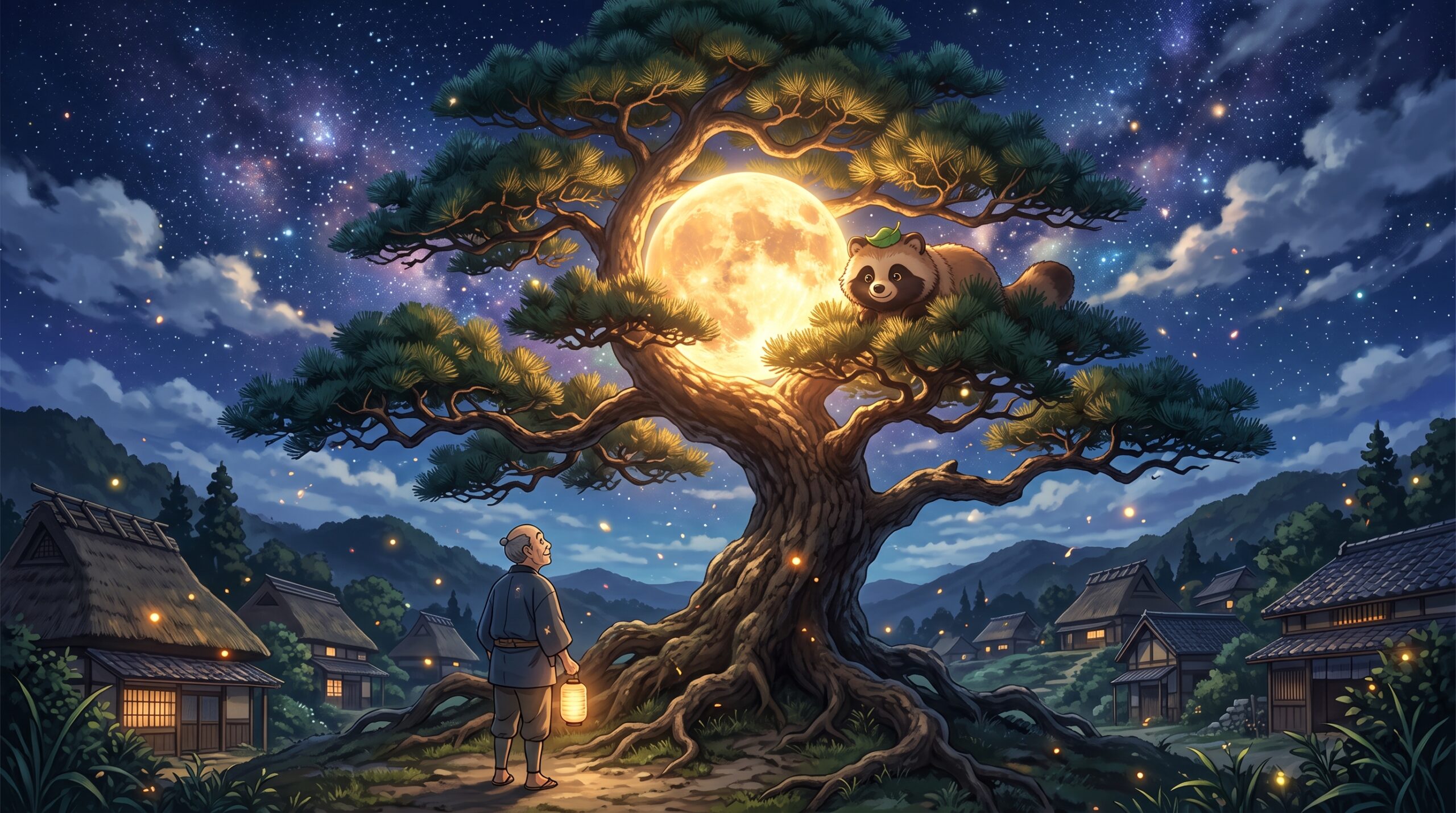
In Japan, alongside terrifying legends of Yokai (monsters), there are many heartwarming folktales depicting interactions between humans and animals. The Japanese folktale introduced here, “Tsukimi no Eda” (The Moon-Viewing Branch), features a “Tanuki” (Japanese raccoon dog) known for shape-shifting. However, its purpose was not to deceive people into misfortune, but rather to bring them joy. Let’s unravel this story of a beautiful full moon that suddenly appeared in a poor village and the gentle bond between humans and animals.
The Story of “Tsukimi no Eda”: Gosaku’s Encounter with the Mysterious Full Moon
Once upon a time, deep in the mountains, there was a very poor village. In the center of the village stood a magnificent, large pine tree, which served as a symbol for the villagers.
One evening, a single man named Gosaku, who lived in the village, was walking home in high spirits after being treated to strong sake in a neighboring village. As Gosaku passed under the large pine tree, he witnessed a mysterious sight. Between the branches of the pine tree, a breathtakingly beautiful full moon was shining brightly.
“Oh, what a beautiful moon…”
As Gosaku stopped and stared in awe, other villagers, drawn by the magnificent light, came out of their houses one after another and gathered under the pine tree. Everyone praised the full moon, and they stayed up late that night gazing at it. The next day, and the day after that, the beautiful full moon hung in the pine tree. The poor villagers began to gather under this beautiful moonlight, bringing modest meals, singing songs, and having a wonderful time.
However, something strange happened. One night, heavy cold rain began to fall from the sky. The villagers hurried home in a panic, but only Gosaku remained under the tree, looking up at the moon. Surprisingly, even in the pouring rain, the full moon remained shining brightly in the pine tree. “It’s strange that a full moon is out when it’s raining,” Gosaku thought to himself, and he finally went home.
For the next few days, for some reason, that beautiful full moon did not appear.
One night, as the villagers were feeling lonely, the beautiful full moon shone in the pine branches for the first time in a while. As Gosaku joyfully gazed at the moon, a real, “half-moon” peaked out from between the clouds high in the sky.
Surprised, Gosaku shouted out, “Ah! There is another moon in the sky!” At that moment, the full moon in the pine branches panicked and retreated deep into the leaves.
Gosaku realized exactly what was going on. “Aha, this must be the work of a Fox or a Tanuki.”
Amused, Gosaku shouted towards the pine tree to tease it.
“Hey! The real moon is much more beautiful! You need to go higher! No, lower!”
As Gosaku was teasing it, suddenly, with a heavy thud, a Tanuki fell from the pine branches. The Tanuki hit its head, getting a big bump, and crouched down with teary eyes.
Instead of getting angry, Gosaku gently picked up the Tanuki and tended to the bump on its head. He pleaded, “You transformed into a beautiful full moon just to make everyone in the village happy, didn’t you? I’ll heal your injury, so please continue to show us the beautiful full moon.”
The Tanuki was overjoyed by Gosaku’s kindness, and from then on, it showed a magnificent full moon almost every night, entertaining the villagers. With gratitude, the villagers came to call this pine tree “Tsukimi no Eda” (The Moon-Viewing Branch).
Deep Analysis of “Tsukimi no Eda”: A Chain of Compassion, Not Deception
In Japanese folktales, Tanuki and Foxes are generally depicted as tricksters who “deceive and trick humans.” They often tease humans by making muddy water look like a feast or turning leaves into money. However, the behavioral principle of the Tanuki in “Tsukimi no Eda” is completely different.
This Tanuki provided the free entertainment of a “beautiful moon” to the poor villagers who had no other amusements. Leaving the full moon out even on a rainy day shows the Tanuki’s naivety and clumsiness, which makes it incredibly endearing. Furthermore, when Gosaku uncovers its true identity, he doesn’t punish or exterminate the Tanuki. Instead, he treats its bump and asks it to “keep showing us.” This clearly depicts a warm attitude of “coexistence,” where there is no hostility between humans and the natural world (Yokai and animals); they acknowledge each other’s existence and try to share joy.
Connection to Japanese Culture: Tsukimi (Moon Viewing) and the Worldview of Animism
The important elements of Japanese culture that can be deciphered from this story are the custom of “Tsukimi” (Moon Viewing) and the worldview of “Animism,” which believes that souls dwell in all things in nature.
Since ancient times, Japan has had a deep-rooted culture called “Tsukimi,” where people admire the moon floating in the clear autumn sky. The moon was not just a celestial body, but a symbol of a good harvest and an object of sacred prayer. The sight of poor villagers gathering under the pine tree, eating and singing while looking at the moon, is the very original landscape of a traditional Japanese banquet that deepens community bonds.
Also, the depiction of the Tanuki nestling close to humans and humans accepting the Tanuki as a member of the village symbolizes Japan’s unique animistic spirit, which does not clearly separate nature from humans. While monsters that deceive humans are often defeated in Western myths and fairy tales, in Japan, they are sometimes treated like neighbors, as they are part of the same nature.
To the Readers: What Would You Do?
Gosaku’s kindness opened the Tanuki’s heart and brought an eternal, beautiful night view to the whole village. If you were in Gosaku’s shoes and a Tanuki that might have been deceiving you fell from a tree, what words would you say to it?
Also, in your busy modern life, where is the place that brings you peace of mind, just like the “Moon-Viewing Branch”? Please look up at the moon in the sky tonight while recalling your own thoughts and episodes.
Reference Links and Related Articles
- Internal Link: Japanese Folktale Series (Click here for more Japanese folktales)
- External Link: Manga Nippon Mukashibanashi Database – Tsukimi no Eda (Japanese)
- External Link: Wikipedia – Tsukimi (History and culture of Japanese moon-viewing)
- The Story of “Tsukimi no Eda”: Gosaku’s Encounter with the Mysterious Full Moon
- Deep Analysis of “Tsukimi no Eda”: A Chain of Compassion, Not Deception
- Connection to Japanese Culture: Tsukimi (Moon Viewing) and the Worldview of Animism
- To the Readers: What Would You Do?
- Reference Links and Related Articles
- 日本昔話「月見の枝」:狸が魅せた心温まる幻の満月
日本昔話「月見の枝」:狸が魅せた心温まる幻の満月
日本には、恐ろしい妖怪の伝説だけでなく、心温まる動物との交流を描いた昔話が数多く存在します。今回ご紹介する日本昔話「月見の枝(つきみのえだ)」は、人々を化かすことで知られる「狸(たぬき)」が登場しますが、その目的は人を陥れることではなく、人々を喜ばせることでした。貧しい村に突如として現れた美しすぎる満月の秘密と、人間と動物の優しい絆の物語を紐解いていきましょう。
「月見の枝」のストーリー:不思議な満月と吾作の出会い
昔々、ある山奥にとても貧しい村がありました。村の中心には一本の大きな松の木が堂々とそびえ立っており、村人たちのシンボルとなっていました。
ある日の晩のことです。この村に住む独り身の男、吾作(ごさく)が隣村で強いお酒をごちそうになり、上機嫌で夜道を歩いて帰ってきました。吾作が村の大きな松の木の下を通りかかると、不思議な光景を目にします。なんと、松の枝と枝の間から、目を奪われるほどに美しい満月がぱぁっと明るく輝いていたのです。
「おお、なんと美しい月だ……」
あまりの美しさに吾作が立ち止まって見とれていると、その見事な光に引き寄せられるように、次々と村人たちが家から出てきて松の木の下に集まりました。誰もがその満月を口々に褒めたたえ、その夜は遅くまで月を眺めました。翌日も、またその翌日も、松の木には見事な満月がかかりました。貧しい村人たちは、この美しい月明かりの下に集まって、質素な食事を持ち寄り、歌を歌って楽しく過ごすようになりました。
しかし、不思議なことが起こります。ある夜、空から冷たい雨が激しく降り始めました。村人たちは慌てて家へ帰りましたが、吾作だけは木の下に残り、月を見上げていました。なんと、土砂降りの雨の中であるにもかかわらず、松の木には煌々と輝く満月が出たままだったのです。「雨なのに満月が出ているなんて、どうもおかしい」と不思議に思いながら、吾作も家へ帰りました。
それから数日間、どうしたことかあの美しい満月は姿を現さなくなってしまいました。
村人たちが寂しく思っていたある夜、久しぶりに松の枝にあの美しい満月が輝きました。吾作が喜んでうっとりと月を眺めていると、上空の雲の切れ間から、本物の「半欠けの月」が顔を出したのです。
驚いた吾作が「あっ、空にも月があるぞ!」と大きな声をあげると、松の枝にあった満月は、あわてて枝の奥へと引っ込んでしまいました。
吾作はピンときました。「ははん、これは狐か狸の仕業だな」
吾作は面白がって、松の木に向かって大声でからかいました。
「おーい!本物の月の方がよっぽど綺麗だぞー!もっと上だ!いや、もっと下だぞー!」
そうやって吾作がからかっていると、突然、松の枝から「ドサッ!」と一匹の狸が落ちてきました。狸は頭を打って大きなタンコブを作ってしまい、涙目でうずくまりました。
吾作は怒るどころか、その狸を優しく抱き上げ、タンコブの手当てをしてやりました。「お前さんが、村のみんなを喜ばせるために綺麗な満月に化けてくれていたんだな。怪我を治してやるから、これからも村に美しい満月を出してくれないか」とお願いしました。
狸は吾作の優しさに大喜びし、それからというもの、毎晩のように見事な満月を出して村人たちを楽しませました。村人たちはこの松の木を感謝を込めて「月見の枝」と呼ぶようになったということです。
「月見の枝」の深い考察:化かし合いではなく、思いやりの連鎖
日本の昔話において、狸や狐は「人間を騙す・化かす」トリックスターとして描かれることが一般的です。泥水をご馳走に見せかけたり、葉っぱをお金に変えたりと、人間をからかう存在です。しかし、この「月見の枝」に登場する狸の行動原理は全く異なります。
狸は、貧しく娯楽のない村人たちに「美しい月」という無償のエンターテインメントを提供しました。雨の日でも満月を出したままにしてしまった詰め甘さは、狸の純粋さや不器用さを表しており、非常に愛嬌があります。また、吾作も正体を見破った際に、狸を退治したり罰したりするのではなく、タンコブを手当てして「これからも見せてくれ」と依頼します。ここには、人間と自然界(妖怪や動物)の間に敵対関係がなく、お互いの存在を認め合い、喜びを共有しようとする温かな「共生」の姿勢が明確に描かれています。
日本文化との関連:月見(十五夜)とアニミズムの世界観
この物語から読み解ける日本文化の重要な要素は、「お月見(十五夜)」の風習と、自然万物に魂が宿るとする「アニミズム」の世界観です。
日本では古来より、秋の澄んだ空に浮かぶ月を愛でる「お月見(Tsukimi)」という文化が根付いています。月は単なる天体ではなく、豊穣の象徴であり、神聖な祈りの対象でもありました。貧しい村人たちが松の木の下に集まり、月を見ながら食事をし、歌を歌う姿は、まさに日本古来のコミュニティの絆を深める宴(うたげ)の原風景です。
また、狸が人間に寄り添い、人間も狸を村の一員のように受け入れる描写は、自然と人間を明確に切り離さない日本独自のアニミズムの精神を象徴しています。西洋の神話や童話では、人間を騙す化け物は討伐されることが多いですが、日本では彼らもまた同じ自然の一部として、時に隣人のように扱われるのです。
読者の皆様へ:あなたならどうしますか?
吾作の優しさが狸の心を開き、村全体に永遠の美しい夜景をもたらしました。もしあなたが吾作の立場で、自分を騙していたかもしれない狸が木から落ちてきたら、どのような言葉をかけますか?
また、現代の忙しい日々の中で、あなたにとって心安らぐ「月見の枝」のような場所はどこでしょうか。ぜひ、あなたの考えやエピソードを思い浮かべながら、今夜は空の月を見上げてみてください。
コメント