Japanese history is a fascinating tapestry woven with political intrigue, mystical legends, and a deeply ingrained spiritual philosophy. At the very core of this ancient nation lies a profound concept that has sustained it for over 2,600 years: the “Kokutai” (national polity). In this unique system, the Emperor does not view the citizens as mere subjects to be exploited, but rather as “Omitakara” (大御宝) — the Great Treasure of the nation. This mutual bond of profound respect and benevolence has allowed the Japanese Imperial lineage to remain unbroken, making it the longest-running continuous hereditary monarchy in human history.
However, this precious lineage was not without its existential crises. During the late 8th century, in the twilight of the Nara period, the imperial bloodline faced its most severe threat of usurpation. The man who stepped forward to protect this 2,600-year-old legacy, risking his life, enduring brutal torture, and facing exile, was a highly devoted government official named Wake no Kiyomaro (和気清麻呂). His incredible life story is one of unwavering loyalty, immense courage, and a miraculous intervention by a herd of wild boars.
- The Golden Age and Dark Shadows of the Nara Period
- The Rise of Monk Dokyo: A Threat to the Imperial Line
- The Usa Hachimangu Oracle Incident (宇佐八幡宮神託事件)
- Brutal Exile and the Miracle of the 300 Wild Boars
- Triumphant Restoration and the Dawn of Heian-kyo (Kyoto)
- Wake no Hiromushi: The Mother of Japanese Orphans
- Conclusion: The Enduring Legacy at Goou Shrine
- 万世一系を守り抜いた忠臣:和気清麻呂と神秘のイノシシが救った2600年の日本帝国
- 奈良時代の栄華と暗い影
- 僧・道鏡の台頭:皇統への脅威
- 宇佐八幡宮神託事件
- 過酷な流罪と300頭のイノシシの奇跡
- 見事な名誉回復と平安京(京都)の夜明け
- 和気広虫:日本の孤児たちの母
- おわりに:護王神社に受け継がれる遺産
The Golden Age and Dark Shadows of the Nara Period
To fully grasp the magnitude of Wake no Kiyomaro’s actions, we must first transport ourselves to the Nara period (710–794). This was an era of magnificent splendor. Japan was heavily absorbing culture, advanced architecture, and religious philosophy from Tang Dynasty China. Buddhism flourished under state sponsorship, leading to the construction of awe-inspiring monuments like Todai-ji Temple and its colossal Great Buddha.
Yet, this intertwining of religion and state governance created immense political instability. Powerful Buddhist monks, possessing both divine authority and vast wealth, began to wield unprecedented political influence, often overshadowing the traditional aristocracy and the imperial court itself. The climax of this dangerous political tension occurred during the reign of Empress Shotoku.
The Rise of Monk Dokyo: A Threat to the Imperial Line
Empress Shotoku, a remarkably devout Buddhist ruler, fell deeply ill in the year 761. Traditional medicine failed her, but she was allegedly cured by the prayers and mystical healing arts of a charismatic, ambitious Buddhist monk named Dokyo (道鏡). Deeply grateful for her miraculous recovery, the Empress placed immense trust in Dokyo, gradually bestowing upon him extraordinary political powers. Eventually, he was granted a title equivalent to the Emperor himself.
But Dokyo’s ambition knew no bounds. He sought the ultimate prize: to become the next Emperor of Japan. Because he lacked even a single drop of imperial blood, this unprecedented move would have completely destroyed the sacred, unbroken lineage of the Japanese Imperial family. It would have fundamentally shattered the “Omitakara” philosophy, shifting the nation from a sacred trust into a mere dictatorship based on political power.
In 769, a divine message (an oracle) was allegedly delivered from the powerful Usa Hachimangu Shrine in Kyushu, stating: “If Dokyo is made Emperor, the nation will enjoy eternal peace.” This was a fabricated political plot, but the authority of the shrine was absolute.
The Usa Hachimangu Oracle Incident (宇佐八幡宮神託事件)
The imperial court was thrown into absolute chaos and terror. Fearing Dokyo’s immense power and wrath, almost all nobles remained silent, bowing their heads in fear. Empress Shotoku, needing absolute confirmation of this unprecedented divine message, summoned a trusted, exceptionally upright official to travel all the way to Kyushu to consult the deity directly. That chosen man was Wake no Kiyomaro.
Before his departure, Dokyo secretly approached Kiyomaro. He promised him the highest ranks and unimaginable wealth if he returned with an oracle supporting Dokyo’s ascension to the throne. Conversely, the implicit threat of death hung over Kiyomaro if he defied the powerful monk. Despite the immense pressure, Kiyomaro embarked on the long, dangerous journey to Usa Hachimangu.
When Kiyomaro returned to the capital, the entire court awaited his words with bated breath. He stood before the Empress, Dokyo, and the trembling nobles, and delivered a vastly different message from the deity, boldly declaring in a booming voice:
“Since the establishment of our state, the distinction between sovereign and subject has been fixed. Never has a subject become the sovereign. The throne of the Heavenly Sun Succession shall be given only to one of the Imperial lineage. Unrighteous persons should be immediately swept away.”
With these fearless words, Wake no Kiyomaro crushed Dokyo’s ambitions. He single-handedly saved the ancient Japanese polity and protected the sacred philosophy that the Emperor exists to cherish the people as a “Great Treasure.”
Brutal Exile and the Miracle of the 300 Wild Boars
Dokyo’s fury was apocalyptic. He immediately stripped Kiyomaro of his official rank. In an act of extreme cruelty, he ordered Kiyomaro’s tendons to be cut to prevent him from ever walking again. He then humiliatingly renamed him “Wake no Kitanamaro” (meaning “Dirty Maro”), and exiled him to the distant, untamed Osumi Province (modern-day Kagoshima in southern Kyushu). Furthermore, Dokyo dispatched assassins to murder Kiyomaro on his arduous journey.
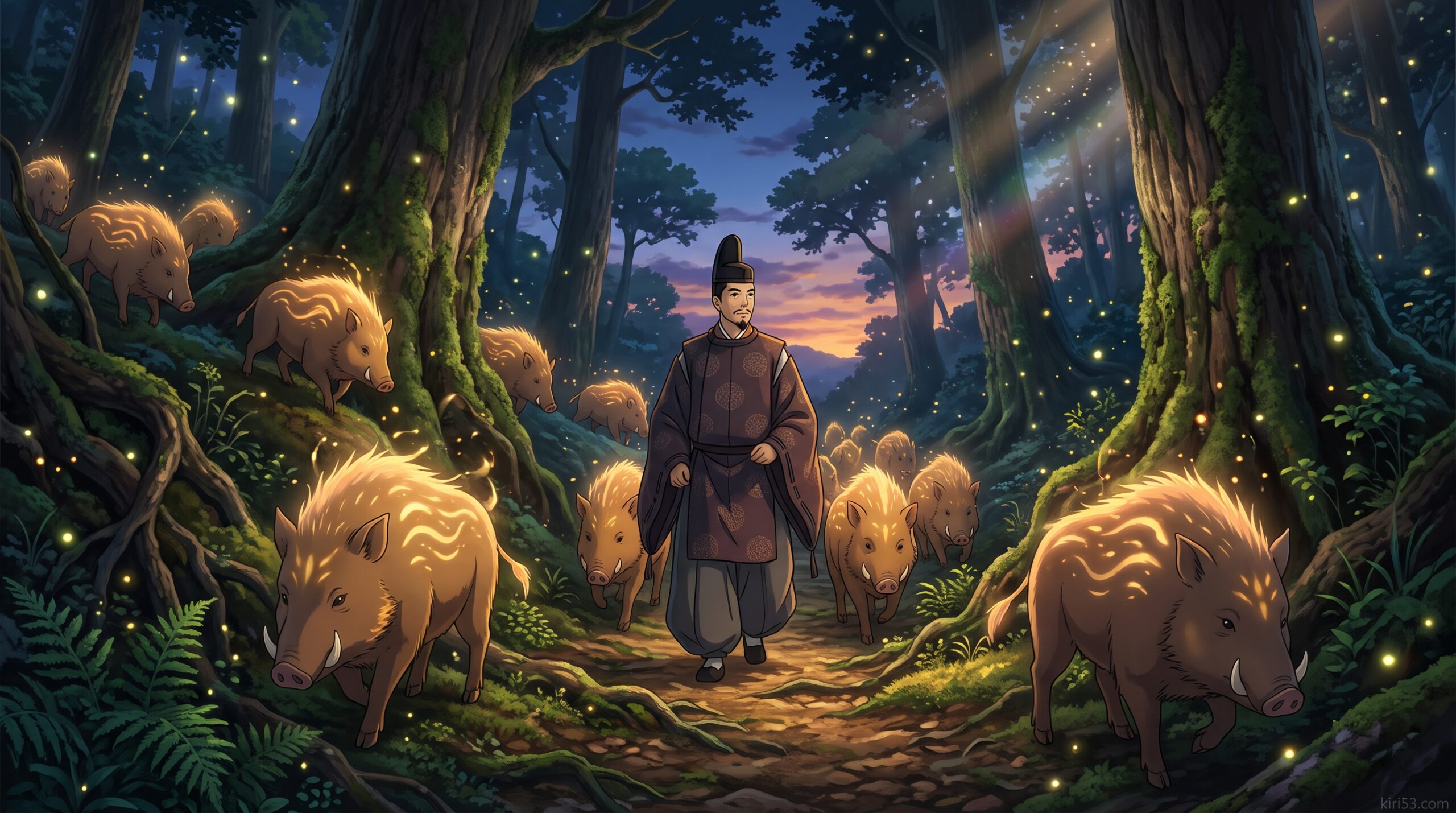
It is here that recorded history blends into the beautiful realm of mystical Japanese folklore. As the injured, exiled Kiyomaro traveled through the treacherous mountains of Kyushu, desperately trying to escape Dokyo’s assassins, a divine miracle occurred. Suddenly, a massive herd of 300 wild boars (Inoshishi) emerged from the dense forest.
Instead of attacking him, the boars surrounded Kiyomaro’s palanquin. Acting as mystical bodyguards sent by the gods, they fiercely protected him from the assassins and safely guided him for tens of miles until he reached the Usa Hachimangu shrine to give thanks. Legend says that after this miraculous escort by the boars, the severe injuries to Kiyomaro’s legs were completely and instantly healed.
Triumphant Restoration and the Dawn of Heian-kyo (Kyoto)
Justice eventually prevailed. In 770, Empress Shotoku passed away. Without her absolute protection, Dokyo instantly lost his power and was banished from the capital in disgrace. The imperial lineage was secured forever. Wake no Kiyomaro was triumphantly recalled to the capital, his honors and ranks fully restored by the new Emperor Konin.
However, Kiyomaro’s contributions to Japan did not end with his loyalty. He proved to be a genius administrator and civil engineer under the subsequent ruler, Emperor Kanmu. To escape the oppressive, corrupting political influence of the Buddhist temples in Nara, Kiyomaro advised the Emperor to boldly move the capital to a completely new location.
He surveyed the lands and led massive civil engineering projects, including vital flood control and river rerouting on the Yodo and Katsura rivers. His visionary planning ultimately led to the establishment of Heian-kyo (modern-day Kyoto) in 794. This momentous move sparked a 1,000-year golden age of Japanese classical culture, art, and literature.
Wake no Hiromushi: The Mother of Japanese Orphans
We cannot discuss Kiyomaro’s legacy without mentioning his equally heroic elder sister, Wake no Hiromushi (和気広虫). While Kiyomaro protected the structural integrity of the state, Hiromushi protected its most vulnerable citizens. During times of severe famine, plague, and political strife, she took in 83 starving orphans, raising them with immense love and care.
She is celebrated today in Japan as a pioneer of social welfare and the founder of the nation’s first orphanage. Her actions perfectly reflected the “Omitakara” spirit—proving that true nobility lies in cherishing and protecting the people.
Conclusion: The Enduring Legacy at Goou Shrine
Today, Wake no Kiyomaro is deeply revered as a guardian deity of the nation, a paragon of loyalty, and the god of physical healing (especially for legs and hips, due to his miraculous recovery). If you visit the heart of Kyoto today, just west of the Imperial Palace, you will find the beautiful Goou Shrine (護王神社), dedicated to Kiyomaro and his sister Hiromushi.
When you enter this shrine, you will notice something truly unique. Instead of the traditional lion-dog statues (Komainu) found at almost all Shinto shrines, the gates of Goou Shrine are guarded by magnificent statues of the wild boars that saved his life over a millennium ago.
Wake no Kiyomaro’s story is not just a tale of ancient political intrigue. It is the ultimate testament to the enduring spirit of Japan. By risking absolutely everything to protect the unbroken Imperial line, he ensured the survival of a nation where the people remain the “Great Treasure.” His legacy, guarded by the mystical boars, continues to inspire awe, reverence, and a deep fascination for the profound history of Japan.
External References to Explore:
- Wake no Kiyomaro – Wikipedia
- Goou Shrine and the Wild Boars – Tsunagu Japan
- The Oracle of Usa Jingu Shrine
万世一系を守り抜いた忠臣:和気清麻呂と神秘のイノシシが救った2600年の日本帝国
日本の歴史は、政治的陰謀、神秘的な伝説、そして深く根付いた精神的哲学が織り成す魅力的なタペストリーです。この古い国家の根底には、2600年以上にもわたって国を支え続けてきた「国体」という深遠な概念が存在します。この独自の体制において、天皇は国民を搾取すべき臣民とは見なしておらず、「大御宝(おおみたから)」——すなわち国家の最も尊い宝として慈しんできました。この深い敬意と慈愛の絆があったからこそ、日本の皇室は世界最長の連続した世襲君主制として今日まで一度も途切れることなく続いているのです。
しかし、この尊い血統にも存亡の危機がありました。8世紀後半、奈良時代の終わりに、皇室の血筋が別の者に簒奪(さんだつ)されそうになるという、歴史上最大の危機が訪れたのです。この2600年の伝統を守るため、自らの命を懸け、過酷な拷問に耐え、流罪の憂き目に遭いながらも立ち上がったのが、和気清麻呂(わけのきよまろ)という非常に忠義に厚い官僚でした。彼の信じられないような生涯は、揺るぎない忠誠心、絶大な勇気、そして野生のイノシシたちによる奇跡の介入の物語です。
奈良時代の栄華と暗い影
和気清麻呂の行動の偉大さを完全に理解するには、まず奈良時代(710〜794年)へとタイムスリップする必要があります。この時代は壮大な栄華の時代でした。日本は唐(中国)から文化、高度な建築技術、宗教哲学を熱心に吸収していました。国家の保護の下で仏教が隆盛を極め、東大寺の大仏のような畏敬の念を抱かせる記念碑的建造物が次々と作られました。
しかし、この宗教と国家統治の密接な結びつきは、大きな政治的不安を引き起こしました。神聖な権威と莫大な富を手にした強力な僧侶たちが、前例のない政治的影響力を行使し始め、時には伝統的な貴族や朝廷そのものをも圧倒するようになりました。この危険な政治的緊張が頂点に達したのが、称徳天皇(孝謙天皇)の治世でした。
僧・道鏡の台頭:皇統への脅威
極めて熱心な仏教徒であった称徳天皇は、761年に重い病に倒れました。伝統的な医療では治癒しませんでしたが、道鏡(どうきょう)というカリスマ的で野心に満ちた僧侶の祈祷と神秘的な治癒術によって回復したとされています。奇跡的な回復に深く感謝した天皇は、道鏡に絶大な信頼を寄せ、徐々に並外れた政治的権力を与えていきました。最終的に彼は、天皇に準ずる「法王」という地位にまで上り詰めました。
しかし、道鏡の野心には際限がありませんでした。彼は究極の目標である「日本の次期天皇になること」を目論んだのです。彼には皇室の血が一滴も流れていなかったため、この前代未聞の行動は、日本の皇室の神聖で途切れることのない血統を完全に破壊することを意味していました。それは、国を神聖な預かり物とする「大御宝」の哲学を根底から打ち砕き、政治権力に基づく単なる独裁国家へと変貌させるものでした。
769年、九州の強力な神社である宇佐八幡宮から「道鏡を天皇にすれば天下は永遠に太平になる」という神のお告げ(神託)が下されたという知らせが届きました。これは捏造された政治的陰謀でしたが、当時の神社の権威は絶対的なものでした。
宇佐八幡宮神託事件
朝廷は絶対的な大混乱と恐怖に陥りました。道鏡の巨大な権力と怒りを恐れ、ほとんどの貴族は恐怖に頭を垂れ、沈黙を守りました。称徳天皇はこの前代未聞の神託の真偽を絶対に確認する必要があると考え、信頼できる、非常に実直な役人を九州へ派遣し、直接神意を問うことにしました。その選ばれた人物が和気清麻呂です。
出発前、道鏡は密かに清麻呂に近づきました。自分が天皇になることを支持する神託を持ち帰れば、最高の位と想像を絶する富を与えると約束しました。逆に、強力な僧侶に逆らえば死が待っているという暗黙の脅威もありました。莫大な重圧にもかかわらず、清麻呂は宇佐八幡宮への長く危険な旅に出発しました。
清麻呂が都に戻ると、朝廷中が息を呑んで彼の言葉を待ち構えていました。彼は天皇、道鏡、そして震える貴族たちの前に立ち、神から受け取った全く異なるメッセージを、大音声で毅然として宣言しました。
「我が国は開闢(かいびゃく)以来、君臣の分が定まっている。臣下をもって君主としたことは未だかつてない。天つ日嗣(皇位)には必ず皇族を立てよ。無道な者は直ちに掃討せよ」
この恐れを知らぬ言葉によって、和気清麻呂は道鏡の野望を完全に粉砕しました。彼は単独で日本の古き良き国体を救い、天皇が国民を「大御宝」として慈しむという神聖な哲学を守り抜いたのです。
過酷な流罪と300頭のイノシシの奇跡
道鏡の怒りは凄まじいものでした。彼は即座に清麻呂の官位を剥奪しました。そして極めて残酷なことに、清麻呂が二度と歩けないように足の腱を切るよう命じました。さらに彼を「別部穢麻呂(わけべのきたなまろ)」という屈辱的な名前に改名させ、遠く未開の大隅国(現在の鹿児島県)へと流罪にしました。さらに道鏡は、過酷な旅の途中で清麻呂を殺害するために刺客を放ちました。
ここで、記録された歴史は神秘的な日本の民間伝承の美しい領域へと溶け込みます。負傷し、流罪人として九州の険しい山道を旅し、道鏡の刺客から必死に逃れようとしていた清麻呂に、神聖な奇跡が起こりました。突如として、300頭もの野生のイノシシ(猪)の群れが鬱蒼とした森から現れたのです。
イノシシたちは彼を襲うどころか、清麻呂の乗る輿の周囲を囲みました。神から遣わされた神秘的なボディガードとして、彼らは刺客から清麻呂を猛烈に守り、彼が感謝を捧げるために宇佐八幡宮に到着するまでの数十キロにわたって安全に案内しました。伝説によれば、このイノシシたちによる奇跡的な護衛の後、清麻呂の足の重傷は完全かつ瞬時に癒えたと言われています。
見事な名誉回復と平安京(京都)の夜明け
正義は最終的に勝利しました。770年、称徳天皇が崩御しました。絶対的な後ろ盾を失った道鏡は瞬く間に権力を失い、不名誉にも都から追放されました。皇室の血統は永遠に守られました。和気清麻呂は都へ凱旋し、新たな光仁天皇によって名誉と官位を完全に取り戻しました。
しかし、清麻呂の日本への貢献は彼の忠誠心だけでは終わりませんでした。彼はその後の桓武天皇の下で、天才的な行政官および土木技術者であることを証明しました。奈良の仏教寺院の抑圧的で腐敗した政治的影響力から逃れるため、清麻呂は天皇に、全く新しい場所へ大胆に都を移すことを進言しました。
彼は土地を測量し、淀川や桂川の重要な治水や河川の付け替えなど、大規模な土木事業を指揮しました。彼の先見の明のある計画は、最終的に794年の平安京(現在の京都)の設立につながりました。この歴史的な遷都は、日本の古典文化、芸術、文学の1000年に及ぶ黄金時代の火付け役となりました。
和気広虫:日本の孤児たちの母
清麻呂の遺産を語る上で、同様に英雄的な彼の姉、和気広虫(わけのひろむし)について言及しないわけにはいきません。清麻呂が国家の構造的完全性を守ったとすれば、広虫は国家の最も弱い立場にある人々を守りました。深刻な飢饉、疫病、政治的混乱の時代に、彼女は83人もの飢えた孤児を引き取り、深い愛情と配慮をもって育て上げました。
彼女は今日、日本の社会福祉の先駆者であり、日本初の孤児院の創設者として称えられています。彼女の行動は「大御宝」の精神を完璧に反映しており、真の高貴さとは人々を慈しみ守ることにあると証明したのです。
おわりに:護王神社に受け継がれる遺産
今日、和気清麻呂は国家の守護神、忠誠の鑑、そして(彼の奇跡的な回復にちなんで)足腰の健康を守る神様として深く崇敬されています。現在の京都の中心部、京都御所のすぐ西を訪れると、清麻呂と姉の広虫を祀る美しい「護王神社(ごおうじんじゃ)」があります。
この神社に入ると、本当にユニークなことに気がつくでしょう。ほとんどの神道神社で見られる伝統的な狛犬の代わりに、護王神社の門は、1000年以上前に彼の命を救った野生のイノシシ(狛猪)の立派な像によって守られています。
和気清麻呂の物語は、単なる古代の政治的陰謀の物語ではありません。それは、日本の不朽の精神に対する究極の証明です。万世一系の皇統を守るために全てを危険に晒すことで、彼は国民が「大御宝」であり続ける国家の存続を確実なものにしました。神秘的なイノシシたちに守られた彼の遺産は、畏敬の念、崇敬、そして日本の深遠な歴史に対する深い魅力を今も私たちに呼び起こし続けています。

コメント