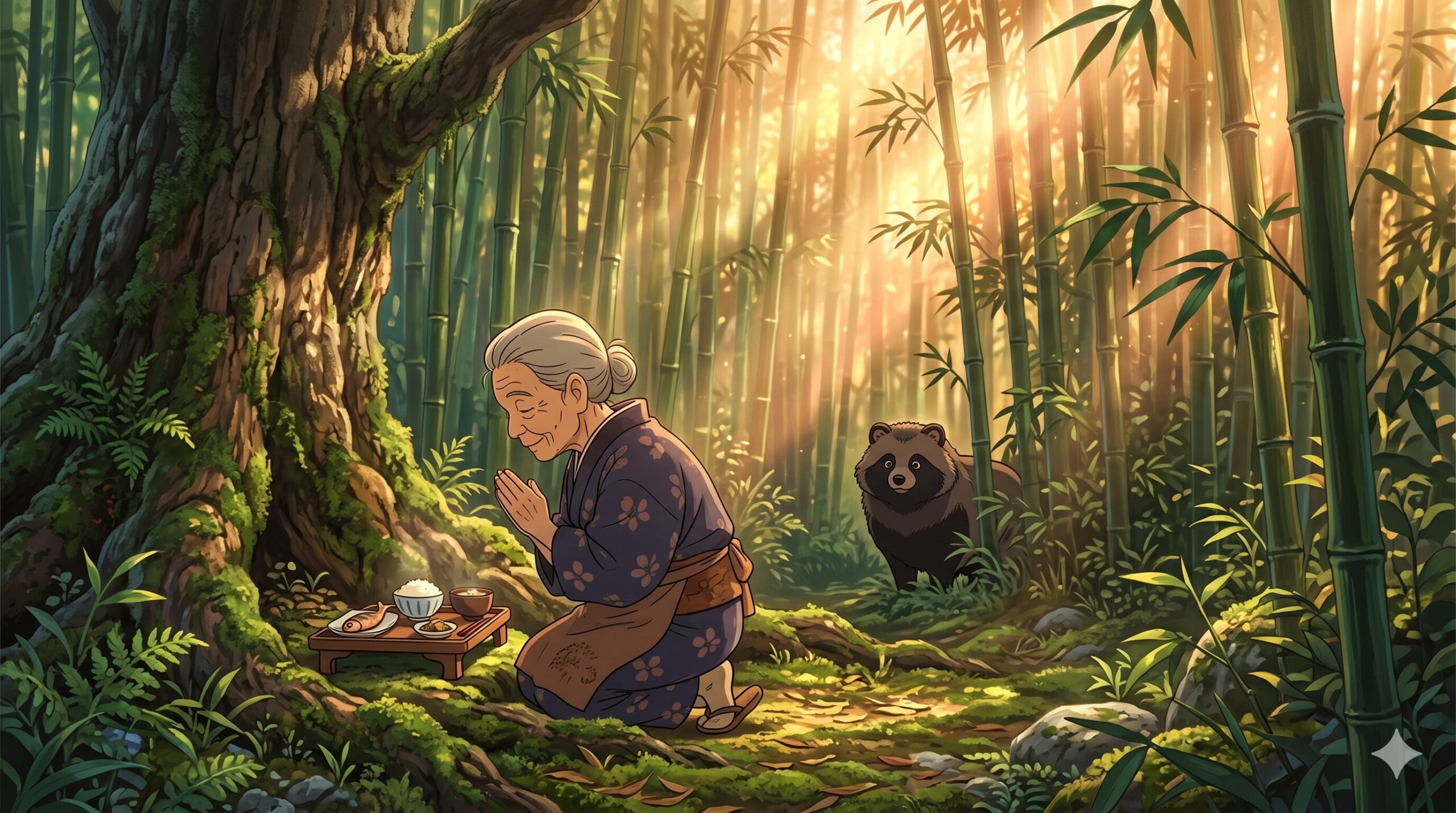
Long, long ago, in a lush mountain village in Kyoto, there lived a kind-hearted elderly woman named Yoshi-baasan. Her only family, her son Kakichi, had gone to work in a distant town to make a living. Left behind, Yoshi-baasan lived a modest, solitary life, supporting herself by helping with the local tea harvest.
Yoshi-baasan’s daily routine centered entirely around praying for the safety and health of her faraway son. Every day, she would set aside a portion of her own meal to create an offering known as a “Kagezen.” She would gently place this offering at the base of a small tree in the mountains behind her home, pressing her hands together in deep prayer: “Please, let Kakichi be safe and healthy again today.” Mysteriously, the Kagezen she placed would always be completely gone by the next morning. Believing that the mountain deities were accepting the food on her son’s behalf, she never missed a single day of offering.
One day, however, Yoshi-baasan suddenly fell deeply ill. Her fever was high, and her body felt as heavy as lead. Yet, even in her suffering, her thoughts were entirely consumed by her son. “If I don’t offer the Kagezen today, something terrible might happen to Kakichi,” she thought. Gathering the very last of her strength, she dragged herself toward the mountain with the food. But her strength finally gave out, and she collapsed unconscious right in front of the tree.
When Yoshi-baasan finally opened her eyes in the middle of the night, she was not in the freezing mountain woods, but warmly tucked into her own futon at home. To her absolute shock, sitting right beside her pillow was her beloved son, Kakichi, who was supposed to be in a faraway town. Kakichi firmly held her hand and nursed her devotedly for three days and three nights without sleeping a wink. Thanks to his profound love and dedicated care, Yoshi-baasan miraculously recovered and regained her health completely.
When the villagers heard this story, they were deeply moved, praising Kakichi: “What an incredibly devoted and filial son!” But at the same time, they were baffled. “How on earth did he manage to travel from that distant town every single night?”
None of the villagers ever discovered the secret. Unbeknownst to anyone, early one morning, a plump Tanuki (Japanese raccoon dog) emerged from the back door of Yoshi-baasan’s house. Looking highly satisfied, it rustled its way back into the bamboo grove. The Tanuki, who had been eating Yoshi-baasan’s lovingly prepared Kagezen every day, had shapeshifted into her son and risked everything to repay her kindness.
Folktale Analysis: The Miracle Brought by Unconditional Love
“Yoshi-baasan and the Kagezen” is a profoundly deep narrative that depicts “unconditional love” that borders on self-sacrifice, and the “gratitude from nature” that answers it. Yoshi-baasan’s love for her son seeks absolutely no reward. Even while living in poverty and physical hardship, she continues to offer her own food for his sake. This represents the purest and most beautiful form of human affection.
The greatest highlight of this story is the revelation that the son nursing her was actually a Tanuki. In Japanese folklore, Tanuki are often portrayed as comical tricksters who deceive humans and play pranks. However, the Tanuki in this tale is entirely different. It understands the “mother’s prayer” infused in the daily meals. When the old woman’s life is in danger, it uses its mystical shapeshifting powers not to trick, but to lovingly nurse her. This emphasizes the beauty of spiritual connection and gratitude that transcends the boundaries between humans and animals. It carries a strong moral message: true compassion will always be understood, regardless of who receives it, and will return to you as a miraculous act of gratitude.
Connection to Japanese Culture: “Kagezen” and “Tanuki”
Through this folktale, we can deeply understand traditional Japanese spirituality and culture. The first key element is the custom of “Kagezen”. Kagezen is an ancient Japanese tradition of preparing a meal at the family dining table for a loved one who is absent due to travel or work, to pray for their safety. Since ancient times, Japanese people have believed that food possesses a sacred power that enhances life force. They believed they could connect souls and protect their family members from afar through the medium of “food.” Yoshi-baasan’s Kagezen was not just a physical meal; it was a powerful “spiritual barrier” meant to protect her son.
The second element is the animistic view of nature expressed through the “Tanuki”. In the Japanese Shinto worldview, a sacred spirit resides in all elements of nature—mountains, trees, and animals. Animals are not merely beasts; they are sometimes messengers of the gods, possessing emotions just like humans, and capable of repaying debts of gratitude. Unlike animals in many Western fairy tales, animals in Japan are deeply rooted in culture as beings intimately involved in human life, directly imparting moral lessons.
What Would You Do?
In our modern society, it is not easy to continue praying for someone far away without ever expecting anything in return, just as Yoshi-baasan did. However, this story teaches us that “pure love and gratitude will always reach someone, somewhere, and return to you in a beautiful way.”
Do you have precious family members or friends living far away? How do you convey your love and compassion to them? Sometimes, instead of just sending a quick message, why not take a moment to deeply pray for their happiness—a modern-day “Kagezen.” We would love to hear your thoughts! How did this story make you feel, and whose face came to your mind while reading it? Please let us know in the comments below!
Reference Links:
Details of Yoshi-baasan and the Kagezen (Manga Nippon Mukashibanashi Database)
Click here for more Japanese Folktale Series
① 日本昔話「吉ばあさんとかげぜん」の物語
むかしむかし、京都の自然豊かな山村に、「吉(よし)ばあさん」という心優しいお婆さんが住んでいました。吉ばあさんの唯一の家族である一人息子の「嘉吉(かきち)」は、遠く離れた町へ出稼ぎに行っており、吉ばあさんは村で茶摘みの手伝いなどをして、細々と一人で暮らしていました。
吉ばあさんの毎日の日課は、遠くで働く息子の無事と健康を祈ることでした。彼女は毎日、自分の食事を少し取り分け、「陰膳(かげぜん)」と呼ばれるお供え物を作りました。そして、それを裏山にある小さな木々の前にそっと置き、「どうか嘉吉が今日も元気でいられますように」と深く手を合わせるのです。不思議なことに、吉ばあさんが置いた陰膳は、翌日には必ず綺麗になくなっていました。吉ばあさんは「山の神様が息子の代わりに食べてくださったのだろう」と信じ、毎日欠かさずお供えを続けました。
しかしある日のこと、吉ばあさんは急な病に倒れ、床に伏せってしまいました。熱が高く、体は鉛のように重く動かせません。それでも吉ばあさんの頭の中は息子のことでいっぱいでした。「今日も陰膳を置かなければ、嘉吉に何か悪いことが起きるかもしれない」。吉ばあさんは最後の力を振り絞って起き上がり、陰膳を持って山へ向かいました。しかし、とうとう木の前で力尽き、ばったりと倒れて気を失ってしまったのです。
真夜中、吉ばあさんがふと目を覚ますと、そこは冷たい山の中ではなく、自分の家の温かい布団の中でした。そして驚いたことに、枕元には遠い町にいるはずの愛する息子、嘉吉が座っていたのです。嘉吉は吉ばあさんの手を力強く握り、三日三晩、一睡もせずに懸命に看病を続けました。その深い愛情と手厚い看病のおかげで、吉ばあさんの病は嘘のようにすっかりと治り、元気を取り戻しました。
この話を聞いた村人たちは、「なんて親孝行な息子だろう」と深く感心しました。しかし、同時に大きな疑問も抱きました。「あの遠い町から、一体どうやって毎晩休まずに通ってくることができたのだろうか」と。
その秘密を村人たちは誰一人として知りませんでした。ある朝早く、吉ばあさんの家の裏口から一匹の丸々としたタヌキが姿を現し、満足そうな顔でカサコソと竹やぶの中へ帰っていったことを。毎日、吉ばあさんの愛情のこもった陰膳を食べていたタヌキが、息子に姿を変え、命懸けで恩返しをしていたのです。
② 物語の深い考察:無償の愛が引き寄せる奇跡
「吉ばあさんとかげぜん」は、自己犠牲を伴うほどの強い「無償の愛」と、それに応える「自然界からの恩返し」を描いた非常に奥深い物語です。吉ばあさんの息子に対する愛情は、見返りを求めるものではありません。自分が貧しく苦しい生活をしていても、息子のために食事を供え続けるその姿は、人間の持つ最も純粋で美しい愛情の形を表現しています。
また、この物語の最大のハイライトは、看病していた息子の正体がタヌキであったという点です。日本の昔話においてタヌキは、しばしば人を化かしたり、いたずらをしたりする滑稽な存在として描かれます。しかし、この物語のタヌキは全く違います。毎日提供される食事に込められた「母の祈り」を理解し、お婆さんが危機に瀕した時には、自らの不思議な力を使って息子に化け、献身的に看病します。これは、人間と動物という種族の壁を越えた、魂の結びつきと恩義の美しさを強調しています。真の思いやりは、相手が誰であれ必ず伝わり、奇跡のような恩返しとなって巡ってくるという、強い道徳的メッセージが込められています。
③ 日本文化との繋がり:「陰膳」と「タヌキ」
この物語からは、日本の伝統的な精神性や文化を色濃く読み解くことができます。まず注目すべきは「陰膳(かげぜん)」という風習です。陰膳とは、旅行や仕事で遠く離れて暮らす家族の安全を祈り、不在の人のために食卓に食事を用意する日本の古い習慣です。日本人は古来より、食べ物には生命力を高める神聖な力が宿ると信じており、離れた場所からでも「食」を通じて魂を繋ぎ、家族を守ることができると考えていました。吉ばあさんの陰膳は、単なる食べ物ではなく、息子を守る強力な「祈りの結界」であったと言えます。
次に、「タヌキ」という存在を通じた自然観(アニミズム)です。日本の神道的な価値観では、自然界のすべてのもの、山や木、そして動物たちにも神聖な魂が宿っていると考えられています。動物は単なる獣ではなく、時には神の使いであり、時には人間と同じように感情を持ち、恩を返す存在として扱われます。欧米の童話における動物とは異なり、日本の動物たちは人間の生活に密接に関わり、道徳的な教訓を直接与えてくれる存在として日本文化に深く根付いています。
④ あなたならどう感じ、どう行動しますか?
吉ばあさんのように、決して見返りを求めず、遠く離れた誰かのために祈り続けることは、現代社会を生きる私たちにとって簡単なことではありません。しかし、この物語は「純粋な愛と感謝の気持ちは、必ずどこかで誰かに届き、美しい形で自分に返ってくる」ということを教えてくれます。
あなたには、遠く離れて暮らす大切な家族や友人がいますか?その人たちに、どのようにあなたの愛情や思いやりを伝えていますか?時には、メッセージを送るだけでなく、心の底から相手の幸せを祈る「現代の陰膳」のような時間を持ってみてはいかがでしょうか。この物語を読んで、あなたが何を感じ、誰の顔を思い浮かべたか、ぜひコメント欄で教えてください。

コメント