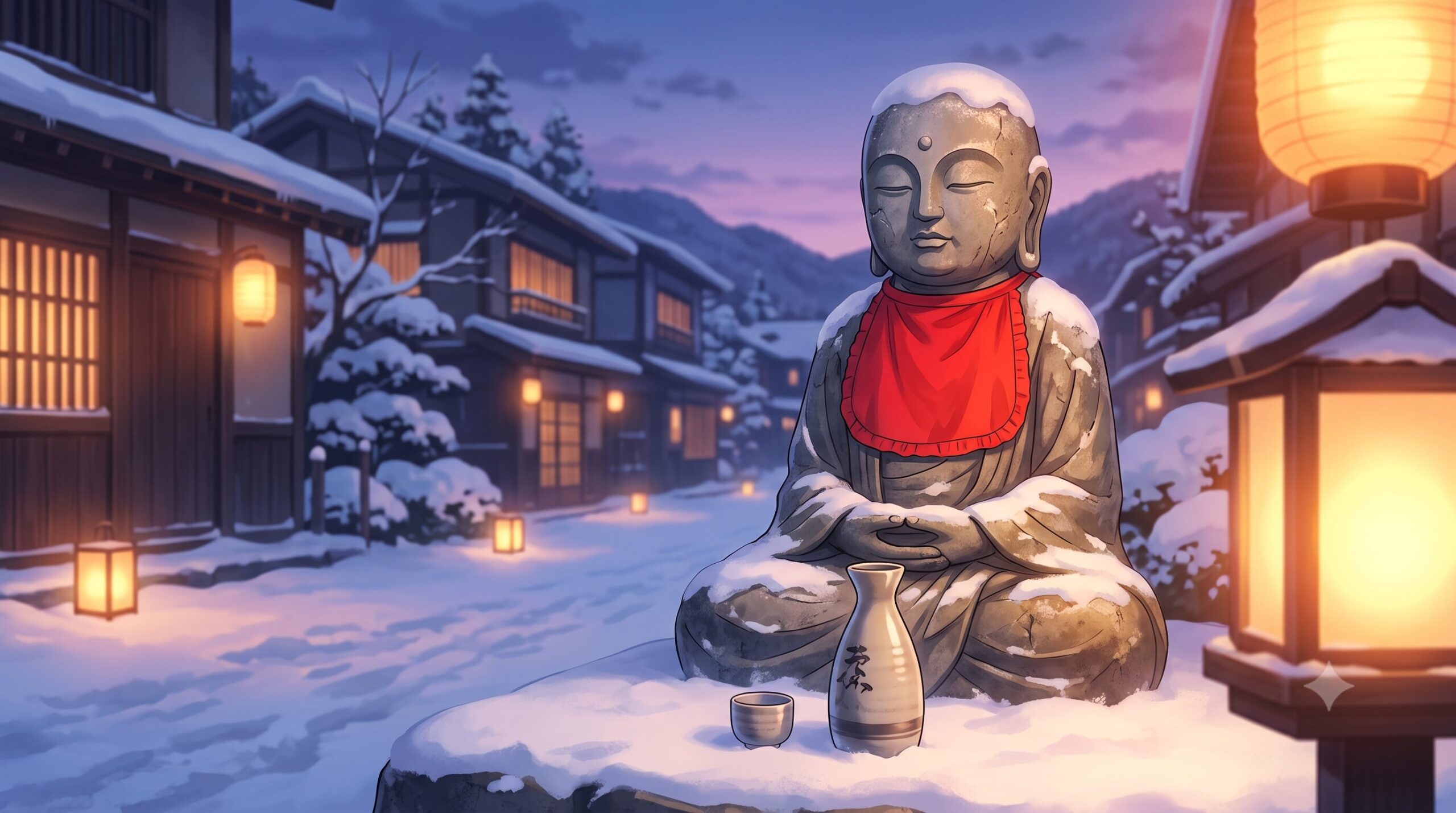
The Story: The Young Monk Who Bought Sake Every Night
Once upon a time, in a bustling post town, there was a well-loved sake brewery. The owner, Gensuke, was a serious and kind-hearted man. His sake was highly praised, said to “warm the very soul,” attracting customers from far and wide. It was the dead of winter. On a night when the snow was falling heavily, Gensuke had closed his shop and was warming himself by the hearth when he heard a quiet “tap, tap” at his door.
When he opened the door, a strange young monk stood there, dressed in a humble robe, his face bright red from the cold. “I apologize for the late hour. Could you please sell me a single measure of sake?” the young boy asked in a trembling voice. Gensuke took pity on the small child sent on an errand on such a snowy night. He generously poured his finest sake into the boy’s ceramic flask (tokkuri) and warmly sent him off, saying, “Be careful on your way home.” The young monk bowed deeply and disappeared into the snowy darkness.
Strangely, from that day on, the exact same young monk came to buy sake every single night. The boy always paid the exact amount in copper coins, happily received his sake, and returned home. After about ten days, Gensuke became incredibly curious about the boy’s identity. One night, after handing over the sake, he decided to secretly follow him. The boy’s footprints led to a dilapidated, deserted temple at the back of the village.
As soon as the boy entered the temple grounds, he vanished into thin air. Gensuke looked around, but there was no one in sight. Puzzled, Gensuke lowered his gaze and found a weathered stone Jizo statue standing quietly in the dark. The Jizo’s mouth was faintly wet, and a rich aroma of sake floated in the air around it. Even more surprisingly, at the feet of the Jizo stood the very same ceramic flask Gensuke had been handing to the boy every night.
“Heavens! The one coming to buy sake every night was this Jizo statue!”
Though shocked, Gensuke realized that the Jizo, who constantly watched over the village in the bitter cold, had been seeking sake to warm its freezing body. The next morning, Gensuke shared this mysterious event with the villagers. While surprised, the villagers were overjoyed, saying, “The Jizo has taken a liking to our sake!” From then on, the villagers affectionately called this statue “Nonbee Jizo” (The Drunken Jizo). Whenever there was a change in season or a celebration, they would offer the most delicious sake in the village to the statue. The Nonbee Jizo was cherished as the guardian deity of the village, and it is said that the village was spared from disease and blessed with abundant harvests and prosperity for many years to come.
Analysis of Nonbee Jizo: Why Would a Buddha Drink Alcohol?
The story of “Nonbee Jizo” highlights a deeply fascinating aspect of Japanese folk belief. Fundamentally, in Buddhist teachings, consuming alcohol is strictly forbidden by the precepts. Bodhisattva Jizo is a noble figure who travels through the six realms of existence to save suffering souls. Why, then, would a story about a sake-loving Jizo emerge in Japan?
The background to this lies in Japan’s unique, intimate religious devotion, which views Buddhas and deities as beings who possess emotions and desires similar to humans. Rather than seeing the Buddha as an untouchable entity who has undergone strict ascetic training, the Japanese interpret the Buddha as a relatable, human-like neighbor who wants to warm up with sake on a cold night and enjoys delicious things. This story, which values “approachability” and “empathy” over strict religious precepts, strongly reflects the tolerant and generous spiritual nature of the Japanese people.
Connection to Japanese Culture: Syncretism and the Spirit of “Omiki”
In Japanese culture, sake is not merely a recreational beverage; it serves as a sacred offering (Omiki) essential for deepening the connection with the divine. Since ancient times, Japan has fostered a unique religious perspective called “Shinbutsu-Shugo,” the syncretism of Shinto and Buddhism. The act of offering sake to a Buddhist Jizo statue, much like one would to Shinto gods who love sake, is a testament to how seamlessly these two religions blend into people’s daily lives.
Furthermore, there is a nationwide custom in Japan of dressing Jizo statues in red bibs and hats. This is an expression of the people’s kindness, treating Jizo as the “guardian deity of children” and trying to protect the stone statues from the rain, wind, and cold. The act of offering sake to the “Nonbee Jizo” is born from this exact same culture—the warm Japanese spirit of hospitality (Omotenashi), driven by a desire to entertain and bring joy even to divine beings.
What Do You Think?
A Bodhisattva, who is supposed to observe strict precepts, enjoying sake alongside the villagers. How did you feel reading about this “Nonbee Jizo,” who is a sacred being yet somehow deeply human and approachable? If your town had a guardian deity that secretly came to buy sake every night, what kind of drink would you treat them to? Please take a moment to reflect and let your imagination run wild.
Reference URL: Nonbee Jizo (Japanese)
You can read other Japanese Folktales here.
日本の不思議な昔話「のんべえ地蔵」
昔話のストーリー:夜な夜な酒を買いに来る小僧
むかしむかし、ある活気あふれる宿場町に、村人から愛される一軒の造り酒屋がありました。店主の源助(げんすけ)は、真面目で心優しい性格であり、彼の造る酒は「心まで温まる」と遠方からも客が訪れるほどの大評判でした。季節は厳しい冬。雪がしんしんと降り積もる夜のことです。店じまいをして囲炉裏で暖を取っていた源助のもとに、「トントン」と控えめに戸を叩く音が聞こえました。
戸を開けると、そこには粗末な袈裟を着た、顔を真っ赤にしている見知らぬ小僧が立っていました。「夜分遅くに申し訳ありません。お酒を一合、売っていただけないでしょうか」と小僧は震える声で言いました。源助は、こんな雪の夜に小さな子供がお使いに出されていることを不憫に思い、一番良い酒をたっぷりと徳利に注ぎ、「気をつけて帰るんだよ」と温かく送り出しました。小僧は深く一礼し、雪闇の中へと消えていきました。
不思議なことに、その日から毎晩、同じ小僧が酒を買いにやって来るようになりました。小僧はいつも代金の銅銭をきっちりと支払い、嬉しそうに酒を受け取っては帰っていきます。十日ほど経ったある夜、源助はどうしても小僧の素性が気になり、酒を渡した後にこっそりと後をつけてみることにしました。小僧の足跡は、村の裏手にある寂れたお寺へと続いていました。
お寺の敷地に入ると、小僧の姿はふっとかき消すように見えなくなってしまいました。辺りを見回しても誰もいません。不思議に思った源助がふと視線を落とすと、そこには古びたお地蔵様が静かに佇んでいました。お地蔵様の口元は微かに濡れており、周囲には芳醇な酒の香りが漂っています。さらに驚くべきことに、お地蔵様の足元には、源助が毎日小僧に渡していた徳利が並んでいました。
「なんと、毎晩お酒を買いに来ていたのは、このお地蔵様だったのか!」
源助は驚愕しながらも、厳しい寒さの中で村を見守り続けてくれているお地蔵様が、冷えた体を温めるためにお酒を求めていたのだと悟りました。翌朝、源助はこの不思議な出来事を村人たちに話しました。村人たちは驚きつつも、「お地蔵様が私たちのお酒を気に入ってくださったのだ」と大変喜びました。それ以来、村人たちはこのお地蔵様を「のんべえ地蔵」と親しみを込めて呼び、季節の節目や祝い事があるたびに、村で一番美味しいお酒をお供えするようになりました。のんべえ地蔵は村の守り神として大切にされ、その村は疫病にも見舞われず、豊作と繁栄に恵まれながらいつまでも平和に暮らしたということです。
のんべえ地蔵の考察:なぜ仏様がお酒を飲むのか
この「のんべえ地蔵」の物語は、日本の民間信仰の非常に興味深い側面を浮き彫りにしています。本来、仏教の教えにおいて飲酒は「不飲酒戒(ふおんじゅかい)」として厳しく禁じられています。地蔵菩薩もまた、六道(地獄・餓鬼・畜生・修羅・人・天)を巡り、苦しむ人々を救済する崇高な仏様です。それにもかかわらず、なぜ日本ではお酒を愛する地蔵の物語が生まれたのでしょうか。
その背景には、仏様を自分たちと同じように感情や欲求を持つ存在として捉える、日本独自の親密な信仰心があります。厳しい修行を積んだ手の届かない存在としてではなく、寒い夜にはお酒で体を温めたくなり、美味しいものを喜ぶ、人間味あふれる身近な隣人として仏様を解釈しているのです。戒律よりも「親しみやすさ」や「共感」を重んじるこの物語には、寛容で大らかな日本の精神性が色濃く反映されています。
日本文化との関連:神仏習合と「お神酒(おみき)」の精神
日本文化において、お酒は単なる嗜好品ではなく、神々との繋がりを深める神聖な供物(お神酒)としての役割を果たしてきました。日本では古くから、神道と仏教が融合する「神仏習合(しんぶつしゅうごう)」という独自の宗教観が育まれてきました。神道の神々がお酒を楽しむように、仏教の地蔵菩薩にもお酒をお供えするという行為は、この二つの宗教が人々の生活の中で違和感なく溶け合っている証拠です。
また、日本ではお地蔵様に赤い前掛けや帽子を被せる風習が全国で見られます。これは、お地蔵様を「子供の守り神」として大切にし、雨風や寒さから守ろうとする人々の優しさの表れです。「のんべえ地蔵」にお酒を供える行為も、これと同じく「神仏をもてなしたい、喜ばせたい」という日本人の温かいおもてなしの心から生まれた文化であると言えます。
あなたはどう思いますか?
厳しい戒律を持つはずの地蔵菩薩が、村人と一緒にお酒を楽しむこの物語。神聖な存在でありながら、どこか人間臭く、親しみやすい「のんべえ地蔵」の姿は、あなたにはどのように映りましたか?もしあなたの住む町に、毎晩こっそりとお酒を買いに来る守り神がいたら、あなたはどんなお酒をご馳走してあげたいですか?ぜひ、あなたの考えや想像を巡らせてみてください。
参考URL:のんべえ地蔵
その他の日本昔話はこちらからご覧いただけます。
コメント