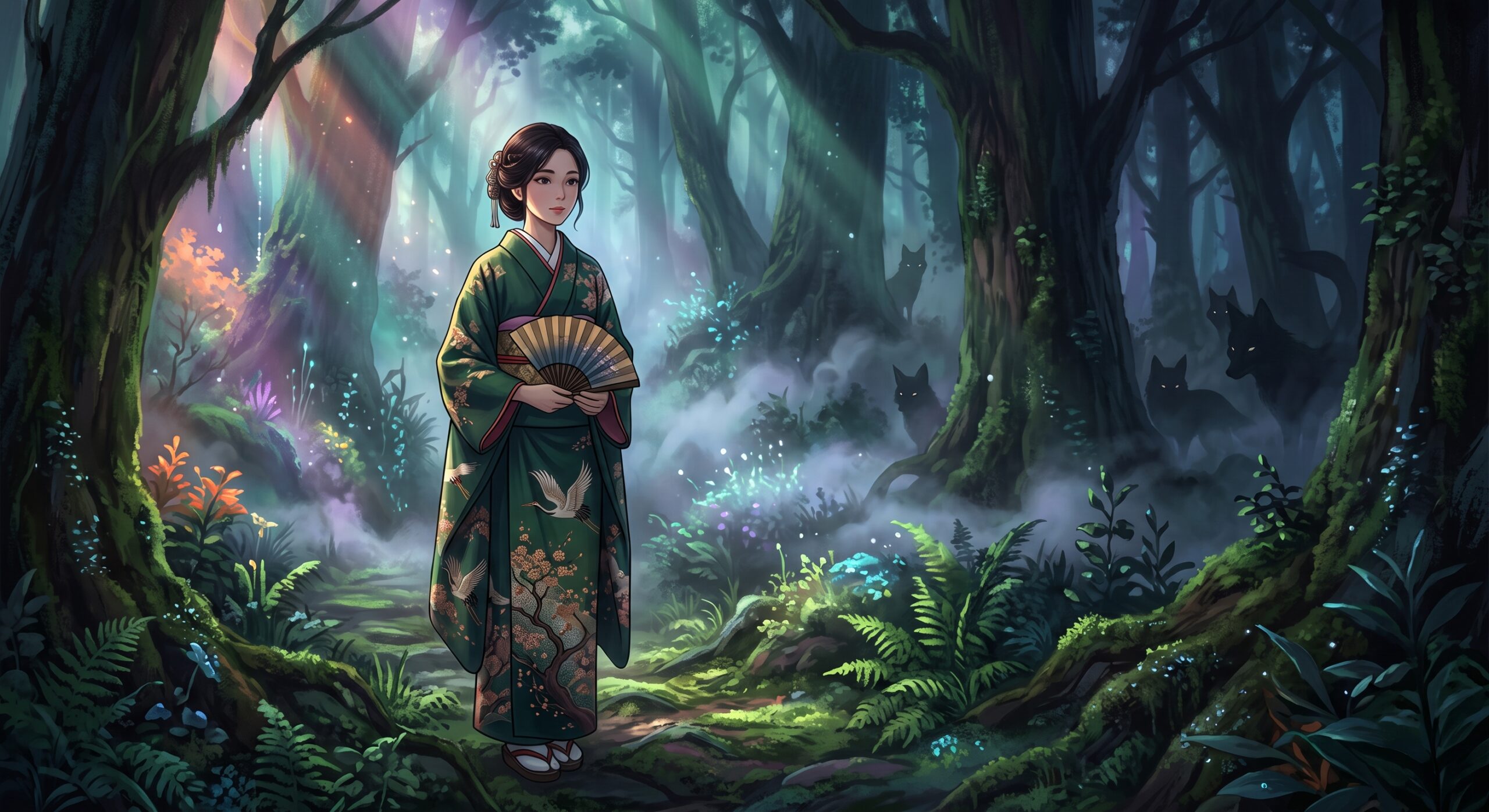
Once upon a time, in a village completely surrounded by the deep mountains of the Tohoku region, there lived three people: a blind monk known as Dainichinobo, his wife who was an Itako (a traditional shaman who channels the voices of the dead), and their beautiful daughter named Choho-ko.
One day, an unknown man dressed in the gorgeous attire of a traditional Kagura dancer visited their home. With a confident and dignified attitude, the man said, “I want Choho-ko to be my bride.” Her parents and Choho-ko herself were captivated by his magnificent appearance and accepted the proposal. Choho-ko left her family and married into the man’s village, located deep in the remote mountains.
As her new life in the mountains began, Choho-ko took on the daily duty of delivering lunch to her husband and relatives working in the mountain fields. However, an old woman in her new family gave her one strange, strict rule: “Whenever you bring lunch to the fields, you must always beat this drum loudly as you walk.”
Choho-ko faithfully followed this instruction for a while, beating the drum every day on the mountain path. But one day, a doubt crossed her mind. “Why must I beat this drum every single day? Today, I will go to the fields quietly without making a sound.” Driven by curiosity, she crept silently toward the fields without striking the drum.
When Choho-ko peeked into the fields from behind the trees, she could not believe her eyes. The figures working in the dirt were not humans at all—they were all foxes! Her husband, her relatives, and all the villagers were foxes disguised in human forms. Realizing she had been deceived and dragged into the world of non-humans, Choho-ko fled back to her parents’ home as fast as her legs could carry her in pure terror.
Upon hearing the full story from Choho-ko, her parents trembled with intense fury. For a blind monk and an Itako—both professionals who dealt directly with the unseen, spiritual world—having their daughter stolen by Yokai (monsters) was an unforgivable humiliation. They immediately devised a brutal revenge plan against the foxes.
The parents prepared an enormous bag and invited the fox husband and all his villagers to their home, claiming, “We wish to treat you to a grand feast at our house.” The foxes, overjoyed at the prospect of free food, disguised themselves as humans and arrived in large numbers. Choho-ko’s family had prepared a massive spread of the foxes’ favorite foods: deep-fried tofu, fish, and an abundance of sake (rice wine). Completely lowering their guard, the foxes drank heavily. As they became intoxicated, their concentration slipped, and their human disguises began to fade. With tails popping out and faces reverting to those of foxes, they continued to drunkenly enjoy the banquet.
As the night deepened, the father, Dainichinobo, picked up his shamisen. Playing an eerie yet cheerful melody, he began to sing: “At the end of a grand banquet, it is our tradition that everyone gets into a large bag.” The completely drunk foxes, having lost all sense of judgment, obediently crawled into the massive bag prepared for them.
The moment every fox was inside and the bag was tied shut, the village men who had been lying in wait outside rushed in all at once. Swinging thick wooden clubs and mallets, they mercilessly beat the foxes trapped inside the bag, exterminating them. It is said that a few foxes barely managed to escape with their lives, and the fox village was destroyed. However, legends say that after many years passed, foxes eventually began to appear in the area once again.
In-Depth Analysis: The Boundary and the Sound of the Drum
This folktale contains highly profound themes that go far beyond a simple story of deception. The most notable element is the meaning behind the rule to “beat the drum.” The foxes were not perfect shape-shifters; they were flawed beings who would revert to their original forms if they relaxed. The sound of the drum served as a warning alarm, signaling: “A human is approaching, assume your human disguise now.” This was an absolute mechanism required to maintain the strict boundary between the human world and the realm of the supernatural.
The professions of Choho-ko’s parents are also deeply suggestive. Both the Zato (blind monk) and the Itako (medium) possess the power to communicate with the unseen world. There is a strong irony in the fact that they could not see through the physical illusion of the foxes. However, once they discovered the truth, their actions were coldly realistic and calculated. By using the sound of the shamisen to lure the foxes in, they executed a perfect retaliation against the creatures who had previously manipulated them through the sound of the drum.
Connection to Japanese Culture: Inter-Species Marriage and the Duality of Foxes
In Japanese folklore, the “Kitsune” (fox) occupies a highly special position. On one hand, they possess a sacred aspect as divine messengers of Inari (the deity of agriculture). On the other hand, they are feared as wild Yako (field foxes) who possess and bewitch humans. Generally, the phrase “Kitsune no Yomeiri” (The Fox’s Wedding) is known as a romantic term referring to a sunshower (rain while the sun is shining) or the mysterious string of atmospheric ghost lights (foxfire) seen in distant mountains. However, this particular story depicts it as a literal, visceral horror where a fox actually steals a human bride.
This story is also a prime example of “Irui Konin-tan” (tales of inter-species marriage), a very common motif in Japanese literature. In stories of unions between humans and non-humans, such as “The Crane Wife” or “Yuki-onna” (Snow Woman), there is always a taboo that must not be broken (the taboo of looking). The moment Choho-ko broke the rule, didn’t beat the drum, and “looked” at the truth, the intersection with the other world collapsed. What makes “Kitsune no Yometori” stand out is that while most inter-species marriage stories end in a sorrowful parting, this tale concludes with ruthless revenge and slaughter by the humans. This dark conclusion heavily reflects the harsh natural environment of the Tohoku region, portraying the primal human defense instincts and cold survival strategies needed to protect the community from wild animals and unknown threats.
To Our Readers: What Would You Do?
This is a thrilling yet somewhat spine-chilling conclusion where human cunning and tenacity overcome supernatural Yokai. How did you feel reading this story? Did you sympathize with the tragic fate of the foxes, or did you relate to the fierce strength of the humans protecting their daughter?
If you were in Choho-ko’s position, would you have continued beating the drum exactly as instructed for the rest of your life to maintain a peaceful marriage? Or would you have peeked into the fields without beating the drum to uncover the truth? Please imagine what your choice would be and let us know your thoughts!
[References and Related Links]
Internal Link: Read more Japanese Folktale Series
External Reference: Manga Nihon Mukashibanashi Database – Kitsune no Yometori (Japanese)
きつねの嫁取り:異類婚姻譚に隠された衝撃の真実
昔々、東北地方の深い山々に囲まれたある村に、大日の坊(だいにちのぼう)という盲目の座頭と、死者の声を代弁するイタコの妻、そして「ちょほ子」という名の美しい娘が三人で静かに暮らしていました。
ある日のこと、神楽舞(かぐらまい)の華やかな衣装を身にまとった見知らぬ男が家を訪ねてきました。男は堂々とした態度で「ちょほ子を私の嫁に欲しい」と申し出ます。両親とちょほ子はその立派な出で立ちに惹かれ、縁談を承諾しました。ちょほ子は家族と別れ、男が住むという深い山奥の村へと嫁いでいきました。
山奥での新しい生活が始まり、ちょほ子は毎日、山の畑で農作業にはげむ夫や親戚たちのために、お弁当を届ける役目を担うことになりました。しかし、嫁ぎ先の老婆から一つだけ奇妙な約束を厳命されます。「畑へお弁当を持っていくときは、必ずこの太鼓をドンドンと打ち鳴らしながら歩きなさい」というものでした。
言いつけを守り、毎日太鼓を鳴らしながら山道を歩いていたちょほ子でしたが、ある日ふと疑問を抱きます。「なぜ、毎日太鼓を鳴らさなければならないのだろう。今日はいっそ、鳴らさずに静かに畑へ行ってみよう」。彼女は好奇心から、太鼓を叩かずに忍び足で畑へと近づきました。
木陰からそっと畑を覗き込んだちょほ子は、我が目を疑いました。そこで農作業をしていたのは人間ではなく、なんと全員が「狐」だったのです。夫も、親戚も、村の者たちも、すべて狐が化けた姿でした。ちょほ子は自分が狐に騙され、人ならざる者の世界へ引きずり込まれたことに気づき、恐怖のあまり一目散に実家へと逃げ帰りました。
実家にたどり着いたちょほ子から事の顛末を聞いた両親は、激しい怒りに震えました。目に見えない霊的世界と関わる座頭とイタコの夫婦にとって、娘を妖怪に騙し取られたことは許しがたい屈辱でした。彼らは狐たちへの壮絶な復讐計画を立てます。
両親は非常に大きな袋を用意し、「ぜひ実家でご馳走を振る舞いたい」と狐の夫とその村人たちを家に招待しました。狐たちはご馳走が食べられると大喜びで、人間の姿に化けて大勢でやってきました。ちょほ子の家には、狐の大好物である油揚げや魚、そして大量の酒が用意されていました。すっかり警戒心を解き、酒を浴びるように飲んだ狐たちは次第に酔いが回り、気が緩んで人間の化けの皮が剥がれていきました。しっぽが飛び出したり、顔が狐に戻ったりしたまま、彼らは上機嫌で宴会を楽しんでいました。
夜もすっかり更けた頃、父親の大日の坊が三味線を手に取り、妖しくも陽気な音色を奏でながらこう歌い出しました。「宴会の最後には、大きな袋に入るのがしきたりだ」。すっかり酔っ払い、冷静な判断力を失っていた狐たちは、言われるがままに用意された巨大な袋の中に次々と入っていきました。
全員が袋に入り口が閉じられた瞬間、家の外で待ち構えていた村の男たちが一斉になだれ込んできました。彼らは太い棒や槌(つち)を振り下ろし、袋に閉じ込められた狐たちを徹底的に打ち据え、退治しました。命からがら逃げ出した狐もわずかにいたと言われていますが、この日を境に狐の村は壊滅しました。しかし、しばらく年月が経つと、再びその周辺には狐の姿が現れるようになったと語り継がれています。
物語の深い考察:境界線と太鼓の音
この物語は、単なる「騙し合い」の枠を超えた非常に奥深いテーマを含んでいます。最も注目すべきは「太鼓を鳴らす」というルールの意味です。狐たちは完全に人間に化け切っていたわけではなく、気を抜くと元の姿に戻ってしまう不完全な存在でした。太鼓の音は、「今から人間が近づくから、人間の姿に化けなさい」という警告のアラームだったのです。これは、人間界と異界(自然界)の間に引かれた「境界線」を維持するための絶対的な装置でした。
また、ちょほ子の両親の職業設定も極めて暗示的です。座頭(盲目の僧や琵琶法師)とイタコ(霊媒師)は、どちらも「見えない世界」と交信する力を持った職業です。それにもかかわらず、物理的な「化け物」である狐の変装に気づけなかったという皮肉が込められています。しかし、一度真実を知った後の彼らの行動は冷酷なまでに現実的で計算高く、三味線の音色という「音」を利用して狐を誘い込み、太鼓という「音」で騙されていたことへの完璧な意趣返しを行っています。
日本文化との関連:異類婚姻譚と狐の二面性
日本の民間伝承において「狐(きつね)」は非常に特別な地位を占めています。稲荷神の使いとしての神聖な側面を持つ一方で、人を化かしたり取り憑いたりする野狐(やこ)としての恐ろしい側面も併せ持っています。一般的に「狐の嫁入り」と言えば、晴れているのに雨が降る「天気雨」の現象や、遠くの山に連なる怪火(狐火)を指すロマンチックな言葉として知られています。しかし、この物語は文字通り「狐が人間の嫁を奪う」という生々しい怪異として描かれています。
また、この物語は日本文学に頻繁に登場する「異類婚姻譚(いるいこんいんたん)」の一つです。「鶴の恩返し」や「雪女」のように、人間と人間以外の存在が結ばれる物語には、「決して見てはいけない」というタブー(見るなのタブー)が必ず存在します。ちょほ子が太鼓を鳴らさずに真実を「見てしまった」瞬間、異界との交わりは破綻しました。特筆すべきは、他の物語が「悲しい別れ」で終わることが多いのに対し、この「きつねの嫁取り」は人間側による「容赦のない復讐」で幕を閉じる点です。ここには、東北地方の厳しい自然環境において、野生動物や未知の脅威から共同体を守るための、人間の防衛本能と冷酷な生存戦略が色濃く反映されています。
読者の皆様へ:あなたならどうしますか?
人間の知恵と執念が妖怪を打ち負かすという、痛快でありながらもどこか背筋の凍る結末。あなたはこの物語を読んで、どのような感想を抱きましたか?狐たちの悲劇的な結末に同情しましたか、それとも娘を守る人間の力強さに共感しましたか?
もしあなたがちょほ子の立場だったら、言いつけ通りに一生太鼓を鳴らし続け、平穏な結婚生活を維持したでしょうか。それとも、やはり真実を知るために太鼓を鳴らさずに畑を覗き込んだでしょうか。ぜひ、あなたの考えや感想を思い描いてみてください。
【参考・関連記事】
内部リンク:日本の昔話シリーズをもっと読む
参考外部リンク:まんが日本昔ばなし〜データベース〜 きつねの嫁取り
コメント