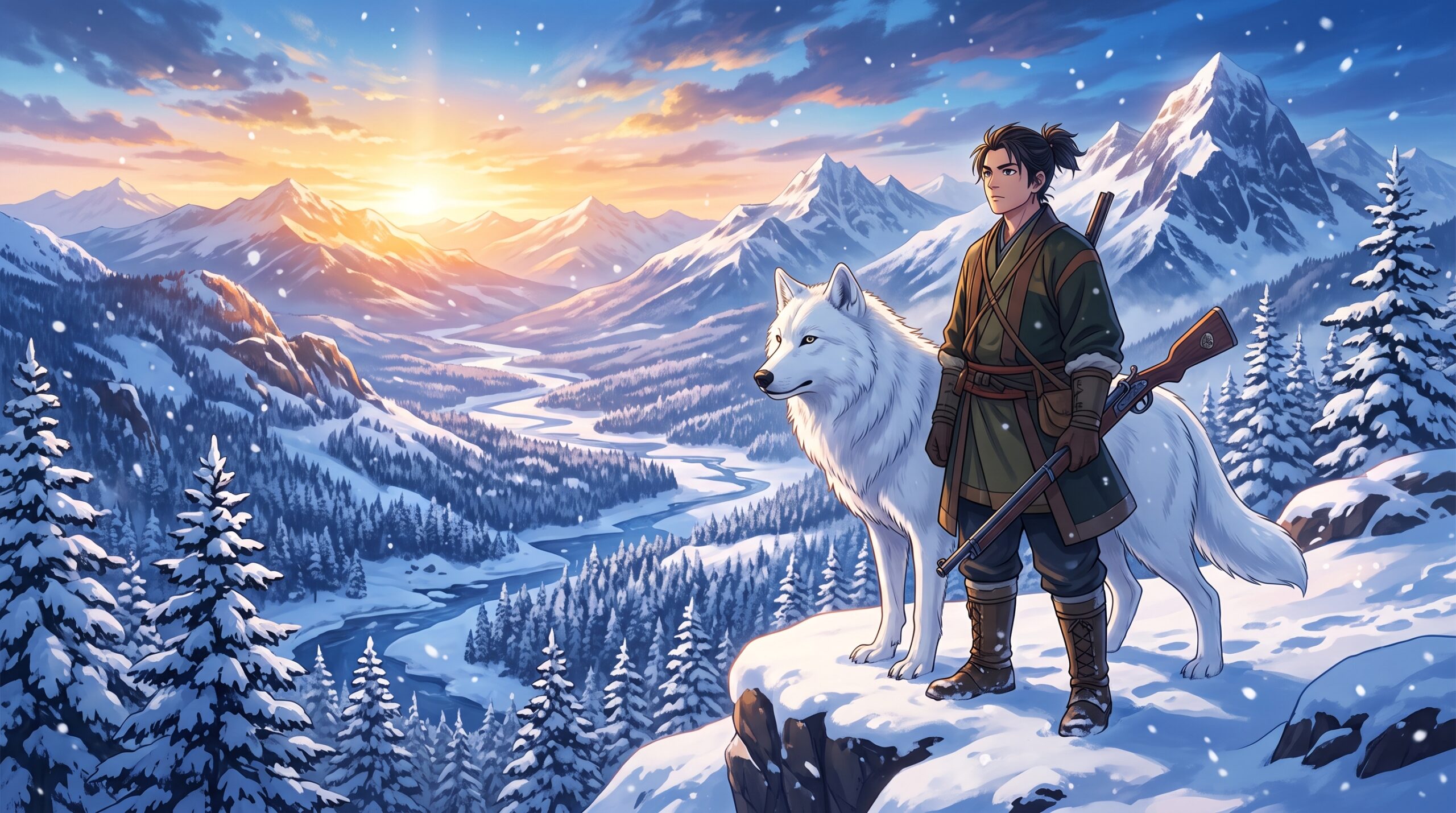
Long ago, in the deep mountains of Kishu (modern-day Mie Prefecture), there lived a highly skilled hunter named Yakuro who lived alone with his mother.
One spring morning, when Yakuro opened the door of his house, he found an adorable puppy sitting right in front of him. Yakuro immediately realized that this was connected to an event from the previous autumn. Late one night in the autumn mountains, Yakuro had encountered a severely injured wolf. Without fear, he treated its wounds and jokingly said, “If you survive this, give me one of your cubs next spring.” The wolf had dutifully kept its promise to its savior.
Yakuro named the puppy “Man” and rigorously trained it in the art of hunting. Man grew rapidly, becoming an extraordinary hunting dog (wolf) with abilities that far surpassed any ordinary hound.
In the early summer of the following year, while Yakuro was hunting in the mountains, he sensed a giant bear and hid behind a rock. However, Man dashed out without the slightest hesitation and fiercely bit into the giant bear’s hind leg. Yakuro instantly finished the bear off with his spear. Upon inspection, they realized that Man had severed the thick muscle of the giant bear’s hind leg with a single bite. Thanks to this heroic deed, the names of Yakuro and Man became famous throughout the entire Kishu region.
That winter, a grand hunt was organized for the local lord to observe. Man brilliantly took down a massive boar on this grand stage, and Yakuro received a generous reward from the lord, returning home in high spirits.
However, the expression on his mother’s face waiting at home was grim. She strongly demanded, “Return Man to the mountains immediately!” While Yakuro was out hunting, a traveling monk who stopped by to chant sutras had seen through Man’s true identity and shared a terrifying legend: “A wolf kept by humans, after killing a thousand creatures, will eventually eat its master.”
Yakuro was furious and flatly refused. He shouted, “Man is my dog! I am who I am because of Man!”
At that exact moment, Man, who was outside the house, was listening intently to their exchange as if understanding human words. Then, letting out a long, sorrowful howl, he ran off into the deep snowy mountains.
“Man, come back!” Yakuro rushed out barefoot into the falling snow, desperately chasing after him. Man looked back just once, staring at Yakuro with eyes full of sorrow, before proceeding further into the depths of the mountain. From that day on, Man never returned to Yakuro. Today, the “Kishu Ken,” renowned as an excellent hunting dog, is said to be the descendant of this very wolf, Man.
Analysis: A True Bond Shattered by Superstition
The greatest tragedy of this story lies in the fact that it was not wild instinct, but “human superstition” that tore their love apart. Was Man truly destined to attack Yakuro after hunting a thousand prey? When reading deeply into the narrative, the answer is clearly “No.”
Man chose to leave for the mountains of his own free will. He did not leave because he was driven by an urge to attack Yakuro, but because he understood that his presence was causing a rift between Yakuro and his mother, bringing pain to his master. This relationship, which began with a wolf’s gratitude, is sustained by the wolf’s “unconditional love and loyalty” until the very end. The story highlights the foolishness of humans who allow themselves to be swayed by baseless rumors and fear, ultimately doubting the partner they should trust the most.
Connection to Japanese Culture: Awe of Nature and the Spirit of “On” (Gratitude)
This tale strongly reflects traditional Japanese views on nature and morality. Since ancient times in Japan, wolves have been deified as “Ookami” (Great God) and worshipped as beneficial beasts that exterminate boars and deer that ruin crops.
The depiction of the parent wolf entrusting its cub as a token of gratitude is the very essence of the unique Japanese spirit of “On” (duty and returning favors). The philosophy that even animals never forget a favor and fulfill their duty is directly tied to Japanese virtues. Furthermore, the story illustrates an “awe of nature”—the idea that humans can never completely control nature (the wolf), and an impassable boundary exists between the two. In Japanese culture, humans and animals are often portrayed not as master and servant, but as spiritual equals.
What Would You Do?
Could you let go of the being you trust most because of the opposition of others or a terrifying superstition? If you were in Yakuro’s position, would you have ignored your mother and society to keep Man? Or would you accept the parting out of love? Please let us know your thoughts.
References
日本昔話「弥九郎の犬」:人間と狼の哀しき絆
昔、紀州(現在の三重県)の深い山奥に、弥九郎という腕の立つ猟師が母親と二人で暮らしていました。
ある春の朝、弥九郎が家の戸を開けると、そこには一匹の可愛らしい子犬がちょこんと座っていました。弥九郎はすぐに、それが昨年の秋の出来事に関係していると気づきました。去る秋の夜中、弥九郎は山で深手を負ったオオカミに出くわしました。彼は恐れることなくその傷を手当てし、「もしこれで助かったなら、来年の春に生まれた子を一匹くれ」と笑いながら語りかけたのです。オオカミは、その命の恩人との約束を律儀に果たしたのでした。
弥九郎はその子犬を「マン」と名付け、厳しく狩りの技を仕込みました。マンはまたたく間に成長し、並みの猟犬をはるかに凌ぐ、類まれな能力を持つ優秀な猟犬(狼)となりました。
翌年の初夏のことです。弥九郎が山で狩りをしている最中、巨大な熊の気配を察知して岩陰に身を潜めていました。しかし、マンは全く怯むことなく飛び出し、大熊の後ろ足に強烈に噛みついたのです。弥九郎はすかさず槍で大熊にトドメを刺しました。確認すると、マンはたった一撃で大熊の後ろ足の太い筋を噛み切っていました。この武勇伝により、弥九郎とマンの名は紀州一帯に広く知れ渡りました。
その年の冬、殿様が視察する大掛かりな狩りが催されました。マンはこの大舞台でも見事に巨大な猪を仕留め、弥九郎は殿様から莫大な褒美を賜り、意気揚々と家へ帰還しました。
しかし、家で待っていた母親の表情は険しいものでした。母親は「マンを今すぐ山に帰せ」と強く迫ります。弥九郎が狩りに出ている間、読経に立ち寄った旅の僧侶がマンの正体を見抜き、「人間に飼われたオオカミは、千匹の生き物を殺すと、次にはその主人を食い殺す」という恐ろしい言い伝えを語ったからです。
弥九郎は激怒し、断固として拒否しました。「マンは俺の犬だ!マンがあってこその弥九郎なんだ!」と叫びました。
その時です。家の外にいたマンは、二人のやり取りを、人間の言葉を理解するかのようにじっと聞いていました。そして、「ウォーン」と長く悲しい遠吠えを一つ残し、雪深い山の方へと走り去ってしまったのです。
「マン、帰ってくれ!」弥九郎は雪が降る中を裸足のまま飛び出し、必死に後を追いました。マンは一度だけ振り返り、哀愁に満ちた目で弥九郎を見つめると、再び山奥へと歩みを進めました。それ以降、マンが弥九郎のもとへ帰ってくることは二度とありませんでした。現在、優秀な猟犬として名高い「紀州犬」は、このマンが祖先であると伝えられています。
考察:迷信が切り裂いた真実の絆
この物語の最大の悲劇は、野性の本能ではなく「人間の迷信」が愛を引き裂いた点にあります。マンは本当に千匹の獲物を狩った後、弥九郎を襲う運命にあったのでしょうか。物語の展開を深く読み解くと、その答えは明確に「否」です。
マンは自ら山へ去ることを選びました。それは弥九郎を襲う衝動に駆られたからではなく、自分がいることで弥九郎と母親の間に亀裂が生じ、弥九郎が苦しむことを理解したからです。オオカミの恩返しから始まったこの関係は、最後までオオカミ側の「無償の愛と忠誠」によって貫かれています。人間側が他人の根拠のない噂や恐怖心に振り回され、最も信じるべきパートナーを疑ってしまったことの愚かさが浮き彫りになっています。
日本文化との関連:自然への畏怖と「恩」の精神
この物語は、日本の伝統的な自然観と道徳観を強く反映しています。日本では古来より、オオカミは「大神(おおかみ)」として神格化され、作物を荒らす猪や鹿を退治する益獣として信仰の対象となっていました。
親オオカミが恩返しとして子を託す描写は、日本特有の「恩(義理と返礼)」の精神そのものです。動物であっても受けた恩を忘れず義理を果たすという思想は、日本人の美徳と直結しています。また、自然(オオカミ)を完全に支配することはできず、人間と自然の間には越えられない境界線があるという「自然への畏怖」も示されています。日本の文化において、人間と動物は主従関係を超えた、霊的な繋がりを持つ対等な存在として描かれることが多いのです。
あなたならどうしますか?
周囲の反対や恐ろしい迷信を理由に、あなたは自分が最も信頼する存在を手放すことができますか?もしあなたが弥九郎の立場だったなら、母親や社会の声を無視してマンを引き留めましたか?それとも、愛するがゆえに別れを受け入れますか?ぜひ、あなたの考えを教えてください。
コメント