The Story: A Cross-Species Bond and a Heartbreaking Goodbye
Once upon a time, in a place called Yokote in Akita Prefecture, lived a kind-hearted old man named Gorobei. Gorobei and his wife had no children, and they lived a quiet, somewhat lonely life.
One day, while working in his field, Gorobei found a very small, incredibly cute snake. Longing for a child of his own, Gorobei felt a deep surge of affection for the tiny creature and decided to take it home. He gave the snake a human name, “Taro,” and showered it with love, raising it exactly as if it were his own flesh and blood.
As if responding to Gorobei’s unconditional love, Taro grew rapidly. However, his growth rate far exceeded human imagination. In the blink of an eye, Taro transformed into a colossal, terrifying giant snake. The neighbors began to fear him, and eventually, even Gorobei’s own wife became terrified of the massive creature living in their home.
Realizing that Taro’s presence was causing fear and disruption in the human village, Gorobei made the agonizing decision to release Taro into the distant Odo River. “Live strong, Taro,” Gorobei cried, bidding a tearful farewell. Taro, too, looked at his foster father with sad eyes before disappearing into the deep waters.
Over time, a deep pool formed in that section of the Odo River, and the shadow of a massive snake was occasionally seen on the water’s surface. The villagers whispered, “Taro has become the master (Nushi) of this river,” and the place came to be known as “Gorobei Fuchi” (Gorobei’s Deep Pool).
The Story: A Miracle in the Storm and a Tragic End
Some time passed, and Gorobei’s wife fell severely ill. Desperate to save her from a high fever, Gorobei ran through a raging storm to the town of Yokote to buy medicine. He managed to get the medicine, but a further tragedy awaited him on his journey home.
The record-breaking heavy rain had caused the Odo River to swell violently, and the bridge he needed to cross had been completely washed away by the muddy rapids. His suffering wife was waiting for him on the other side. But jumping into the raging water meant certain death. Gorobei stood at the edge of despair.
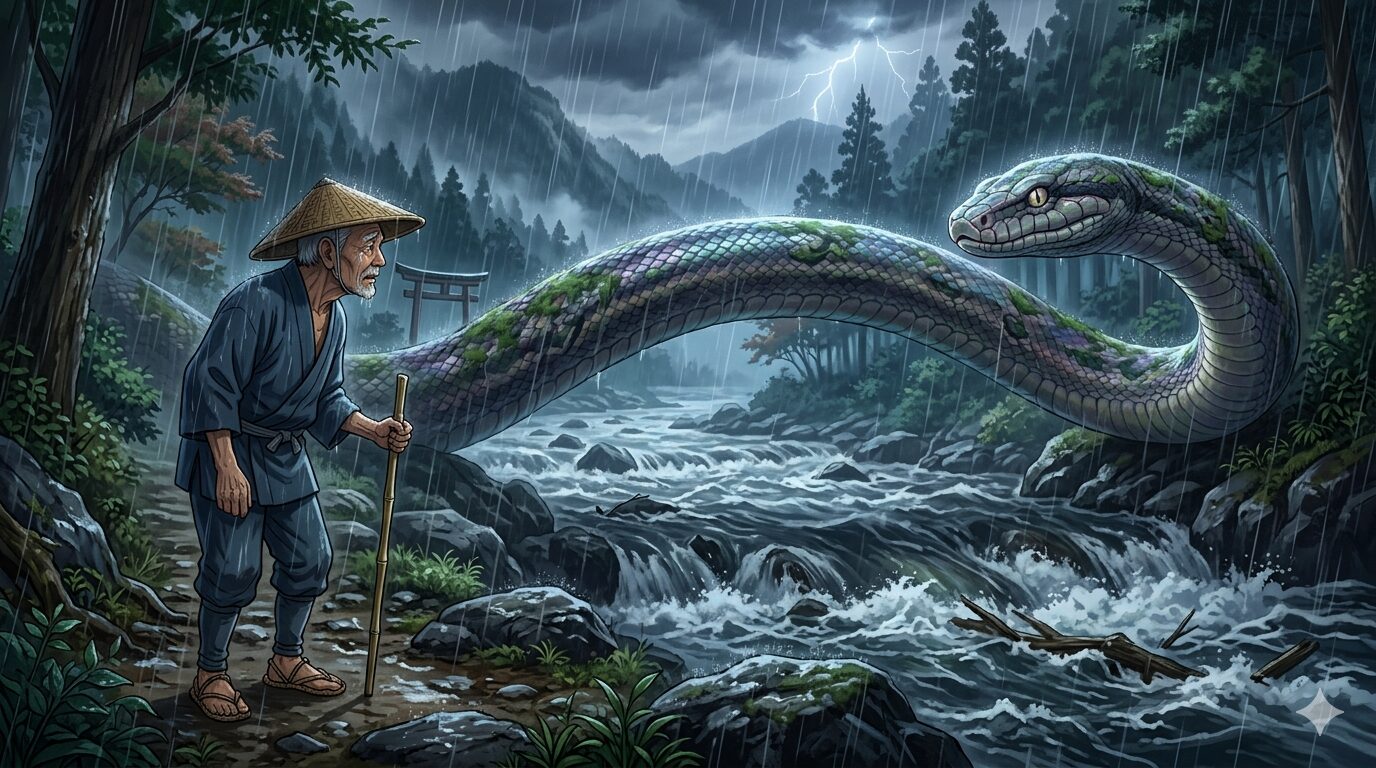
Suddenly, amidst the violent splashing, a massive tree trunk fell from the near bank across to the opposite side, bridging the roaring river. It was a perfect, miraculous bridge! Overjoyed, Gorobei leaped onto the log to cross, but as he looked down at his feet, he was struck with astonishment.
It was not a tree trunk. It was Taro, the beloved son he had parted with. The giant snake had stretched his body to its absolute limit to serve as a living bridge so his foster father could cross. While his entire body was being violently battered by the raging rapids, Taro did not flinch, firmly supporting Gorobei’s footsteps.
The moment Gorobei safely reached the opposite shore, Taro’s body, which had been pushed far beyond its limits, snapped in several places. The giant snake was mercilessly swallowed by the muddy rapids. Taro had sacrificed his own life to save the father who raised him. Gorobei stood in the storm, weeping and screaming Taro’s name into the roaring river for hours on end.
Analysis: Unconditional Love and the Tragedy of Coexistence
The story of “Gorobei Fuchi” is a masterpiece that goes far beyond a simple “animal repaying a favor.” It profoundly depicts deep sorrow and unconditional love. The joy of coexistence between humans and animals (or supernatural beings), followed by the inevitable and decisive “separation,” is a crucial theme in Japanese folktales.
Despite being a creature of a different species, Taro completely understood human emotion and love. He understood that his massive size was causing fear, and he comprehended the unbearable pain Gorobei felt when releasing him. That is exactly why Taro never held a grudge against Gorobei, even after becoming the master of the river. He continued to watch over him silently from afar.
Taro’s final act of becoming a bridge at the cost of his own life is the ultimate “Ongaeshi” (repayment of kindness) for the unconditional love he received from Gorobei. The fact that their physical differences and the boundaries of their species prevented them from living together, yet their spiritual bond remained unbroken, deeply strikes the hearts of readers.
Connection to Japanese Culture: Animism and the Concept of “Nushi”
The core of Japanese culture to be decoded from this story is “Animism” (nature worship) and “Suijin Shinko” (water deity worship). Since ancient times, Japanese people have believed that gods and spirits reside in waterfronts such as rivers, deep pools, and lakes. Snakes and dragons, in particular, have been revered and feared as messengers of the water deity or the deity itself.
The depiction of Taro becoming the “Nushi” (master) of the river is a deification of the overwhelming power of nature. The raging Odo River represents the sheer threat of nature itself. A story where a being within that threat sacrifices itself to save a human perfectly illustrates the complex Japanese view of nature: a profound respect and fear for its destructive power, coupled with deep gratitude for its blessings.
Furthermore, the spirit of “Ongaeshi” (repaying a favor) accompanied by self-sacrifice flows deep within the foundation of Japanese morality, which values duty and compassion. Taro’s willingness to fulfill his debt of gratitude even at the cost of his life is the purest embodiment of the “loyalty” and “devotion” that Japanese people have idealized since ancient times.
What Would You Do?
When the child you raised with love turns into an entity that threatens your community, was Gorobei’s decision to release Taro into the river the right one? If you were in Gorobei’s shoes, would you have defied everyone to keep Taro at home? Or would you have swallowed your tears and chosen to part ways?
And how do you feel about Taro’s profound love, sacrificing his very life to repay his debt of gratitude? Through this heartbreakingly beautiful story that transcends species, we can learn the true essence of “love” and “self-sacrifice” that we must never forget in modern times. Please let me know your thoughts!
Reference: Manga Nihon Mukashibanashi Database – Gorobei Fuchi
Discover more fascinating stories of Japan here: Japanese Folktale Series
【日本昔話】蛇の悲しくも美しい恩返し「五郎兵衛淵」
あらすじ:種族を超えた親子の絆と別れ
昔々、秋田県の横手という場所に、五郎兵衛という心優しいお爺さんが住んでいました。五郎兵衛と妻のお婆さんの間には子どもがなく、二人は静かで少し寂しい日々を送っていました。
ある日のこと、五郎兵衛が畑仕事をしていると、一匹のとても小さく可愛らしい蛇を見つけました。子宝に恵まれなかった五郎兵衛は、その小さな命に深い愛情を抱き、家に連れて帰ることにしました。五郎兵衛はこの蛇に「太郎」という人間の名前を付け、まるで本当の我が子のようにたっぷりの愛情を注いで育てました。
太郎は五郎兵衛の愛に応えるかのように、すくすくと成長していきました。しかし、その成長のスピードは人間の想像を遥かに超えていました。瞬く間に巨大な大蛇へと姿を変えた太郎に対し、近所の人々は恐怖を抱くようになります。ついには、共に暮らしていたお婆さんまでもが、その巨大すぎる姿に怯えるようになってしまいました。
周囲の人々を怖がらせてしまう以上、もはや人間の村で一緒に暮らすことはできません。五郎兵衛は断腸の思いで、太郎を村から離れた大戸川へと放す決断をします。「太郎、元気で生きるんだぞ」と泣く泣く別れを告げる五郎兵衛。太郎もまた、悲しげな瞳で育ての親を見つめながら、川の奥深くへと姿を消していきました。
やがて大戸川のその場所には深く淀んだ「淵」ができ、時折、水面に巨大な蛇の影が浮かび上がるようになりました。村人たちは「太郎がこの川のヌシになったのだ」と噂し合い、いつしかその場所は「五郎兵衛淵」と呼ばれるようになりました。
あらすじ:嵐の夜の奇跡と悲劇の結末
それからしばらくの時が流れたある日、お婆さんが重い病に倒れてしまいます。高熱にうなされる妻を救うため、五郎兵衛は猛烈な嵐の中、薬を求めて横手の町へと走りました。無事に薬を手に入れたものの、帰り道でさらなる悲劇が五郎兵衛を襲います。
記録的な豪雨により、大戸川にかかっていた橋が濁流に飲み込まれ、完全に流されてしまっていたのです。川の向こうには、今も苦しみながら夫の帰りを待つ妻がいます。しかし、荒れ狂う水の中に飛び込めば、命はありません。五郎兵衛が絶望の淵に立たされたその時です。
激しい水しぶきの中、濁流をまたぐようにして、一本の巨大な大木が川岸から対岸へと倒れ込んできました。見事な一本橋の完成です。「これで帰れる!」と喜んで大木に飛び乗った五郎兵衛でしたが、足元を見て驚愕します。
それは大木ではありませんでした。あの別れたはずの愛息子、巨大な蛇の太郎だったのです。太郎は己の体を限界まで伸ばし、育ての親を対岸へ渡すための「橋」となっていました。激流に全身を打ち付けられながらも、太郎は微動だにせず五郎兵衛の足場を支え続けました。
五郎兵衛が無事に対岸へ辿り着いた瞬間、限界を超えていた太郎の体は幾重にも折れ曲がり、無残にも濁流へと飲み込まれていきました。命を懸けて育ての親の危機を救った太郎。五郎兵衛は嵐の川に向かって、いつまでも泣き叫び続けました。
考察:「五郎兵衛淵」が描く無償の愛と異類婚姻譚の系譜
この「五郎兵衛淵」は、単なる動物の恩返しという枠を超えた、深い悲哀と無償の愛を描いた傑作です。人間と動物(異類)が共存する喜びと、やがて訪れる決定的な「別離」というテーマは、日本の昔話において極めて重要な要素です。
太郎は蛇という異形の存在でありながら、人間の心と愛情を完全に理解していました。自分の体が大きくなることで周囲に恐怖を与えていることも、五郎兵衛がどれほど心を痛めて自分を川へ放したのかも、すべて理解していたのです。だからこそ、太郎は川のヌシとなっても五郎兵衛を恨むことなく、遠くから静かに見守り続けていました。
最後に自らの命と引き換えに橋となった太郎の行動は、五郎兵衛から受けた「無償の愛」に対する、最大の「恩返し」です。物理的な大きさや種族の壁によって共に生きることは叶わなくとも、魂の絆は決して切れることがなかったという事実は、読者の胸を激しく打ちます。
日本文化との関連:水神信仰と「ヌシ」の概念
この物語から読み解くべき日本文化の核心は、「アニミズム(自然崇拝)」と「水神信仰」です。古来より日本では、川や淵、湖といった水辺には神や精霊が宿ると考えられてきました。特に「蛇(龍)」は水神の使い、あるいは水神そのものとして畏怖の対象とされてきました。
太郎が川の「ヌシ」になったという描写は、自然界の圧倒的な力(水害や川の氾濫)を神格化したものです。荒れ狂う大戸川は自然の脅威そのものですが、その脅威の中に自らを犠牲にして人間を救う存在がいたという物語は、自然の猛威に対する畏れと、同時に自然から受ける恵みへの感謝という、日本人の持つ複雑な自然観を見事に表しています。
また、自己犠牲を伴う「恩返し」の精神は、義理人情を重んじる日本の道徳観の根底に流れるものです。命を投げ出してでも恩義を果たす太郎の姿は、日本人が古くから理想としてきた「忠義」や「献身」の最も純粋な形であると断言できます。
あなたならどうしますか?
愛する我が子として育てた存在が、自分たちを脅かす存在に変わってしまった時、五郎兵衛のした「川へ放す」という決断は正しかったのでしょうか。もしあなたが五郎兵衛の立場だったら、周囲の反対を押し切ってでも太郎を家に留めましたか?それとも、同じように涙を飲んで別れの道を選んだでしょうか。
そして、自らの命を犠牲にしてまで恩を返した太郎の深い愛情について、あなたはどう感じましたか?種族を超えたこの悲しくも美しい物語から、私たちが現代で忘れてはならない「愛」と「自己犠牲」の真髄を学ぶことができます。ぜひ、あなたの考えを聞かせてください。
日本の魅力を伝えるその他の物語はこちら:Japanese Folktale Series
コメント