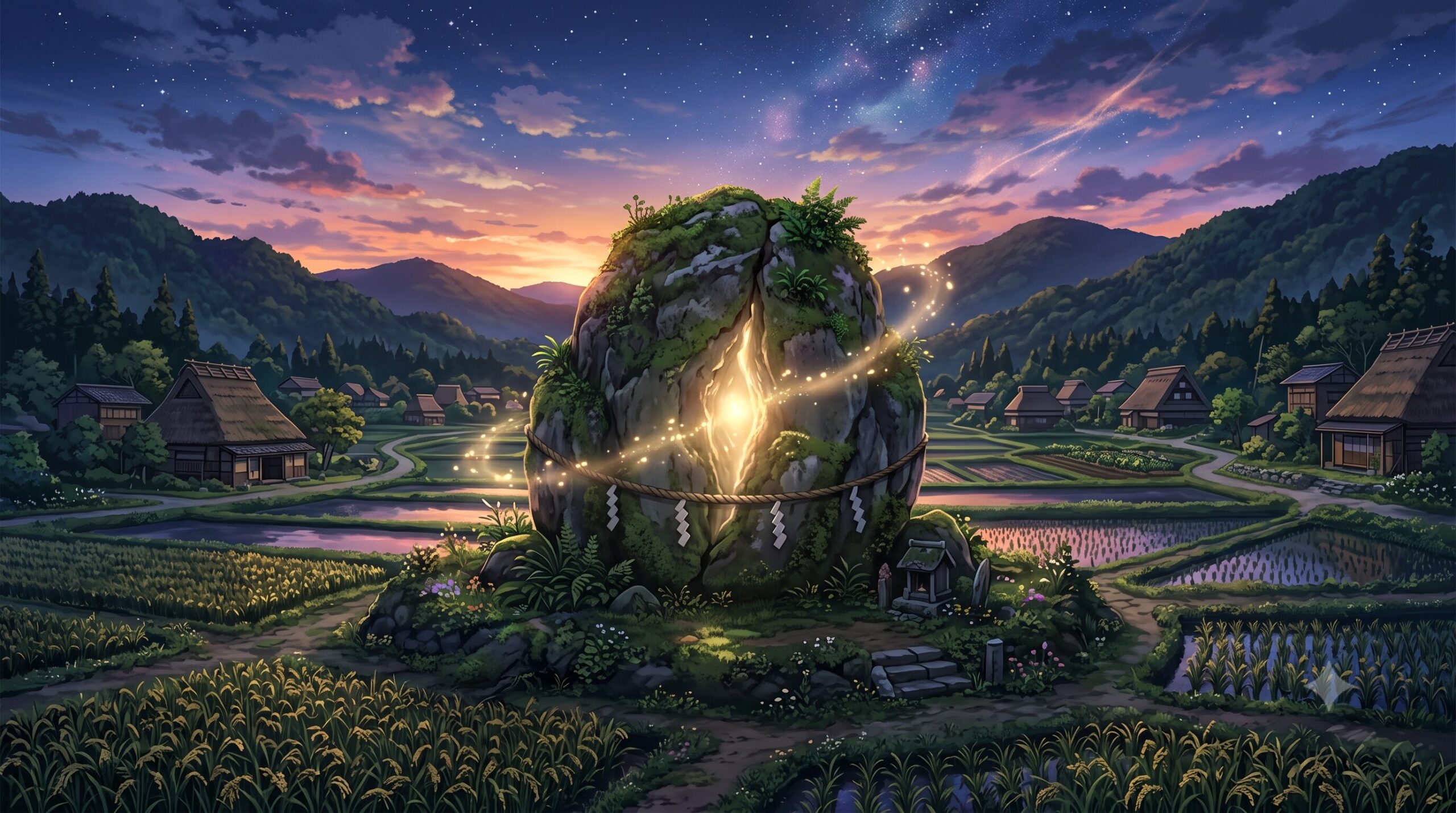
In Japan, there is an ancient, deeply rooted belief known as “Yaoyorozu no Kami” (Eight Million Gods), the concept that spirits and deities reside in all things in nature. It has been believed that even trees, rivers, and the seemingly ordinary “stones” by the roadside possess their own will and power. Today, we will delve into the profound concepts of “On” (gratitude/debt) and “Awe toward nature” that Japanese people have cherished since ancient times, through the captivating folktale “The Mysterious Stone” from Ishikawa Prefecture.
1. The Story of “The Mysterious Stone”
Long, long ago, in Ishikawa Prefecture, there was a field called “Yokouchi” located between the villages of Ikezaki and Naozu. Right in the middle of this field lay a massive, heavy stone.
One day, a terribly impoverished traveler was passing through the village. He had not eaten a single grain of rice or drank a drop of water for three days and three nights. Finally, overcome by starvation and exhaustion, he collapsed in front of the giant stone. As his consciousness faded, the traveler muttered unintentionally:
“Ah… if only I had just one bowl of rice…”
To his astonishment, a bowl overflowing with steaming, fluffy white rice suddenly appeared right before his eyes. Though bewildered, the traveler frantically devoured the food. He looked around, but there was absolutely no one in sight. Still not completely full, the traveler wished, “I want to eat another bowl.” This time, bowls of rice appeared one after another from inside the giant stone. Overjoyed, the traveler ate a total of seven bowls of rice and completely regained his strength.
The next morning, the traveler went to Ikezaki village and told the villagers about this miraculous event. Surprised, the villagers gathered around the giant stone and, half-doubting, began to voice their wishes one by one.
“I want medicine to cure my chronic asthma!”
“I need a beautiful kimono for my daughter’s wedding!”
“Please give us a bag of rice to survive the winter!”
Instantly, the giant stone materialized everything the villagers wished for right before their eyes. From then on, whenever the villagers faced any hardship in their daily lives, they would ask the giant stone to provide them with what they needed.
However, some time later, a strange, unknown man arrived in the village. He gathered the villagers and announced:
“I am the ‘Yokouchi Lending Stone.’ It is time for you to return the things I have lent to you.”
The villagers were shocked. The gifts from the giant stone were not “presents,” but “loans.” Although suspicious, the man demanded repayment so earnestly that the villagers honestly returned the cost of the medicine, the kimono, the rice, and everything else they had borrowed. Furthermore, a letter and money arrived from the traveler whose life was saved first, stating, “Please use this money to buy rice and return it to the stone.” Taking this event to heart, the villagers formally enshrined the giant stone as a deity and strictly kept their promise to always return whatever they borrowed.
But the peaceful days did not last forever. A highly greedy monk living in a nearby temple heard the rumors. The monk borrowed expensive goods and massive amounts of money from the giant stone to line his own pockets. When the Lending Stone came to demand repayment, instead of returning the items, the monk beat the man with a stick, shouting, “How dare a mere stone act so arrogantly!”
In that instant, the sky was suddenly covered with black clouds, and terrifying thunder roared across the area. The Lending Stone, which had been lying in the field, gently floated up into the air, flew straight toward the temple, and crashed down upon it with a tremendous earth-shattering thud. The impact completely destroyed the temple, leaving no trace behind.
Furious, the Lending Stone, which had always laid flat on the ground, stood straight up vertically, piercing the earth. After that day, no matter how much the villagers pleaded, the Lending Stone never lent anything to anyone ever again.
2. Deep Analysis of “The Mysterious Stone”
The most fascinating aspect of this folktale is the premise that the blessings from the divine are not “free gifts” but “loans.” While magic lamps and fairies in Western fairy tales often grant wishes unconditionally, the stone in this story explicitly names itself the “Lending Stone.”
Furthermore, because the villagers and the traveler took the action of “properly returning what they borrowed,” a sacred contractual relationship was established, and the stone became worshipped as the village’s guardian deity. However, when the greedy monk unilaterally broke that “contract (relationship of trust)” and resorted to violence, he received a severe retaliation in the form of nature’s fury (thunderstorms and the falling stone). The final description of the stone standing “vertically” instead of lying “horizontally” serves as a powerful visual representation of the deity’s anger and its complete severance from humanity (the will to never interact again).
3. Connection to Japanese Culture Decoded from the Folktale
From this story, we can decode several important cultural values that flow through the foundation of Japan.
- Giri and On (Duty and Gratitude): Since ancient times, Japanese people have held the ethical view that any “On” (kindness or blessing) received must absolutely be repaid. The depiction of the traveler sending money from far away symbolizes this virtue of “returning a favor.”
- Awe Toward Nature (Animism): The story contains a moral lesson: if humans continue to selfishly exploit nature’s blessings (the gifts from the stone), retaliation from nature (disasters) will inevitably follow. The stone that destroyed the temple can be seen as a metaphor for natural disasters like earthquakes and lightning.
- Knowing When One Has Enough (Taru wo Shiru): The stone was merciful to the traveler and villagers who were truly in need, but it punished the monk who succumbed to selfish greed. It integrates Buddhist values that warn against the folly of having limitless desires.
4. What Would You Do?
If a mysterious stone that would “lend” you anything you desired was right in front of you, what would you ask for? And, would you be able to properly “return” to the stone what you gained from that wish later on?
Never take the blessings given by nature or others for granted, and always maintain a feeling of gratitude. This folktale poses such an important question to all of us living in the modern world.
Read more fascinating Japanese folktales:
Japanese Folktale Series
日本の昔話「不思議な石」:願いを叶える石と日本人の精神性
日本には、自然界のあらゆるものに神が宿るとする「八百万の神(やおよろずのかみ)」という信仰が古くから根付いています。木や川、そして道端にある「石」にさえ、意思や力が宿ると信じられてきました。今回は、石川県に伝わる「不思議な石」という魅力的な昔話を通じて、日本人が古来より大切にしてきた「恩」と「畏敬の念」について深く掘り下げていきます。
1. 昔話「不思議な石」のストーリー
むかしむかし、石川県の池崎と直津という村の間に「横打(よこうち)」と呼ばれる畑地がありました。その畑の真ん中には、どっしりとした大きな石が横たわっていました。
ある日のこと、一人のひどく貧しい旅人がこの村を通りかかりました。旅人は三日三晩、水一滴、米一粒すら口にしておらず、ついに飢えと疲労で大石の前に倒れ込んでしまいました。薄れゆく意識の中で、旅人は思わずこう呟きました。
「ああ、せめてご飯が一椀でもあったらなぁ……」
するとどうでしょう。旅人の目の前に、湯気を立てるふっくらとした白いご飯が山盛りにされたお椀が、忽然と現れたのです。旅人は驚きながらも、無我夢中でそのご飯を平らげました。周囲を見渡しても、誰の姿もありません。お腹が満たされきっていない旅人が「もう一杯食べたい」と願うと、今度は大石の中から次々とご飯のお椀が現れました。旅人は大喜びで、なんと七杯ものご飯を平らげ、すっかり元気を取り戻しました。
翌朝、旅人は池崎の村へ行き、村人たちにこの不思議な出来事を話しました。驚いた村人たちは大石の周りに集まり、半信半疑で次々と願い事を口にしました。
「長引く喘息を治す薬が欲しい!」
「娘の嫁入りのための、美しい晴れ着が欲しい!」
「冬を越すための米一俵を出してくれ!」
すると、大石は村人たちが望むものを次々と目の前に出現させました。それ以来、村人たちは生活で不自由なことがあると、大石にお願いして物を出してもらうようになりました。
ところが、それからしばらく経ったある日のこと。村に奇妙な見知らぬ男がやってきました。男は村人たちを集め、こう名乗りました。
「私は『横打の物貸石(ものかしいし)』である。お前たちに貸した物を、そろそろ返してもらいたい」
村人たちは驚きました。大石からの贈り物は「もらいもの」ではなく「借りもの」だったのです。不審に思いつつも、男があまりにも熱心に催促するため、村人たちは大石から借りていた薬の代金や着物、米などをすべて律儀に返しました。さらに、最初に命を救われたあの旅人からも手紙とお金が届き、「このお金で米を買い、石に返してほしい」と記されていました。村人たちはこの出来事を機に大石を神様として立派に祀り、何かを借りた時は必ず返すという約束を固く守るようになりました。
しかし、平和な日々は長くは続きませんでした。あるお寺に住む、非常に欲深いお坊さんがこの噂を聞きつけたのです。お坊さんは大石から高価な物や大量のお金を借りまくり、私腹を肥やしました。そして、物貸石が催促にやってくると、返すどころか「石の分際で生意気な!」と棒で叩き返してしまったのです。
その瞬間でした。にわかに空が黒雲に覆われ、辺り一面に恐ろしい雷鳴が轟きました。畑に横たわっていた物貸石がフワリと宙に浮かび上がったかと思うと、一直線にお寺へと飛んでいき、ドスン!とものすごい地響きを立ててお寺の上に落ちました。その衝撃で、お寺は跡形もなく崩れ落ちてしまいました。
怒り狂った物貸石は、それまで畑で横に寝ていたにもかかわらず、地面に突き刺さるように縦に真っ直ぐ立ち上がりました。その後、村人たちがどれほど懇願しても、物貸石が二度と物を貸してくれることはありませんでした。
2. 「不思議な石」の深い考察
この昔話の最も興味深い点は、神からの恩恵が「無償の贈与」ではなく「貸与(貸し出し)」であるという設定です。西洋の童話に登場する魔法のランプや妖精たちは、願いを無条件で叶えてくれることが多いですが、この物語の石は明確に「物貸石」と名乗ります。
また、村人たちや旅人が「借りたものをきちんと返す」という行動をとったことで、一度は神聖な契約関係が成立し、石が村の守り神として祀られるようになります。しかし、欲深いお坊さんがその「契約(信頼関係)」を一方的に破棄し、さらには暴力を振るったことで、自然の猛威(雷雨と石の落下)という形で手痛いしっぺ返しを受けます。最後に石が「横」から「縦」に立ち上がったという描写は、神の怒りと、人間との断絶(もう二度と交わらないという意志)を視覚的に強烈に表現しています。
3. 昔話から読み解く日本文化との関連
この物語からは、日本の根底に流れる重要な文化的価値観を読み解くことができます。
- 義理と恩(Giri and On):日本人は古くから、受けた恩(親切や恵み)は必ず返さなければならないという倫理観を持っています。旅人が遠方からわざわざ代金を送ってきた描写は、この「恩を返す」という美徳を象徴しています。
- 自然への畏怖(Animism):自然の恩恵(石からの授かりもの)を人間の都合で搾取し続ければ、必ず自然からのしっぺ返し(災害)が来るという教訓が含まれています。寺を破壊した石は、地震や雷といった自然災害のメタファーとも言えます。
- 足るを知る(Knowing when one has enough):本当に困っていた旅人や村人たちには慈悲深かった石が、私利私欲に走った僧侶には罰を下しました。欲望に際限を持たないことの愚かさを戒める、仏教的な価値観も融合しています。
4. あなたならどうしますか?
もしあなたの目の前に、望むものを何でも「貸して」くれる不思議な石があったら、あなたは何をお願いしますか?そして、その願いによって得たものを、後できちんと石に「返す」ことができるでしょうか。
自然や他者から与えられている恵みを当たり前のものだと思わず、感謝の気持ちを持ち続けること。この昔話は、現代を生きる私たちにもそんな大切な問いを投げかけています。
他の魅力的な日本の昔話を読む:
Japanese Folktale Series(日本の昔話シリーズ)

コメント