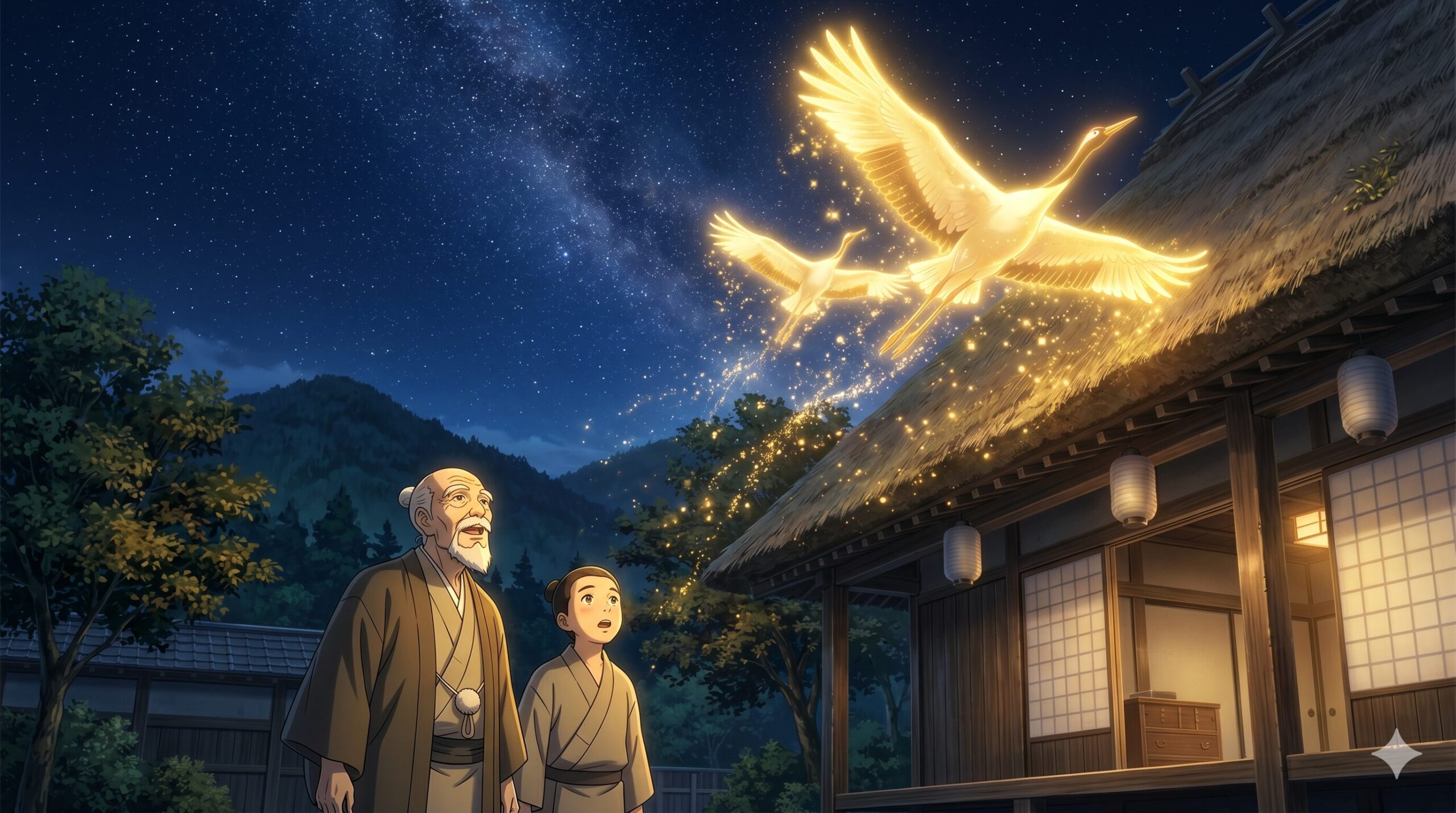
Welcome, readers from all over the world, to the rich universe of Japanese mythology and folktales! In Japan, there are countless beautiful stories where nature and humans are deeply connected, sometimes resulting in miraculous events. Today, we are introducing a breathtaking and moving folktale passed down in the Soma region of Fukushima Prefecture, called “Old Man Gyotoku and the Crane.” This is not just a fairy tale; it is a profound story that teaches the “reverence for nature” and the “kindness of forgiving mistakes” deeply rooted in the Japanese heart. Let’s embark on a journey into this magical world together!
① The Story: “Old Man Gyotoku and the Crane”
Once upon a time, in a lush village called Soma in Fukushima Prefecture, there lived a kind-hearted elderly man known as Old Man Gyotoku. In front of his house was a beautiful pond, and every spring, it was customary for two magnificent cranes to fly in from afar. The old man loved these cranes as if they were his own family and eagerly looked forward to their arrival every spring.
One bright and beautiful spring day, the two cranes arrived at the pond once again. As Old Man Gyotoku sat at the base of a tree, happily puffing on his tobacco pipe and admiring the elegant birds, a young villager named Naokado passed by. Together, they smiled and watched the affectionate cranes.
A few days passed, and the cranes laid a splendid egg in their nest. However, a devilish whisper of curiosity and greed suddenly sprouted in young Naokado’s heart. Under the cover of darkness that night, Naokado sneaked up to the pond and stole the precious egg while the parent birds were not looking.
The next morning, the heartbreaking cries of the cranes echoed from the pond. Startled, Old Man Gyotoku rushed over, only to find the egg missing from the nest. The old man immediately had a hunch: “This must be the doing of Naokado, who was watching them with me yesterday.” Convinced of this, he went straight to Naokado’s house.
However, Naokado stubbornly lied, saying, “I didn’t steal anything!” Since Old Man Gyotoku disliked conflict, he tried to convince himself, “I see… Perhaps the cranes thought this egg wouldn’t hatch properly and threw it away themselves,” and quietly returned home.
That night, intending to eat the stolen egg, Naokado put a pot over the fire in his *irori* (a traditional Japanese sunken hearth) and was boiling the egg while drinking sake. Suddenly, the fire in the hearth unnaturally vanished, and two mysterious, glowing golden lights appeared outside his house!
The two lights began to spin rapidly around Naokado’s house, and soon, the mass of light transformed into the giant shape of cranes! It was as if the anger and sorrow of the parent cranes whose egg was stolen had materialized. Terrified, Naokado bowed down on the tatami mats and cried out, “I understand! I’ll return the egg, please forgive me!” Miraculously, the glowing lights immediately vanished into thin air.
With trembling hands, Naokado grabbed the egg—which had already been boiled—and ran through the night to Old Man Gyotoku’s house to apologize and return it.
The next morning, an unbelievable miracle occurred. As the repentant Naokado and Old Man Gyotoku watched over the crane’s nest together, a healthy baby crane miraculously broke through the shell of the “boiled egg” and was born! Touched by the mystery of life and divine power, Naokado shouted loudly, “Old man! A baby crane has hatched from the egg!” Old Man Gyotoku and Naokado shed tears of joy and celebrated the miracle together.
② Deep Analysis: Why Did Life Emerge from a “Boiled Egg”?
The tale of “Old Man Gyotoku and the Crane” is highly dramatic and full of moral lessons. The most notable point of analysis is the ultimate miracle depicted: a chick hatching from an egg that had been boiled and supposedly stripped of life.
Naokado clearly committed a sin. He tried to take a life and even lied about it. However, upon seeing the golden light (a sacred warning from nature), he felt genuine fear, admitted his mistake, and apologized. The deep theme of redemption and rebirth conveyed in this story is that “even if you make a mistake, if you truly repent, nature will forgive you and show you the miracle of life once again.”
Furthermore, Old Man Gyotoku’s non-confrontational attitude is crucial. Instead of fiercely blaming Naokado, he initially swallowed his suspicion, thinking it might have been the cranes’ will. It can be thought that this tolerance served as the catalyst that awakened Naokado’s own conscience.
③ Connection to Japanese Culture: Animism and the Sacredness of “Cranes”
From this story, we can strongly decode the underlying culture and spirituality of Japan. It is the spirit of Animism, represented by the concept of “Yaoyorozu no Kami” (Eight Million Gods). Since ancient times, Japanese people have believed that sacred spirits reside in all elements of nature, including animals, plants, mountains, and rivers.
In particular, the “Crane” (Tsuru) is a very special bird in Japanese culture. As the proverb goes, “Cranes live for a thousand years, turtles for ten thousand,” making them a symbol of longevity, prosperity, and marital harmony. The culture of folding “Senba-tsuru” (a thousand origami cranes) is a traditional Japanese custom filled with prayers for peace and recovery from illness. The depiction of the cranes emitting a golden, spiritual light in this story is evidence that they were recognized not just as birds, but as “messengers of the gods.”
Additionally, the “Irori” (Sunken Hearth), which serves as a setting in the story, is a uniquely Japanese cultural element. The place around the fire is not only the center of daily family life but was also considered a mystical boundary where the human world intersected with the otherworld (the realm of gods and spirits). The scene where the hearth fire goes out and paranormal phenomena occur is a brilliant fusion of traditional Japanese lifestyle and the spiritual world.
④ A Question for You
How did you feel reading this mysterious and heartwarming story of a miracle?
If you were in Naokado’s shoes and golden cranes started flying outside your house in the middle of the night, how would you react? Would you run away in terror? Or would you be able to immediately admit your mistake and apologize?
Are there similar legends in your country or region where animals bring about miracles? Please let us know your thoughts on human mistakes and nature’s forgiveness in the comments section!
Reference Link:
For tourism information to experience the history and nature of Fukushima, please visit here.
Fukushima Travel – Official Tourism Website
Want to enjoy more Japanese Folktales? Click here:
Japanese Folktale Series
日本の不思議な魔法と奇跡:「行徳じいさんと鶴」の物語へようこそ!
世界中の読者の皆様、日本の豊かな神話や昔話の世界へようこそ!日本には、自然と人間が深く結びつき、時には奇跡のような出来事が起こる美しい物語が数多く存在します。今回は、福島県相馬地方に古くから伝わる、驚きと感動に満ちた昔話「行徳じいさんと鶴」をご紹介します。この物語は単なるおとぎ話ではなく、日本人の心に根付く「自然への畏敬の念」と「過ちを許す優しさ」を教えてくれる素晴らしいストーリーです。さあ、一緒に不思議な昔話の世界へと旅に出ましょう!
① ストーリー:「行徳じいさんと鶴」
むかしむかし、福島県の相馬という自然豊かな村に、行徳じいさんという心優しいおじいさんが住んでいました。行徳じいさんの家の前には美しい池があり、毎年春になると、遠くから美しい二羽の鶴が飛来してくるのが恒例でした。おじいさんは、この鶴たちをまるで自分の家族のように愛し、春が来るのを心から楽しみにしていました。
ある春のうららかな日のこと。今年も二羽の鶴が池にやってきました。行徳じいさんが木の根元に腰を下ろし、美味しそうに煙草をふかしながら鶴の優雅な姿を眺めていると、同じ村に住む「直門(なおかど)」という若者が通りかかりました。二人は一緒に、仲睦まじい鶴の様子を微笑ましく眺めていました。
それから数日が過ぎたある日、鶴は巣に立派な卵を産みました。しかし、若者の直門の心にふと、悪魔のささやきのような好奇心と欲望が芽生えてしまったのです。その日の夜、直門は暗闇に乗じてこっそりと池に忍び寄り、親鳥が目を離した隙に、その大切な卵を盗み出してしまいました。
翌朝、池のほうから鶴たちの悲痛な鳴き声が聞こえてきました。驚いた行徳じいさんが慌てて見に行くと、巣にあったはずの卵が消え去っています。じいさんはすぐにピンときました。「昨日一緒に見ていた直門の仕業に違いない」。そう確信したじいさんは、直門の家へと足を運びました。
しかし、直門は「俺は盗んでなんかいない!」と頑なに嘘をつきました。行徳じいさんは争いを好まない性格だったため、「そうか……鶴が、この卵は無事に孵らないだろうと思って、自分たちでどこかへ捨ててしまったのかもしれんのう」と自分を納得させ、静かに家へ帰っていきました。
その日の夜のことです。直門は盗んだ卵を食べるため、囲炉裏(いろり:日本の伝統的な室内用の炉)の火に鍋をかけ、グツグツと卵を茹でながら酒を飲んでいました。すると突然、囲炉裏の火がフッと不自然に消え去り、家の外にピカピカと金色に輝く二つの謎の光が現れたのです!
その二つの光は、直門の家の周りをぐるぐると猛スピードで回り始め、やがてその光の塊は、巨大な「鶴の形」へと変化しました。それはまるで、卵を奪われた親鶴の怒りと悲しみが具現化したかのようでした。恐れおののいた直門は、畳の上に平伏し、「わかった!卵は返すから、どうか許してくれ!」と泣き叫びました。すると不思議なことに光はスッと消え去りました。
直門は震える手で、すでに茹で上がってしまった卵を抱え、夜道を走って行徳じいさんのもとへ謝罪に行き、卵を返しました。
そして翌朝、信じられない奇跡が起きます。直門が反省し、行徳じいさんと一緒に鶴の巣を見守っていると、なんと「茹でてしまったはずの卵」から、元気な鶴のヒナがパカッと殻を破って誕生したのです!生命の神秘と神聖な力に触れた直門は、「じいさん!卵から鶴の子が孵ったぞ!」と大声で叫び、行徳じいさんと直門は涙を流して一緒にその奇跡を喜び合いました。
② 昔話の考察:なぜ「ゆで卵」から命が生まれたのか?
この「行徳じいさんと鶴」は、非常にドラマチックで教訓に満ちた物語です。最も注目すべき考察ポイントは、「一度茹でられて生命を失ったはずの卵からヒナが孵る」という究極の奇跡が描かれている点です。
直門は明らかに罪を犯しました。命を奪おうとし、嘘までつきました。しかし、金色の光(神聖な自然の警告)を見て心から恐怖し、己の過ちを認めて謝罪しました。この物語が伝えているのは、「過ちを犯しても、心から悔い改めれば、自然はそれを許し、再び命の奇跡を見せてくれる」という深い贖罪(しょくざい)と再生のテーマです。
また、行徳じいさんの「争わない姿勢」も重要です。彼は直門を激しく責め立てるのではなく、鶴の意思かもしれないと一度は飲み込みました。この寛容さが、直門自身の良心を呼び覚ますきっかけになったとも考えられます。
③ 日本文化との関連性:アニミズムと「鶴」の神聖さ
この物語からは、日本の根底に流れる文化や精神性を強く読み解くことができます。それは「八百万の神(やおよろずのかみ)」に代表されるアニミズムの精神です。日本では古来より、動物や植物、山や川といったすべての自然物に神聖な霊性が宿っていると信じられてきました。
特に「鶴(Tsuru)」は、日本文化において非常に特別な鳥です。「鶴は千年、亀は万年」ということわざがあるように、長寿と繁栄、そして夫婦円満の象徴とされています。折り紙で鶴を折る「千羽鶴」の文化も、平和や病気平癒の祈りを込める日本の伝統的な風習です。この物語で鶴が金色の光を放つ霊的な存在として描かれているのは、鶴がただの鳥ではなく、「神の使い」として認識されていた証拠です。
また、物語の舞台となる「囲炉裏(Irori)」も日本特有の文化です。火を囲む場所は、家族が集まる生活の中心であると同時に、異界(神や精霊の世界)と人間界が交差する神秘的な場所でもありました。囲炉裏の火が消え、超常現象が起きるという描写は、日本の古き良き生活様式と精神世界が見事に融合したシーンと言えます。
④ 読者の皆様への問いかけ
この不思議で心温まる奇跡の物語を読んで、あなたはどのように感じましたか?
もしあなたが直門の立場で、夜中に自分の家の外を金色の鶴が飛び交い始めたら、どう行動するでしょうか?恐怖で逃げ出しますか?それとも、すぐに自分の過ちを認めて謝ることができるでしょうか?
また、あなたが住む国や地域にも、動物が奇跡を起こすような似た伝承はありますか?人間の過ちと自然の許しについて、ぜひあなたの考えをコメント欄で教えてください!
参考リンク:
福島県の歴史や自然に触れる観光情報についてはこちらをご覧ください。
福島県公式観光情報サイト「ふくしまの旅」
日本の昔話をもっと楽しみたい方はこちら:
Japanese Folktale Series(日本の昔話シリーズ)

コメント