- Introduction: A Thrilling Folktale from Akita Prefecture
- The Story of “The Stingy Millionaire and Sankichi”
- Analysis of the Folktale: Rebellion Against Power and the Triumph of Wit
- Connection to Japanese Culture: Karmic Retribution and the Gods of Mount Taihei
- A Question for You: What Would You Do?
- はじめに:秋田県に伝わる痛快な昔話
- 「けちんぼ長者と三吉さん」のストーリー
- 昔話を考察する:権力への反抗と「機知」の勝利
- 日本文化との関連:因果応報と「太平山三吉神社」
- 読者のあなたへ:あなたならどうしますか?
Introduction: A Thrilling Folktale from Akita Prefecture
Japanese folktales, born from the country’s rich nature and history, are deeply engraved with the wisdom and moral values of the people. Today, I would like to introduce a thrilling and satisfying story passed down in Akita Prefecture, located in the Tohoku region of Japan, titled “The Stingy Millionaire and Sankichi.” Through the contrasting figures of a greedy millionaire obsessed with power and wealth, and a strong, hardworking young man named Sankichi, this story questions what true wealth really means.
The Story of “The Stingy Millionaire and Sankichi”
Once upon a time, at the foot of Mount Taihei in Akita, there lived an exceptionally stingy millionaire.
He was not just thrifty; he was ruthlessly greedy. He lent money to poor local farmers at exorbitant interest rates. When they couldn’t repay their debts, he would take their daughters and sons to his mansion as servants, making them work for almost nothing for years. By exploiting people and hoarding money in this way, he became the richest man in the village.
Many servants worked at the millionaire’s mansion, and among them was a young man named Sankichi. Although small in stature, Sankichi possessed superhuman strength and was an incredibly hard worker. He could easily carry multiple heavy bales of rice all by himself.
The millionaire’s only joy in life was secretly counting his hidden money. However, as his wealth grew, he became paranoid, fearing that someone would discover and steal it. Consequently, he decided to hide his gold and loan documents at the bottom of a pickle barrel.
One day, unable to shake his paranoia about his money, the millionaire gathered his servants and unreasonably interrogated them: “You guys know where the money is hidden, don’t you?!” While everyone denied any knowledge, Sankichi, who usually worked in silence, stepped forward.
“Are you really doubting the servants who have worked so hard and devotedly for you without any proof?”
For the first time, Sankichi spoke back clearly to the millionaire. Enraged that things weren’t going his way, the millionaire turned red and shouted.
“You insolent brat! I’ll give you whatever you want, just get out of my house this instant!”
Sankichi replied in a calm voice.
“Understood. I will leave. But in return, I will take exactly ‘one back-load’ of rice bales with me.”
The millionaire, underestimating him and thinking, “How much could one person possibly carry?”, readily agreed.
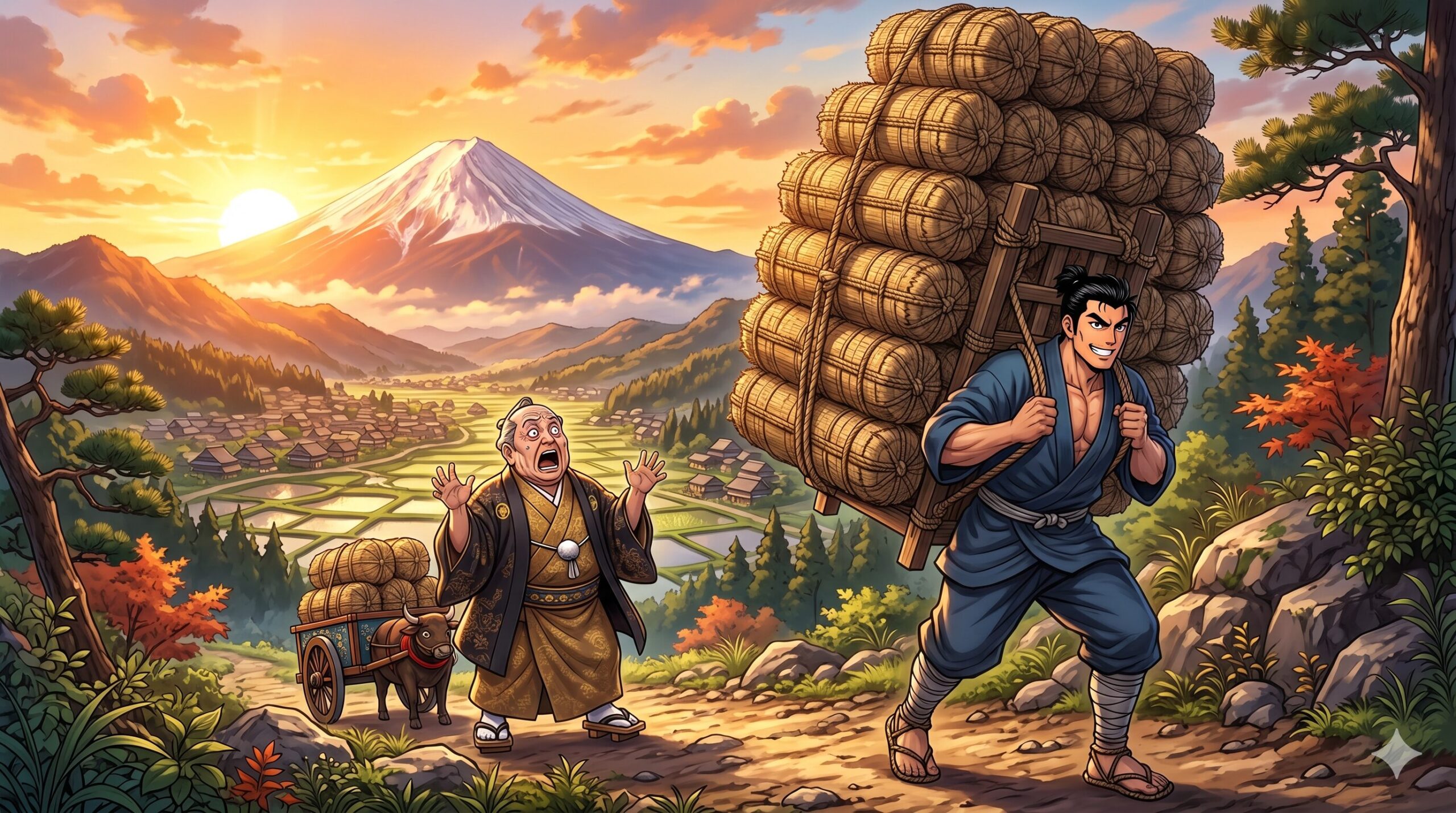
The next morning, as the millionaire was watching the sun rise over Mount Taihei, he noticed that the mountain in the foreground was suddenly shaking and moving. “The mountain is moving!” he gasped. Looking closely, he realized it wasn’t a mountain at all. It was a massive pile of rice bales being carried on Sankichi’s back.
Sankichi’s “one back-load” was on a completely different scale from an ordinary person’s. He had piled up almost every single grain of rice in the mansion into a mountain-like heap, easily hoisted it onto his back, and walked straight home. The millionaire was left standing there completely dumbfounded, his mouth wide open, unable to utter a single word. His own arrogance and deep greed had backfired, causing him to lose his precious fortune.
Analysis of the Folktale: Rebellion Against Power and the Triumph of Wit
This story carries a profound message that goes beyond simple “poetic justice.” The millionaire represents an “evil exploiter” in a capitalist sense, while Sankichi symbolizes the “oppressed worker.”
The millionaire was under the illusion that money and power could control everyone. However, the one thing he lacked was “trust in people.” The act of doubting his servants revealed his own spiritual poverty. On the other hand, Sankichi never bowed down to unreasonable authority. The “one back-load of rice” he demanded was a brilliant display of wit (humor and wisdom) that turned the millionaire’s arrogance against him. Instead of starting a violent rebellion, defeating the oppressor legally by taking advantage of their own promise makes for a highly satisfying conclusion.
Connection to Japanese Culture: Karmic Retribution and the Gods of Mount Taihei
This tale strongly reflects the Buddhist concept of “Inga-oho” (Karmic Retribution)—the idea that good deeds bring good outcomes, and bad deeds bring bad outcomes, which is a traditional Japanese spiritual value. The millionaire, who continuously exploited the labor of others out of greed, ultimately lost his wealth because of his own words.
The presence of “Gods” (Kami) in Japanese culture is also crucial here. At Mount Taihei in Akita Prefecture, the setting of the story, there is an actual shrine called “Taiheizan Miyoshi Shrine.” The deity enshrined here, “Miyoshi Okami,” is known as the god of strength, victory, and good fortune, and is widely worshipped as a powerful god who hates injustice. Sankichi, the protagonist of this story, is depicted as an avatar of this local guardian deity, or a being who embodies the will of the god. The animistic belief (the eight million gods) that gods dwell in Japanese nature (mountains) gave birth to such a powerful and reliable character.
A Question for You: What Would You Do?
How did you feel after reading “The Stingy Millionaire and Sankichi”?
Becoming too attached to material wealth and losing sight of what is truly important, like the millionaire, is something that could happen to any of us living in modern society.
If you were in Sankichi’s shoes and were told, “Take any one thing and get out,” what would you pack into your “one back-load”? Also, if there were someone like the millionaire in your life, how would you stand up to them? Please share your thoughts and opinions with us!
■ If you want to read more fascinating Japanese folktales, click here:
Read more in the Japanese Folktale Series
けちんぼ長者と三吉さん:日本の昔話が教える「欲」の末路と真の強さ
はじめに:秋田県に伝わる痛快な昔話
日本の豊かな自然と歴史の中から生まれた昔話には、人々の生活の知恵や道徳観が深く刻まれています。今回は、日本の東北地方、秋田県に古くから伝わる痛快な物語「けちんぼ長者と三吉さん」をご紹介します。権力と富に執着する強欲な長者(大金持ち)と、力持ちで働き者の若者・三吉(さんきち)の対照的な姿を通して、真の豊かさとは何かを問いかける物語です。
「けちんぼ長者と三吉さん」のストーリー
昔々、秋田にある太平山のふもとに、それはそれはケチな長者が住んでいました。
この長者はただのケチではありません。近くの貧しい百姓たちに高い利子でお金を貸し、もしお金が返せなくなると、彼らの娘や息子を奉公人(使用人)として自分の屋敷に連れてきて、長年タダ同然で働かせていました。そうやって人々から搾取し、金を貯め込み、気づけば村一番の長者になっていたのです。
長者の屋敷にはたくさんの奉公人が働いていましたが、その中に「三吉」という若者がいました。三吉は体こそ小柄でしたが、とにかく大変な力持ちで働き者でした。重い米俵も、一人でいくつも担いでしまうほどです。
さて、そんな長者の唯一の楽しみといえば、隠してあるお金を一人でこっそり数えることでした。しかし、金が増えるにつれて「このままでは誰かに気づかれて盗まれてしまうのではないか」と疑心暗鬼になり、長者は金と借金の証文をまとめて漬物樽の中に隠すことにしました。
ある日、金のことが気になって仕方がない長者は、ついに奉公人たちを集めて「お前たち、金の隠し場所を知っているだろう!」と理不尽に問い詰めました。誰もが身に覚えがないと答える中、普段は黙々と働いていた三吉が前に進み出ました。
「今まで一生懸命尽くしてきた奉公人たちを、根拠もなく疑うのですか!」
三吉は長者に対して、初めてはっきりと口答えをしました。自分の思い通りにならないことに腹を立てた長者は、真っ赤になって怒鳴りました。
「生意気な奴め!何でもくれてやるから、お前のような奴は今すぐこの家から出ていけ!」
すると三吉は、落ち着いた声でこう言いました。
「わかりました。それでは出ていきますが、その代わり『一背負い(ひとせおい)分の稲束』をもらっていきますよ」
長者は「たかが一人が背負える量など知れている」と高を括り、それを承諾しました。
翌朝のことです。太平山の上に朝日が昇るのを長者が見ていると、手前の山がぐらり、ぐらりと不意に動き出しているではありませんか。「お山が動いたぞ!」と驚いてよく見ると、それは山ではなく、三吉が背中に担いでいる稲束の山だったのです。
三吉の「一背負い」は、常人のそれとは桁違いでした。屋敷にある米という米を山のように積み上げ、三吉はそれをひょいと担いで、そのまま自分の家へと帰っていきました。ポカンと立ち尽くす長者は、口を開けたまま声も出ません。己の傲慢さと欲の深さが仇となり、長者は大切な財産をすっかり失ってしまったのでした。
昔話を考察する:権力への反抗と「機知」の勝利
この物語は、単なる「勧善懲悪」を超えた深いメッセージを持っています。長者は資本主義における「悪徳な搾取者」の象徴であり、三吉は「抑圧された労働者」の象徴です。
長者は、お金と権力があれば全ての人を支配できると錯覚していました。しかし、彼が唯一持っていなかったのは「人への信頼」です。奉公人を疑うという行為は、彼自身の心の貧しさを表しています。一方、三吉は理不尽な権力に対して決して屈しませんでした。彼が要求した「一背負いの稲束」は、長者の「人間を見下す傲慢さ」を逆手に取った見事な機知(ユーモアと知恵)です。武力で反乱を起こすのではなく、相手の約束を逆手にとって合法的に富を奪い返すという結末は、読んでいて非常に痛快です。
日本文化との関連:因果応報と「太平山三吉神社」
この物語は、日本の伝統的な精神性である「因果応報(良い行いには良い報いが、悪い行いには悪い報いが来る)」という仏教的価値観を強く反映しています。強欲に他人の労働を搾取し続けた長者は、最終的に自らの言葉によって財産を失います。
また、日本文化における「神様」の存在も重要です。物語の舞台となった秋田県の「太平山」には、現在も「太平山三吉神社(たいへいざんみよしじんじゃ)」が実在しています。この神社に祀られている「三吉霊神(みよしのおおかみ)」は、力・勝負・開運の神様として知られ、曲がったことが大嫌いで、力持ちの神様として信仰を集めています。本作の主人公「三吉」は、まさにこの土地の守り神の化身、あるいは神の意志を体現する存在として描かれています。日本の自然(山)には神が宿るという「アニミズム(八百万の神)」の信仰が、このような力強く頼もしいキャラクターを生み出しました。
読者のあなたへ:あなたならどうしますか?
この「けちんぼ長者と三吉さん」を読んで、あなたはどのように感じましたか?
長者のように、物質的な富に執着しすぎて大切なものを見失ってしまうことは、現代社会を生きる私たちにも起こり得ることかもしれません。
もしあなたが三吉の立場で、「何でも一つだけ持って出ていけ」と言われたら、何を一背負いして持っていきますか?また、あなたの身近に長者のような人がいたら、どのように立ち向かいますか?ぜひ、あなたの考えや意見を聞かせてください。
■ 日本の不思議で魅力的な昔話をさらに読みたい方はこちら:
Japanese Folktale Series をもっと読む

コメント