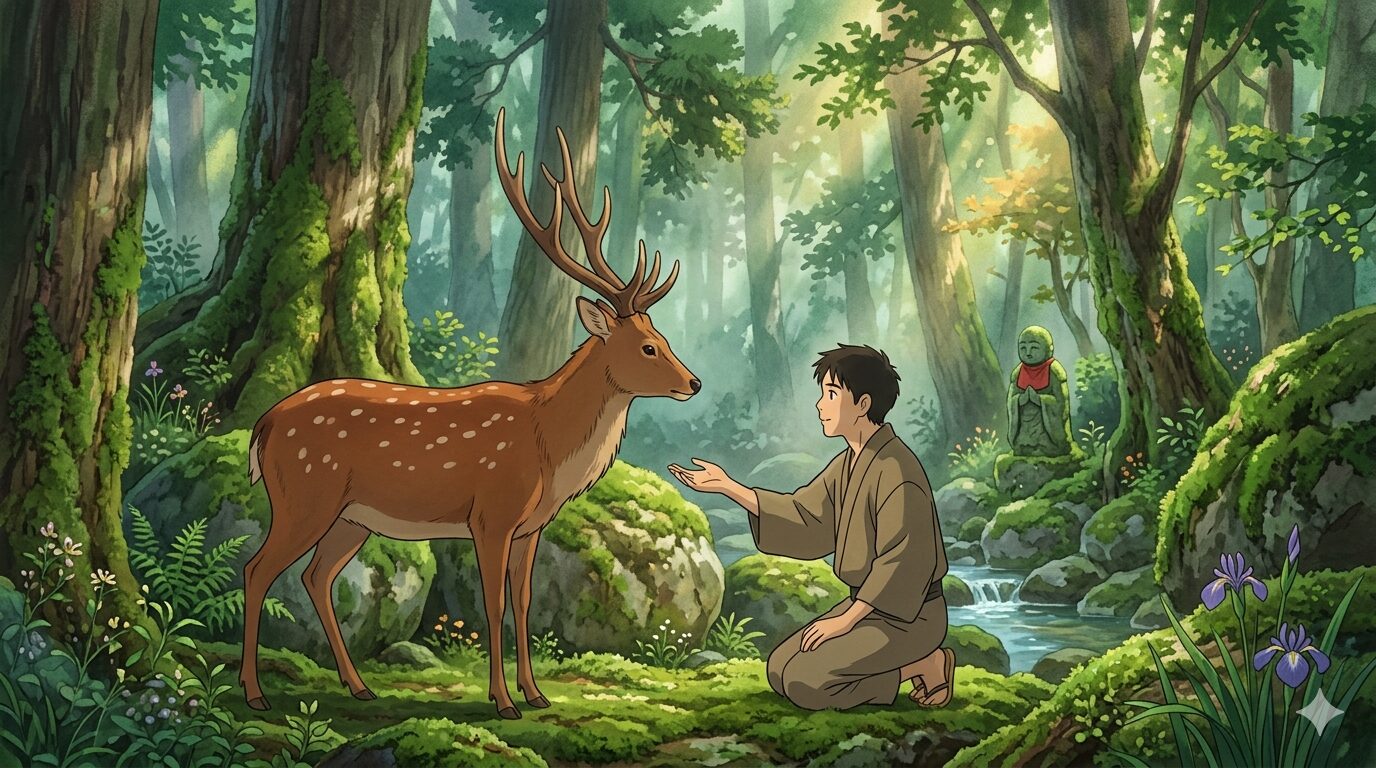
① The Story: The Deer’s Gratitude (Shika no Ongaeshi)
Once upon a time, deep in the quiet mountains of Japan, there lived a kind-hearted young woodcutter. Every day, he would go into the mountains at dawn, chopping wood while giving thanks for the blessings of nature, living a humble and peaceful life.
One autumn evening, as he was finishing his work and heading home, he heard a heartbreaking cry coming from deep within the thicket. He rushed toward the sound and found a magnificent stag with grand antlers caught in a cruel trap set by poachers. Blood was seeping from the deer’s leg, and its eyes trembled with fear and unbearable pain.
“You poor thing. Don’t worry, I will save you right now.”
The young man pried open the sharp iron teeth of the trap with his bare hands and freed the deer’s leg. He tore his own hand towel to bandage the deer’s wound and let it escape deep into the mountains. Just before disappearing into the forest, the deer looked back one last time and bowed its head deeply toward the young man. The man saw it off, whispering, “Be careful out there.”
Several years passed. During the rainy season one year, record-breaking heavy rains fell in the mountains for days on end. The water was closing in on the floorboards of the young man’s small hut, and the mountain ground was making an ominous, rumbling sound. As the young man spent an anxious, stormy night, the wooden door of his hut was suddenly violently struck.
When he timidly opened the door, there stood the magnificent stag he had saved years ago, completely drenched in the rain. The deer grabbed the sleeve of the young man’s kimono in its mouth and began pulling him outside frantically.
“What’s wrong? It’s a terrible storm out there!”
But the deer would not back down. Seeing the deer’s desperate demeanor, the young man realized something was terribly wrong. Yielding to the deer’s pull, he dashed out into the torrential rain. Driven by the deer, he ran up to higher ground. The very moment they reached safety, an earth-shattering roar echoed behind them.
Looking back, he saw that the hut he had been in just moments before was swallowed by a massive landslide, disappearing without a trace. The deer had run down the dangerous, stormy mountain solely to save his life. When the young man turned around to offer his words of gratitude, the deer had already vanished into the depths of the rainy forest.
② Analysis: The Message Behind Animal Gratitude
The tale of “The Deer’s Gratitude” is not merely a beautiful anecdote; it is a story that vividly reflects the view of nature that the Japanese have embraced since ancient times. In Japanese folktales, there are many stories of “Irui Onchoutan” (tales of animals returning favors to humans), but stories featuring deer hold a particularly special meaning.
In Western fairy tales, animals are often depicted as creatures dominated by humans or as symbols of evil. However, in Japanese folktales, animals are depicted as “equals to humans” or even as “messengers of the gods.” The young man’s act of saving the trapped deer represents human “awe” and “compassion” toward the natural world.
The deer’s action of coming to warn of danger symbolizes the very will of nature. Nature sometimes bares its fangs at humanity (through heavy rains and landslides), but the profound philosophy of karmic reward—that nature will always extend a helping hand to those who respect and seek to coexist with it—is condensed into this short story.
③ Cultural Connection: Deer as “Shinshi” and the Spirit of “On”
In Japanese culture, particularly in Shinto, deer are highly revered as “Shinshi” (divine messengers) who convey the will of the gods. Even today, at Kasuga Taisha Shrine in Nara Prefecture and Itsukushima Shrine in Hiroshima Prefecture, deer are carefully protected as sacred animals and coexist with humans. The spirit of “Animism” (the belief that gods reside in all things) flows at the foundation of this story.
Another crucial Japanese cultural concept to decipher from this story is “On” (恩 – profound gratitude or obligation). “On” is not a simple give-and-take transaction; it refers to a deep spiritual bond where the gratitude received is never forgotten for a lifetime. The deer remembering the young man’s face after several years and coming to his rescue at the risk of its own life is the very essence of the “Giri and On” (duty and gratitude) spirit that Japanese people consider most beautiful.
Even in modern Japanese society, this culture of “returning a favor” continues to live on in different forms, whether through seasonal gifts like Ochugen and Oseibo, or within everyday human relationships. Japanese folktales have served as moral textbooks, passing down the importance of this “On” to children for generations.
④ To Our Readers: What Would You Do?
Through this story, were you able to feel the beautiful bond that crosses the boundary between nature and humanity?
Living in modern society, we sometimes fall into the illusion that we can control nature. However, by listening to the small voices of nature, we might receive unexpected blessings and realizations.
If you encountered an injured wild animal in the forest, what would you do? And if that animal was desperately trying to tell you something, would you have the courage to trust its voiceless words and take a step forward? Please, share your thoughts with us in the comments.
⑤ Reference & Related Links
- External Reference Link: The Japanese Folktale “The Deer’s Gratitude” (Japanese)
- Read more Japanese Folktales: Japanese Folktale Series
日本の心に触れる:昔話「鹿の恩返し」が教える自然と人間の絆
① 物語:「鹿の恩返し」
昔々、日本の深く静かな山奥に、心優しい木こりの青年が住んでいました。毎日、夜明けとともに山へ入り、自然の恵みに感謝しながら木を切り、慎ましく暮らしていました。
ある秋の夕暮れ時のことです。青年が仕事を終えて家路についていると、茂みの奥から悲痛な鳴き声が聞こえてきました。声のする方へ急いで駆けつけると、そこには立派な角を持った一頭の雄鹿が、密猟者が仕掛けた冷酷な罠に足を挟まれ、もがいていました。鹿の足からは血が滲み、その瞳は恐怖と痛みに震えていました。
「かわいそうに。今、助けてやるからな」
青年は罠の鋭い鉄の歯を素手でこじ開け、鹿の足を解放しました。彼は持っていた手ぬぐいを裂いて鹿の傷の手当てをし、山の奥深くへと逃がしてやりました。鹿は森へ消える直前、一度だけ振り返り、青年に向かって深く頭を下げるような仕草を見せました。青年はそれを「気をつけるんだぞ」と見送りました。
それから数年が経ちました。ある年の梅雨、山では何日も記録的な大雨が降り続いていました。青年の住む小さな小屋の床下まで水が迫り、山の地盤は不気味な音を立てていました。嵐の夜、青年が不安な夜を過ごしていると、突然、小屋の木の戸が激しく叩かれました。
青年が恐る恐る戸を開けると、そこには数年前に助けた、あの立派な角を持つ雄鹿がずぶ濡れになって立っていました。鹿は青年の着物の袖を口で咥え、狂ったように外へ引っ張ります。
「どうしたんだ?外は嵐だぞ!」
しかし鹿は引き下がりません。あまりの必死な様子に、青年は只事ではないと悟り、鹿に引かれるままに豪雨の外へと飛び出しました。鹿に導かれて高台へと駆け上がったその瞬間です。背後で「ゴゴゴゴゴ!」という鼓膜を破るような轟音が響き渡りました。
振り返ると、青年がたった今しがたまで居た小屋が、巨大な土砂崩れに飲み込まれ、跡形もなく消え去っていました。鹿は青年の命を救うために、危険な嵐の山を駆け下りてきたのです。青年が感謝の言葉をかけようと振り返ると、鹿はすでに雨の降る森の奥へと姿を消していました。
② 考察:動物の恩返しに込められたメッセージ
この「鹿の恩返し」は、単なる美談ではなく、日本人が古来より抱いてきた自然観を色濃く反映した物語です。日本の昔話において、動物が人間に恩返しをする「異類恩寵譚(いるいおんちょうたん)」は数多く存在しますが、鹿が登場する物語には特別な意味があります。
西洋の童話では、動物は人間によって支配される存在、あるいは悪の象徴として描かれることが少なくありません。しかし、日本の昔話において動物は「人間と対等」、あるいは「神の使い」として描かれます。罠にかかった鹿を助ける青年の行動は、自然界に対する人間の「畏敬の念」と「慈悲」を表しています。
鹿が危険を知らせに来た行動は、自然そのものが持つ意志を象徴しています。自然は時に人間に牙を剥きますが(大雨や土砂崩れ)、自然を敬い、共生しようとする人間に対しては、必ず救いの手を差し伸べるという因果応報の深い哲学がこの短い物語に凝縮されています。
③ 文化との関連:神使(しんし)としての鹿と「恩」の精神
日本の文化、特に神道(Shinto)において、鹿は神の意志を伝える「神使(Shinshi)」として非常に神聖視されています。現在でも奈良県の春日大社や、広島県の厳島神社などでは、鹿が神聖な動物として手厚く保護され、人間と共生しています。この物語の根底には、万物に神が宿るとする「アニミズム(八百万の神)」の精神が流れています。
また、この物語から読み解くべきもう一つの重要な日本文化は「恩(On)」という概念です。「恩」とは、単なるギブ・アンド・テイクではなく、受けた感謝を生涯忘れない深い精神的な結びつきを指します。鹿が数年の時を経ても青年の顔を忘れず、自らの命の危険を顧みずに助けに来た姿は、日本人が最も美しいとする「義理と恩」の精神そのものです。
現代の日本社会においても、お中元やお歳暮、あるいは日常的な人間関係の中で、この「恩を返す」という文化は形を変えて生き続けています。日本の昔話は、道徳の教科書として、子どもたちにこの「恩」の大切さを何世代にもわたって伝えてきたのです。
④ 読者の皆様へ:あなたならどうしますか?
この物語を通して、自然と人間の境界線を越えた美しい絆を感じていただけたでしょうか。
現代社会を生きる私たちは、時に自然をコントロールできると錯覚しがちです。しかし、自然の小さな声に耳を傾けることで、思いがけない恩恵や気づきを得ることができるかもしれません。
もし、あなたが森の中で怪我をした野生動物に出会ったら、あなたはどうしますか? そして、その動物があなたに何かを必死に伝えようとしているとき、あなたはその声なき言葉を信じて一歩を踏み出す勇気を持てるでしょうか? ぜひ、あなたの考えを聞かせてください。
⑤ 参考・関連リンク
- 外部参考リンク:日本の昔話「鹿の恩返し」
- 日本の昔話をもっと読む:Japanese Folktale Series(日本の昔話シリーズ)

コメント