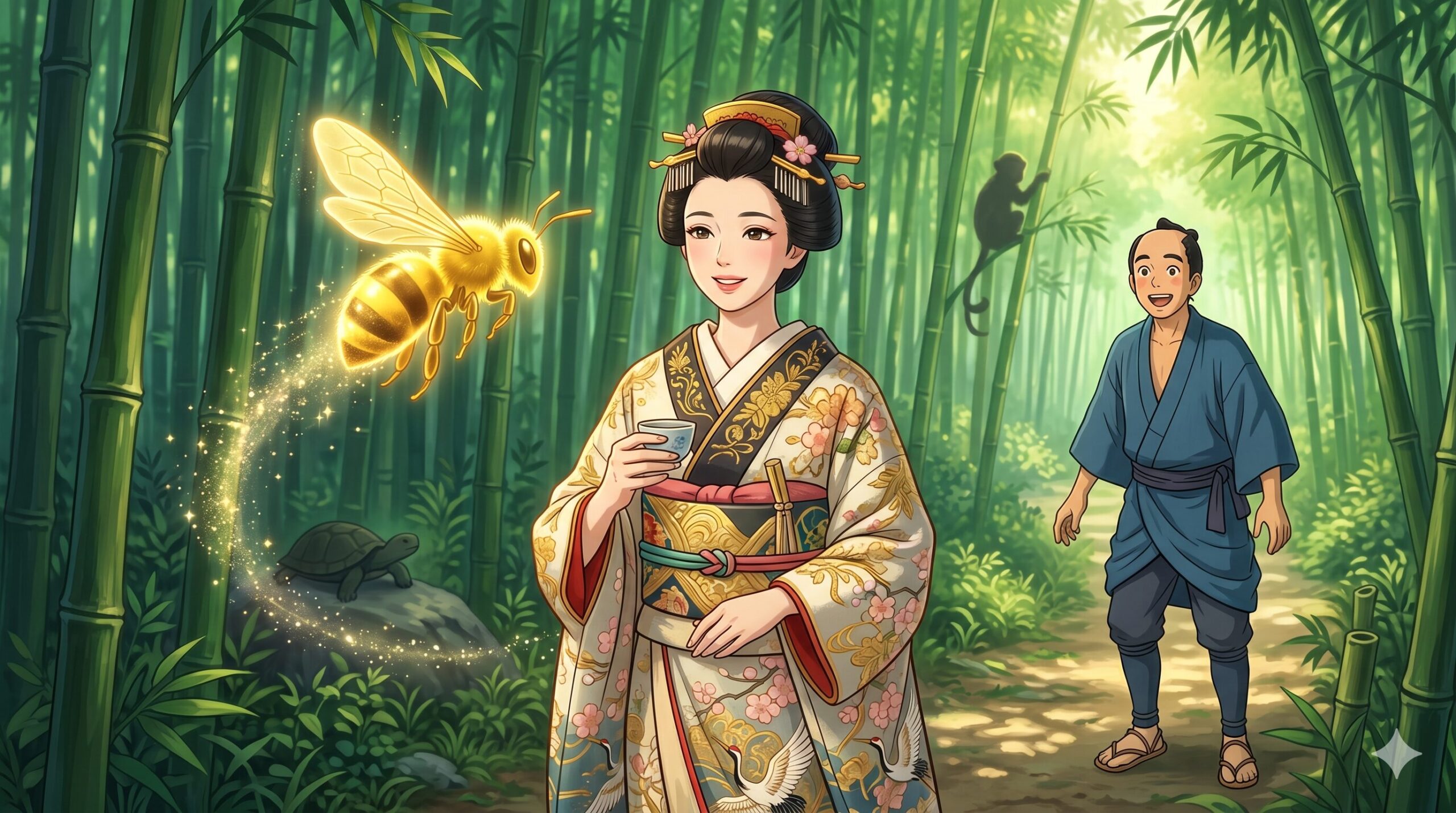
Within the rich tapestry of Japanese folklore, there are countless magical stories that resonate with people all over the world. Today, we introduce a particularly unique and heartwarming folktale called “Bunbun Shaku ni Sase” (Let the Buzzing Bee Pour the Sake). Behind this slightly quirky title lies a profound respect for nature and important life lessons that the Japanese have cherished since ancient times. Let us travel back in time to an old Japanese village.
1. The Story: A Lazy Man’s Mysterious Journey and Animal Gratitude
Once upon a time, in a certain village, there lived a young orphaned man. He despised hard work and spent his days wandering aimlessly, earning him the reputation of a lazy idler. One day, to decide his life’s path, he stood a needle in the ground and tossed a coin. The needle fell pointing West. Just to be sure, he prayed, “Gods of heaven, please show me the direction to success,” and threw the coin again. The needle fell West once more. Believing this to be his destiny, the young man set off on a journey westward.
As he walked along the road, he came across some children bullying a small turtle. Feeling pity for the creature, he gave the children some of his precious coins to set the turtle free. Continuing his journey, he encountered children tormenting a large hornet (bee). He paid money here as well and saved the bee. A little further down the road, he found a monkey being abused by children. Without hesitation, he handed over his very last coins to rescue the monkey. He had saved three lives, but in return, he was left completely penniless.
Walking dejectedly, he met a mysterious old woman. “Where are you from?” she asked. Trying to show off, he lied, “I am a man from above the clouds.” The old woman then told him, “In the next village, the daughter of a rich man (Choja) is suffering from a severe illness. In the middle of the river stands a giant camphor tree with a bush warbler’s nest. If you feed her 15 eggs from that nest, she will be cured, and you can become her husband.”
When the young man reached the village, he saw the giant tree in the middle of a raging river. The current was far too fast for him to cross. As he stood there at a loss, the monkey he had saved suddenly appeared. “My savior, what troubles you?” Hearing the situation, the monkey called for the turtle. Riding on the turtle’s back, the monkey effortlessly crossed the rapids, climbed the giant tree, and successfully retrieved the 15 bush warbler eggs.
The young man took the eggs to the rich man’s house. As soon as the daughter ate them, she miraculously recovered from her illness. The rich man was overjoyed, but he soon felt reluctant to give his precious daughter to a dirty, unknown man in rags. So, the rich man devised a cruel test. He lined up 13 beautiful women—his daughter and 12 beautiful maids—all wearing identical stunning kimonos with their faces hidden. He declared, “I will give my daughter to you, but only if you pour a cup of sake for the right one.”
The young man was in a cold sweat. He had no idea who the real daughter was. Just as he was about to give up, a bee flew in from nowhere. It buzzed around the head of one specific woman, whispering with its wings, “Bunbun, shaku ni sase” (Buzz buzz, pour it here). Taking a leap of faith, the young man poured the sake into that woman’s cup. Miraculously, she was the true daughter of the rich man! As promised, the young man married the beautiful daughter, dressed in fine clothes, and having changed his lazy ways, they lived happily ever after.
2. Analysis: Why Did the Lazy Man Succeed?
The most fascinating aspect of this story is that the protagonist is not a flawless hero from the start. He is a lazy man who hates working and even lies to an old woman. While Western fairy tales often feature perfect knights or princes achieving success, Japanese folktales frequently depict imperfect, relatable characters who eventually grasp good fortune.
So, why did he succeed? It was because he possessed a pure heart capable of empathizing with the pain of others, prioritizing their lives over his own gain. The unconditional love he showed by risking absolute poverty to save the tiny lives of a turtle, a bee, and a monkey was the key that drastically changed his destiny. Furthermore, the rich man’s final test—finding the true daughter among 13 women—serves as a metaphor for the ability to see hidden truths rather than being blinded by outward appearances. The young man overcame this trial not through his own power, but through the “seeds of goodwill” he had sown in the past.
3. Connection to Japanese Culture: “Ongaeshi” and Animism
There are two core elements of Japanese culture that can be decoded from this story. The first is the spirit of “Ongaeshi” (Repayment of kindness). In Japan, the moral concept that “one must never forget a favor received and must always repay it” is deeply rooted in society. Similar to other famous tales like “The Crane’s Return of Favor,” the way these animals risk their lives to repay a human’s kindness reflects the traditional Japanese aesthetics of duty and compassion.
The second is the concept of Animism. In Japanese Shinto belief, humans, animals, and nature are seen as equal entities, and it is believed that spirits reside in all living things. The depiction of a turtle, a bee, and a monkey feeling gratitude and using their unique wisdom to help a human perfectly illustrates the unique Japanese view of nature, where the natural world and human world are deeply interconnected. Moreover, the mysterious old woman who offered advice can be interpreted as an avatar of a deity watching over the human realm.
4. What Would You Do?
Now, how did you feel after reading this story? If you were in the young man’s shoes, would you be able to give up all your money to save bullied little animals? Or would you choose to protect your wealth, worrying about your own future?
In modern society, immediate profit and efficiency are often prioritized. However, the tale of “Bunbun Shaku ni Sase” poses a timeless question: selfless kindness will eventually come full circle and enrich your own life. We would love to hear your thoughts. The next time you encounter a small insect or animal, how will you treat them?
Learn more about the Japanese culture of “Ongaeshi”:
Understanding Japanese Values (Wikipedia)
Read more enchanting Japanese folktales:
Explore the Japanese Folktale Series
日本昔話「ぶんぶん酌にさせ」:動物たちの恩返しと運命の選択
日本の豊かな民間伝承には、世界中の人々の心を打つ魔法のような物語が無数に存在します。今回は、その中でも特にユニークで心温まる昔話「ぶんぶん酌にさせ(Bunbun Shaku ni Sase)」をご紹介します。この少し変わったタイトルの物語には、日本人が古くから大切にしてきた自然への敬意や、人生を切り開くための重要な教訓が隠されています。それでは、時空を超えて日本の古い村へと旅に出ましょう。
1. 昔話のストーリー:怠け者の不思議な旅と恩返し
昔々、ある村に身寄りのない一人の若い男がいました。彼は働くことを嫌い、毎日ぶらぶらと過ごす「怠け者」でした。ある日のこと、彼は自分の人生の行く末を決めるため、地面に一本の針を立ててお金を投げました。すると針は西の方角へと倒れました。念のために「天の神様、私が出世できる方角を教えてください」と祈ってもう一度投げると、やはり針は西に倒れました。これを運命だと信じた怠け者は、西へ西へと旅に出ることにしました。
道を歩いていると、子どもたちが小さな亀をいじめているのに出くわしました。かわいそうに思った彼は、なけなしの銭を子どもたちに渡して亀を逃がしてやりました。さらに歩を進めると、今度は子どもたちが大きな蜂(獅子蜂)を捕まえていじめています。彼はここでも銭を払い、蜂を助けました。またしばらく行くと、今度は猿が子どもたちにいじめられています。彼は残っていたすべてのお金を差し出し、猿を助け出しました。こうして彼は3匹の命を救いましたが、引き換えに完全に無一文になってしまいました。
途方に暮れてトボトボと歩いていると、見知らぬ老婆に出会いました。「お前はどこの者だ」と聞かれ、見栄を張った彼は「私は雲の上から来た者です」と嘘をつきます。すると老婆はこう言いました。「この先の村に住む長者(お金持ち)の娘が、重い病気で苦しんでいる。川の真ん中にある大きな楠(くすのき)の木の上に鶯(うぐいす)の巣がある。その卵を15個食べさせれば病気は治り、娘の婿になれるだろう」と。
若者がその村へ行ってみると、確かに激しい流れの川の真ん中に巨大な楠がそびえ立っていました。しかし、川の流れが速すぎて到底渡ることができません。困り果てていると、なんと彼が助けた猿が現れました。「命の恩人よ、何を困っているのですか?」事情を聞いた猿は、すぐに亀を呼び寄せました。亀の背中に猿が乗り、激流をスイスイと渡って楠の木に登り、見事15個の鶯の卵を取ってきてくれたのです。
若者が長者の家へ行き、卵を娘に食べさせると、不思議なことに娘の病気はみるみるうちに完治しました。長者は大喜びしましたが、見ず知らずの汚い身なりの若者に大事な娘を嫁がせるのが惜しくなってしまいました。そこで長者は意地悪な試練を与えます。美しい着物を着飾った娘と12人の美しい侍女、合計13人をずらりと並べ、「この中で、お前が盃に酒を注いだ者(酌をした者)を嫁にやろう」と言ったのです。
全員が同じように美しく着飾っており、顔も隠されているため、誰が本物の娘なのか全くわかりません。若者が冷や汗を流して迷っていると、どこからともなく一匹の蜂が飛んできました。蜂は一人の女性の頭の周りを飛び回り、羽音を立てながら「ぶんぶん、酌にさせ(ここに酒を注げ)」と囁きました。若者が思い切ってその女性の盃にお酒を注ぐと、見事それが本物の長者の娘でした。約束通り若者は長者の娘を妻に迎え、立派な身なりとなって、その後は心を入れ替えて幸せに暮らしました。
2. 昔話の考察:なぜ怠け者が成功したのか?
この物語の非常に興味深い点は、主人公が最初から「立派な英雄」ではないということです。彼は働くことを嫌う怠け者であり、老婆に対しては「雲の上から来た」と嘘までついています。西洋の童話では、完全無欠の騎士や王子が成功を収めることが多いですが、日本の昔話では人間味あふれる不完全なキャラクターが幸運を掴むことがよくあります。
では、なぜ彼は成功できたのでしょうか?それは、彼が「他者の痛み」に共感し、自分の損得を後回しにして行動できる純粋な心の持ち主だったからです。無一文になるリスクを負ってまで、亀、蜂、猿という小さな命を救った無償の愛こそが、彼の運命を大きく変える鍵となりました。また、長者が約束を反故にして仕掛けた「13人の女性から本物の娘を見つけ出す」という試練は、外見や身分ではなく、見えない真実を見極める力を試すメタファーとなっています。彼は自分自身の力だけでなく、過去に蒔いた「善意の種」によってこの試練を乗り越えました。
3. 日本文化との関連:「恩返し」とアニミズムの世界
この物語から読み解ける日本文化の核心は、大きく分けて二つあります。一つ目は「恩返し(Ongaeshi)」の精神です。日本では「受けた恩は決して忘れず、必ず報いるべきだ」という道徳観念が古くから根付いています。「鶴の恩返し」などの他の有名な昔話と同様に、動物たちが人間の親切に対して命懸けで報いる姿は、日本人が理想とする義理と人情の美学を表現しています。
二つ目は「アニミズム(自然崇拝)」の考え方です。日本の神道において、人間と動物、そして自然は対等な存在であり、すべての生き物には魂が宿っていると信じられています。亀、蜂、猿が人間と同じように恩義を感じ、知恵を絞って助けに来るという描写は、自然界と人間界が深く繋がっているという日本独自の自然観を見事に表しています。また、彼に助言を与えた不思議な老婆は、実は人間界を見守る神様の化身であったとも解釈できます。
4. あなたならどうする?
さて、この物語を読んであなたはどう感じましたか?もしあなたがこの怠け者の若者の立場だったら、手持ちの全財産を投げ打って、いじめられている小さな動物たちを救うことができるでしょうか?それとも、自分の将来を案じてお金を守る道を選ぶでしょうか。
現代社会では、目先の利益や効率ばかりが重視されがちです。しかし、「ぶんぶん酌にさせ」の物語は、無償の優しさが巡り巡って自分の人生を豊かにするという、時代を超越した真理を私たちに問いかけています。ぜひ、あなたの考えを聞かせてください。次に小さな虫や動物に出会ったとき、あなたは彼らにどう接しますか?
日本の「恩返し」文化についてもっと深く知る:
恩返しの解説(Wikipedia・日本語)
他にも魅力的な日本の昔話を読む:
Japanese Folktale Series(日本の昔話シリーズ)

コメント