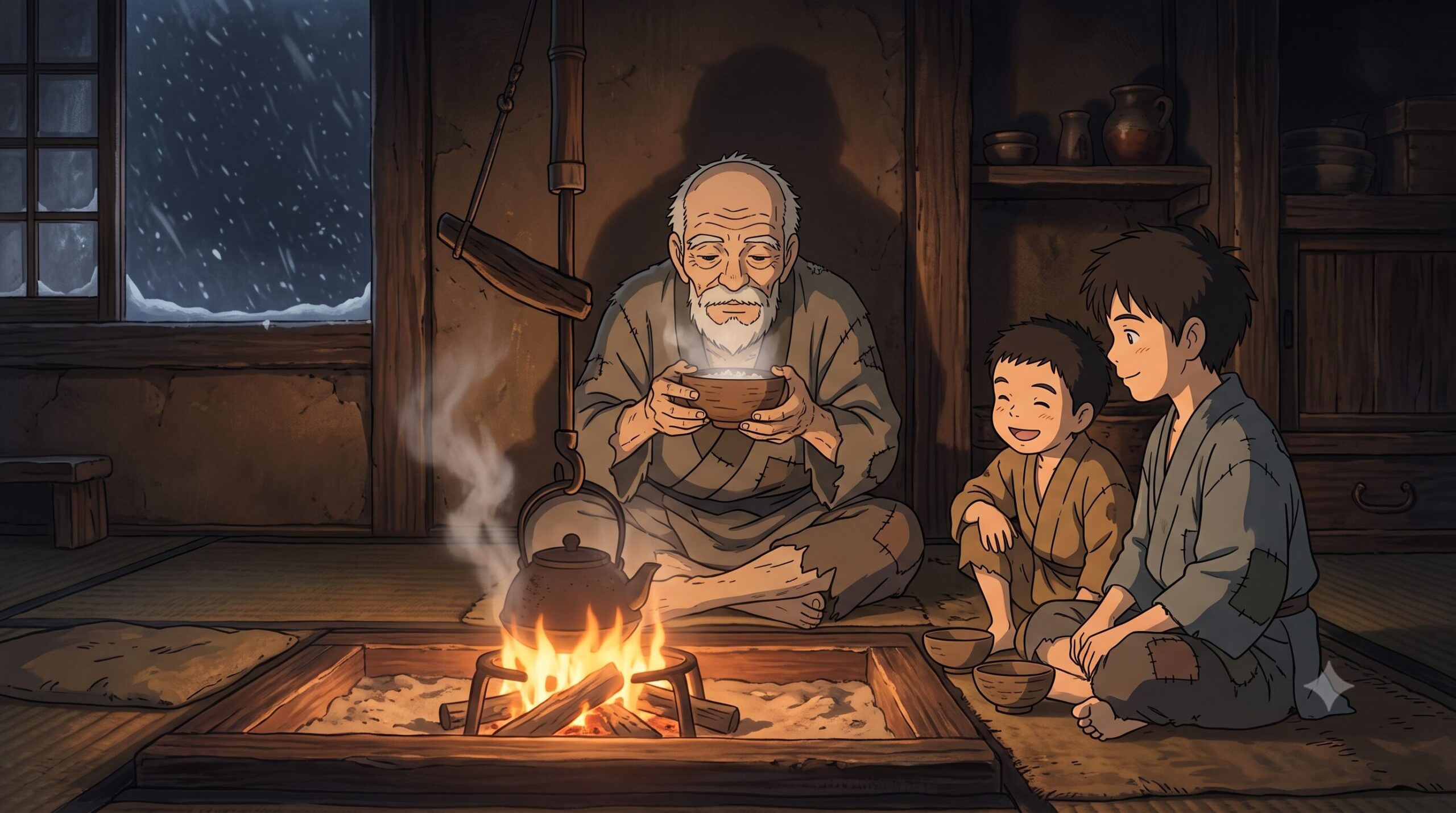
Once upon a time, deep in the snowy mountains of the Echigo province (present-day Niigata Prefecture), lived two brothers named Ichiro and Jiro. Having lost their parents at a young age, they lived quietly, helping each other survive in the harsh natural environment. The winters in Echigo were brutally severe, with snow piling up higher than a person’s height, completely burying the houses.
During the winter of one particular year, an unprecedented blizzard raged on for days. The brothers’ stored food was nearly depleted; all that remained was a small handful of millet and a few pieces of firewood. “If this snow doesn’t stop, we might not live to see the spring,” said the younger brother, Jiro, with a trembling voice. The older brother, Ichiro, hugged him tightly and encouraged him, “It will be alright. The Mountain God is surely watching over us.”
That night, mixed with the howling of the blizzard, a faint voice was heard from outside the house. When Ichiro pushed open the heavy wooden door, he found a shabby old man covered in snow, on the verge of freezing to death. Without hesitation, the brothers invited the old man inside.
“Please, warm yourself by the hearth,” they said.
Ichiro threw all their remaining firewood into the hearth to warm the room. Jiro boiled their last precious handful of millet to make warm porridge and offered it to the old man. Fighting the desperate rumbling of their own empty stomachs, the brothers warmly watched as the old man gratefully ate the porridge.
The next morning, miraculously, the blizzard had completely stopped, and brilliant morning sunlight was streaming through the clouds. When the brothers awoke, the old man was nowhere to be found. Instead, placed near the hearth was a single, glowing stone shaped like a beautiful, crystal-clear snowflake.
As the warm light emitting from the stone spread throughout the house, the deep snow surrounding their home melted in an instant. From the bare earth, fresh green butterburs and an abundance of wild mountain vegetables sprouted forth. Even though it was the dead of winter, spring had arrived only around the brothers’ house. The old man had been the Mountain God, who ruled the harsh winter mountains. The brothers’ selfless hearts and deep compassion had reached the deity.
Afterwards, the brothers did not hoard this abundant bounty of the mountains for themselves. They shared it with all the villagers who were starving because of the blizzard. The villagers were deeply grateful for the brothers’ kindness and welcomed them as the leaders of their village. It is said that Ichiro and Jiro never grew arrogant, continued to help the poor, and the village of Echigo prospered forever.
In-Depth Analysis of “Echigo Brothers”: Why Were They Saved?
The story of the “Echigo Brothers” brilliantly depicts human moral choices in extreme situations. The biggest turning point in the story is that they unconditionally offered their last remaining food and warmth—the very things keeping them alive—to a complete stranger.
When a person’s survival is threatened, the instinct for self-preservation works strongest. However, Ichiro and Jiro could not overlook the suffering of another. The brothers’ actions transcend mere “kindness”; it is “compassion accompanied by self-sacrifice.” In folktales, an entity that presents such a trial (in this case, the old man) is often a temporary form taken by gods or Buddhas to test the true hearts of humans.
If they had abandoned the old man, they might have survived for a few more days, but would eventually have succumbed to the cold and starvation. However, by giving everything to another, they ultimately gained the infinite abundance of a “miraculous spring.” This represents a profound philosophical and religious truth: “Letting go of attachment and devoting oneself to others ultimately brings the greatest reward.” The paradox of gaining not by taking, but by giving, is the core of this narrative.
Decoding Japanese Culture from the Folktale: Marebito Belief and the Spirit of Omotenashi
From this story, we can decode several crucial elements that shape Japanese spiritual culture.
First is the traditional Japanese belief in “Marebito” (sacred guests). In ancient Japan, it was believed that foreigners or unfamiliar travelers arriving from outside were sacred beings (Marebito) bringing good fortune from a distant otherworld or the realm of gods. The depiction of treating a shabby old man with reverence as a god is a classic Marebito hospitality motif in Japanese folklore. It can be said that the spirit of “Omotenashi” (Japanese hospitality), now known worldwide, originates from this deep sense of awe that “a guest might be a god in disguise.”
Second is the “coexistence with nature.” Echigo (Niigata Prefecture) is one of the heaviest snowfall regions in the world. While fearing the ferocity of nature, the people have lived with gratitude for the abundant blessings (such as delicious rice, sake, and mountain vegetables) brought by the meltwater in spring. The Mountain God in the story symbolizes the dual nature of the environment: “threat” and “blessing.” The Japanese view of nature—not trying to control it, but respecting it and living in accordance with its providence—is vividly portrayed.
How Will You Live? A Message to the Readers
How did you feel after reading this story?
In the modern society we live in, food and heating are readily available for many of us. However, at the same time, we often lose our concern for our neighbors and the emotional capacity to help strangers.
If you were in the extreme cold and starvation like Ichiro and Jiro, would you be able to share your last meal with an unfamiliar stranger?
And to make the “snowflake” within your own heart shine, what kind of kindness can you offer to someone today?
Please, take a moment to converse with your own heart.
Related Links
- Read more Japanese Folktale Series
- Discover the beautiful nature of Niigata (Echigo), the setting of the story (JNTO Official Guide)
日本の雪国に伝わる心温まる物語「越後の兄弟」
昔々、雪深い越後の国(現在の新潟県)の山奥に、一郎と次郎という兄弟が住んでいました。彼らは幼い頃に両親を亡くし、厳しい自然の中で互いに助け合いながらひっそりと暮らしていました。越後の冬は非常に厳しく、背丈を超えるほどの雪が降り積もり、家々は雪に埋もれてしまうほどでした。
ある年の冬、例年にない大吹雪が何日も続きました。兄弟の蓄えていた食料も底をつきかけ、残るはほんの一握りの粟(あわ)と、数本の薪だけになってしまいました。「この雪がやまなければ、僕たちは春を迎えることができないかもしれないね」と、弟の次郎が震える声で言いました。兄の一郎は弟を力強く抱きしめ、「大丈夫だ。きっと山の神様が見守ってくださる」と励ましました。
その夜、猛吹雪の音に混じって、家の外からかすかな声が聞こえてきました。一郎が重い戸を押し開けると、そこには雪にまみれ、今にも凍え死にそうなみすぼらしい老人が倒れていました。兄弟は迷うことなく老人を家の中に招き入れました。
「さあ、囲炉裏の火に当たってください」
一郎は残っていた全ての薪を囲炉裏にくべ、部屋を暖めました。そして次郎は、自分たちの最後の大切な食料である一握りの粟を煮て、温かいお粥を作り、老人に差し出しました。兄弟は自分たちの腹の虫が鳴くのを必死に堪えながら、老人が美味しそうにお粥をすする姿を温かく見守りました。
翌朝、不思議なことに吹雪はすっかりやみ、雲の隙間から眩しい朝日が差し込んでいました。兄弟が目を覚ますと、そこには老人の姿はありませんでした。代わりに、囲炉裏のそばに、透き通るような美しい氷の結晶の形をした光り輝く石が一つ置かれていました。
その石から放たれる温かい光が家中に広がると、家の周りに積もっていた雪があっという間に溶け出し、土の中から青々としたふきのとうや、豊かな山の恵みが次々と顔を出しました。真冬であるにもかかわらず、兄弟の家の周りだけが春を迎えたのです。あの老人は、厳しい冬の山を司る山の神様だったのです。兄弟の無私の心と深い愛情が、神様に通じたのでした。
その後、兄弟はその豊かな山の恵みを自分たちだけで独占することなく、吹雪で飢えていた村の人々全員に分け与えました。村人たちは兄弟の優しさに深く感謝し、彼らを村の長として迎え入れました。一郎と次郎はその後も決して驕ることなく、貧しい人々を助け、越後の村はいつまでも豊かに栄えたと伝えられています。
「越後の兄弟」の深い考察:なぜ彼らは救われたのか
この「越後の兄弟」という物語は、極限状態における人間の道徳的選択を見事に描き出しています。物語の最大の転換点は、自分たちの命をつなぐための最後の食料と暖を、見ず知らずの老人に無条件で提供したという点です。
人間は、自分の生存が脅かされている時、自己保存の欲求が最も強く働きます。しかし一郎と次郎は、他者の苦痛を見過ごすことができませんでした。この兄弟の行動は、単なる「親切」を超えた「自己犠牲を伴う慈愛」です。昔話において、このような試練を与える存在(ここでは老人)は、神仏が人間の真の心を試すための仮の姿であることが多くあります。
もし彼らが老人を見捨てていれば、数日生き延びることはできたかもしれませんが、やがて寒さと飢えで命を落としていたでしょう。しかし、彼らがすべてを他者に与えたことで、結果的に「奇跡の春」という無限の豊かさを手に入れました。これは、「執着を捨て、他者のために尽くすことが、結果として最大の報いをもたらす」という深い哲学的・宗教的な真理を表しています。与えることで失うのではなく、与えることで得られるというパラドックスが、この物語の核心です。
昔話から読み解く日本文化:マレビト信仰とおもてなしの心
この物語からは、日本の精神文化を形作るいくつかの重要な要素を読み解くことができます。
第一に、日本の伝統的な「マレビト(稀人)信仰」です。古代日本において、外からやってくる異邦人や見知らぬ旅人は、遠い異界や神の国から福をもたらす神聖な存在(マレビト)であると信じられていました。みすぼらしい姿の老人を神として丁重に扱う描写は、日本の民俗学における典型的なマレビト歓待のモチーフです。現在世界中で知られている日本の「おもてなし(Omotenashi)」の精神は、この「客人は神様かもしれない」という深い畏敬の念から端を発していると言えます。
第二に、「自然との共生」です。越後(新潟県)は世界有数の豪雪地帯です。人々は自然の猛威を恐れながらも、春になれば雪解け水がもたらす豊かな恩恵(美味しい米や酒、山菜など)に感謝して生きてきました。物語に登場する山の神は、自然の「脅威」と「恩恵」の二面性を象徴しています。自然をコントロールするのではなく、畏れ敬い、自然の摂理に合わせて生きるという日本人の自然観が鮮明に描かれています。
あなたはどう生きますか?
この物語を読んで、皆様はどのように感じられたでしょうか。
私たちが生きる現代社会では、食料や暖房が当たり前のように手に入りますが、その一方で、隣人への関心や、見知らぬ人を助けるという心の余裕を失いがちです。
もしあなたが、一郎と次郎のように極限の寒さと飢えの中にいたなら、見知らぬ他者に最後のご飯を分け与えることができますか?
そして、あなたの心の中にある「氷の結晶」を輝かせるために、今日、誰にどのような優しさを与えることができるでしょうか。
ぜひ、あなた自身の心と対話してみてください。
コメント