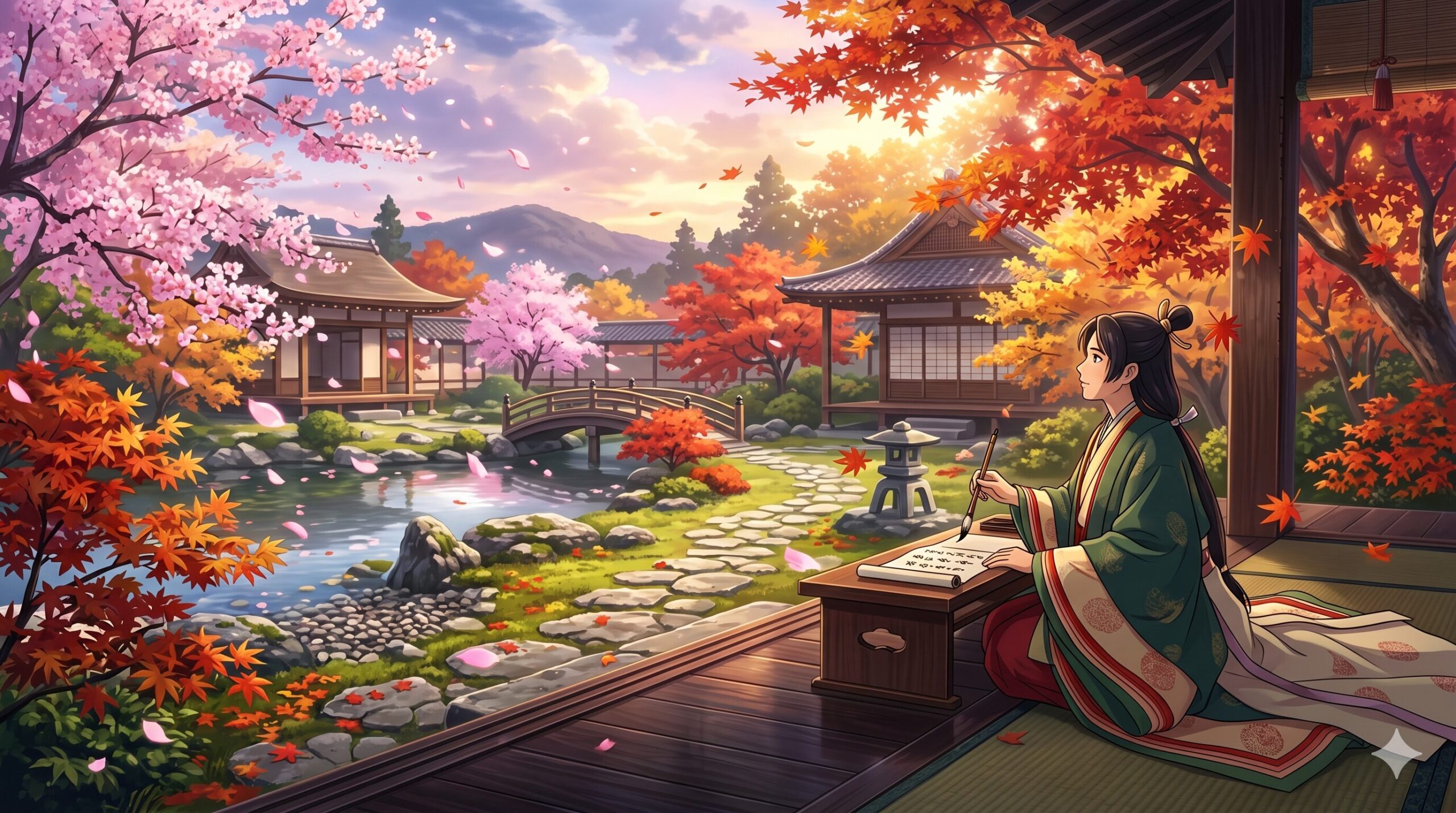
May 29, 905 (the 5th year of the Engi era) marks a defining moment that shaped the history of Japanese literature and the very soul of the Japanese people. On this day, the Kokin Wakashu (Collection of Japanese Poems of Ancient and Modern Times)—Japan’s first imperial anthology of waka poetry compiled by order of Emperor Daigo—was officially presented to the throne.
The delicate sensitivity to the seasons that we naturally associate with Japan today—such as lamenting the falling of cherry blossoms in spring or feeling a deep, quiet melancholy while viewing autumn leaves—was largely systematized and firmly established by the Kokin Wakashu. This day is not merely the anniversary of an old book’s completion; it is a monumental day when Japan’s unique aesthetic consciousness was clearly defined.
Historical Background: From Chinese Poetry to Native “Waka”
In the early Heian period, the foundation of education in Japanese aristocratic society was Kanshi (Chinese poetry). In official settings, Chinese poetry, written according to Chinese grammatical rules, was highly respected, while Japan’s native linguistic expression was mostly relegated to personal letters and casual, daily exchanges.
However, from the late 9th to the 10th century, a “Kokufu” (national style) culture blossomed, re-evaluating and celebrating unique Japanese cultural forms. The compilation of the Kokin Wakashu was the symbolic pinnacle of this movement. Four outstanding poets—Ki no Tsurayuki, Ki no Tomonori, Oshikochi no Mitsune, and Mibu no Tadamine—acted as compilers, carefully selecting roughly 1,111 exceptional waka poems. This elevated waka to a public literary art form equal to, or even surpassing, Chinese poetry in cultural value.
The Greatness of Ki no Tsurayuki’s “Kana Preface”
At the beginning of the Kokin Wakashu is the “Kanajo” (Kana Preface), written by Ki no Tsurayuki in the native phonetic hiragana script. This preface begins with a profoundly famous opening line:
“The poetry of Japan takes the human heart as its seed and flourishes into a myriad of leaves of words.”
Tsurayuki declared that poetry is not something created only by privileged intellectuals. Rather, it naturally spills from the lips of people when they are moved by the beauty of nature—flowers, birds, wind, and the moon—or when they suffer the pangs of love. This serves as a brilliant definition of poetry even in the context of world literature and became the underlying philosophy of Japanese literature.
Decoding Japanese Culture and Spirit from the Kokin Wakashu
The Changing Seasons and “Mono no Aware”
The Kokin Wakashu consists of 20 volumes. Poems about the four seasons (Spring, Summer, Autumn, Winter) make up about one-third of the collection, and poems about “Love” occupy another five volumes. This method of categorization decisively structured the Japanese view of nature.
For example, spring poems do not merely state the fact that “flowers have bloomed.” They meticulously capture the passage of time and emotional shifts: the eager anticipation of swelling buds, the breathtaking beauty of full bloom, and the fleeting sorrow as petals scatter in the wind. The view of impermanence (Mujōkan)—the idea that beauty holds value precisely because it does not last forever—and the deeply resonant emotion born from it, known as “Mono no Aware” (the pathos of things), originated right here.
The DNA Passed Down to Modern Pop Culture
The aesthetic values established by the Kokin Wakashu remain alive in modern Japanese culture, traversing over a thousand years of time. In contemporary anime and manga, the technique of expressing a character’s emotional changes through scenery—like dancing cherry blossom petals or cold autumn rain—is the exact same artistic technique utilized in waka poetry.
The uniquely Japanese communication style of not explaining everything with direct words, but rather entrusting one’s feelings to the natural landscape and allowing the other person to infer them, is also an influence of waka culture. We unconsciously view the world through the filter created by the Kokin Wakashu.
How Would You Express Your Emotions?
People over a thousand years ago were exactly like us today. They were deeply moved by beautiful scenery, spent sleepless nights longing for the ones they loved, and condensed those overflowing emotions into short verses (the 5-7-5-7-7 syllable structure) to share with others.
Today, we live in an era where we can instantly share photos and videos on social media. But if you had to convey the beautiful landscape in front of you, or the movements of your heart, using *only words* to the world right now, what words would you choose? I encourage you to search for the “myriad of leaves of words” within your own heart. Your words, too, have the power to become a seed that moves someone else’s soul.
References and Related Articles
- Internal Link: Read more from the “What’s Today’s Special Day?” Series
- External Link: Wikipedia: Kokin Wakashū
5月29日:日本人の美意識を決定づけた『古今和歌集』奏上の日
905年(延喜5年)5月29日、日本の文学史、そして日本人の心そのものを形作る決定的な出来事がありました。醍醐天皇の命により編纂された日本初の勅撰和歌集(天皇の命で作られた公式な詩歌集)である『古今和歌集(こきんわかしゅう)』が奏上された日です。
現代の私たちが当たり前のように感じている「春の桜の散り際を惜しむ心」や「秋の紅葉に感じる哀愁」といった季節に対する繊細な感情は、実はこの『古今和歌集』によって体系化され、定着したと言っても過言ではありません。この日は単なる古い本が完成した日ではなく、日本独自の美意識が明確に定義された記念碑的な日なのです。
歴史的背景:漢詩から「和歌」の時代へ
平安時代初期、日本の貴族社会における教養の基本は「漢詩(中国の詩)」でした。公的な場では中国語の文法に則った漢詩が重んじられ、日本独自の言語表現は個人的な手紙や日常のやり取りなどに留まっていました。
しかし、9世紀末から10世紀にかけて、日本独自の文化を見直す「国風文化」が花開きます。その象徴的な出来事が『古今和歌集』の編纂でした。紀貫之(きのつらゆき)、紀友則(きのとものり)、凡河内躬恒(おおしこうちのみつね)、壬生忠岑(みぶのただみね)という4人の優れた歌人が選者となり、約1,111首の優れた和歌が厳選されました。これにより、和歌は漢詩と対等、あるいはそれ以上の価値を持つ公的な文学として認知されることになったのです。
紀貫之が記した「仮名序」の偉大さ
『古今和歌集』の冒頭には、紀貫之がひらがな(仮名)で書いた序文「仮名序(かなじょ)」が置かれています。この序文は、次の一文から始まります。
「やまとうたは、人の心を種として、よろづの言の葉とぞなれりける」
(日本の和歌は、人間の心を種として、何万もの言葉の葉となったものである)
貫之は、詩とは特別な知識人だけが作るものではなく、人が花鳥風月を見て感動したり、恋をして心を痛めたりした時に自然と口からこぼれ落ちるものであると宣言しました。これは世界文学の歴史においても見事な「詩の定義」であり、日本文学の根底に流れる哲学となりました。
『古今和歌集』から読み解く、日本の文化と精神
四季の移ろいと「もののあわれ」
『古今和歌集』は全20巻から構成されていますが、その中でも「春・夏・秋・冬」の四季の歌が全体の約3分の1を占め、さらに「恋」の歌が5巻分を占めています。この分類方法こそが、日本人の自然観を決定づけました。
例えば、春の歌は単に「花が咲いた」という事実を歌うのではなく、「つぼみが膨らむ待ち遠しさ」「満開の桜の美しさ」「そして風に散っていく儚さ」という時間の経過と感情の動きを細やかに切り取っています。美しさは永遠に続かないからこそ価値があるという「無常観」や、そこから生まれる深いしみじみとした感情「もののあわれ」の精神は、ここから生まれました。
現代のポップカルチャーへと続くDNA
この『古今和歌集』が確立した美意識は、千年以上の時を超えて現代の日本文化に息づいています。現代のアニメや漫画において、登場人物の心情の変化を「桜の舞い散る描写」や「秋の冷たい雨」などの風景で表現する演出は、まさに和歌の技法そのものです。
言葉にして全てを説明するのではなく、自然の風景に感情を託して相手に察してもらうという日本特有のコミュニケーションスタイルも、和歌の文化がもたらした影響です。私たちは無意識のうちに、『古今和歌集』のフィルターを通して世界を見ているのです。
あなたなら、この感情をどう表現しますか?
千年前の人々も、現代の私たちと同じように、美しい景色に感動し、愛する人を想って眠れぬ夜を過ごし、そしてそのあふれる感情を短い言葉(五・七・五・七・七)に込めて共有しました。
現代はSNSで瞬時に写真や動画を共有できる時代ですが、もしあなたが今、言葉だけで目の前の美しい風景や心の動きを世界に伝えるとしたら、どんな言葉を選びますか? ぜひ、あなたの心の中にある「よろづの言の葉」を探してみてください。あなたの言葉もまた、誰かの心を震わせる種になるはずです。
参考リンク・関連記事
- 内部リンク:今日は何の日シリーズをもっと読む
- 外部リンク:Wikipedia: Kokin Wakashū

コメント