① The Story of the “Inoko Matsuri” (Boar Festival)
Once upon a time, in a village surrounded by abundant nature in Amakusa, Kumamoto Prefecture, lived a deeply greedy moneylending landlord and his beautiful daughter. On the landlord’s vast property sat a massive boulder. The landlord found this boulder incredibly annoying and tried many times to move it, but it was impossible for human strength to budge. Frustrated by the boulder’s presence, the landlord came up with a wild idea one day.
“Whoever can move that massive boulder shall have my beautiful daughter as his bride!” he announced throughout the village. However, perhaps because the daughter’s bad personality was well-known, or because the villagers despised the landlord’s greed, not a single human came forward. Astonishingly, the only one who showed up was a single, giant wild boar.
The landlord’s pride could never allow a wild beast to take his daughter as a bride. Furious, he raised the stakes and announced again, “Whoever moves the rock will get not only my daughter but my entire fortune!” A massive fortune changes everything. This time, strong men boasting of their physical prowess gathered from all over the village and even from distant lands.
Yet, no matter how hard the muscular giants tried, the boulder did not move an inch. As the men gave up one after another, the giant boar that had remained until the end charged at the boulder and brilliantly moved it out of the way. A promise is a promise. Even the stubborn landlord could not refuse now. Reluctantly, in tears, he dressed his daughter in a gorgeous bridal kimono and sent her off to marry the boar.
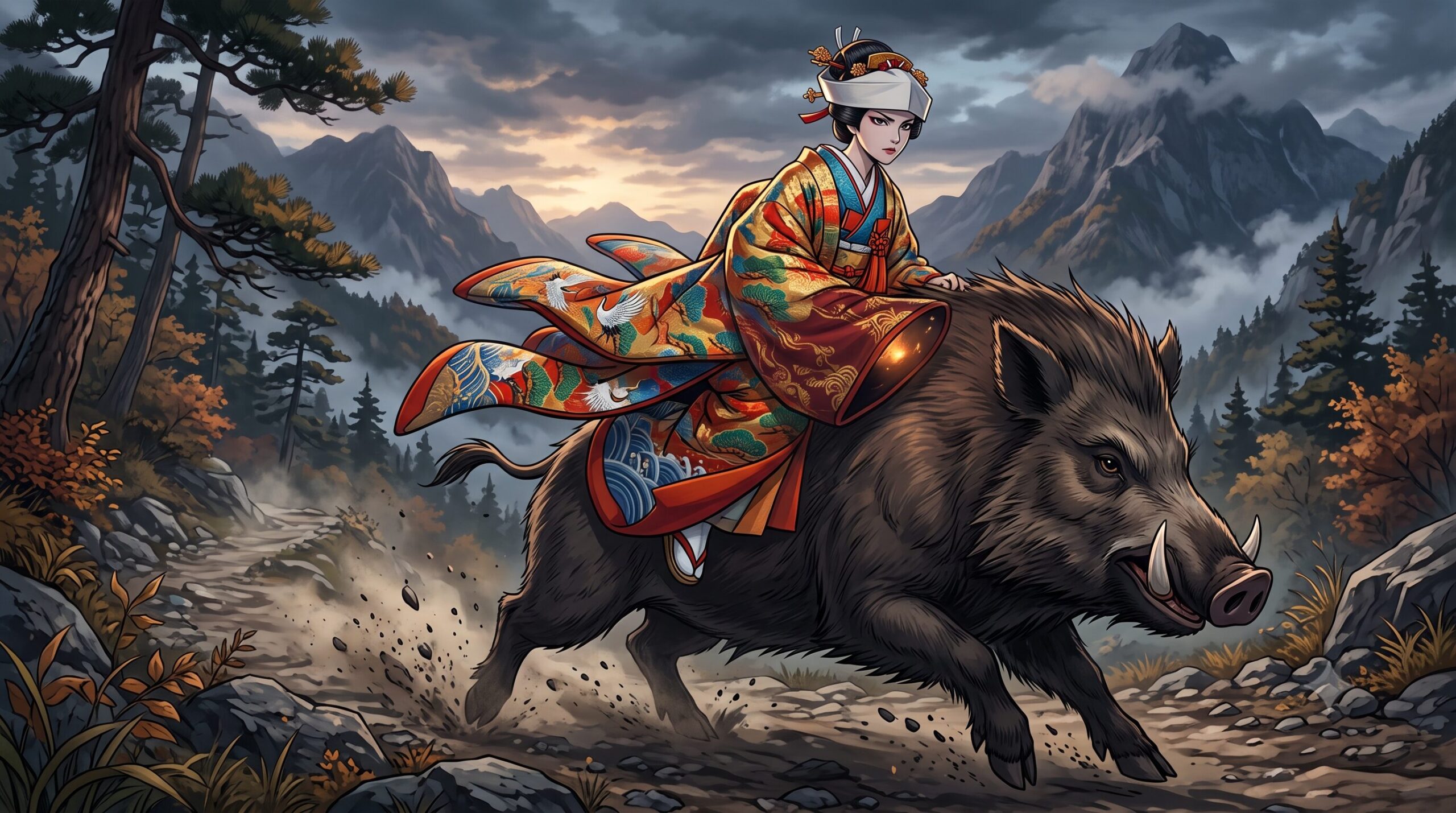
The boar, overjoyed at winning a beautiful bride, was ecstatic. He placed the beautiful daughter on his broad back and triumphantly began to run towards his home deep in the mountains. However, the feelings of the daughter riding on his back were entirely different. She absolutely refused to become the wife of a beast.
After running towards the mountains for a while, the daughter pulled out a flint she had hidden in the sleeve of her kimono. Cold-bloodedly, she set fire to the straw that was spread across the boar’s back. The fire spread in the blink of an eye, and the boar literally became a ball of flames. Panicking from the intense heat and pain, the boar continued to run at full speed until he finally plummeted headfirst off a steep cliff and died.
Later, when the villagers heard of this tragic end, their hearts ached. “No matter what, the boar who was tricked and burned to death is far too pitiful.” To console the boar’s spirit, the villagers began holding a festival on the first “Day of the Boar” in the 10th lunar month. This is the origin of the “Inoko Matsuri” (Festival of the Boar).
② In-Depth Analysis of the Folktale “Inoko Matsuri”
This story goes far beyond the boundaries of a simple fairy tale; it sharply condemns “endless desire” and “cruel selfishness” inherent in humans. The landlord used his daughter as a prize for the selfish reason of wanting a rock removed from his land, and when the result was not to his liking, he tried to bend the rules using his wealth as bait. This is the very essence of the arrogance of those in power.
Furthermore, the daughter’s actions possess a chilling ruthlessness. Even if it was to protect herself, setting fire to the back of an innocent boar who had rightfully fulfilled the promise and was simply rejoicing is an extremely cruel method. Hidden here is the truth of how merciless human beings can be toward nature and animals.
On the other hand, the boar is a symbol of “pure existence.” He cleared the proposed conditions with legitimate strength and purely rejoiced in carrying the daughter. It was the humans who lied, manipulating the power of nature (the boar) for their convenience, and ultimately destroying it unjustly. This dynamic perfectly parallels the modern history of environmental destruction and exploitation. The fact that the villagers pitied the boar and enshrined him in a festival is a manifestation of human guilt, filled with awe and an apology toward nature.
③ Decoding Japanese Culture from the Folktale: The Intersection of Fertility and Requiem
This folktale serves as an etiological myth explaining the origins of “Inoko Matsuri,” a traditional annual event in Japan. In real Japanese history, Inoko Matsuri is an important event widely practiced, primarily in Western Japan.
On the first “Day of the Boar, Hour of the Boar” of the 10th lunar month, people eat “Inoko Mochi” (Boar Rice Cakes) made from the new harvest, praying for good health and the prosperity of their descendants. Because wild boars give birth to many piglets at once, they have been an object of worship as a symbol of fertility and multi-birth since ancient times. It also carries strong significance as a “harvest festival” where farmers who have finished the harvest give thanks to the deity of the rice paddies.
A notable aspect of Japanese culture is that “gratitude” for nature’s blessings (celebration of fertility) and “requiem” for sacrificed lives (mourning) are always two sides of the same coin. This folktale attached a uniquely Japanese emotional narrative—”a requiem for a boar that met a tragic death”—to the Inoko Matsuri, which originally came from China and evolved from a court ritual into a farmers’ harvest festival. Instead of fearing a being that died unjustly as a “vengeful ghost,” the Japanese generously enshrine it as a “god” or the “main figure of a festival.” This reflects the unique spirituality of Japan, represented by Goryo Shinko (the worship of pacifying spirits).
④ What Would You Do?
The boar, whose promise was broken and whose life was taken by deception. And the daughter, who resorted to extreme measures to escape the fate of becoming a beast’s wife. If you were a character in this story, what choice would you have made? If you were one of the villagers, would you offer prayers for the boar wrapped in flames falling from the cliff?
Japanese folktales contain deep messages that cannot easily be divided into good and evil. Through this story, please reflect on the relationship between humans and nature. Ask yourself in your heart for your own opinions and thoughts.
There are many other fascinating stories in Japanese folklore. If you wish to learn more about Japanese culture deeply, please visit the Japanese Folktale Series. Also, for detailed source information on the story in this article, please refer to the Manga Nippon Mukashibanashi Database “Inoko Matsuri”.
【日本の悲しき昔話】亥の子まつりの真実と日本文化への深い繋がり
① 昔話「亥の子まつり」の物語
昔々、豊かな自然に囲まれた熊本県の天草のある村に、たいそう欲深い金貸しの地主とその美しい娘が住んでいました。この地主の広大な土地には、巨大な大岩が鎮座していました。地主はこの大岩が邪魔で仕方がなく、動かそうと何度も試みましたが、人間の力では到底びくともしません。大岩の存在をいつも苦々しく思っていた地主は、ある日とんでもないことを思いつきます。
「あの大岩を動かした者には、私の美しい娘を嫁にやろう!」と村中に触れ回ったのです。しかし、地主の娘は性格の悪さが知れ渡っていたのか、あるいは地主の強欲さを村人が嫌っていたのか、人間は誰一人として名乗りを上げませんでした。なんと、集まってきたのは一匹の巨大なイノシシだけだったのです。
イノシシが娘を嫁にもらうなど、地主のプライドが許しません。怒り狂った地主は条件を吊り上げ、「娘だけでなく、私の全財産もくれてやる!」と再び村中に触れ回りました。全財産がもらえるとなれば話は別です。今度は村中、いや遠方からも腕に覚えのある力自慢の大男たちが大集合しました。
しかし、どんな怪力の大男が挑んでも、大岩は少しも動きません。男たちが次々と諦めていく中、最後に残ったあのイノシシが大岩に突進し、見事に大岩を動かしてしまったのです。約束は約束です。さすがの地主も今さら断るわけにはいきません。地主は泣く泣く娘に豪華な晴れ着を着せ、イノシシのもとへ嫁に出すことにしました。
見事な花嫁を手に入れたイノシシは大喜びです。美しい娘を自分の広い背中に乗せ、意気揚々と住処である深い山に向かって走り出しました。しかし、背中に乗せられた娘の心中は全く違いました。獣の嫁になるなど絶対に御免です。
山へ向かってしばらく走った所で、娘は晴れ着のたもとに隠し持っていた火打石を取り出しました。そして、冷酷にもイノシシの背中に敷かれていたワラに火を放ったのです。火は瞬く間に燃え広がり、イノシシは文字通り火だるまになりました。熱さと痛みにパニックに陥ったイノシシは、猛スピードで走り続け、最後は断崖絶壁から真っ逆さまに落ちて命を落としてしまいました。
後日、この悲惨な結末を聞いた村人たちは心を痛めました。「いくらなんでも、だまし討ちにあって焼き殺されたイノシシが可哀想すぎる」。村人たちはイノシシの霊を慰めるため、旧暦10月の最初の「亥の日」に祭りを行うようになりました。これが「亥の子まつり」の始まりです。
② 昔話「亥の子まつり」の深い考察
この物語は、表面的なおとぎ話の枠を超え、人間の持つ「果てしない欲望」と「残酷な利己主義」を鋭く告発しています。地主は自分の土地にある岩を退けたいという身勝手な理由で娘を景品にし、さらに意に沿わない結果になると財産というエサでルールを捻じ曲げようとしました。これは権力者の傲慢さそのものです。
また、娘の行動には背筋が凍るほどの冷酷さがあります。自分の身を守るためとはいえ、約束を果たして喜んでいる無垢なイノシシを、背後から火をつけて焼き殺すという手段は極めて残虐です。ここには、人間が自然や動物に対してどれほど無慈悲になれるかという真理が隠されています。
一方で、イノシシは「純粋な存在」の象徴です。提示された条件を正当な力でクリアし、ただ純粋に喜んで娘を背負いました。嘘をついたのは人間であり、自然の力(イノシシ)を人間の都合で利用し、最後には不当に破滅させるという構図は、現代の環境破壊や搾取の歴史とも重なります。村人たちがイノシシを哀れみ、祭りとして祀り上げたのは、人間の罪悪感の表れであり、自然に対する畏怖と謝罪の念が込められています。
③ 昔話から読み解く日本文化:豊穣と鎮魂の交差点
この昔話は、日本の伝統的な年中行事である「亥の子まつり(いのこまつり)」の起源を説明する由来譚(ゆらいたん)として機能しています。現実の日本の歴史において、亥の子まつりは西日本を中心に広く行われてきた重要な行事です。
旧暦10月の最初の「亥の日、亥の刻」に、新穀で作った「亥の子餅」を食べ、無病息災や子孫繁栄を祈ります。イノシシは一度にたくさんの子供を産むため、多産や豊穣の象徴として古代から信仰の対象でした。また、収穫を終えた農民たちが田の神様に感謝を捧げる「収穫祭」としての意味合いも強く持っています。
日本文化の特筆すべき点は、自然の恵みに対する「感謝(豊穣の祝い)」と、犠牲になった命に対する「鎮魂(哀悼の意)」が常に表裏一体となっていることです。この昔話は、もともと中国から伝わり宮中行事から農民の収穫祭へと変化した「亥の子まつり」に、「非業の死を遂げたイノシシへの鎮魂」という日本独自の情緒的な物語を付与しました。不条理に命を落としたものを「怨霊」として恐れるのではなく、「神」や「祭りの主役」として手厚く祀り上げるのは、御霊信仰(ごりょうしんこう)に代表される日本特有の精神性です。
④ あなたならどうしますか?
約束を反故にされ、騙し討ちで命を奪われたイノシシ。そして、獣の妻になる運命から逃れるために極端な手段に出た娘。もしあなたがこの物語の登場人物であれば、どのような選択をしたでしょうか?あなたが村人の一人であったなら、炎に包まれて崖から落ちたイノシシのために祈りを捧げますか?
日本の昔話には、このように善悪では簡単に割り切れない深いメッセージが込められています。この物語を通じて、人間と自然の関係性についてぜひ考えてみてください。あなた自身の意見や感想を、心の中で問いかけてみてください。
日本の昔話には他にも魅力的な物語が数多く存在します。さらに深く日本文化を知りたい方は、こちらのJapanese Folktale Series(日本の昔話シリーズ)をぜひご覧ください。また、本記事の物語の出典詳細については、まんが日本昔ばなし〜データベース〜「亥の子まつり」をご確認ください。
コメント