1. Once Upon a Time at “Suiton-ji” in Tokyo
Long ago, in Tokyo, there was an old temple called “Suison-ji.” A solitary monk lived there. He was a very hard worker, never missing his morning and evening Buddhist chants. In between, he spent his entire day drawing water and working in the fields. At night, exhausted, he would lay out his futon in front of the Amitabha Buddha statue and immediately fall fast asleep. It was a quiet and lonely life.
One summer night, as the monk was laying out his futon, he heard a voice from outside calling, “Sui, ton, jii.” It was very rare for anyone to visit the temple so late at night. Wondering who it could be, the monk crawled over and gently opened the paper sliding door (shoji), but there was no one there. Only the summer night breeze blew through.
Eventually, the seasons changed, and autumn arrived. On a pitch-black night with no moon, the monk thought, “That voice might come again tonight,” so he sat in front of the shoji, dozing off while waiting. Sure enough, he clearly heard, “Sui, ton, jii.” The monk hurriedly grabbed a lantern and illuminated every corner of the garden, but again, no one was there.
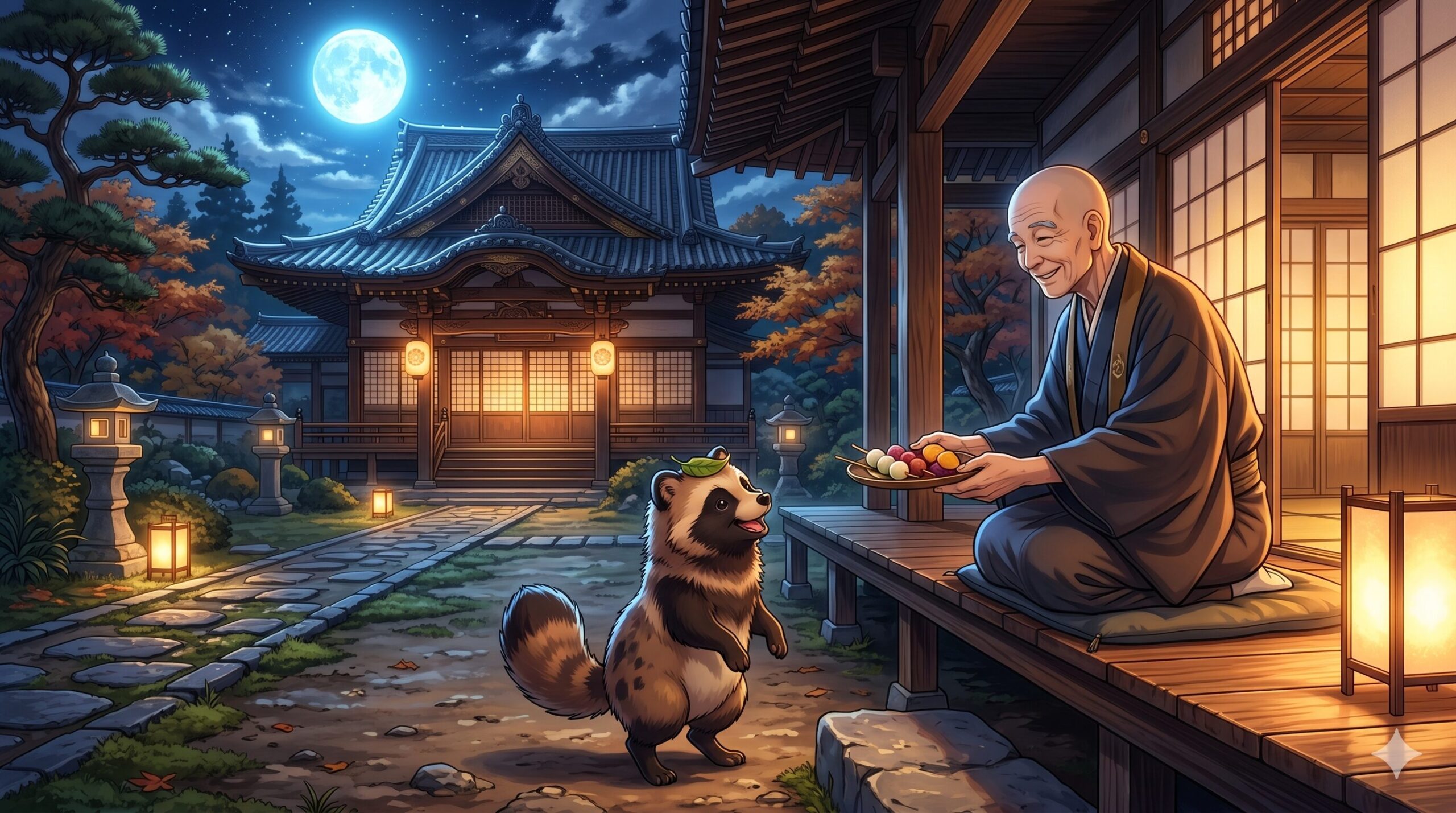
Some time passed, and it was the night of the full moon (Jugoya). Determined to uncover the mystery, the monk peeked through a small hole in the shoji and waited. To his surprise, illuminated by the moonlight, a terribly skinny tanuki (raccoon dog) appeared in the garden.
The tanuki rubbed its body against the shoji making a “sui” sound, kicked the wood with its front paws making a “ton” sound, and rubbed its tail making a “jii” sound. This poor, skinny tanuki was so hungry that it had lost its magical ability to shape-shift, and was desperately calling out to the lonely monk.
Seeing this, the monk felt deep pity. He gave the tanuki all the moon-viewing dango (dumplings), sweet potatoes, and chestnuts he had harvested from his field. The tanuki was overjoyed. From that night on, the tanuki came every evening making the “sui, ton, jii” sound, and before long, the temple became known as “Suiton-ji” (Sui-ton Temple).
2. Analysis of the “Suiton-ji” Tale
At first glance, this folktale is a simple, heartwarming story of interaction between an animal and a monk. However, a deeper analysis reveals various hidden messages.
The most notable point is that the tanuki was “so starved it couldn’t shape-shift.” In Japanese folktales, the tanuki is often depicted as a trickster who deceives people or plays pranks using magical transformations. However, the tanuki in this story is portrayed entirely as a vulnerable creature. The image of a creature of nature, stripped of its magic and relying on human compassion, reflects the harsh realities of the natural environment and wildlife.
The monk’s attitude is also crucial. It would be natural to feel fear toward an unknown, eerie sound in the dark. Yet, the monk ultimately uncovers its identity and, upon realizing it is a tanuki, gives up his own food without hesitation. A lonely monk and a lonely, starving tanuki—the process where these two lonelinesses intersect to form a bond across species beautifully expresses a spirit of tolerance, compassion, and profound kindness.
3. Connection to Japanese Culture: The Special Bond Between Tanuki and the Japanese
This story beautifully illustrates the traditional Japanese cultural view of “coexistence with nature and animals.” Japan has an ancient belief system rooted in animism (the concept of eight million gods, or Yaoyorozu no Kami), where it is believed that spirits dwell in animals, trees, and nature itself. Foxes and tanuki, in particular, have been treated either as messengers of the gods or as neighbors with very human-like emotions.
Even in modern Japan, it is very common to see ceramic tanuki statues (Shigaraki ware) placed at the entrances of restaurants. While this serves as a lucky charm for business prosperity (playing on the pun of “ta-nuki,” meaning to “surpass others”), it also shows how familiar and beloved the tanuki is to the Japanese people.
Furthermore, the food the monk gave the tanuki—dango, sweet potatoes, and chestnuts—represents the quintessential flavors of autumn in Japan. During the Jugoya (mid-autumn moon viewing), there is a custom of offering dango and taro to the moon. This indicates that the story is deeply intertwined with Japan’s beautiful four seasons and traditional annual events. The spirit of not hoarding nature’s blessings but sharing them with hungry creatures connects to the traditional Japanese culture of “Mottainai” (avoiding waste) and “Osusowake” (sharing one’s good fortune).
4. How Did You Feel?
How did you feel after reading the story of “Suiton-ji”?
If a starving, exhausted wild animal knocked on your door, what would you do? In modern society, we often find ourselves distanced from animals and nature. However, just like the monk in this story, maintaining a compassionate heart toward unknown strangers might be essential in any era. Please let me know your thoughts and what you would do if you were in the monk’s place!
Reference Links:
- Source & Detailed Folktale Data: Manga Nippon Mukashibanashi Database – Suiton-ji (Japanese)
- Read more wonderful Japanese folktales: Japanese Folktale Series
すいとん寺:心優しい和尚と痩せダヌキの温かい日本昔話
むかしむかし、東京の「すいとん寺」での不思議な出来事
昔、東京に「すいそん寺」という古いお寺がありました。そこには一人のお坊さん(和尚さん)が暮らしていました。和尚さんはとても働き者で、朝晩の仏様へのおつとめを欠かさず、その合間には水を汲んだり畑仕事をしたりと、一日中よく働きました。夜になると、疲れ果てて阿弥陀さまの前に布団を敷き、コロッと眠りに落ちる、そんな静かで孤独な毎日を送っていました。
ある夏の夜のことです。和尚さんがいつものように布団を敷いていると、外から「すい、とん、じい」と誰かが呼ぶ声が聞こえてきました。こんな夜更けにお寺に人が訪ねてくることなどめったにありません。「誰じゃろう?」と和尚さんが四つんばいのままそっと障子を開けてみましたが、そこには誰もいませんでした。ただ、夏の夜風が吹き抜けるだけでした。
やがて季節は巡り、秋になりました。月のない真っ暗闇の夜、和尚さんは「今夜、またあの声がするかもしれない」と考え、障子の前に座ってうつらうつらと待っていました。すると案の定、「すい、とん、じい」とはっきりと声が聞こえました。和尚さんは急いで提灯をぶら下げ、庭の隅々まで照らしてみましたが、やはり誰もいません。
それからしばらくたった、満月の十五夜の夜。和尚さんは今度こそ正体を突き止めようと、障子の穴から庭をじっと覗いて待っていました。すると、月明かりに照らされた庭に現れたのは、なんと一匹のひどく痩せこけたタヌキでした。
タヌキは障子に体をこすりつけて「すぅい」、前足で障子を蹴って「とん」、しっぽで障子をこすって「じい」と、体全体を使って音を出していたのです。この痩せダヌキは、お腹がすきすぎて得意の化ける術も使えなくなり、一人ぼっちの和尚さんを頼って呼んでいたのでした。
その姿を見た和尚さんは、哀れに思い、お月見用のお団子や、畑で採れたサツマイモ、栗などを残らずタヌキに持たせてやりました。タヌキはとても喜びました。それからというもの、毎晩のように「すい、とん、じい」とタヌキがやって来るようになり、いつしかこのお寺は「すいとん寺」と呼ばれるようになったということです。
「すいとん寺」の物語から読み解く考察
この昔話は、一見すると動物とお坊さんの心温まる交流を描いたシンプルな物語ですが、深く考察すると様々なメッセージが隠されています。
まず注目すべきは、「タヌキが化けられなくなるほど飢えていた」という点です。日本の昔話において、タヌキは人を化かしたり、いたずらをしたりするトリックスター(悪戯者)として描かれることが多い存在です。しかし、この物語のタヌキは完全に弱者として描かれています。魔法の力を失った自然の生き物が、人間の情けにすがる姿は、厳しい自然環境と野生動物のリアルな一面を映し出していると言えます。
また、和尚さんの態度も非常に重要です。正体のわからない不気味な音に対し、恐怖心を抱いてもおかしくない状況ですが、和尚さんは最終的に正体を突き止め、それがタヌキだとわかると迷わず自分の食料を与えます。孤独な和尚さんと、孤独で飢えたタヌキ。二つの孤独が交わり、種族を超えた絆が生まれるプロセスは、他者を受け入れる寛容さと慈愛の精神を見事に表現しています。
日本文化との関連:タヌキと日本人の特別な関係
この物語から読み取れるのは、日本特有の「自然や動物との共生」という文化観です。日本では古くから「アニミズム(八百万の神)」の信仰があり、動物や草木にも魂が宿ると考えられてきました。特にタヌキやキツネは、神の使いであったり、あるいは人間臭い感情を持った隣人として扱われてきました。
現代の日本でも、飲食店の入り口に「信楽焼(しがらきやき)」のタヌキの置物が置かれているのをよく見かけます。これは「他を抜く(商売繁盛)」という縁起物としての意味もありますが、同時に日本人にとってタヌキがどれほど親しみ深い存在であるかを示しています。
さらに、和尚さんがタヌキに与えた「お団子、芋、栗」は、日本の秋の代表的な味覚です。特に十五夜(中秋の名月)にはお団子や里芋をお供えする風習があり、この物語は日本の美しい四季と伝統的な年中行事を背景にしていることがわかります。自然の恵みを独り占めするのではなく、飢えた生き物にも分け与えるという精神は、日本の伝統的な「もったいない」や「おすそ分け」の文化にも通じています。
あなたはどう感じましたか?
この「すいとん寺」の物語を読んで、あなたはどのように感じましたか?
もしあなたの家の扉を、飢えて力尽きそうな野生動物がノックしたとしたら、あなたはどうするでしょうか? 現代社会では動物との自然との距離が遠くなりがちですが、この和尚さんのように、見知らぬ他者に対して思いやりの心を持ち続けることは、いつの時代も大切なのかもしれません。ぜひ、あなたの感想や、「自分ならこうする!」というご意見をコメントで聞かせてください。
参考リンク:
- 出典元・詳細な昔話のデータ:まんが日本昔ばなし〜データベース〜 すいとん寺
- 他の素晴らしい日本の昔話も読む:Japanese Folktale Series (当ブログカテゴリー)
コメント