Chapter 1: The Terror Lurking in the Mountains of Izu and the “Red Moons”
Once upon a time in Kai Province (modern-day Yamanashi Prefecture), there lived a hunter renowned for having the finest archery skills in the land. One day, the hunter spotted a magnificent giant deer. Deeply engrossed in tracking it, he wandered far away into the remote, deep mountains of Izu (modern-day Shizuoka Prefecture).
Upon arriving at an unfamiliar village, the villagers noticed his exceptional physique and the splendid bow he carried on his back. Clinging to him in desperation, they presented a matter of life and death.
“Please, won’t you save our village? A terrifying monster has taken residence at Basara Pass, located between our village and the next,” they pleaded.
According to the villagers, many people were being swallowed by a mysterious monster at the pass when night fell, disappearing without a trace. Tragically, on the nights when victims were taken, an eerie phenomenon occurred: “Two Red Moons” would float in the dark sky. There should only be one moon in the night sky. The appearance of two red moons meant certain death. Trembling with fear, the villagers spent their days unable to step a single foot outside their homes after dark.
Chapter 2: The Master Hunter’s Challenge and Tragedy
Possessing a strong sense of justice and absolute confidence in his archery skills, the hunter willingly accepted the villagers’ heartbreaking plea. With his bow and arrows in hand, he headed toward the deadly Basara Pass, silently waiting for nightfall as the cold wind howled around him.
Eventually, the sun set, and a deep darkness enveloped the pass. Just as the villagers had described, “Two Red Moons” glowing ominously in the pitch-black void slowly emerged. Without a shred of fear, the hunter took aim precisely at the center space between the two moons and fired a powerful arrow.
Unbelievably, his lethal arrow was repelled by something incredibly hard. Enraged, the two red moons rapidly closed the distance toward the hunter. With no time to escape, the master hunter was swallowed by the monster in the darkness, never to return.
Chapter 3: To Avenge Their Father: The Sisters’ Cruel Training
The hunter had left behind two beautiful daughters in his hometown of Kai. The older sister was named Komatsu, and the younger was Kosugi. The villagers traveled all the way to Kai Province to inform the sisters of their father’s tragic death, apologizing through their tears.
The sorrow of Komatsu and Kosugi upon learning of their beloved father’s death was immeasurable. However, they did not just collapse in tears. From the very next day, the two sisters began grueling, blood-sweating archery training to avenge their father. Day after day, from dawn till dusk, they endlessly drew their bows. Their hands blistered, tore, and bled. Yet, they never gave up, continuing to hone their skills with a terrifying obsession.
Then came the autumn of their second year. The sisters were finally fully prepared and headed for Basara Pass with a resolute determination to face death. The villagers desperately tried to stop them, saying, “Even your highly skilled father was no match for it. It’s suicide for young girls like you to go!” But the sisters’ resolve was as hard as steel and never wavered. They had prepared exactly “one” arrow each. The arrowheads were custom-made of steel and coated heavily with a lethal poison.
Chapter 4: The Death Match at Basara Pass: The True Identity of the Red Moons
Night fell on Basara Pass. The sisters hid in the shadows of cold rocks, holding their breath as they waited for the monster. Soon, the air froze, and from the depths of the darkness, those eerie “Two Red Moons” floated into view.
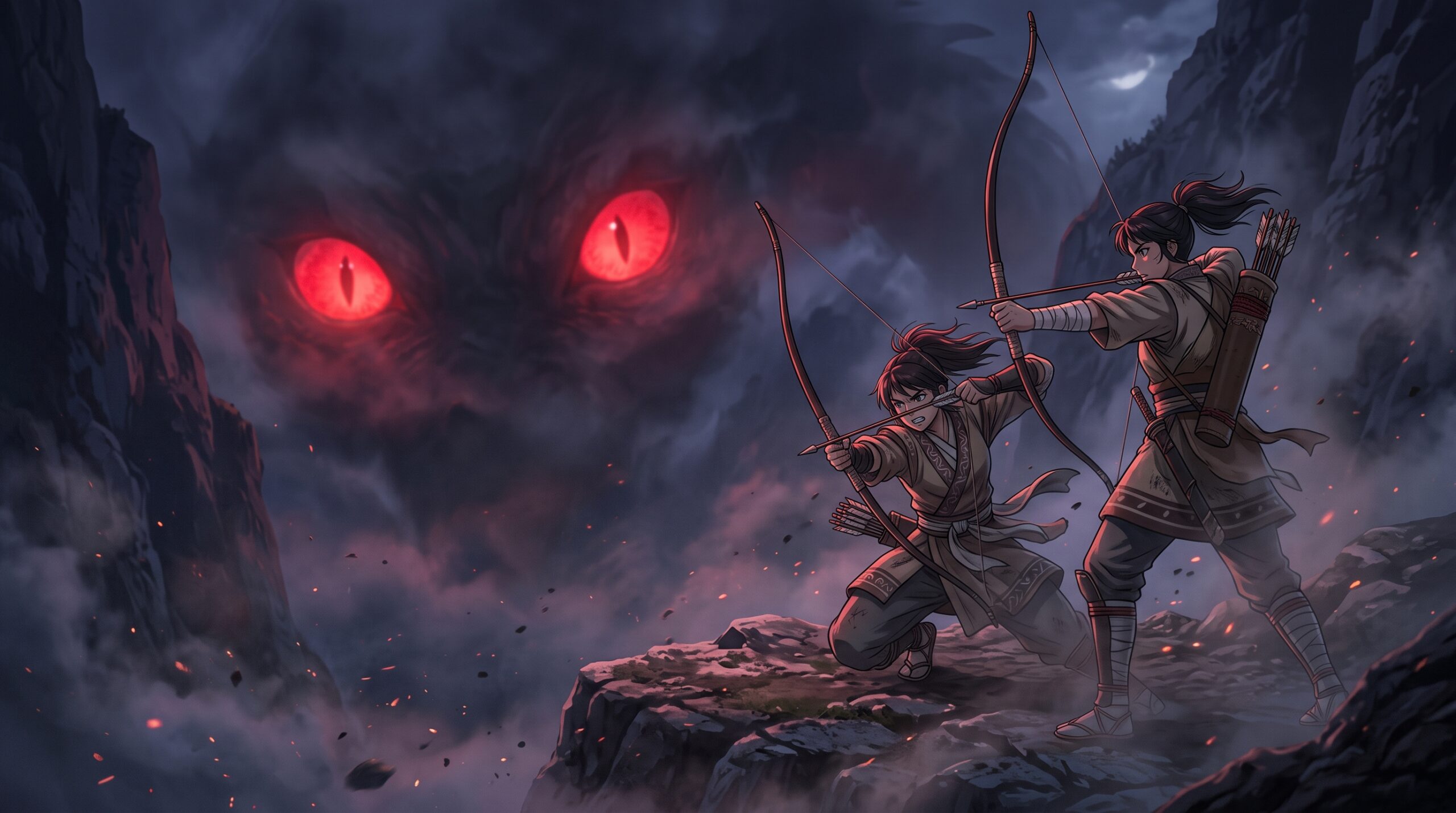
However, looking closely, they were not moons floating in the sky. The true identity of the two red moons was the glowing, blood-red eyes of an incredibly massive Dairochi (giant serpent) that was as large as a mountain. Its scale was so colossal that, in the pitch-black darkness, its eyes appeared as celestial bodies high in the sky.
The moment the giant serpent came close enough, Komatsu and Kosugi leaped onto a rock. Without hesitation, they aimed at the serpent’s two eyes and released their arrows simultaneously. The arrows, infused with two years of their life force and dedication, pierced deeply and flawlessly into both of the monster’s eyes.
Blinded and writhing in agonizing pain, the giant serpent tried to escape, but its massive body became deeply wedged between the rocks of the pass, rendering it immobile. As the poison circulated, the serpent suffered and thrashed violently for seven days and seven nights. It is said that the rhythmic, earthquake-like thumping of its massive heart could be heard echoing all the way to the distant village homes. Finally, the giant serpent drew its last breath.
Even today, the rock formation where the serpent became stuck and died remains, known as “Jagasami” (Snake Gap). The younger sister, Kosugi, chose not to return to her hometown but stayed in that land, protecting her father’s grave for the rest of her life. Legend has it that due to her beautiful filial devotion, the surrounding area came to be known as “Kosugihara.”
Chapter 5: Deep Analysis of the Story: Why Did the Monster Look Like “Moons”?
The most fascinating aspect of this tale is how the eyes of a giant snake were perceived as “Two Red Moons.” The deep mountains in an era devoid of modern lighting were engulfed in a pitch-black darkness unimaginable to people today. If gigantic glowing eyeballs appeared high up in that total darkness, people had no choice but to visually mistake them for celestial bodies floating in the sky.
This is a brilliant representation of how ancient people’s fear of unknown threats lurking in nature merged with optical illusions. It vividly demonstrates that Yokai (monsters) and supernatural phenomena were not merely fabricated tales, but concepts verbalized from a genuine awe of nature and terror based on actual experiences.
Chapter 6: Understanding Japanese Culture and Spirituality Through “Two Moons”
This folktale deeply reflects Japan’s unique culture and spirituality.
First is the “Samurai Spirit and Filial Piety (dedication to family).” The image of two young daughters enduring brutal training for two years to avenge their father symbolizes traditional Japanese values that heavily emphasize duty and honor. The strong will to clear their parent’s regrets, even at the cost of their own lives, was considered the most beautiful form of spirituality by the people of that time.
Second is the perspective of “Animism (nature worship).” The giant serpent, which thrashed for seven days and seven nights with a heartbeat that echoed to the village, embodies the “untamed, raw power of Mother Nature” itself. It symbolizes the sacred yet dangerous domains (mountains) where humans should not easily tread, making this a story of pacifying such immense natural forces.
Third is the “Strength of Japanese Women.” While women in fairy tales are often portrayed as beings meant to be protected, Komatsu and Kosugi in this story take up arms themselves. They are depicted as “warriors” who face a colossal monster after rigorous physical and mental conditioning. This highlights a depiction of Japanese women possessing strong inner cores and proactive agency.
What Would You Do? A Question Posed by the Tale
Komatsu and Kosugi staked their lives on a single arrow to avenge their father, confronting unimaginable terror. Their unwavering resolve and profound love for their family resonate strongly in our hearts today.
If you were in the sisters’ position, what would you have done? Would you have succumbed to fear and given up? Or could you spend two long years forging yourself into a weapon, willing to risk your life to fight for the one you love?
After reading this beautiful yet terrifying story of the “Two Moons,” listen closely to your own heart. What do you feel, and what would you do?
Related Links
- Learn more about the Izu Peninsula, the setting of this story (Wikipedia)
- Discover more captivating Japanese folktales here
- Chapter 1: The Terror Lurking in the Mountains of Izu and the “Red Moons”
- Chapter 2: The Master Hunter’s Challenge and Tragedy
- Chapter 3: To Avenge Their Father: The Sisters’ Cruel Training
- Chapter 4: The Death Match at Basara Pass: The True Identity of the Red Moons
- Chapter 5: Deep Analysis of the Story: Why Did the Monster Look Like “Moons”?
- Chapter 6: Understanding Japanese Culture and Spirituality Through “Two Moons”
- What Would You Do? A Question Posed by the Tale
- 日本の恐ろしくも美しい昔話「二つの月」:勇敢な姉妹と巨大な怪物の伝説
日本の恐ろしくも美しい昔話「二つの月」:勇敢な姉妹と巨大な怪物の伝説
第一章:伊豆の山奥に潜む恐怖と「赤い月」
むかしむかし、甲斐の国(現在の山梨県)に、弓の腕前が誰よりも優れていると評判の猟師が住んでいました。ある日のこと、猟師は一匹の立派な大鹿を見つけ、その跡を夢中で追っていくうちに、遠く離れた伊豆(現在の静岡県)の深い山奥へと足を踏み入れていました。
見知らぬ村にたどり着いた猟師でしたが、彼の並外れた体格と背負っている立派な弓を見た村人たちは、彼にすがりつくようにしてある重大な相談を持ちかけました。
「どうか、私たちの村を救ってはくださらんか。この村と隣村の間にある『婆娑羅峠(ばさらとうげ)』には、恐ろしい化け物が棲み着いているのです」
村人たちの話によると、その峠では夜になると何人もの村人が謎の化け物に飲み込まれ、姿を消しているとのことでした。そして、犠牲者が出る夜には決まって、暗闇の空に不気味な「赤い二つの月」が浮かび上がるというのです。夜空に月は一つしかないはず。赤い二つの月が現れるとき、それは死を意味していました。村人たちは恐怖に震え、夜になると家から一歩も出られない日々を過ごしていました。
第二章:名高き猟師の挑戦と悲劇
正義感が強く、己の弓の腕に絶対の自信を持っていた猟師は、村人たちの悲痛な願いを快く引き受けました。彼は弓と矢を手に、死の危険が潜む婆娑羅峠へと向かい、冷たい風が吹き抜ける中で夜が来るのを静かに待ち構えました。
やがて太陽が沈み、深い闇が峠を包み込みました。すると、村人たちの言葉通り、漆黒の空間に不気味に光る「赤い二つの月」がゆっくりと姿を現したのです。猟師は少しも怯むことなく、二つの月のちょうど真ん中を狙って、力強く矢を放ちました。
しかし、信じられないことに、必殺の矢は硬い何かに弾き返されてしまいました。そして赤い二つの月は、怒り狂ったように猟師へと急接近してきます。逃げる間もなく、凄腕の猟師は暗闇の中で化け物に飲み込まれ、帰らぬ人となってしまったのです。
第三章:父の無念を晴らすため。姉妹の過酷な修練
猟師には、故郷の甲斐の国に残してきた二人の美しい娘がいました。姉の名前は小松(こまつ)、妹の名前は小杉(こすぎ)と言いました。村人たちはるばる甲斐の国まで赴き、姉妹に父親の悲しい死を告げ、涙ながらに謝罪しました。
愛する父の死を知った小松と小杉の悲しみは計り知れません。しかし、二人はただ泣き崩れるだけではありませんでした。次の日から、二人は父の仇を討つために、血の滲むような弓の修行を始めました。来る日も来る日も、朝から晩まで弓を引き続け、その手はマメで破れ、血に染まりました。それでも二人は決して諦めず、凄まじい執念で腕を磨き続けました。
そして二年目の秋。姉妹はついに身支度を整え、決死の覚悟で婆娑羅峠へと向かいました。村人たちは「腕の立つお前たちの父親でさえ敵わなかったのだから、若い娘に行っては犬死にだ!」と必死に引き止めました。しかし、姉妹の決心は鋼のように固く、決して揺らぐことはありませんでした。二人が用意した矢は、それぞれたったの「一本」ずつ。その鏃(やじり)は特注の鋼(はがね)で作られており、致死性の猛毒がたっぷりと塗り込まれていました。
第四章:婆娑羅峠の死闘。明かされた赤い月の正体
夜の婆娑羅峠。姉妹は冷たい岩陰に身を潜め、息を殺して化け物を待ちました。やがて、空気が凍りつき、暗闇の奥からあの「赤い二つの月」が不気味に浮かび上がりました。
しかし、目を凝らしてよく見ると、それは空に浮かぶ月などではありませんでした。赤い二つの月の正体は、山のように巨大な大蛇(オロチ)の、血のように真っ赤に光る「二つの目」だったのです。そのスケールはあまりに巨大で、暗闇の中では空に浮かぶ月のように見えていたのでした。
大蛇が十分に近づいたその瞬間、小松と小杉は岩の上に飛び乗り、迷うことなく大蛇の二つの目を狙って同時に矢を放ちました。二年間、命を削って磨き上げた渾身の矢は、見事、大蛇の両目に深く突き刺さりました。
視力を奪われ、激痛に狂い悶える大蛇は逃げ出そうとしましたが、巨大な体が峠の岩の間に深く挟まり、身動きが取れなくなってしまいました。毒の回った大蛇は、七日七晩にわたって苦しみ、のたうち回りました。その巨大な心臓の鼓動は、遠く離れた村の家々にまで「ドクン、ドクン」と地響きのように聞こえ続けたと言われています。そしてついに、大蛇は息絶えました。
現在でも、その場所には大蛇が挟まって死んだとされる「蛇ヶ狭(じゃがさみ)」という岩が残っています。そして妹の小杉は、故郷には帰らずその地に留まり、生涯にわたって父の墓を守り続けました。その美しい孝心から、その辺りの地名は「小杉原(こすぎはら)」と呼ばれるようになったと伝えられています。
第五章:物語の深い考察。なぜ怪物は「月」に見えたのか?
この物語で最も興味深いのは、巨大な蛇の目が「赤い二つの月」として認識されていた点です。近代的な照明が一切ない時代の深い山奥は、現代人が想像もできないほどの完全な暗闇でした。その漆黒の闇の中、遥か高い位置に光る巨大な目玉が現れたら、人々はそれを「空に浮かぶ天体」だと錯覚するしかなかったのでしょう。
これは、自然界に潜む未知の脅威に対する昔の人々の恐怖心が、視覚的な錯覚と結びついて生み出された見事な表現です。妖怪や怪異というものが、単なる作り話ではなく、自然に対する畏怖や実体験に基づいた恐怖から言語化されたものであることがよくわかります。
第六章:「二つの月」から読み解く日本文化と精神性
この昔話には、日本独自の深い文化と精神性が色濃く反映されています。
第一に、「武士道精神と孝(家族への献身)」です。二人の若い娘が、父親の仇を討つために二年間も過酷な修練に耐え抜く姿は、義理と名誉を重んじる日本の伝統的な価値観を象徴しています。自分の命を懸けてでも親の無念を晴らすという強い意志は、当時の人々が最も美しいと感じる精神性でした。
第二に、「自然崇拝(アニミズム)」の観点です。七日七晩のたうち回り、その心臓の音が村にまで響き渡った大蛇は、ただの動物ではなく「荒ぶる大自然そのもの」を具現化しています。人間が容易に足を踏み入れてはならない神聖で危険な領域(山)の象徴であり、それを鎮める物語でもあります。
そして第三に、「日本女性の強さ」です。昔話における女性は守られる存在として描かれることも多いですが、この物語の小松と小杉は自ら武器を取り、厳しい鍛錬を経て巨大な怪物に立ち向かう「戦士」として描かれています。芯の強さと行動力を持つ日本の女性像がここに表れています。
あなたならどうしますか?物語からの問いかけ
父親の仇を討つため、たった一本の矢に命を懸け、巨大な恐怖に立ち向かった小松と小杉。二人の揺るぎない覚悟と家族への深い愛は、現代を生きる私たちの心にも強く響くものがあります。
もし、あなたが姉妹の立場だったらどうしていたでしょうか? 恐怖に屈して諦めてしまうでしょうか。それとも、大切な人のために、二年もの歳月をかけて自分を鍛え上げ、命を懸けて立ち向かうことができるでしょうか?
この美しくも恐ろしい「二つの月」の物語を読んで、あなたが何を感じ、どう思ったか。ぜひあなたの心の声に耳を傾けてみてください。
コメント