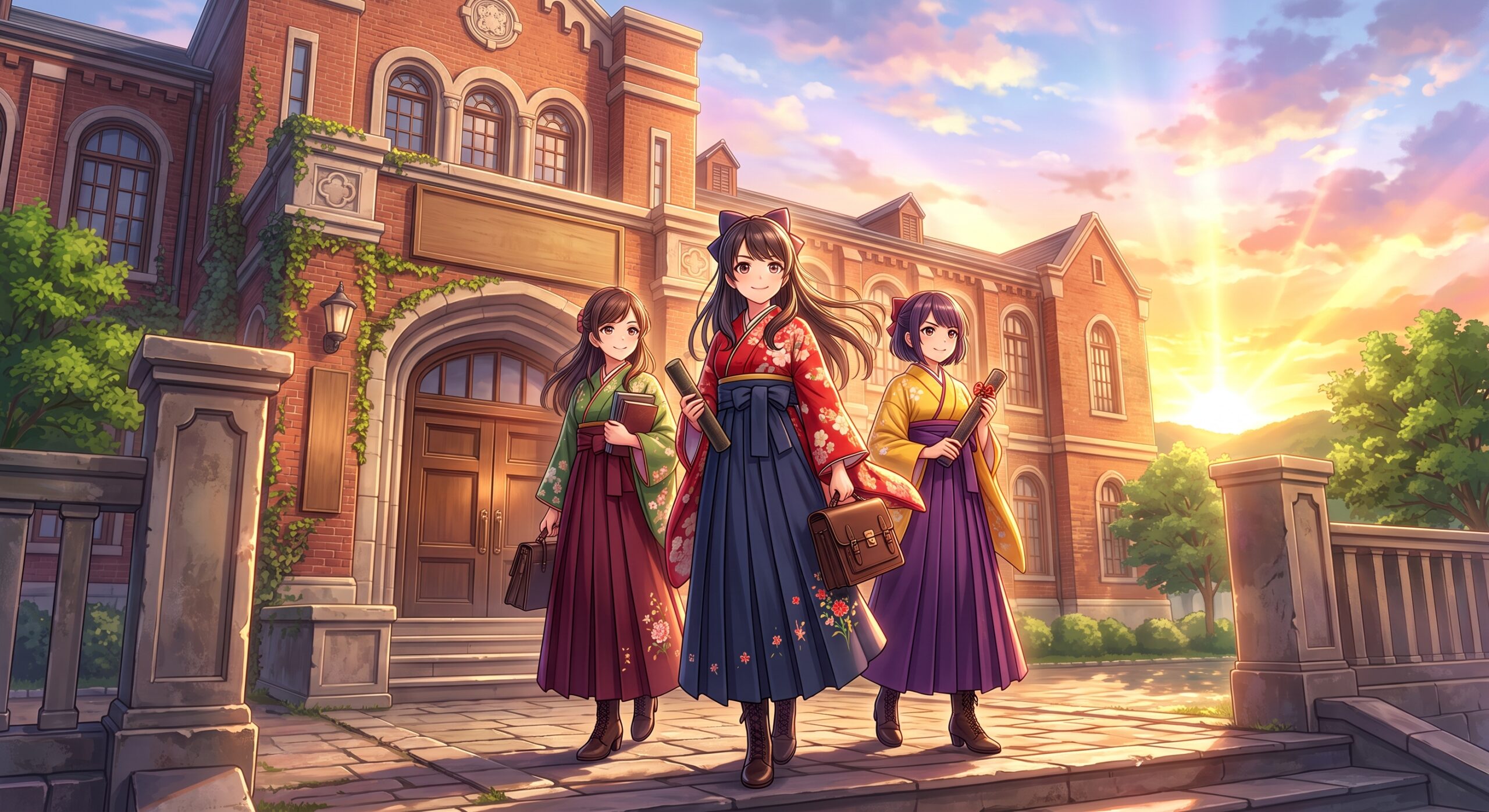
August 21st is a monumental anniversary in Japanese history, known as “Female College Student Day” (Joshi Daisei no Hi). In modern Japan, seeing women studying on university campuses is an everyday occurrence. However, if we turn the clock back over a century, the landscape was entirely different. Today, we will delve deep into this historic turning point in Japanese higher education, exploring the social background of the time and the dramatic stories of the three women who paved the way.
The Era of “Learning is Unnecessary for Women”
In 1913 (Taisho 2), Japan was taking shape as a modern nation following the Meiji Restoration, but a powerful patriarchal system remained deeply rooted in society. The national ideology regarding women’s roles was strictly “Good Wife, Wise Mother” (Ryosai Kenbo)—meaning a woman’s primary purpose was to support her household and raise good children. Higher education (university level) for women was institutionally non-existent. The highest academic institutions for women were limited to normal schools for teachers. The gates of the “Imperial Universities,” dedicated to the pursuit of truth, were an exclusive privilege for men.
The Story: August 21, 1913, and the Three Pioneers
In this restrictive era, one university made an unprecedented decision. Masataro Sawayanagi, the president of Tohoku Imperial University (now Tohoku University), introduced an “Open Door” policy, declaring that the university would accept brilliant minds regardless of gender. Three women took on this challenge in the 1913 entrance examinations: Chika Kuroda, Raku Makita, and Ume Tange.
Their journey was far from smooth. The Ministry of Education, which governed Japan’s educational system, sent strong protests and immense pressure to Tohoku Imperial University, labeling the admission of women as “unprecedented” and a “grave incident.” However, President Sawayanagi, holding a firm conviction that “educational opportunities should be equal,” repelled the government’s interference with logic and passion.
On August 21, 1913, the official gazette announced the successful applicants for Tohoku Imperial University, and the names of these three women were etched into history. It was the exact moment Japan’s first-ever “female college students” were born. Newspapers covered the event extensively, sending massive shockwaves throughout Japanese society.
The Pioneers’ Aftermath: Carving Out a Path
The three women who successfully gained admission went on to make immeasurable contributions to the advancement of academia in Japan, despite facing intense public scrutiny.
- Chika Kuroda (Chemistry): She became Japan’s first female chemist. She left a world-renowned legacy in the structural research of natural pigments, such as onion skin and safflower, and later became the second woman in Japan to earn a Doctor of Science degree. Her inquisitive mind lit the way for generations of female researchers.
- Ume Tange (Chemistry): After graduation, she studied abroad in the United States to broaden her horizons. She learned cutting-edge nutrition science and chemistry, becoming a leading expert in vitamin research. She also eventually earned a doctorate and devoted her life to mentoring the next generation.
- Raku Makita (Mathematics): Despite possessing outstanding mathematical talent and achieving excellent grades, she chose the path of marriage due to the strict social norms and family circumstances of the time. Although she did not pursue a career as a scholar, the very fact of her admission to an Imperial University became a beacon of hope, proving the infinite potential of women.
Decoding Japanese Culture and Its Current Position
This event is not merely a page in educational history; it vividly illustrates the “evolution of gender perspectives” in Japanese culture. Occurring during a transitional period from an era dominated by a powerful patriarchal family system to the liberal atmosphere of the “Taisho Democracy,” it represented the dawn of modern democratic ideals in Japan—the belief that individual ability and rights transcend gender.
But what happens when we look at modern Japan? Despite being the world’s third-largest economy, Japan consistently ranks low among developed nations in the World Economic Forum’s Global Gender Gap Index. The proportion of women in political and economic leadership remains insufficient, and unconscious biases still linger in various aspects of society. The door that three women forced open over 110 years ago has still not swung fully open.
“Female College Student Day” serves not only as a celebration of past triumphs but also as a crucial indicator for facing modern Japan’s cultural and social challenges. It forces us to rethink what a truly equal society should look like. Carrying the courage of our predecessors in our hearts, we must continue marching forward.
A Question for You
How do you feel after reading the story of these Japanese women who leaped into the unknown over a century ago, defying severe opposition and prejudice? What were the turning points in the history of education and equality in your own country? Please share your thoughts in the comments below.
Reference & Explore More
- Discover more stories about Japanese special days: What’s Today’s Special Day Series
8月21日:日本初の「女子大生」誕生—偏見の壁を打ち破った3人の女性たちの軌跡
8月21日は、日本の歴史、とりわけ教育史と女性の社会進出において極めて重要な意味を持つ「女子大生の日」です。現代の日本では、大学キャンパスで女性が学ぶ風景はごく当たり前の日常ですが、時計の針を100年以上前に戻すと、その景色は全く異なるものでした。本日は、日本の高等教育における歴史的な転換点となったこの日について、当時の社会背景、そして時代を切り開いた3人の女性たちのドラマチックなストーリーを通じて深く掘り下げていきます。
「女に学問は不要」とされた時代背景
1913年(大正2年)、日本は明治維新を経て近代国家としての体裁を整えつつありましたが、社会の根底には強力な家父長制が敷かれていました。女性の役割については「良妻賢母(家庭を支え、良き子供を育てること)」が国是とされ、女性が高等教育(現在の大学教育)を受けることは制度上まったく想定されていませんでした。当時の女性の最高学府は「女子高等師範学校」などに限られており、真理を探究する「帝国大学」の門は、男性にのみ開かれた特権だったのです。
ストーリー:歴史が動いた1913年8月21日と、3人のパイオニア
そんな時代に、ひとつの大学が前代未聞の決断を下します。東北帝国大学(現在の東北大学)の総長であった澤柳政太郎は、「門戸開放」の理念のもと、性別を問わず優秀な人材を受け入れる方針を打ち出しました。そして迎えた1913年の入学試験。これに挑んだのが、黒田チカ、牧田らく、丹下ウメという3人の女性でした。
彼女たちの挑戦は、決して平坦なものではありませんでした。女性の受験を認めた東北帝国大学に対し、日本の教育を管轄する文部省(現在の文部科学省)から「前例がない」「重大な事件である」と強い抗議と圧力が押し寄せたのです。しかし、澤柳総長は「教育の機会は平等であるべきだ」という確固たる信念を持ち、文部省の干渉を論理と熱意ではねのけました。
そして1913年8月21日。官報にて東北帝国大学の合格発表が行われ、3人の女性の名前が刻まれました。日本に初めて「女子大生」が誕生した瞬間です。新聞各紙はこの出来事を「紅一点」「女学生の帝大入学」と大々的に報じ、日本社会に巨大な衝撃を与えました。
道を切り拓いた彼女たちのその後
見事合格を手にした3人は、厳しい視線に晒されながらも、日本の学問の発展に計り知れない貢献を果たしました。
- 黒田チカ(化学):日本初の女性化学者となりました。タマネギの皮や紅花など、天然色素の構造研究で世界的な功績を残し、後に女性として日本で2人目となる理学博士号を取得しています。彼女の探究心は、後に続く多くの女性研究者の道を照らしました。
- 丹下ウメ(化学):大学卒業後、さらに見聞を広めるためにアメリカへ留学。最先端の栄養学と化学を学び、ビタミン研究の第一人者として活躍しました。彼女もまたのちに博士号を取得し、生涯をかけて後進の育成に尽力しました。
- 牧田らく(数学):卓越した数学の才能を持ち、優秀な成績を収めましたが、当時の強固な社会規範や家庭の事情の中で結婚という道を選びました。学者の道へは進みませんでしたが、彼女の帝大入学という事実そのものが、女性の可能性を証明する希望の光となったことは間違いありません。
「女子大生の日」から読み解く日本文化と現在地
この出来事は、単なる教育史の1ページにとどまらず、日本の文化における「ジェンダー観の変遷」を如実に表しています。「家」制度が強力だった時代から、大正デモクラシーという自由主義的な気風へと向かう過渡期に起きたこの快挙は、個人の能力や権利が性別を超えるという、近代民主主義の萌芽でした。
しかし、現代の日本に目を向けてみましょう。世界第3位の経済大国でありながら、世界経済フォーラムが発表するジェンダーギャップ指数では、日本は先進国の中で常に低い順位に甘んじています。政治や経済のリーダーシップにおける女性の割合は未だに十分とは言えず、無意識の偏見(アンコンシャス・バイアス)は社会の様々な場面に残存しています。110年以上前に3人の女性が身を挺してこじ開けた扉は、まだ完全に開ききっているわけではないのです。
「女子大生の日」は、過去の偉業を称えるだけでなく、現在の日本が抱える文化的・社会的な課題に直面し、これからの真に平等な社会のあり方を再考するための重要な指標です。先人たちの勇気を胸に、私たちは歩みを進めなければなりません。
あなたへの問いかけ
100年以上前、周囲の強烈な反対や偏見を押し切って未知の世界へ飛び込んだ日本の女性たちのストーリーに触れて、あなたはどう感じましたか? あなたの国における教育と平等の歴史には、どのような転換点がありましたか? ぜひ、あなたの考えをコメント欄で聞かせてください。
Reference & Explore More
- Discover more stories about Japanese special days: What’s Today’s Special Day Series

コメント