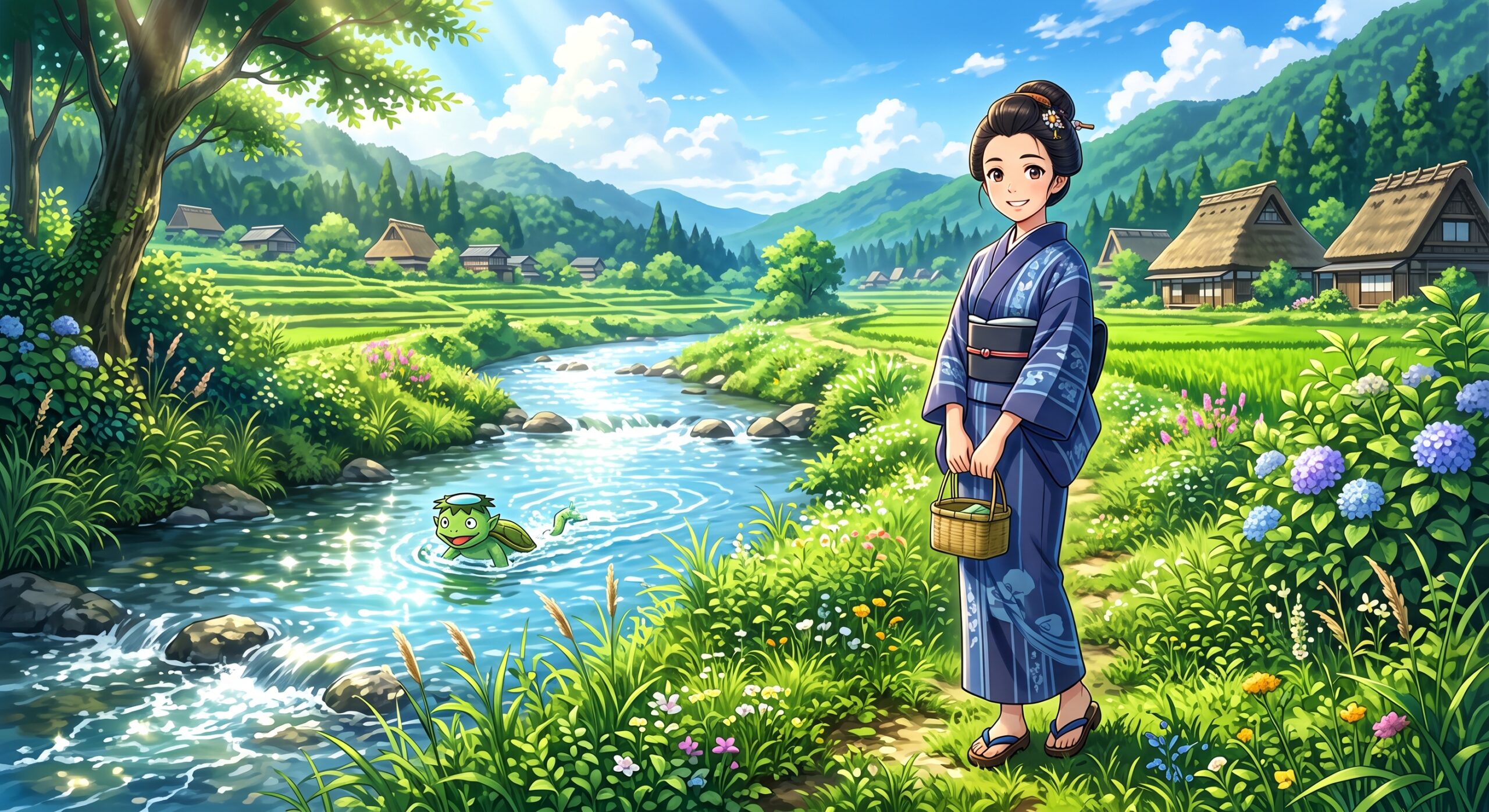
Japan’s rich natural landscapes are heavily steeped in folklore, filled with countless legendary creatures known as Yokai. Among them, the “Kappa” is arguably the most famous—a mischievous water sprite that resides in rivers and ponds. Today, we introduce a captivating folktale from Kumamoto Prefecture about a regional Kappa known as “Gawappa,” and a kind-hearted, exceptionally quick-witted maid named Otake-don.
The Mischievous Gawappa and the Powerful Village Headman
Long ago, in the beautiful Ide River of Kumamoto Prefecture, lived a group of playful Gawappa. They spent their days swimming and playing harmless pranks on humans, forming an integral part of the villagers’ daily lives. However, there was one single human these Yokai absolutely feared and deeply respected. Her name was Otake-don, a humble maid working for the wealthy Shoya (the village headman). Why would supernatural creatures bow to an ordinary maid? The answer lies in a dramatic incident from years past.
One scorching summer day, the Shoya was enjoying a fishing trip by the river. The mischievous Gawappa gathered around and repeatedly stole the fish he managed to catch. Furious at their constant interference, the Shoya seized an opportunity and captured one of the Gawappa. The source of a Kappa’s superhuman strength lies in the water kept inside the “sara” (a dish-like depression) on top of its head. The Shoya swiftly emptied the water from the creature’s head, completely neutralizing its power. To make an example of it, he bound the Gawappa tightly with rough rope and left it in the center of his garden under the blazing summer sun.
Otake-don’s Conviction and Respect for Life
Under the merciless sun, the Gawappa began to dry up, slowly inching towards death. Watching this cruel scene from the corner of the yard was the hardworking maid, Otake-don. She felt a deep surge of righteous anger in her heart. “Water is the absolute source of all life,” she thought. “No matter how mischievous this creature was, to deliberately cut off its source of life and subject it to such cruelty is an act of extreme human arrogance.”
However, as a mere servant, Otake-don was completely powerless against the Shoya. Openly defying her master to give water to the Yokai was strictly forbidden. If caught, she would face severe punishment and be immediately cast out of the house. Faced with this dilemma, Otake-don formulated a brilliant and daring plan.
The “Waterless” Strategy and a Satisfying Climax
That day, Otake-don executed a bizarre strategy: she performed all her chores entirely without water. She cooked meals without a single drop of moisture, and even prepared the rice completely dry. Furthermore, she denied water to all the other servants working under the harsh sun, and completely restricted water from the Shoya’s prized horse.
Eventually, driven mad by unbearable thirst, the horse began to thrash about violently in the yard. Startled by the extraordinary commotion, the panicked Shoya shouted at the top of his lungs, “Water! Water! Bring water immediately, Otake!” This was exactly the moment Otake-don had been waiting for. “Yes, right away, my lord!” she replied cheerfully. She rushed out into the garden holding a massive wooden bucket filled to the brim with water.
Otake-don dynamically splashed the water over the crazed horse and the exhausted servants. And, in the midst of the organized chaos, she hurled a generous amount of water directly onto the dying Gawappa tied up on the ground.
The moment the life-giving water filled the dish on its head, the Gawappa instantly regained its tremendous supernatural strength. It effortlessly snapped the thick ropes binding it and dashed back to the safety of the river in a flash. Realizing that the entire chaotic situation was Otake-don’s calculated plot, the Shoya furiously roared, “You did this on purpose, Otake! Get out of my house!” But the truth was, Otake-don was the most capable and indispensable worker in the household. The Shoya knew he could not afford to lose her. Ultimately, Otake-don calmly continued to work at the estate. As for the Gawappa in the river, they spent the rest of their lives bowing in absolute respect to Otake-don—the clever, fearless woman who saved their lives.
Story Analysis: Intelligence Over Authority and the Value of Water
This folktale is much more than a simple satisfying story. Within the strict hierarchy of feudal Japan, where the power dynamic between a “Master” and a “Maid” was absolute, Otake-don did not resort to direct rebellion. Instead, she utilized advanced intellect and wit to force the master himself to demand water. This highly reflects the Japanese aesthetic of overcoming adversity through wisdom rather than brute force.
Cultural Connection: Animism and Coexistence with Nature
In Japanese culture, water is entirely sacred, serving as the most vital resource in a society traditionally centered around rice farming. The Shoya’s act of depriving a living creature of water symbolizes human arrogance against nature. Conversely, Otake-don’s profound respect for the life of a mischievous Yokai perfectly embodies the Japanese spirit of “Animism” (the belief that spirits dwell in all things) and harmonious coexistence with nature. In Japan, Yokai are not inherently evil; they are neighbors sharing the same environment.
What Are Your Thoughts?
Otake-don refused to yield to authority, using her unshakeable beliefs and sharp wit to save a single life. If you were in her shoes, would you have risked your livelihood to save an oppressed Yokai? Or would you have looked the other way? This story strongly challenges us to reflect on our modern relationship with nature and authority.
If you wish to explore more profound and fascinating Japanese legends, please visit our Japanese Folktale Series. The primary reference material for this specific legend can be found at the Manga Nippon Mukashibanashi Database.
- The Mischievous Gawappa and the Powerful Village Headman
- Otake-don’s Conviction and Respect for Life
- The “Waterless” Strategy and a Satisfying Climax
- Story Analysis: Intelligence Over Authority and the Value of Water
- Cultural Connection: Animism and Coexistence with Nature
- What Are Your Thoughts?
- 日本の妖怪伝説:がわっぱとお竹どんの痛快な物語
日本の妖怪伝説:がわっぱとお竹どんの痛快な物語
日本の豊かな自然には、古来より数多くの妖怪が棲んでいると伝えられています。中でも「カッパ(河童)」は最も有名で、川や沼に住み、人間にいたずらを仕掛ける存在として親しまれてきました。今回は、熊本県に伝わるカッパの別名「がわっぱ」と、心優しく圧倒的な機転を持った女中「お竹どん」の物語を紹介します。
いたずら好きのがわっぱと、絶対的な権力を持つ庄屋
昔々、熊本県にある美しい井出川には、いたずら好きな「がわっぱ」たちが住んでいました。彼らは川辺で遊び、人間にちょっとした悪戯をしては逃げ隠れしていました。しかし、彼らにはたった一人、絶対に頭の上がらない人間の女性がいました。それが、村の有力者である庄屋(村の長)の家で女中として働く「お竹どん」です。妖怪であるはずのがわっぱが、一介の女中をこれほどまでに恐れ敬うのには、過去に起きたある重大な事件が関係しています。
ある焼け付くような真夏の日、庄屋は川で魚釣りを楽しんでいました。そこにがわっぱたちが集まり、庄屋がせっかく釣り上げた魚を次々と盗むといういたずらを働きました。度重なる妨害に激怒した庄屋は、隙を突いて一匹のがわっぱを見事に捕縛します。カッパの力の源は、頭の上にある「皿」に乗った水です。庄屋は捕まえたがわっぱの頭の皿から素早く水をかき出し、その力を完全に封じ込めました。そして、見せしめとして、炎天下の庭の真ん中に荒縄でがわっぱをきつく縛り付けたのです。
お竹どんの信念と命への尊厳
容赦なく照りつける太陽の下で、がわっぱは干からび、次第に息絶え絶えになっていきました。その無残な姿を庭の隅から見ていたのが、働き者のお竹どんです。お竹どんは心の中で強く憤りました。「水はすべての命の大元です。いくらいたずらをしたからといって、命の源である水を絶ち、残酷な仕打ちをするのは、人間の思い上がりが過ぎます」と。
しかし、お竹どんの立場は単なる使用人です。主である庄屋の命令に背き、堂々とがわっぱに水を与えることなど絶対に許されません。もし見つかれば厳しい罰を受け、家を追い出されてしまいます。そこで、お竹どんは自らの人生を懸けた見事な機転を利かせました。
水なしの奇策と痛快な結末
お竹どんはその日、家事の一切を「完全に水なし」で行うという奇策に出ます。料理には一切水を使わず、米すらも水を含ませずにそのまま炊き上げました。さらに、炎天下で働く他の使用人たちにも一滴の水も与えず、大切な馬にも全く水を飲ませなかったのです。
やがて、強烈な喉の渇きに耐えかねた馬が狂ったように暴れ出しました。その尋常ではない騒ぎに驚いた庄屋は慌てふためき、「水じゃ!水!早く水を持ってこい!」とお竹どんに大声で命じました。お竹どんはまさにこの瞬間を待っていました。「はい、ただいま!」と威勢よく返事をすると、水をなみなみと張った大きな桶を抱えて庭に飛び出しました。
お竹どんは、庭で暴れる馬や喉を渇かせた使用人たちに向かって、豪快に水をぶちまけました。そして、そのどさくさに紛れて、荒縄で縛り付けられ瀕死の状態だったがわっぱにも、たっぷりと水を浴びせかけたのです。
頭の皿に命の水を取り戻したがわっぱは、瞬く間に本来の強大な力を取り戻しました。太い荒縄を軽々と引きちぎると、あっという間に川へと逃げ帰っていきました。庄屋はすべてがお竹どんの計略であったことに気づき、「お竹の奴、わざとやったな!もう出て行け!」と雷を落としました。しかし、お竹どんは庄屋の家にとって必要不可欠な最も優秀な働き手です。庄屋も本心ではお竹どんを手放すわけにはいかず、結局、お竹どんはその後も庄屋の家で平然と働き続けました。そして川のがわっぱたちは、命の恩人であり、機転と度胸を持ち合わせたお竹どんに一生頭が上がらなくなったのです。
物語の考察:権力に屈しない知恵と「水」の価値
この物語は、単なる痛快な昔話にとどまりません。封建社会における「権力者(庄屋)」と「労働者(女中)」という絶対的な上下関係の中で、お竹どんは真っ向から反発するのではなく、「主人の口から水を持ってこさせる」という高度な知恵(智謀)を用いて目的を達成しました。これは、力ではなく知性で困難を乗り越える日本人の美学を色濃く反映しています。
日本文化との関連:自然崇拝とアニミズム
日本文化において「水」は神聖なものであり、稲作を中心とする社会において最も重要な資源です。命の源である水をみだりに奪う庄屋の行為は、自然界に対する人間の「傲慢さ」を象徴しています。一方、いたずらをする妖怪であっても命あるものとして尊ぶお竹どんの姿勢は、日本の根底に流れる「アニミズム(万物に魂が宿るという思想)」や「自然との共生」の精神そのものです。妖怪は完全な悪ではなく、人間と共に生きる隣人なのです。
あなたはこの物語から何を感じましたか?
権力に屈することなく、自分の信念と知恵で一つの命を救ったお竹どん。もしあなたが彼女の立場なら、職を失うリスクを冒してまで、虐げられている妖怪を助けたでしょうか?それとも、見て見ぬふりをしたでしょうか?人間と自然の関わり方について、この物語は現代を生きる私たちに強く問いかけています。
さらに日本の奥深い昔話を知りたい方は、こちらの日本の昔話シリーズをぜひご覧ください。また、本記事の物語の原典に関する情報は、まんが日本昔ばなし〜データベース〜に掲載されています。
コメント