Introduction: Spirits Lurking in the Waters of Japan
Since ancient times, Japan has passed down numerous tales of supernatural beings known as “Yokai.” Among the most famous of these, and deeply rooted in the hearts of Japanese people even today, is the “Kappa.” Characterized by their green skin, a turtle-like shell on their backs, and a small, water-filled dish on top of their heads, they are said to be either messengers of water gods living in rivers and swamps or mischievous spirits. Today, from the countless Kappa legends across Japan, we introduce a highly fascinating folktale: “The Kappa That Plucked Horse Hair.”
1. The Story of “The Kappa That Plucked Horse Hair”
Once upon a time, in a small village, there lived a Kappa in the local river. While the Kappa usually lived quietly, catching fish, it was also a nuisance that occasionally played minor pranks on the villagers.
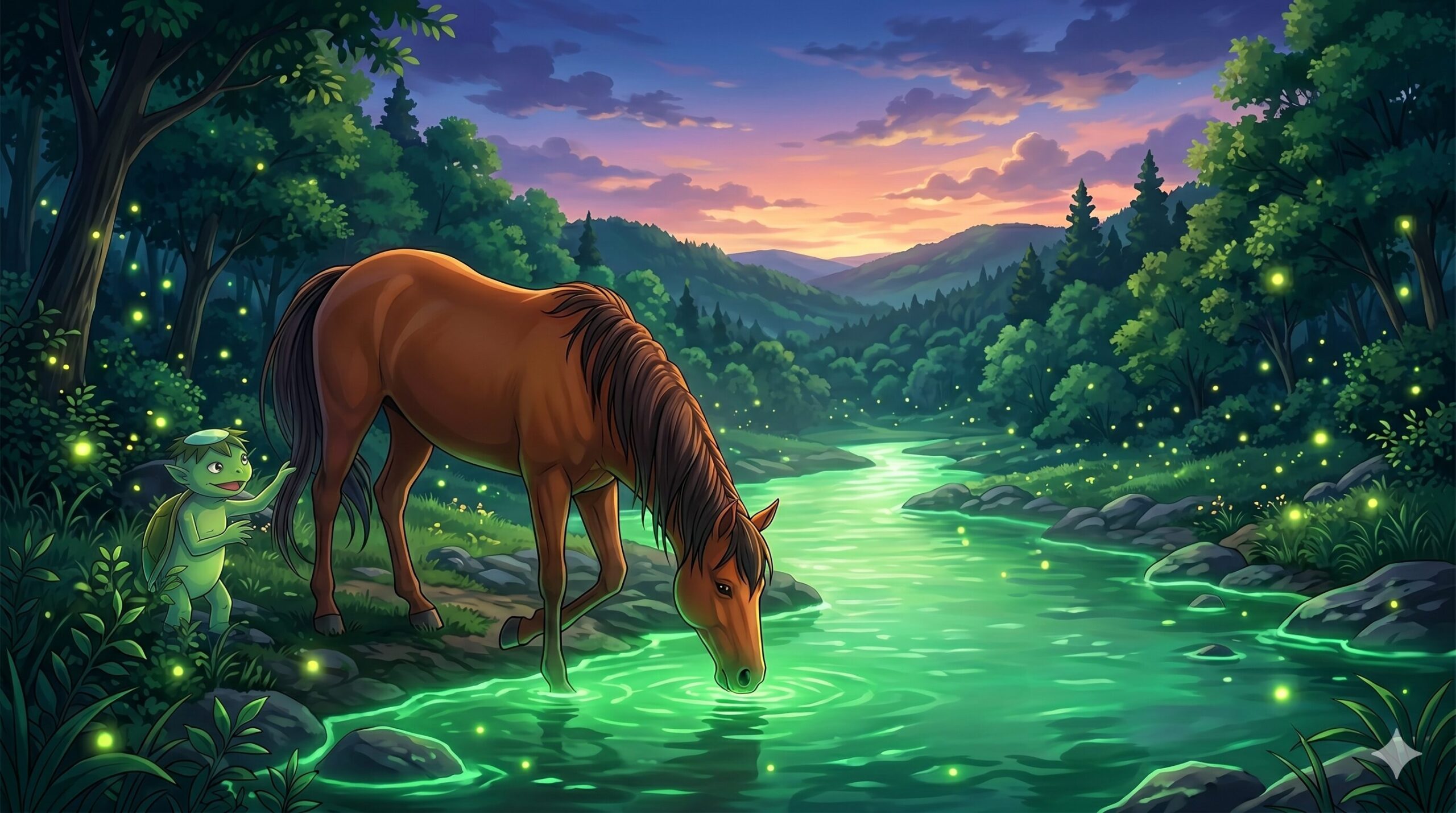
One summer evening, a village farmer brought his precious farm horse to the river for a drink. As the horse delightfully drank the cool river water, the surface of the water quietly rippled. The Kappa was stealthily approaching from the riverbed. The Kappa set its sights on the horse’s magnificent tail hair. “I will pluck those stiff, durable horse hairs and use them to build a splendid nest,” the creature schemed.
Reaching out from the water, the Kappa yanked on the horse’s tail hair with all its might. Startled, the horse let out a loud neigh, reared up on its hind legs, and began to thrash about. Surprised, the Kappa tried to let go, but the long, strong hairs of the horse’s tail had tangled intricately around the Kappa’s webbed fingers. It could not get free.
In a panic, the horse bolted from the river and ran at breakneck speed straight back to its stable in the village. Hanging from the horse’s tail, the Kappa was dragged along the ground, bumping into rocks all the way to the village.
Hearing the commotion of the horse fleeing back to the stable, the farmer and the villagers gathered around. There lay the Kappa, completely exhausted, covered in dust, and still tangled in the tail. The villagers bound the creature with ropes, shouting, “You wicked Kappa, always playing tricks in the river! We will not forgive you today!”
The water from the dish on the Kappa’s head had completely spilled out, rendering it weak. With tears streaming down its face, it begged the villagers for its life. “Please, I beg you, spare my life! I promise I will never harm the village people or the horses again. In return for your forgiveness, I will teach you the secret recipe for a medicine that instantly heals cuts.”
Seeing that the Kappa was truly remorseful, the village elder decided to forgive it. True to its word, the Kappa taught the villagers how to make the miraculous medicine and then returned to the river. From that day on, the Kappa never played another prank in the village river, and thanks to the medicine the Kappa shared, the villagers were able to heal their injuries immediately.
2. Folktale Analysis: Why Did the Kappa Target the Horse?
Delving deeper into this story, there is a clear folkloric background as to why the Kappa obsesses over horses. In ancient Japan, the horse was considered a sacred vehicle for the gods (Shinme) and an animal with strong ties to water deities. A leading theory suggests that Kappas are the fallen forms of these “water gods.” The act of a Kappa—a servant of the water god—trying to drag a sacred horse into the water or meddling with it symbolizes a “test of strength” at the boundary between the realm of water and the realm of land.
Furthermore, for farmers, a horse was not just a workforce but a precious asset, almost like family. The act of trying to pluck its hair represents the very threat of unpredictable nature menacing the farmers’ livelihoods. The Kappa is a personification of the river that provides blessings, but at the same time, it is a symbol of wild nature that brings dangers like water accidents.
3. Connection to Japanese Culture: Awe of Nature and the Spirit of Forgiveness
The core of Japanese culture deciphered from this folktale is “Animism (nature worship)” and the spirit of “coexistence and forgiveness.”
In Western monster-slaying tales, a beast threatening a village is typically vanquished and killed by a hero. However, in Japanese folktales, the Kappa is not “killed” but “forgiven.” Instead of taking the Kappa’s life, the villagers urge it to reflect on its actions, receive the blessing of medical knowledge, and reconcile.
This is the very view of nature rooted in the Japanese climate. Nature, such as typhoons and floods, sometimes bares its fangs at humans, but it also provides the blessings of abundant water and fertile soil. Instead of trying to completely control or defeat nature, the Japanese have chosen to live together by finding a compromise, respecting and fearing it simultaneously. The ending—forgiving the Kappa and returning it to the natural world—beautifully expresses this philosophy of “coexisting with nature.”
4. To Our Readers: What Would You Do?
Through the story of “The Kappa That Plucked Horse Hair,” we hope you have felt the profound depth of Japan’s view of nature and Yokai culture. The villagers’ decision to accept an apology, grant forgiveness despite the mischief, and choose the path of coexistence by gaining wisdom (the medicine) offers many insights for us today.
If you were the farmer in this village, would you have been able to forgive the Kappa that tried to harm your precious horse? Or would you have given it a severe punishment so it could never do wrong again? Please let us know your thoughts and how this story made you feel.
Reference Links & Related Categories
- External Link: Wikipedia – Kappa (folklore)
- Internal Link: Read more from our Japanese Folktale Series
- Introduction: Spirits Lurking in the Waters of Japan
- 1. The Story of “The Kappa That Plucked Horse Hair”
- 2. Folktale Analysis: Why Did the Kappa Target the Horse?
- 3. Connection to Japanese Culture: Awe of Nature and the Spirit of Forgiveness
- 4. To Our Readers: What Would You Do?
- Reference Links & Related Categories
- 神秘なる日本の妖怪伝承:「馬の毛をぬくカッパ」が語る自然との共生
神秘なる日本の妖怪伝承:「馬の毛をぬくカッパ」が語る自然との共生
はじめに:水辺に潜む日本の精霊
日本には古くから「妖怪(Yokai)」と呼ばれる超自然的な存在が数多く語り継がれています。中でも最も有名で、現在でも日本人の心に深く根付いているのが「カッパ(河童)」です。緑色の肌、背中の甲羅、そして頭の上にある水が入った「お皿」。彼らは川や沼に住む水神の使いとも、いたずら好きな精霊とも言われています。今回は、日本各地に伝わる数あるカッパ伝説の中から、「馬の毛をぬくカッパ」という非常に興味深い昔話をご紹介します。
① 昔話「馬の毛をぬくカッパ」のストーリー
むかしむかし、ある村の川辺での出来事です。この村の川には、一匹のカッパが住み着いていました。カッパは普段は魚を捕まえて静かに暮らしていましたが、時折、村人たちに小さないたずらを仕掛ける困り者でもありました。
ある夏の夕暮れ時、村の農夫が大切な農耕馬を連れて、川へ水を飲ませにやってきました。馬が美味しそうに冷たい川の水を飲んでいると、水面が静かに波立ちました。カッパが水底からそっと近づいてきたのです。カッパは馬の立派な尻尾の毛に目をつけました。「あの硬くて丈夫な馬の毛を抜いて、自分の巣を立派にする材料にしてやろう」と企んだのです。
カッパは水の中から手を伸ばし、馬の尻尾の毛を力いっぱい引っ張りました。しかし、馬は驚いて大きく嘶き、前足を高く上げて暴れ出しました。カッパは驚いて手を離そうとしましたが、馬の長くて丈夫な尻尾の毛が、カッパの指と水かきに複雑に絡みついてしまい、どうしても外れません。
パニックになった馬は、川を飛び出し、そのまま村の自分の厩(うまや)に向かって猛スピードで走り出しました。カッパは馬の尻尾にぶら下がったまま、地面を引きずられ、石にぶつかりながら村まで連れて行かれてしまいました。
厩に逃げ帰った馬の騒ぎを聞きつけ、農夫と村人たちが集まってきました。そこには、すっかり弱り果て、埃まみれになったカッパが尻尾に絡まって倒れていました。村人たちは「いつも川でいたずらをするカッパめ、今日という今日は許さないぞ!」とカッパを縛り上げました。
すると、カッパは頭のお皿の水をすっかりこぼし、涙を流しながら村人たちに命乞いをしました。「どうか、どうか命だけはお助けください。もう二度と、村の人々や馬に悪さはしません。お詫びに、切り傷がすぐに治る秘伝の薬の作り方を教えますから」
村の長老は、カッパが心から反省しているのを見て、彼を許すことにしました。カッパは約束通り、村人たちに特効薬の作り方を教え、川へと帰っていきました。それ以来、その村の川では二度とカッパのいたずらは起きず、村人たちはカッパが教えてくれた薬のおかげで、怪我をしてもすぐに治るようになったということです。
② 昔話の考察:なぜカッパは馬を狙ったのか?
この物語を深く考察すると、カッパが馬に執着する理由には明確な民俗学的背景があります。日本では古来、馬は神の乗り物(神馬)とされ、水神との結びつきが強い動物でした。カッパは元々「水神」が零落(神格を失うこと)した姿であるという説が有力です。水神の使いであるカッパが、同じく神聖な動物である馬を水の中に引き込もうとする、あるいはちょっかいを出すという行為は、水の世界と陸の世界の境界線における「力の試し合い」を象徴しています。
また、農民にとって馬は労働力であり、家族同然の貴重な財産でした。その馬の毛を抜こうとする行為は、農民の生活を脅かす自然の脅威そのものを表しています。カッパは、恵みを与える川の擬人化であると同時に、水難事故などの危険をもたらす予測不可能な自然の象徴なのです。
③ 日本文化との関連:自然への畏敬と「許し」の精神
この昔話から読み解ける日本文化の核心は、「アニミズム(自然崇拝)」と「共生・許し」の精神です。
西洋の怪物退治の物語であれば、村を脅かすモンスターは最終的に勇者によって討伐されるのが一般的です。しかし、日本の昔話では、カッパは「殺される」のではなく、「許され」ます。村人たちはカッパの命を奪うのではなく、反省を促し、薬の知識という恩恵を受け取って和解するのです。
これは、日本の風土に根ざした自然観そのものです。台風や洪水など、自然は時として人間に牙を剥きますが、同時に豊かな水や土壌という恵みも与えてくれます。日本人は自然を完全にコントロールしたり打ち負かしたりするのではなく、恐れ敬いながらも、互いに妥協点を見つけて共に生きる道を選んできました。カッパを許し、自然界へ帰すという結末は、まさにこの「自然との共生」の哲学を見事に表現しています。
④ 読者の皆様へ:あなたならどうしますか?
この「馬の毛をぬくカッパ」の物語を通して、日本の自然観や妖怪文化の奥深さを感じていただけたのではないでしょうか。悪さをしたにもかかわらず、謝罪を受け入れて許しを与え、さらには知恵(薬)を得て共存の道を選んだ村人たちの決断は、現代の私たちにも多くの気づきを与えてくれます。
もし、あなたがこの村の農夫だったら、大切な馬を傷つけようとしたカッパを許すことができたでしょうか? それとも、二度と悪さができないように厳しい罰を与えたでしょうか? ぜひ、あなたの考えやこの物語を読んで感じたことを教えてください。
コメント