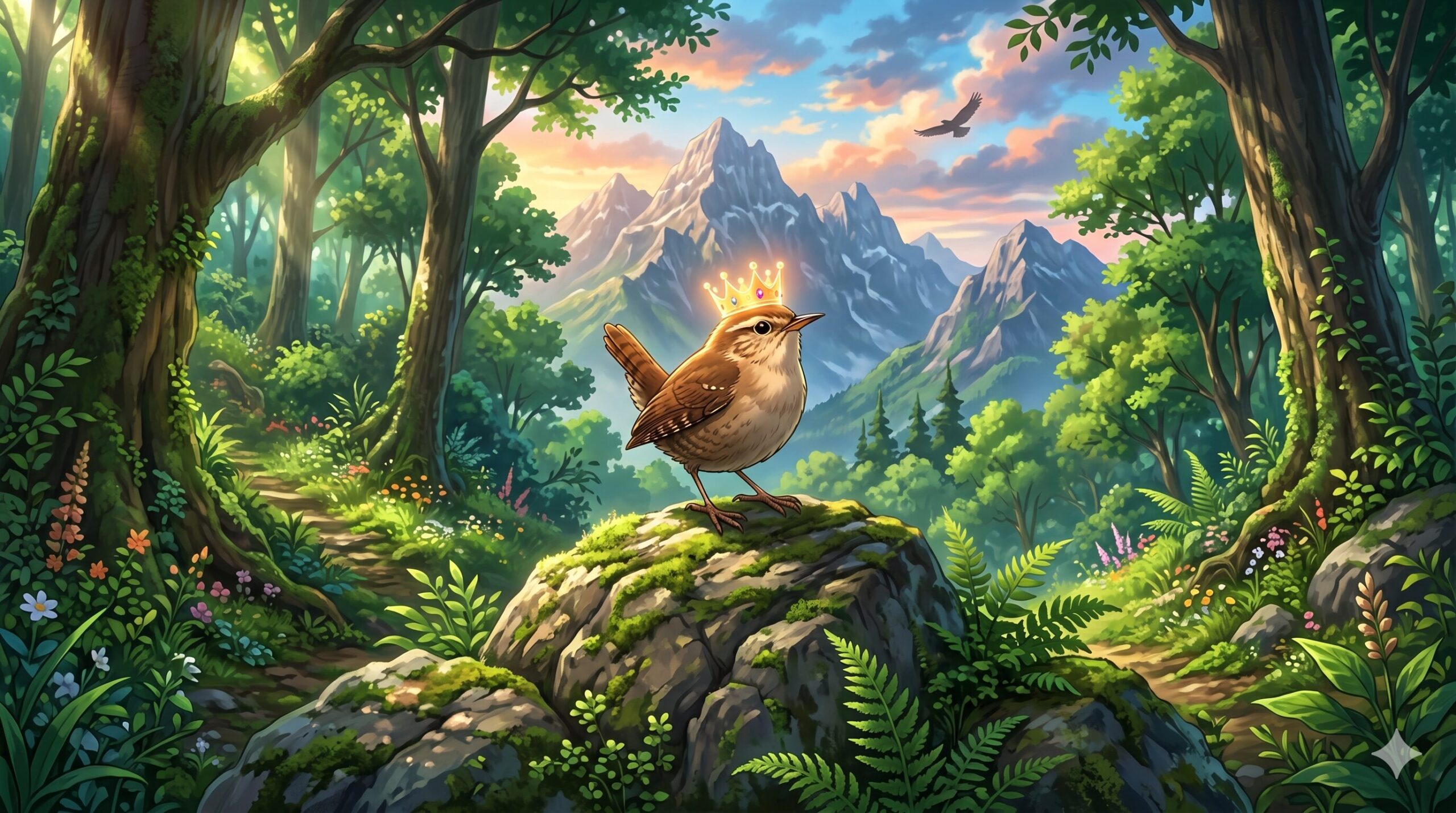
Japan is home to countless folktales that, while perhaps not globally famous, carry profound and resonant lessons that serve as a compass for life. Today, I will introduce a particularly fascinating and satisfying story: “The Wren is the King of Birds.” The wren is an incredibly tiny bird that lives in the lush forests of Japan. How did this seemingly fragile little bird come to be called the “King of Birds,” defeating the mighty hawk, a powerful bird of prey? Let’s unravel the full story and the deep Japanese cultural spirituality hidden within it.
A Tiny Bird’s Giant Challenge: The Story of “The Wren is the King of Birds”
Once upon a time, on a beautiful and verdant mountain called “Manmaru-yama,” the birds gathered to hold a grand and joyful banquet. Crows, owls, hawks, and all the birds of the forest drank delicious sake together, healing their daily fatigue and enjoying a wonderful time.
As the banquet reached its peak, perhaps fueled by the alcohol, a major topic of discussion arose among the birds: “Who exactly is the strongest and greatest bird among us?”
The birds began to argue passionately. “Of course, the hawk with its sharp claws and powerful beak is the strongest,” said one. “No one can surpass the hawk when it comes to overwhelming physical power,” agreed another. It was unanimously agreed that the fierce bird of prey, the hawk, was the absolute strongest and most fitting to be the King of Birds.
However, in a corner of the banquet, the absolute smallest bird of all, the wren—who had gotten completely drunk—suddenly shouted at the top of his lungs, “What are you all talking about?! It’s obvious that I am the strongest bird of all!”
At those words, the banquet fell dead silent. The wren, the smallest bird in Japan, had boldly boasted in front of the mighty hawk that he was the strongest. His pride deeply wounded, the hawk accepted the wren’s reckless provocation and declared, “Very well. Let us have a contest to see who is truly the strongest. Whoever manages to defeat that terrifying, giant wild boar deep in the forest will be named the greatest of all birds—the King.”
In his drunken state, the wren bravely accepted, shouting, “Challenge accepted!”
The next morning, the sun rose, and the wren, completely sober, remembered the terrifying words he had spoken the night before. His face turned pale. “I made a terrible promise… There is no way a tiny creature like me can defeat a giant, ferocious wild boar.” But having made such a grand boast in front of all the birds, he absolutely could not back down now.
Trembling with fear, the wren flew deep into the forest where the wild boar lived. When he found the massive beast emerging from the bushes, he conquered his fear and utilized his small size and incredible speed to fly rapidly around the boar. Then, seizing a split-second opportunity, he dove straight into the giant earhole of the wild boar.
With the wren flapping violently deep inside its ear, the wild boar fell into a complete panic. Driven mad by the extreme discomfort and terror of being attacked directly inside its head, the boar ran wildly through the forest until it finally crashed violently into a massive rock and died. Thus, the tiny wren emerged completely unharmed, achieving the miraculous feat of defeating the giant wild boar.
Watching this, the hawk panicked. “There is no way I will lose to that tiny wren. I will show them something even more amazing.” Determined to show off his absolute power, the hawk made a plan to defeat two wild boars at the exact same time.
The hawk soared high into the sky and dive-bombed toward two wild boars running on the ground. He powerfully grabbed the back of one boar with his right talons and the back of the other boar with his left talons. Up to this point, everything went exactly according to the hawk’s plan.
However, the two wild boars did not just submit peacefully. Startled, one boar charged to the right, and the other charged to the left at top speed, running in completely opposite directions. The hawk desperately held on with his powerful grip, refusing to let go. But unable to withstand the tremendous rushing power of the wild beasts, his legs were pulled violently in opposite directions, and his body was tragically torn completely in half.
Through this, the wren, who understood his tiny size and used his wisdom, survived. The hawk, who drowned in his overwhelming power and arrogance, perished. Consequently, the tiny wren was officially recognized by all as the “King of Birds.”
Analyzing the Depths of the Story: The Contrast Between Wisdom and Arrogance
This story is not just a simple fairy tale about animals comparing their strength; it contains extremely deep life lessons that strike at the essence of human nature.
First, it teaches the universal truth that “wisdom overcomes physical strength.” Even when facing an opponent you cannot possibly match in size or physical power, you can completely overturn seemingly impossible situations by maximizing your own strengths (in the wren’s case, small size and overwhelming speed) and accurately striking the opponent’s weak point (the boar’s earhole).
Second, it highlights the “dangers of arrogance and overconfidence.” The hawk originally possessed the ability to easily defeat a single wild boar. However, driven by rivalry with the tiny wren and a desire to show off, he set an unnecessary and impossible goal of “defeating two at once,” which resulted in his self-destruction. This serves as a strong warning against overestimating one’s abilities and taking reckless actions. The fact that everything started from a slip of the tongue while drinking alcohol also realistically portrays human foolishness and weakness.
Connection to Japanese Culture: The Spirit of “Softness Overcomes Hardness”
The story of “The Wren is the King of Birds” is deeply intertwined with traditional Japanese values and culture.
Since ancient times, Japan has cherished the phrase “Ju yoku go wo seisu” (Softness overcomes hardness). This is spoken as a fundamental spirit in Japanese martial arts such as Judo and Kendo, meaning that “something flexible and soft can defeat something hard and powerful by utilizing its flexibility.” The wren’s fighting style perfectly embodies this exact spirit. The attitude of standing up against overwhelming physical force or power (hardness) with wisdom and quick thinking (softness) is a heroic archetype deeply loved by the Japanese people since ancient times.
Furthermore, Japan has a cultural concept called “Hogan-biiki” (Sympathy for the underdog), which is a cultural foundation where people deeply sympathize with and cheer for the weak or small who stand up against massive power. The sight of the tiny wren using his wits to defeat a formidable enemy fits this psychology perfectly.
Finally, the importance of knowing one’s place, or “Bunsouou” (acting according to one’s standing), is a highly respected virtue in Japanese culture. The tragic end of the hawk, who acted beyond his capabilities just to show off, serves as a strict lesson for Japanese society, which values social order, harmony, and humility.
What Would You Do?
What did you feel after reading this Japanese folktale?
If you were the tiny wren who, while drunk, made a life-or-death promise to fight an absolutely unbeatable giant opponent, how would you have acted the next morning? Would you have just run away from the forest? Or would you have desperately used your wisdom to face the challenge, just like him?
Also, have you ever experienced a moment in your life where you felt that “wisdom and ideas” triumphed over “physical strength”? Is true strength about muscle power, or is it the flexible thinking required to break through difficult situations? Please share your thoughts and experiences with us!
If you want to discover more fascinating stories, please explore our Japanese Folktale Series. Enchanting stories are waiting for you.
To learn more about the real-life ecology of the Eurasian Wren, the hero of our story, check out this Wikipedia article on the Wren.
日本の隠れた名作昔話:「ミソサザイは鳥の王様」〜知恵が力に打ち勝つ物語と日本文化の深層〜
日本には、世界中であまり知られていないものの、深く心に響き、人生の指針となる素晴らしい昔話が数多く存在します。今回は、その中でも特に興味深く、痛快な教訓を持つ「ミソサザイは鳥の王様」という物語をご紹介します。ミソサザイとは、豊かな森に生息する、日本最小クラスの非常に小さな鳥です。一見すると弱々しいこの小さな鳥が、どのようにして猛禽類である強大な鷹を差し置いて「鳥の王様」と呼ばれるようになったのでしょうか。この物語の全貌と、そこに隠された日本文化の深い精神性を紐解いていきましょう。
小さな鳥の大きな挑戦:「ミソサザイは鳥の王様」のストーリー
むかしむかし、緑豊かで美しい「まんまる山」という場所で、鳥たちが集まって愉快な宴会を開いていました。カラス、フクロウ、そして鷹など、森のあらゆる鳥たちが美味しいお酒を飲み交わし、日々の疲れを癒しながら楽しい時間を過ごしていました。
宴もたけなわとなり、お酒の力もあってか、鳥たちの間で一つの大きな話題が持ち上がりました。「一体、我々鳥の中で一番強くて偉いのは誰だろうか?」
鳥たちは口々に議論を始めました。「もちろん、鋭い爪と強力なくちばしを持つ鷹が一番強いに決まっている」「いや、圧倒的な力強さで言えば鷹の右に出る者は絶対にいない」。満場一致で、猛禽類である鷹こそが最強であり、鳥の王様にふさわしいという空気が流れていました。
ところが、その宴会の片隅で、すっかり酔っ払ってしまった一番小さな鳥、ミソサザイが突然大声を上げました。「お前たち、何を言っているんだ!鳥の中で一番強いのは、この俺様に決まっているじゃないか!」
その言葉に、宴会の場は一瞬にして静まり返りました。日本最小の鳥であるミソサザイが、最強の鷹を前にして「自分が一番強い」と堂々と豪語したのです。プライドを深く傷つけられた鷹は、ミソサザイの無謀な挑発に乗り、こう宣言しました。「それならば、どちらが本当に強いか勝負をしようじゃないか。あの森の奥にいる恐ろしい巨大なイノシシを見事やっつけた方を、鳥の一番、つまり王様と決めよう」
ミソサザイは酔った勢いで「望むところだ!」と受けて立ちました。
翌朝。太陽が昇り、すっかり酔いが覚めたミソサザイは、昨晩自分が言ってしまった恐ろしい言葉を思い出し、顔を真っ青にしました。「とんでもない約束をしてしまった……こんな小さな自分が、巨大で凶暴なイノシシに勝てるわけがない」。しかし、鳥たちの前で大見得を切ってしまった以上、もう絶対に後には引けません。
ミソサザイは震える体で、イノシシが住む森の奥へと向かいました。そして、草むらから現れた巨大なイノシシを見つけると、恐怖に打ち勝ち、己の小さな体と素早さを最大限に活かしてイノシシの周囲を飛び回りました。そして、一瞬の隙を突き、なんとイノシシの大きな耳の穴の中にスポッと飛び込んだのです。
耳の奥深くでバタバタと激しく暴れ回るミソサザイに、イノシシは完全にパニックに陥りました。頭の中を直接攻撃されるような不快感と恐怖で、イノシシは狂ったように森の中を走り回り、最終的に巨大な岩に激突して倒れて絶命してしまいました。こうして、ミソサザイは無傷で見事にイノシシをやっつけるという大金星を挙げたのです。
これを見ていた鷹はひどく焦りました。「あんな小さなミソサザイに負けてたまるか。俺はもっとすごいところを見せてやる」。そう意気込んだ鷹は、己の力を見せつけるため、なんと同時に2匹のイノシシをやっつけようと計画しました。
鷹は空高く舞い上がり、地上を走る2匹のイノシシに向かって急降下しました。そして、右の足で一匹のイノシシの背中を、左の足でもう一匹のイノシシの背中を力強く鷲掴みにしました。ここまでは鷹の思惑通りでした。
しかし、2匹のイノシシはおとなしく捕まってはいませんでした。驚いた一匹は右へ、もう一匹は左へ、それぞれ全く逆の方向へと猛スピードで走り出したのです。強力な力でイノシシを掴んで絶対に離さなかった鷹ですが、野生のイノシシの凄まじい突進力に耐えきれず、そのまま両足を左右に強く引っ張られ、無惨にも体を真っ二つに引き裂かれてしまいました。
こうして、己の小さな体を理解し、知恵を使ったミソサザイが生き残り、圧倒的な力と傲慢さに溺れた鷹が滅びたことで、ミソサザイが正式に「鳥の王様」として認められることになったのです。
物語の深層を考察する:知恵と傲慢の対比
この物語は、単なる動物の力比べを描いた童話ではなく、人間の本質を突く非常に深い人生の教訓を含んでいます。
第一に、「知恵は力に勝る」という普遍的な真理です。身体的な力や大きさでは到底敵わない相手であっても、自分の強み(ミソサザイの場合は小ささと圧倒的な素早さ)を最大限に活かし、相手の急所や弱点(イノシシの耳の穴)を的確に突くことで、不可能に見える状況を完全に覆すことができるという事実を教えてくれます。
第二に、「傲慢さと過信の恐ろしさ」です。鷹は本来、一匹のイノシシであれば容易に倒す能力を持っていたはずです。しかし、小さなミソサザイへの対抗心や見栄から「二匹同時に倒す」という不必要で無理な目標を設定し、結果として自滅してしまいました。己の能力を過信し、無謀な行動に出ることへの強い戒めがここにあります。お酒の席での失言からすべてが始まるという展開も、人間の愚かさや弱さをリアルに描き出しています。
日本文化から読み解く「真の強さ」と精神性
「ミソサザイは鳥の王様」の物語は、日本の伝統的な価値観や文化と密接に結びついています。
日本では古くから「柔よく剛を制す(じゅうよくごうをせいす)」という言葉が重んじられてきました。これは柔道や剣道などの日本の武道において根本的な精神として語られるもので、「しなやかで柔らかいものが、その柔軟性を活かして、硬くて力強いものを打ち負かす」という意味です。まさにミソサザイの戦い方は、この精神を完璧に体現しています。圧倒的な武力や権力(剛)に対して、知恵と機転(柔)で立ち向かう姿勢は、日本人が古来より深く愛する英雄像です。
また、日本には「判官贔屓(ほうがんびいき)」という言葉があり、弱者や小さな存在が強大な力に立ち向かう姿に深く共感し、心を寄せて応援する文化的な土壌があります。小さなミソサザイが知恵を絞って強敵を倒す姿は、まさにこの心理にぴたりと当てはまります。
さらに、身の程を知ること、つまり「分相応」であることの重要性も、日本文化において極めて重んじられる美徳です。見栄を張って身の丈に合わない行動をとった鷹の悲惨な結末は、謙虚さを忘れた者に待つ末路として、社会の秩序や周囲との協調性を大切にする日本社会の厳しい教訓として機能しています。
あなたならどうしますか?
あなたは、この日本の昔話を読んで何を感じましたか?
もしあなたが、酔った勢いで絶対に勝てない巨大な相手と命がけの勝負の約束をしてしまった小さなミソサザイだったら、翌朝どのように行動したでしょうか。そのまま森から逃げ出していましたか?それとも、彼のように必死に知恵を絞って立ち向かったでしょうか。
また、あなたがこれまでの人生で「物理的な力」よりも「知恵やアイデア」が勝ったと実感した経験はありますか?真の強さとは、腕力なのでしょうか、それとも困難な状況を打開する柔軟な思考力なのでしょうか。ぜひ、あなたの考えや経験を教えてください!
日本の昔話をもっと知りたい方は、こちらのJapanese Folktale Series(日本の昔話シリーズ)をぜひご覧ください。魅力的な物語があなたを待っています。
また、物語の主人公であるミソサザイの実際の生態については、こちらのWikipedia(ミソサザイ)を参照してください。

コメント