The Right to Learn for All: The Grand Vision of Meiji Japan
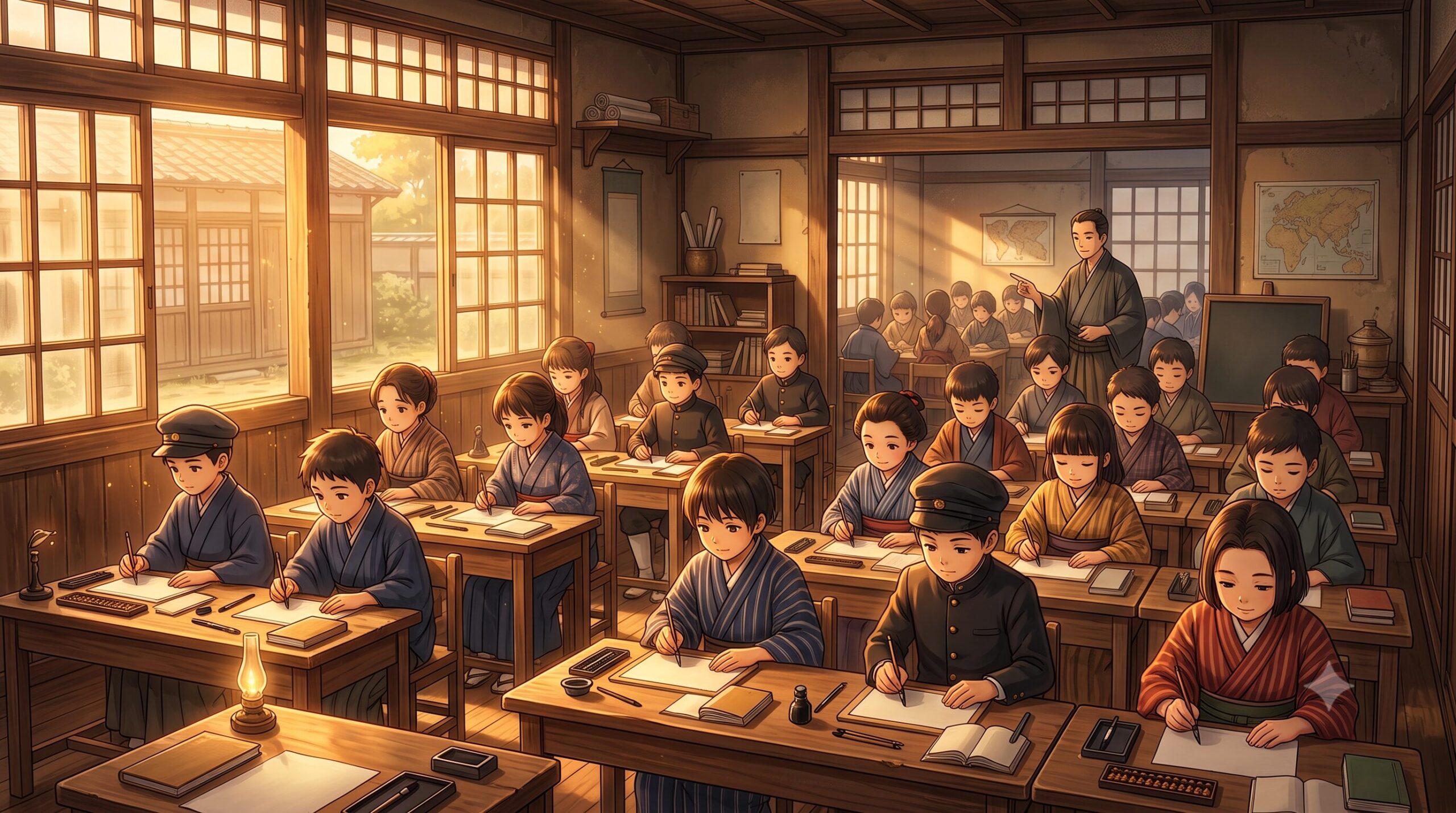
On August 3, 1872 (Meiji 5 in the old lunar calendar), the Japanese government promulgated an epoch-making law that would become the foundation of a modern state. This was the “Gakusei” (Education System Order). Today, this date is etched in history as “Gakusei Promulgation Day.” At the time, Japan was awakening from about 260 years of national isolation during the Edo period, rapidly pushing for modernization (the Meiji Restoration) to stand shoulder-to-shoulder with Western powers.
Prior to this, education in Japan was fragmented by social class and region, such as “Hanko” (domain schools) for the samurai class and “Terakoya” (temple schools) where commoners learned basic reading, writing, and arithmetic. However, the primary goal of the Gakusei was to mandate compulsory education for all citizens, regardless of social status or gender, under the ideal of equality for all people. It was the dawn of an incredibly ambitious project—especially given the nation’s economic strength at the time—to divide the country into school districts and build more than 50,000 elementary schools.
The Pursuit of Knowledge and Social Turmoil
The Gakusei raised a famous slogan: “Let there be no uneducated home in the village, and no uneducated person in the home.” It was a highly modern system incorporating French school districts and American educational content. However, there was a massive gap between ideal and reality.
The costs of building schools and paying tuition were generally expected to be borne by the citizens themselves, placing a heavy burden on impoverished farmers. Furthermore, the term “blood tax” (originally meant metaphorically as a “citizen’s duty”) used in government proclamations was misunderstood by many as “literally having one’s blood drained.” This led to widespread riots and the burning down of newly built schools across the country. The road to modernization was by no means smooth; it was fraught with blood, sweat, and chaos.
Decoding the Passion for “Learning” in Japanese Culture through Gakusei
Nearly 150 years have passed since the promulgation of the Gakusei. The fact that today’s Japan is globally recognized as a technological powerhouse and a nation with a highly refined culture is rooted in the “seeds of education” sown during this time.
In Japanese culture, “learning” (often referred to as Do or Michi, “the way”) goes beyond merely acquiring knowledge. As seen in traditional arts like the tea ceremony (Sado), flower arrangement (Kado), and martial arts (Budo), it has been revered as a process for self-discipline and spiritual elevation. Because Japanese society already had a foundation of high literacy rates cultivated in the Terakoya of the Edo period, it was able to absorb the Western-derived Gakusei system and sublimate it into a uniquely Japanese form.
Moreover, in Japanese school education since the Gakusei, activities like “Souji” (cleaning the school) and serving school lunches have been incorporated into the curriculum, requiring students to maintain their own environment and cooperate with others. This is a globally unique system and serves as a vital cultural mechanism that fosters the Japanese national character of cooperativeness, a sense of responsibility within a group, and consideration for others. The Gakusei was not merely an imported system; it merged with the traditional Japanese spirit of “Wa” (harmony) to become the starting point of a distinct educational culture.
What Do You Think?
Creating a society where everyone can learn equally, overcoming barriers of social class and gender. To us today, this seems like an obvious right, but to the people of that era, it was a world-turning revolution.
If you were living in Meiji-era Japan, how would you face this rapid change? Would you knock on the doors of the new schools, heart pounding with the excitement of unknown studies? Or would you resist, fearing the financial burden on your livelihood? Take a moment to compare the origins of your own country’s education system with Japan’s—what similarities or differences can you find?
Reference Links
- What’s Today’s Special Day Series (Blog Category)
- MEXT: 100 Years of the Education System (External Site / Japanese)
- Wikipedia: Gakusei (External Site / Japanese)
8月3日は「学制発布記念日」:日本の近代化を支えた教育の夜明け
すべての国民に学ぶ権利を。明治日本が描いた壮大なビジョン
1872年(明治5年)8月3日(旧暦)、日本政府は近代国家の基盤となる画期的な法令を公布しました。それが「学制(がくせい)」です。この日は現在「学制発布記念日」として歴史に刻まれています。当時の日本は、約260年続いた江戸時代の鎖国から目覚め、西洋列強に肩を並べるべく急激な近代化(明治維新)を推し進めていました。
それまでの日本の教育は、武士階級のための「藩校」や、庶民が読み書きそろばんを学ぶ「寺子屋」など、身分や地域によって教育内容も機会もバラバラでした。しかし、学制の大きな目的は「四民平等(すべての国民が平等であること)」の理念のもと、身分や性別に関係なく、全国民に義務教育を受けさせることでした。全国を学区に分け、5万以上の小学校を建設するという、当時の国力からすれば途方もない、非常に野心的なプロジェクトの幕開けだったのです。
知識の追求と社会の混乱
学制には「邑に不学の戸なく、家に不学の人なからしめん(村に学校に行かない家はなく、家に学ばない人がいないようにする)」という有名なスローガンが掲げられました。これは、フランスの学区制やアメリカの教育内容を取り入れた非常に近代的なものでした。しかし、理想と現実には大きなギャップがありました。
学校を建設する費用や授業料は原則として国民の自己負担とされたため、貧しい農民たちにとっては重い負担となりました。さらに、学制の布告文にあった「血税(けつぜい)」という言葉(本来は「国民の義務」という意味)を「文字通り生き血を絞られる」と誤解した人々による暴動(血税一揆)や、学校の打ちこわし事件も全国で多発しました。近代化への道のりは決して平坦なものではなく、血と汗と混乱に満ちたものでした。
学制から読み解く、日本文化における「学び」への情熱
学制の発布から約150年。今日の日本が技術大国として、また高度な文化を持つ国として世界から評価されている根底には、この時に蒔かれた「教育の種」があります。
日本文化において「学ぶこと(道・みち)」は、単に知識を得るための手段にとどまりません。茶道、華道、武道といった伝統文化に見られるように、自己を修練し、精神性を高めるためのプロセスとして尊ばれてきました。江戸時代の寺子屋ですでに高い識字率を誇っていた日本社会の素地があったからこそ、学制という西洋由来のシステムも、独自の形へ昇華させることができたのです。
また、学制以降の日本の学校教育では、「掃除(そうじ)」や「給食当番」など、生徒自身が身の回りの環境を整え、他者と協力する活動がカリキュラムに組み込まれました。これは世界的に見ても独特なシステムであり、日本人の協調性、集団における責任感、他者への配慮という国民性を育む重要な文化的装置となっています。学制は単なる制度の輸入ではなく、日本人が古来より持つ「和」の精神と結びつき、独自の教育文化を形成する出発点となったのです。
あなたはどう考えますか?
身分や性別の壁を越え、誰もが平等に学べる社会を作る。それは現代の私たちにとっては当たり前のことのように思えますが、当時の人々にとっては世界がひっくり返るほどの革命でした。
もしあなたが明治時代の日本に生きていたら、この急激な変化にどう立ち向かいますか?未知の学問に胸を躍らせて新しい学校の門を叩くでしょうか。それとも、生活の負担を恐れて抵抗するでしょうか。あなたの国の教育制度の成り立ちと比べて、どのような共通点や違いがあるか、ぜひ考えてみてください。
コメント