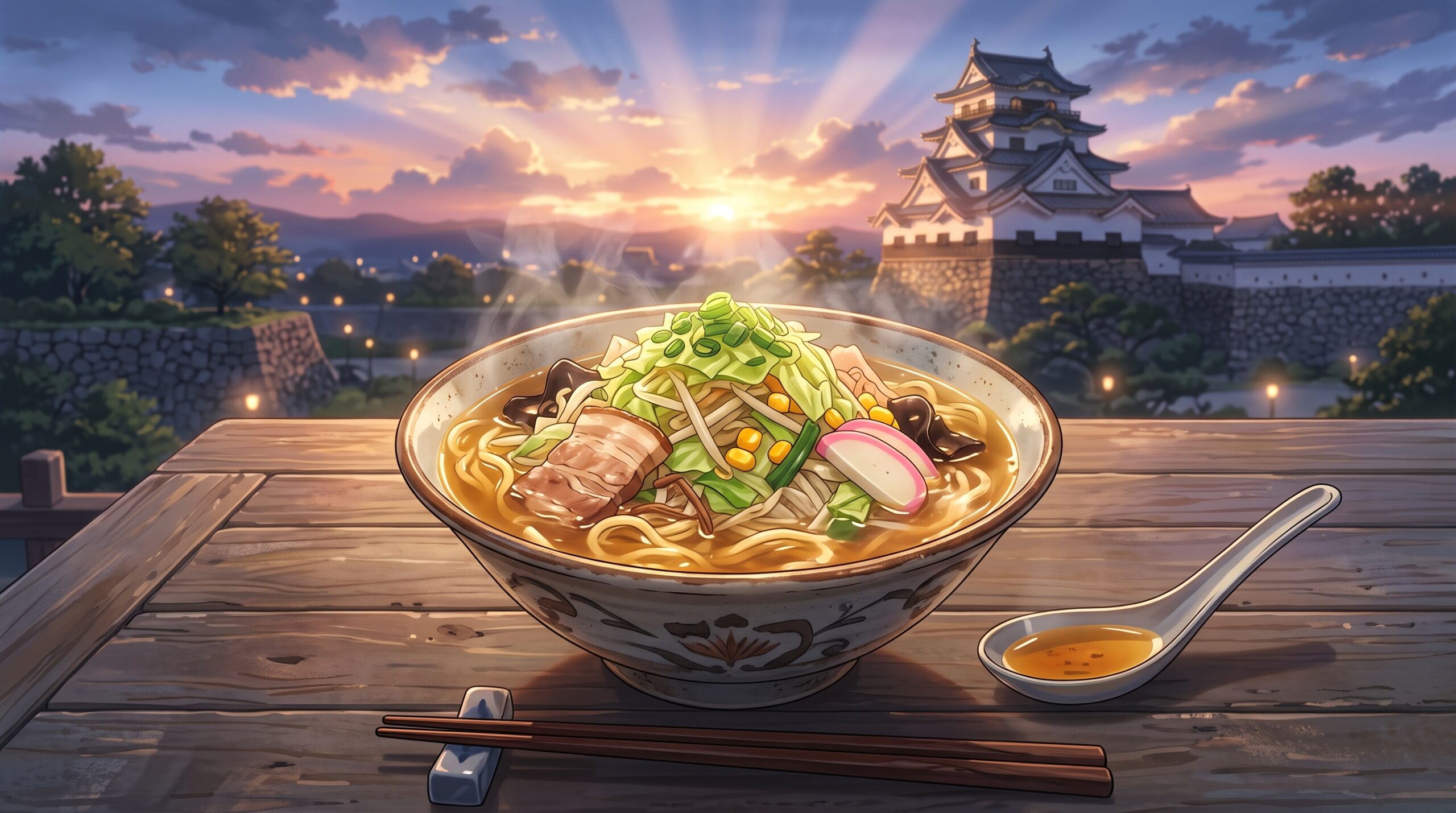
September 7th marks the celebration of “Omi Champon,” a soul food hailing from Hikone City, Shiga Prefecture, that Japan proudly shares with the world. Japanese food culture possesses a genius characteristic: the ability to refine foreign dishes with a unique sensibility, evolving them into forms perfectly suited to regional climates and tastes. While the famous Nagasaki Champon traces its roots back to Chinese noodle dishes, Omi Champon was born from a completely different and entirely original approach.
In this article, we will deeply unravel the history, cultural background, and the Japanese spirituality contained within a single bowl of this astonishing noodle dish from Shiga Prefecture. Furthermore, through a story set in Showa-era Hikone, you will relive how Omi Champon has been cherished by the local people for generations.
The Birth of Omi Champon: The Challenge of “Menrui Okabe” in Hikone City
The history of Omi Champon began in 1963 (Showa 38) at a small diner called “Menrui Okabe” established in Hikone City, Shiga Prefecture. The founder focused on the word “Champon,” which was gradually spreading across Japan at the time. However, he sought to create the ultimate bowl that would suit the palates of people in the Kansai region—especially Shiga residents—which meant departing entirely from the cloudy pork bone soup of Nagasaki.
The result was a soup based on a clear, “golden Japanese dashi” carefully extracted from Kyoto-style dried bonito flakes (katsuobushi) and kelp (kombu). A generous amount of vegetables, including pork, cabbage, green onions, and bean sprouts, are used as toppings. The most defining characteristic, however, is that they are “never stir-fried.” By directly boiling the vegetables and meat in the Japanese dashi, the natural sweetness and umami of the ingredients melt into the soup, elevating it to an exquisite masterpiece that is light yet profoundly rich. This cooking method shares its DNA with the techniques of traditional Japanese “Nabemono” (hot pots), reflecting the traditional Japanese culinary philosophy of maximizing the inherent flavor of the ingredients.
The Decisive Difference from Nagasaki Champon and the Localization of Food Culture
For overseas readers, hearing the word “Champon” might immediately bring Nagasaki Champon to mind. However, Omi Champon differs in both preparation and philosophy. Nagasaki Champon features a cloudy white broth based on pork and chicken bones, and the ingredients are stir-fried in lard before being combined with the soup. It is also characterized by the abundant use of seafood (such as shrimp and squid).
In stark contrast, Omi Champon uses absolutely no seafood; it consists solely of pork and vegetables. Shiga Prefecture is an inland prefecture with no ocean border. This geographical condition birthed the ingenuity to make the most of fresh, readily available local vegetables. Furthermore, the strong influence of the Kansai region’s unique “Dashi Culture” is heavily reflected, resulting in a gentle, body-friendly soup that you can comfortably drink down to the very last drop. This is a brilliant example demonstrating the process by which different regions of Japan flawlessly localize cuisine based on their own unique geographical and cultural backgrounds.
The Philosophy of Omi Merchants: “Sanpo-Yoshi” in a Bowl
Shiga Prefecture (formerly known as Omi Province) is the birthplace of the “Omi Merchants,” who built the foundation of the Japanese economy. Their behavioral philosophy, known as “Sanpo-yoshi” (Good for the seller, Good for the buyer, Good for society), breathes vividly within Omi Champon.
Being inexpensive, highly nutritious, and generous in portion brings joy to the “buyer” (the customer). Using easily accessible local ingredients and providing them through an efficient, zero-waste cooking method supports the sustainability of the “seller” (the restaurant). Finally, consuming massive amounts of vegetables from local farmers and supporting the health and vitality of the local people is nothing less than a grand contribution to “society” (the local community). Omi Champon is not merely a noodle dish; it is a work of art where the history and philosophy of Omi harmonize beautifully within a single bowl.
A Story: Showa-Era Hikone, The Golden Hue After the Rain
Here, we introduce a story set in Hikone during the late Showa period.
It was the 1970s, during Japan’s period of rapid economic growth. On a late afternoon amidst a cold autumn rain, Takashi, a young man working at a local factory, was walking in front of Hikone Station, shivering from fatigue and the chill. His eyes caught the traditional noren curtain of a small diner, its glass sliding doors fogged up with steam. As he slid the door open, the fragrant aroma of bonito and kelp dashi tickled his nose, instantly unravelling the tension in his heart.
“One Champon, please,” he told the cheerful woman behind the counter.
The bowl placed before him featured a mountain of vegetables, overflowing with an amber-colored, glowing golden soup. Taking a sip of the broth with his renge spoon, the piping-hot dashi and the sweetness of the vegetables permeated his freezing stomach. There was no heavy greasiness from lard—just pure, unadulterated umami racing through his entire body.
Takashi enthusiastically slurped the noodles. When he was about halfway done, he reached for the bottle of “vinegar” on the table and poured it in circles over the bowl. This is the true essence of Omi Champon. Adding vinegar dramatically changes the profile of the soup, transforming it into a mild, refreshingly crisp flavor. After drinking down the very last drop, Takashi wiped the sweat from his forehead and stepped out of the diner. The rain had stopped, and the majestic keep of Hikone Castle was illuminated by the setting sun. *I can work hard again tomorrow.* Right there, in that bowl, was a magical meal that provided exactly that kind of vital energy.
The Message Omi Champon Conveys to the Modern World
Today, Omi Champon has garnered passionate support not only as the soul food of Shiga residents but also from travelers across Japan and overseas. In an era overflowing with fast food and junk food, this style of eating massive amounts of vegetables through the natural umami of dashi perfectly aligns with rising global health consciousness.
If you come to Japan to experience its food culture, do not just limit your list to Tokyo’s sushi or Osaka’s takoyaki. Make absolutely sure to add Shiga Prefecture’s Omi Champon to your itinerary. While it may not be flashy, it is packed with the genuine warmth and wisdom that has quietly supported the daily lives of Japanese people for decades.
What Do You Think?
How do you feel knowing that such deep regional history and philosophy are hidden behind a single bowl of noodles? Does your country or region have its own unique “soul food” packed with historical background and local wisdom? If you visit Japan, wouldn’t you want to try adding “vinegar” to this clear golden soup to enjoy the dramatic change in flavor? Please share your thoughts and tell us about your local comfort foods!
■ Related Article: Read more from the “What’s Today’s Special Day?” Series
■ Deepen your knowledge of Shiga Prefecture’s tourism and food culture (External Link): Official Shiga / Biwako Travel Guide
- The Birth of Omi Champon: The Challenge of “Menrui Okabe” in Hikone City
- The Decisive Difference from Nagasaki Champon and the Localization of Food Culture
- The Philosophy of Omi Merchants: “Sanpo-Yoshi” in a Bowl
- A Story: Showa-Era Hikone, The Golden Hue After the Rain
- The Message Omi Champon Conveys to the Modern World
- What Do You Think?
- 9月7日は近江ちゃんぽんの日:日本の心を満たす黄金のスープと歴史
9月7日は近江ちゃんぽんの日:日本の心を満たす黄金のスープと歴史
9月7日は、日本の滋賀県彦根市が世界に誇るソウルフード「近江ちゃんぽん」を称える記念日です。日本の食文化は、外来の料理を独自の感性で洗練させ、地域ごとの風土に合わせた形へと進化させる天才的な特徴を持っています。長崎ちゃんぽんが中国から伝わった麺料理をルーツに持つ一方で、近江ちゃんぽんは全く異なる独自のアプローチから誕生しました。
本記事では、この滋賀県発祥の驚くべき麺料理の歴史、文化的背景、そして一杯のどんぶりに込められた日本人の精神性を深く紐解いていきます。さらに、昭和時代の彦根を舞台にした一つの物語を通じて、近江ちゃんぽんが地元の人々にどのように愛されてきたのかを追体験していただきます。
近江ちゃんぽんの誕生:彦根市「麺類をかべ」の挑戦
近江ちゃんぽんの歴史は、1963年(昭和38年)に滋賀県彦根市に開業した「麺類をかべ」という小さな食堂から始まりました。創業者は、当時の日本で徐々に広がりつつあった「ちゃんぽん」という言葉に着目しましたが、長崎の白濁した豚骨スープとは全く異なる、関西人、特に滋賀県民の味覚に合う究極の一杯を追求しました。
その結果生まれたのが、京風の鰹節と昆布から丁寧に取った透き通る「黄金の和風だし」をベースにしたスープです。具材には豚肉、キャベツ、ネギ、モヤシなどのたっぷりの野菜が使われますが、最大の特徴は「炒めない」ことです。野菜と肉を和風だしで直接煮込むことで、食材の甘みと旨味がスープに溶け出し、あっさりとしながらも深いコクを持つ絶品へと昇華されます。この調理法は、日本料理における「鍋物」の技法に通じるものであり、素材そのものの味を最大限に引き出す日本の伝統的な食の哲学が反映されています。
長崎ちゃんぽんとの決定的な違いと食文化のローカライズ
海外の読者にとって、「ちゃんぽん」と聞けば長崎ちゃんぽんを思い浮かべる人が多いかもしれません。しかし、近江ちゃんぽんは製法も思想も異なります。長崎ちゃんぽんは豚骨や鶏ガラをベースにした白湯スープで、具材をラードで炒めてからスープを合わせます。また、海鮮(エビやイカなど)が豊富に使われるのが特徴です。
対照的に、近江ちゃんぽんは海鮮を使用せず、豚肉と野菜のみで構成されます。海に面していない内陸県である滋賀県の地理的条件が、身近で手に入る新鮮な野菜を美味しく食べるための工夫を生み出しました。また、関西地方特有の「出汁(だし)文化」が色濃く反映されており、最後の一滴まで飲み干せる体に優しいスープが完成しました。これは、日本の各地域が独自の地理的・文化的背景をもとに、料理を完璧にローカライズしていく過程を示す素晴らしい実例です。
近江商人の哲学「三方よし」と一杯のどんぶり
滋賀県(旧近江国)は、日本経済の礎を築いた「近江商人」の発祥の地です。彼らの行動哲学である「三方よし(売り手よし、買い手よし、世間よし)」の精神は、近江ちゃんぽんの中にも息づいています。
安価で栄養満点、そしてボリュームたっぷりであることは「買い手(客)」にとっての喜びです。手に入りやすい地元の食材を使用し、無駄のない調理法で提供することは「売り手(店)」の持続可能性を支えます。そして、地元農家の野菜を大量に消費し、地域の人々の健康と活力を支えることは「世間(地域社会)」への貢献に他なりません。近江ちゃんぽんは、単なる麺料理ではなく、近江の歴史と哲学がどんぶりの中で見事に調和した芸術作品なのです。
物語:昭和の彦根、雨上がりの黄金色
ここで、昭和後期の彦根を舞台にした一つの物語を紹介します。
1970年代、高度経済成長期の日本。冷たい秋の雨が降る夕暮れ時、地元の工場で働く青年・タカシは、疲労と寒さで身を震わせながら彦根駅前を歩いていました。彼の目に入ったのは、湯気でガラス戸が曇った小さな食堂の暖簾です。引き戸を開けると、鰹と昆布の出汁の香りが鼻腔をくすぐり、一瞬にして心がほどけました。
「おばちゃん、ちゃんぽん一つ」
運ばれてきたどんぶりには、山のように盛られた野菜と、琥珀色に輝く黄金のスープがなみなみと注がれていました。レンゲでスープを一口すすると、熱々の出汁と野菜の甘みが冷え切った胃の腑に染み渡ります。ラードの重たさはなく、ただ純粋な旨味が全身を駆け巡りました。
タカシは夢中で麺をすすり、半分ほど食べたところで、卓上に置かれた「お酢」をどんぶりに回しかけました。これが近江ちゃんぽんの真髄です。酢を加えることでスープの輪郭が劇的に変化し、まろやかでさっぱりとした味わいに生まれ変わるのです。最後の一滴まで飲み干したタカシは、額の汗を拭いながら店を出ました。雨は上がり、彦根城の天守閣が夕日に照らされていました。明日もまた頑張れる。そんな活力を与えてくれる魔法の一杯が、そこにはありました。
近江ちゃんぽんが現代に伝えるメッセージ
現在、近江ちゃんぽんは滋賀県民のソウルフードとしてだけでなく、日本全国、そして海外の旅行者からも熱烈な支持を集めています。ジャンクフードが溢れる現代において、たっぷりの野菜を自然な出汁の旨味で食べるこのスタイルは、健康志向の高まりとも完璧に合致しています。
日本の食文化を体験するために来日するなら、東京の寿司や大阪のたこ焼きだけでなく、滋賀県の近江ちゃんぽんを必ずリストに加えてください。そこには、派手さはないものの、日本人の日常を支えてきた本物の温もりと知恵が詰まっています。
あなたはどう感じましたか?
一杯の麺料理の背後に、これほどまでに深い地域の歴史と哲学が隠されていることを知って、どう思いましたか?あなたの国や地域にも、歴史的な背景や地元の知恵が詰まった独自の「ソウルフード」はありますか?もし日本を訪れたなら、この透き通る黄金のスープに、あなたも「お酢」を入れて味の変化を楽しんでみたいと思いませんか?ぜひ、あなたの考えや地元の料理について教えてください。
■ 関連記事:今日の記念日シリーズをもっと読む
■ 滋賀県の観光と食文化について深く知る(外部リンク):滋賀・びわ湖観光情報 公式サイト


コメント