- 1. The Story of the Cowardly Man and the “Amenbuchi Obake” (Raindrop Monster)
- 2. Story Analysis: The Power of Perception and a Supportive Partner
- 3. Connection to Japanese Culture: “Tsukumogami” (Spirits in Objects)
- 4. What Would You Do?
- 5. Related Links
- 1. 臆病な男と「雨んぶちおばけ」の物語
- 2. 物語の考察:思い込みの力とパートナーの存在
- 3. 日本文化との関連:万物に宿る魂「付喪神(つくもがみ)」
- 4. あなたなら、どうしますか?
- 5. 関連リンク集
1. The Story of the Cowardly Man and the “Amenbuchi Obake” (Raindrop Monster)
Once upon a time, there lived a man who was ridiculously cowardly. His cowardice was so extreme that, despite being a full-grown adult, he couldn’t even go to the bathroom alone at night. Every time he needed to relieve himself in the dark, he would wake up his wife and make her accompany him to the outhouse.
One summer day, the man was invited to a Buddhist memorial service in the village. Terrified of walking home in the dark, he didn’t even touch the delicious simmered dishes and fish prepared for the guests. He rushed out in a panic to make it home before sunset. Trembling with fear, he lost his footing in his haste, fell hard on his waist, and had to practically crawl his way back to his front door.
Just as he reached his house, something icy cold touched the back of his neck.
“Hyaaa! A monster! Get your freezing hand off me!!”
Hearing his earth-shattering scream, his startled wife rushed outside. But there was no monster in sight. It was simply a large raindrop—an “Amenbuchi”—falling from the eaves after an evening shower, which had landed squarely on his neck. The “icy hand of the monster” was nothing more than a drop of water.
“What’s all this fuss? It’s just a raindrop,” his wife laughed, wiping his neck with a towel. Then, she casually declared, “All the other monsters out there in the world are probably just like this raindrop.”
Struck by a sudden realization, the man thought, “She’s right! All monsters are just like raindrops!” This simple shift in perspective instantly cured his cowardice. From that night on, he could proudly go to the bathroom entirely alone.
Sometime later, rumors began to spread through the village that a real monster had appeared. Hearing this, the man scoffed, “Monsters are just raindrops! Why don’t these people understand?” Grabbing a long bamboo pole, he confidently marched out into the night to defeat the beast.
When he reached the graveyard, he found a creepy monster beckoning him, chanting, “Come here, come here.” While an ordinary villager would have fainted from terror, our newly fearless man was completely unfazed.
“Hey, where are you going? Hurry up and move!”
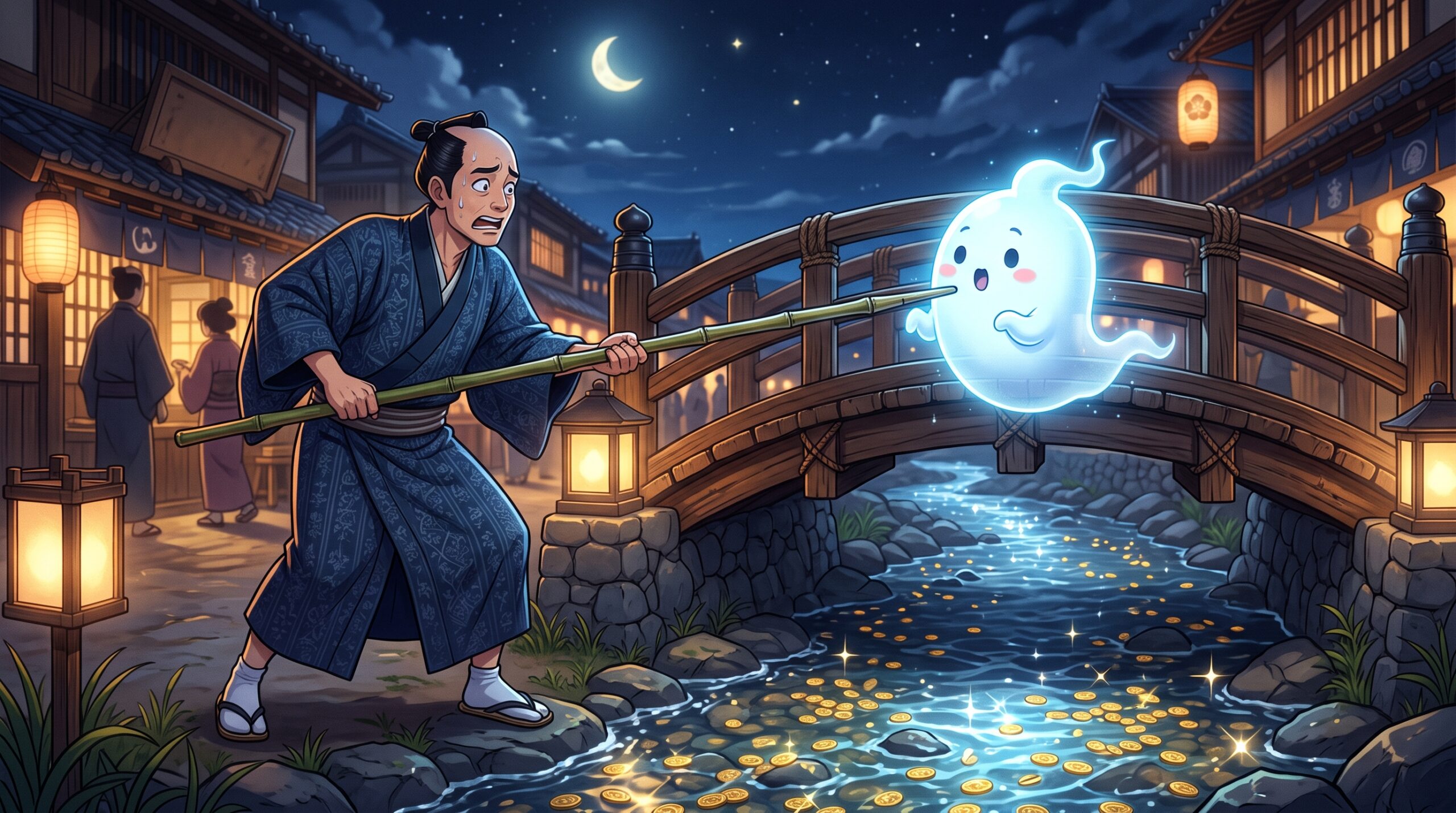
He began poking and prodding the monster with his bamboo pole, forcing it to walk forward. When they reached a small bridge over a stream, the monster suddenly vanished into thin air. Puzzled, the man poked the bottom of the stream with his pole and heard a distinct clinking sound.
He stepped into the water, felt around the riverbed, and discovered a large pot filled to the brim with gold coins (Koban). These coins had been submerged in the freezing river for so long that they developed a soul. Desperate for someone to find and use them, they had manifested as a monster to guide a human to their location. Thanks to this gold, the man and his wife lived out their days wealthier and happier than ever before.
2. Story Analysis: The Power of Perception and a Supportive Partner
This folktale comically illustrates how subjective and ambiguous human “fear” can be. The man’s extreme cowardice was fueled by his overactive imagination regarding the dark. However, his wife’s somewhat dismissive comment—that “all monsters are just like raindrops”—drastically altered his perception. This reflects a universal truth akin to modern psychology: simply changing your perspective can make the world look entirely different.
Furthermore, the wife’s role in this story is crucial. She didn’t scold him for his cowardice, nor did she coddle him. Her ability to laugh off his irrational fear as just another everyday occurrence ultimately helped him grow and led them to a fortune.
3. Connection to Japanese Culture: “Tsukumogami” (Spirits in Objects)
The cultural view unique to Japan that can be read from this story is “Animism” (the belief that spirits dwell in all things in nature). While Western monsters are often depicted as absolute evil or objects of pure terror, Japanese yokai (monsters/spirits) are somewhat human-like and occasionally even charming.
At the end of the story, the monster’s true identity is revealed to be a pot of gold coins submerged in the riverbed. This ties directly into the Japanese concept of “Tsukumogami”—the idea that tools or objects left unused for a long time acquire a spirit and become yokai. Money has value only when it is used. Unable to bear sitting idle in the cold riverbed, the coins’ desperate desire to be “used” manifested in the form of a monster. This expresses the Japanese aesthetic of valuing objects and ensuring they fulfill their intended purpose.
4. What Would You Do?
This is the tale of a man who conquered his fears over a simple drop of water and ultimately found a massive fortune. In our own lives, many of the “monsters” we fear might just be harmless “raindrops.” What is something you are terrified of and actively avoiding right now? If you gather your courage and poke it with a bamboo pole, you might just uncover a hidden treasure. How did you feel reading this story? Let me know in the comments below!
5. Related Links
- Read more from the Japanese Folktale Series
- Reference: Manga Nippon Mukashibanashi Database “Amenbuchi Obake” (Japanese)
日本のユーモアと哲学が詰まった昔話「雨んぶちおばけ」の世界へようこそ
1. 臆病な男と「雨んぶちおばけ」の物語
むかしむかし、ある所に、呆れるほど臆病な男が住んでいました。その臆病さは筋金入りで、いい大人であるにもかかわらず、夜中に一人でトイレに行くことすらできません。用を足したくなるたびに女房を叩き起こし、便所までついて来てもらう始末でした。
ある夏の日、男は村の法事に招かれました。しかし、夜道を帰る恐怖から、せっかくのご馳走であるお煮しめや魚には一切手をつけることなく、日が暮れる前にと大慌てで家路につきます。暗闇への恐怖から足元はおぼつかず、途中で派手に転んで腰を強く打ち、這うようにしてなんとか自宅の戸口までたどり着きました。
その時です。男の首筋に「ヒヤリ」と冷たいものが触れました。
「ひゃー!!化け物!そのひゃっこい手をどけてくれろ!!」
男がこの世の終わりのような悲鳴を上げたため、驚いた女房が慌てて飛び出してきました。しかし、そこに化け物などいません。昼間に降った夕立の雨水が、軒先から「雨んぶち(雨のしずく)」としてポタリと落ち、男の首筋に当たっただけだったのです。化け物の冷たい手だと思ったものは、ただの雨水でした。
「なーんだ、雨んぶちでねえか」と笑いながら、女房は男の首筋を手ぬぐいで拭いてやりました。そして、こう言い放ちます。「世の中にいる他の化け物も、みんなこの雨んぶちみたいなもんや」
この言葉を聞いた男は雷に打たれたような衝撃を受け、「そうか、化け物なんてみんな雨んぶちみたいなものなんだ!」と思い込みます。これを境に男の臆病は完全に直り、夜中でも一人で堂々とトイレに行けるようになりました。
それからしばらく経ったある日。村で「本物の化け物が出た」という噂が立ちました。それを聞いた男は「化け物なんて、みんな雨んぶちじゃ!なぜ皆の衆はそれがわからんのか!」と息巻き、長い竹ざおを握りしめ、化け物を退治する勢いで夜の闇へと飛び出していきました。
男が墓場を通りかかると、噂通り、不気味な化け物が「ついてんこ~、ついてんこ~(ついて来い、ついて来い)」と手招きをしています。普通の村人なら腰を抜かして気絶する場面ですが、恐怖心を完全に克服した男は全く動じません。
「ほら、どこさ行く?はよ行け!!」
男は竹ざおで化け物をツンツンと小突きながら、どんどん前へ歩かせました。やがて小川にかかる橋のたもとまで来ると、化け物はフッと姿を消してしまいます。不思議に思った男が、小川の底を竹ざおで突っついてみると「シャリシャリ」と硬い音が鳴りました。
男が川の中に入って底をさぐると、なんとそこには小判がぎっしり詰まった壺が沈んでいたのです。長い間、冷たい川底に沈んでいた小判たちが「誰かに使ってほしい」という強い念を持ち、化け物となって現れ、人を導いていたのでした。この小判のおかげで、男と女房は以前にも増して仲良く、そして大変豊かに暮らしました。
2. 物語の考察:思い込みの力とパートナーの存在
この昔話は、人間の「恐怖」がいかに主観的で曖昧なものであるかをコミカルに描いています。男の異常なまでの臆病さは、暗闇に対する過剰な想像力によるものでした。しかし、妻の「化け物はみんな雨のしずくのようなものだ」という適当とも言える一言が、男の認識を劇的に変えました。これは、視点を変えるだけで世界が全く違って見えるという、現代の心理学にも通じる普遍的な真理です。
また、この物語において妻の存在は非常に重要です。夫の臆病さを責めることなく、また大げさに慰めることもなく、日常の一コマとして笑い飛ばした彼女の大らかさが、結果的に夫を成長させ、さらには幸運(小判)を引き寄せるきっかけとなりました。
3. 日本文化との関連:万物に宿る魂「付喪神(つくもがみ)」
この物語から読み取れる日本独特の文化観は、「アニミズム(自然界のあらゆるものに魂が宿るという考え方)」です。西洋のモンスターがしばしば絶対的な悪や恐怖の対象として描かれるのに対し、日本の妖怪やお化けは、どこか人間臭く、時に愛嬌すらあります。
物語の結末で、化け物の正体が「川底に沈んでいた小判の壺」であることが明かされます。これは日本の「付喪神(つくもがみ)」という概念に直結します。使われずに放置された道具や物に魂が宿り、妖怪となるという考え方です。お金は使われてこそ価値があるもの。冷たい川底でじっとしていることに耐えられなくなった小判の「使ってほしい」という切実な願いが、化け物の姿をとって現れたのです。ここには、物を大切にし、それぞれの役割を全うさせようとする日本人の美意識が表れています。
4. あなたなら、どうしますか?
ただの雨粒から恐怖を克服し、最後には大金を手に入れた男の物語。人生において、私たちが恐れている「化け物」の多くも、実はただの「雨んぶち(雨粒)」に過ぎないのかもしれません。あなたが今、どうしても怖くて避けているものは何ですか? もし勇気を出してその正体を竹ざおで突っついてみたら、思いがけない宝物が隠されているかもしれませんよ。この物語を読んで、あなたはどう感じましたか?ぜひコメント欄で教えてください。

コメント