1. The Story of “Chobei the Hole Digger”
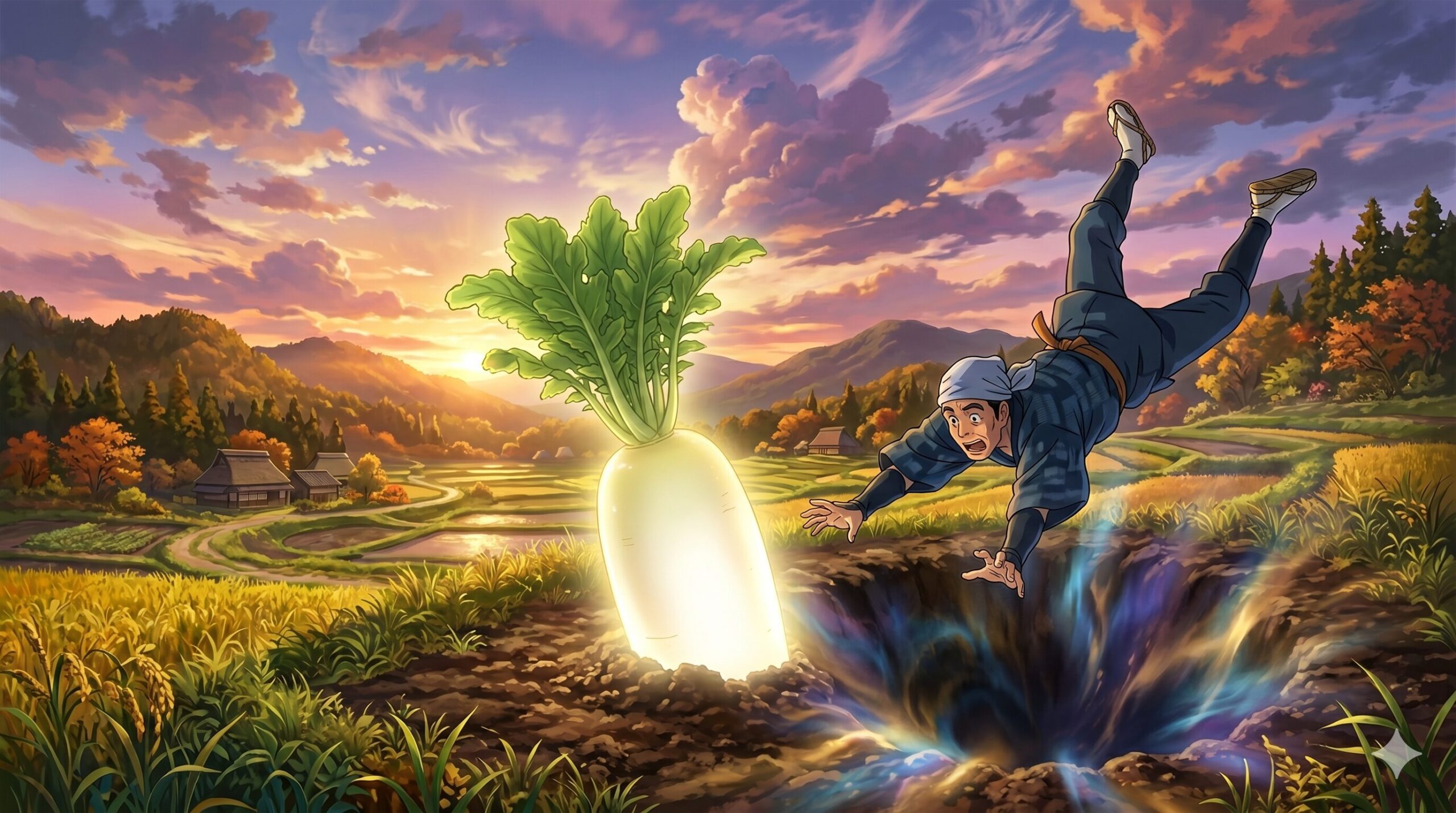
Once upon a time, a good-natured old man and old woman lived in a quiet Japanese village. One autumn day, when they went to harvest radishes (daikon) in their backyard field, they discovered a giant radish, larger than anything they had ever seen. They pulled with all their might, but it wouldn’t budge. Realizing they couldn’t do it alone, the old man went to call Chobei, the village’s most skilled well digger.
Chobei arrived at the field, took his hoe, and immediately began digging around the massive radish. He dug for one day, then two, but the full shape of the radish was still hidden. He continued digging without rest for seven days and seven nights until he finally saw the tip of the radish. Chobei tied a thick rope to the top of the radish and pulled with all his strength, shouting, “Now, it’s finally coming out!”
At that exact moment, with a loud snap, the tail of the radish broke off. Losing his balance, Chobei tumbled headfirst into the bottomless hole he had just dug, falling straight down alongside the broken radish tail. He fell endlessly through the darkness, breaking right through the bottom of the earth, until he arrived in a terrifying place: “Hell” (Jigoku).
The demons of Hell were sent into a panic upon seeing a man suddenly fall from the sky. Mistaking him for a terrible sinner, they tied Chobei up and dragged him before King Enma, the great judge of the underworld. However, Chobei was just an honest well digger and had done nothing wrong. After King Enma strictly examined his records of the living, Chobei was proven completely innocent.
Feeling sorry for Chobei, King Enma gave him special magical pills to return to the surface. He instructed, “Swallow one pill, and your body will float halfway up the hole. Swallow two, and you will reach the surface. I will give you three just in case the magic is weak, but you must take them strictly one by one.”
Overjoyed that he could return home safely, Chobei completely forgot King Enma’s careful warning. In his excitement, he swallowed all three pills at once. Instantly, Chobei’s body began to shoot upward at incredible speed. He burst out of Hell, flew right past the earth’s surface, and shot high into the sky, landing above the clouds.
Up in the heavens, the Thunder Gods (Raijin) were in deep trouble. The god in charge of playing the taiko drum to summon rain had fallen ill, and they couldn’t create thunderstorms. Seeing Chobei fly up, the Thunder God commanded, “Perfect timing! You, play the drum instead!”
As Chobei played the taiko with all his might, the Thunder God scooped water from a bucket and scattered it over the earth, creating a magnificent thunderstorm. Delighted by the rain nourishing the land below, Chobei got completely carried away. He hit the drum harder and faster until, finally, he smashed right through the drumhead.
The Thunder God was furious. “You fool!” he roared, chasing Chobei around the clouds. Trying to escape, Chobei slipped from the cloud and began falling backward to the earth once again. Fortunately, he caught onto a tree branch at the foot of Mount Iwaki in Aomori Prefecture, saving his life. From there, a strong wind blew him away to a place called Tomita in Hirosaki. It is passed down in local folklore that the name “Tomita” originally came from “Tobita” (meaning “flew”), named after the legend of Chobei flying into the town.
2. Deep Analysis of “Chobei the Hole Digger”
The greatest charm of this story lies in its overwhelming scale and continuous, unpredictable twists. Usually, in myths and folktales, traveling to the “Underworld” or “Heaven” is depicted as a hero’s trial or a sacred ritual. However, in “Chobei the Hole Digger,” a mundane agricultural task (digging a radish) unexpectedly plunges the protagonist into otherworldly realms through an accident.
Chobei is not a brave hero with special powers; he is just a well digger. Even when he falls into Hell, there is no sense of tragedy. Instead, every crisis is transformed into a comical situation—from being falsely arrested to his innocent verdict, and ending up playing drums in Heaven. This reflects the powerful spirit of the common people in historical Japan, who tried to overcome the unpredictable hardships of life, harsh nature, and grueling labor through “laughter.” Furthermore, the fact that Chobei’s own human greed and carelessness (swallowing all three pills at once) trigger his biggest trouble makes this narrative brilliantly human.
3. What We Learn About Japanese Culture
This folktale vividly reflects unique Japanese culture and beliefs. First, the “Daikon radish,” the starting point of the story, is one of the most familiar and essential crops in Japanese agriculture. A giant crop symbolizes a bountiful harvest and reverence for nature’s power.
Moreover, “King Enma,” the ruler of Hell, originates from Buddhist teachings, but in Japanese folk belief, he is not merely terrifying; he is often depicted as compassionate and reasonable, just as he is in this story. Furthermore, the “Thunder God” (Raijin) in Heaven plays the role of an agricultural deity who brings the rain essential for crops. The imagery of Chobei beating the drum while the Thunder God scatters water is a clear, animistic personification of thunder and rain.
Most notably, the conclusion of the story serves as an origin tale for a real place name. The folklore claims that the actual place name “Tomita” in Hirosaki City, Aomori Prefecture, derived from Chobei “flying” (Tobita). While this differs from documented historical facts regarding the evolution of the place name, blending geographical reality with fiction allowed local communities to pass down these tales as their own intimate, regional history.
4. How Would You Live? Lessons from Chobei
Chobei’s grand adventure presents us with several questions. If King Enma handed you magical pills and told you to “take them one by one,” would you remain calm and follow his instructions? Or would you, like Chobei, become so desperate to escape your current situation that you swallow them all at once?
In life, taking shortcuts or getting too carried away can lead to unexpected failures. Yet, at the same time, Chobei’s resilience—somehow surviving no matter where he falls or flies—gives us the courage to live without fearing mistakes. What did you feel after reading this bizarre folktale? If you were in Chobei’s shoes, how would you have acted above the clouds? Please share your thoughts with us!
External Links:
Source: Manga Nippon Mukashibanashi Database “Anahori Chobei”
Hirosaki City Tourism Information (Real history and culture of Mt. Iwaki and Tomita area)
Internal Link:
Read more articles in our Japanese Folktale Series
【日本の昔話】巨大大根から地獄と天界へ!「あなほり長兵衛」の奇想天外な大冒険
1. 昔話「あなほり長兵衛」のストーリー
むかしむかし、ある村に人の良いお爺さんとお婆さんが住んでいました。ある秋の日のこと、二人が裏の畑へ大根を収穫しに行くと、そこには今まで見たこともないほど巨大な大根が育っていました。二人は力いっぱい引っ張りましたが、大根はびくともしません。「これは我々の手には負えない」と考えたお爺さんは、村で一番の穴掘り(井戸掘り)名人である長兵衛どんを呼びに行きました。
長兵衛どんは畑にやってくると、さっそく鍬を手に取り、巨大な大根の周りを掘り始めました。一日、二日と掘り進めても、大根の全貌は見えません。なんと七日七晩も休まずに掘り続け、ようやく大根の先端が見えてきました。長兵衛どんは大根の頭に太い縄を結びつけ、「さあ、これで引き抜けるぞ!」と力いっぱい引っ張りました。
その瞬間、「バキッ!」という大きな音とともに、大根のしっぽが折れてしまいました。勢い余った長兵衛どんはバランスを崩し、自分が掘った底なしの深い穴の中へ、大根のしっぽと共に真っ逆さまに落ちていきました。暗闇の中をどこまでも落ち続け、ついに地面の底を突き破って到着したのは、なんと恐ろしい「地獄」でした。
突然空から降ってきた長兵衛どんを見て、地獄の鬼たちは大慌て。「大変だ、とんでもない悪人が落ちてきたぞ!」と勘違いした鬼たちは、長兵衛どんを縛り上げ、地獄の裁判官である閻魔大王の前に引きずり出しました。しかし、長兵衛どんは真面目な穴掘り職人であり、悪いことなど一切していません。閻魔大王が過去帳を厳格に調べた結果、長兵衛どんの完全な無罪が証明されました。
閻魔大王は長兵衛どんを気の毒に思い、地上へ帰るための特別な丸薬を与えました。「この丸薬を一粒飲めば体が宙に浮き、穴の途中まで昇る。二粒飲めば地上まで辿り着く。もし効き目がなかった時のために三粒渡しておくが、必ず一粒ずつ飲むのだぞ」と念を押しました。
長兵衛どんは無事に帰れると分かり、大喜びしました。しかし、嬉しさのあまり閻魔大王の忠告を完全に忘れ、手元にあった三粒の丸薬をいっぺんに飲み込んでしまったのです。すると、長兵衛どんの体は凄まじい勢いで上昇を始めました。地獄を抜け、地上を通り越し、そのまま空高く雲の上まで飛んでいってしまいました。
雲の上では、雷様たちが困り果てていました。雨を降らせるための太鼓係が病気で休んでおり、雷を鳴らすことができなかったのです。そこへ長兵衛どんが飛んできたため、雷様は「ちょうどいいところに来た!お前、代わりに太鼓を叩け」と命じました。
長兵衛どんが一生懸命に太鼓を叩くと、雷様が桶から水を汲んで地上に撒き、見事な雷雨となりました。地上を潤す雨に気分を良くした長兵衛どんは、調子に乗って力いっぱい太鼓を連打しました。ドンドンドンドン!と叩きすぎた結果、とうとう太鼓の皮が破れてしまいました。
これには雷様も大激怒。「この罰当たりめ!」と長兵衛どんを追いかけ回します。逃げ惑う長兵衛どんは、ついに雲の上から足を滑らせ、再び真っ逆さまに落ちていきました。幸運なことに、青森県の岩木山のふもとにある木の枝に引っかかり、命拾いをします。しかし、そこから強い風に吹かれて、弘前の富田という場所まで飛ばされてしまいました。富田が昔「とびた(飛んだ)」と呼ばれていたのは、この長兵衛どんが飛んできたという伝説に由来していると語り継がれています。
2. 「あなほり長兵衛」の深い考察
この物語の最大の魅力は、圧倒的なスケール感と予期せぬ展開の連続にあります。通常、神話や民話において「地下世界(地獄)」や「天上世界(天界)」へ行くことは、英雄の試練や神聖な儀式として描かれます。しかし、「あなほり長兵衛」では、単なる農業の日常(大根掘り)から偶然の事故によって異界へと突入します。
長兵衛どんは特別な力を持った勇者ではなく、ただの井戸掘り職人です。彼が地獄に落ちても悲壮感はなく、誤認逮捕からの無罪放免、そして天界での太鼓叩きというように、ピンチがすべてコミカルな出来事へと変換されていきます。これは、厳しい自然環境や過酷な労働の中で生きていた庶民たちが、人生における予測不能な困難を「笑い」で乗り越えようとした力強い精神性を表しています。丸薬を三つ同時に飲んでしまうという長兵衛どんの「人間の欲やそそっかしさ」が、結果として最大のトラブルを引き起こす点も、非常に人間味に溢れた秀逸な物語構造です。
3. 昔話から読み解く日本文化との関連性
「あなほり長兵衛」には、日本独自の文化や信仰が色濃く反映されています。まず、物語の起点となる「大根」は、日本の農業において最も身近で重要な作物のひとつです。巨大な作物は豊穣の象徴であり、自然への畏敬の念を示しています。
また、地獄の管理者である「閻魔大王」は、仏教の教えに基づく存在ですが、日本の民間信仰では恐ろしいだけでなく、本作のように情け深く、道理の分かる存在として親しまれてきました。さらに天上界の「雷様(雷神)」は、農作物に不可欠な雨をもたらす農業神としての役割を持っています。長兵衛どんが太鼓を叩き、雷様が水を撒く描写は、雷と雨の自然現象を擬人化した日本古来のアニミズム的な世界観を分かりやすく伝えています。
そして最も注目すべきは、物語の結末が「地名の由来(地名起源譚)」に繋がっている点です。青森県弘前市にある「富田」という実際の地名が、長兵衛どんが「飛んだ(とびた)」ことに由来するという語り口は、歴史的事実に基づく地名の変遷とは異なる、民衆の想像力による伝承です。現実の地理とフィクションを交差させることで、地域の人々はこの物語を自分たちの身近な歴史として語り継いできたのです。
4. あなたはどう生きる?長兵衛の教訓
長兵衛どんの大冒険は、私たちに多くの問いを投げかけます。もしあなたが閻魔大王から「一粒ずつ飲むように」と丸薬を渡されたら、焦らずに指示通りに飲むことができますか?それとも、長兵衛どんのように一刻も早く現状から抜け出したいと焦り、すべて飲み込んでしまうでしょうか。
人生においても、近道をしようとしたり、調子に乗ってやり過ぎたりすると、思いがけない失敗を招くことがあります。しかし同時に、どんな場所に落ちても(あるいは飛んでいっても)なんとか生き延びる長兵衛どんのたくましさからは、失敗を恐れずに生きる勇気をもらえます。あなたはこの奇想天外な昔話を読んで、何を感じましたか?長兵衛どんの立場なら、雲の上でどのように振る舞ったでしょうか。ぜひ、あなたの考えを聞かせてください。
外部リンク:
参考元:まんが日本昔ばなしデータベース「あなほり長兵衛」
青森県弘前市観光情報サイト(岩木山・富田地域の現実の歴史と文化)
コメント