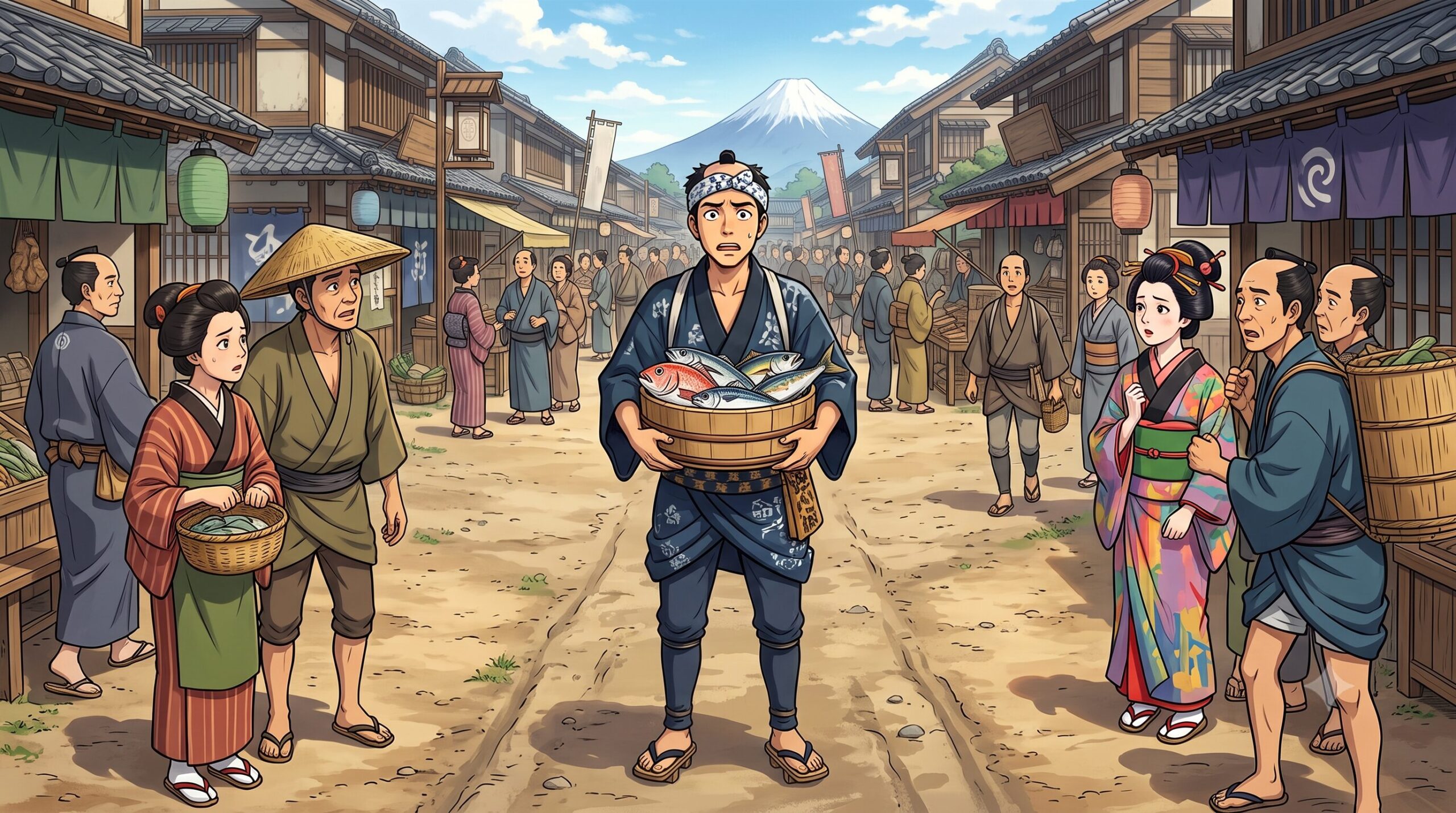
At the root of Japan’s rich culture lies a unique etiquette of communication. Today, we introduce the humorous folktale “The Foolish Son’s Fish Shop,” which conveys this essence perfectly. This story is not merely a comedy; it teaches one of the most critical skills required to survive in Japanese society.
Synopsis: The Foolish Son’s Fish Shop
Once upon a time, in a certain town, lived an extremely lazy and foolish young man. He spent his days idling about, but eventually, he reached a marriageable age and took a wife. However, even after getting married, he showed absolutely no signs of working.
Unable to just watch him do nothing, his wife persuaded him to start a business as a fishmonger. She carefully instructed him, “Go to places where large crowds gather and shout in a loud voice, ‘Would you like some fresh fish!'” and sent him on his way.
Carrying his fish, the man’s first encounter was a house where a large crowd had gathered for a funeral. Exactly as instructed, the man cheerfully shouted, “Would you like some fresh fish!” Naturally, the grieving family was furious, and he was promptly chased out.
Returning home dejected, his exasperated wife taught him, “In such situations, you are supposed to offer your condolences. If you do that, they might even buy some fish.”
The next day, the man encountered a joyous household celebrating a wedding. Following yesterday’s lesson, he offered deep condolences: “It is such a pity that someone was lost…” Predictably, they were enraged and chased him out.
When he returned home, his wife said, “At such a celebratory occasion, you are supposed to sing a congratulatory song like the ‘Takasago’.”
The following day, while walking, the man came across a raging fire. Standing calmly in front of the flames, he began to loudly sing the celebratory “Takasago.” The firefighters, desperately trying to extinguish the blaze, were furious and drove him away.
Sighing deeply, his wife taught him, “At a fire, you are supposed to throw a bucket of water to help put it out.”
The next day, the man walked past a blacksmith’s shop. Seeing the brightly burning fire in the forge, he immediately threw water on it, putting the fire out. The blacksmith was enraged and chased him out.
His wife taught him once more, “At a blacksmith’s shop, you are supposed to help them strike the hammer.”
The next day, the man stumbled upon a couple having a fierce argument. Following his instructions, he took out a hammer and struck the husband hard on the head. The wife screamed, and he was chased away.
His wife said, “When people are fighting, you should intervene by saying, ‘Please stop and leave out of respect for me.'”
And so, the next day, the man encountered two massive bulls glaring and locking horns with each other. The man stepped between the two beasts and attempted to persuade them, “Now, now, please leave out of respect for me…” As a result, he was mercilessly chased around by the furious bulls.
In the end, the foolish son was never able to become a successful fishmonger.
Folktale Analysis: Why Does He Keep Failing?
The comical nature of this story lies in the protagonist’s literal application of rules without any contextual awareness. His wife’s advice is always the perfect correct answer for the *previous* situation. However, the protagonist blindly applies this past formula for success to the next, completely different scenario.
He only grasps superficial events like “people gathering” or “fire burning,” completely failing to understand the emotions of the people involved or the underlying meaning of the events. This serves as a strong satire from people of the past directed at those who can only operate according to a rigid manual.
Connection to Japanese Culture: “Reading the Air” and the Art of TPO
The most crucial elements of Japanese culture to decipher from this folktale are the concept of “Kuuki wo yomu” (reading the air/room) and the absolute importance of “TPO” (Time, Place, Occasion).
Japan possesses one of the world’s most “high-context cultures.” Even without explaining everything in words, one is strongly expected to infer “what I should do right now” from the atmosphere, facial expressions, and situational background. This “foolish son” is depicted as the ultimate symbol of someone who cannot read context at all in this high-context society.
Even in modern Japanese society, behavior tailored to TPO is highly prioritized—from ceremonial occasions and business scenes to daily communication. Through this negative example, the story teaches how vital it is to carefully observe one’s surroundings and empathize with others’ feelings.
Learn More About Japanese Folktales
The best way to understand Japan’s rich spirituality is to explore its folktales.
Read more from our Japanese Folktale Series
Reference: Manga Nippon Mukashibanashi Database – The Foolish Son’s Fish Shop
To Our Readers
How did you feel reading about the foolish son’s massive failures? Most of us have probably experienced trying to help, only to have it backfire because it didn’t fit the situation. If you were this man’s friend, what kind of advice would you give him? Let us know what you think and what you would do differently!
日本の昔話「あほうむすこの魚屋さん」が教えるコミュニケーションの真髄
日本の豊かな文化の根底には、独自のコミュニケーション作法があります。今回は、その神髄をユーモアたっぷりに伝える昔話「あほうむすこの魚屋さん」をご紹介します。この物語は単なる笑い話にとどまらず、日本社会で生きていく上で最も重要なスキルの一つを教えてくれます。
あらすじ:あほうむすこの魚屋さん
むかしむかし、ある町に大変な怠け者の「あほうむすこ」が住んでいました。毎日ぶらぶらと遊んでばかりの男でしたが、年頃になり嫁をもらいます。しかし、結婚後も一向に働く気配がありません。
見かねた嫁は男を説得し、魚屋として商いをさせることにしました。嫁は「人が大勢集まっている場所へ行って、『とりたての魚はいらんかね〜』と大きな声で売るのですよ」と丁寧に教え、男を送り出しました。
魚を担いで出かけた男が最初に出くわしたのは、お葬式で大勢の人が集まっている家でした。男は教えられた通り、元気よく「とりたての魚はいらんかね〜!」と叫びました。当然、遺族は激怒し、男は追い出されてしまいます。
落ち込んで帰宅した男に、嫁は呆れながら教えます。「そういう場では、お悔やみの言葉を言うものです。そうすれば魚も買ってくれますよ」
翌日、男は結婚式を挙げているおめでたい家に出くわします。そこで男は昨日の教え通り、「惜しい人を亡くしてしまいましたね……」と深くお悔やみを申し上げました。当然、またしても激怒され追い出されます。
帰宅すると嫁は言いました。「そういうおめでたい席では、『高砂(たかさご)』のような祝いの歌を歌うのですよ」
翌日、男が歩いていると火事場に遭遇します。男は火の前で悠然と「高砂や〜」と祝いの歌を歌い始めました。必死に火を消している火消したちは激怒し、男を追い返します。
嫁はため息をつきながら教えます。「火事場では、水の一杯でもかけて火を消す手伝いをするものですよ」
翌日、男は鍛冶屋の前を通りかかります。赤々と燃える炉の火を見た男は、すかさず水をかけて火を消してしまいました。鍛冶屋は激怒し、男を追い出します。
嫁はまた教えます。「鍛冶屋では、向こう槌(相槌)を打ってあげるものですよ」
翌日、男は激しい夫婦喧嘩をしている現場に出くわします。男は教え通り、槌を持ち出して夫の頭を思い切り叩きました。女房は泣き叫び、男は追い出されます。
嫁は言いました。「そういう喧嘩の場では、『私に免じてここはお引き取りください』と仲裁するものですよ」
そして翌日、男は二頭の大きな牛が角を突き合わせて睨み合っている場に出くわします。男は二頭の牛の間に割って入り、「まあまあ、私に免じてお引き取りを……」と説得を試みました。結果、怒り狂った牛たちに散々追い回される羽目になりました。
こうして、あほうむすこはいつまで経っても魚屋になることはできませんでした。
昔話の考察:なぜ彼は失敗を繰り返すのか
この物語の滑稽さは、主人公が「ルールやアドバイスを、文脈を無視して文字通りに適用してしまう」点にあります。嫁のアドバイスは、常に「前回の状況」に対しては完璧な正解でした。しかし、主人公は状況が変わっているにも関わらず、過去の成功法(正解)をそのまま次の全く異なる状況に当てはめてしまいます。
彼は「人が集まっている」や「火が燃えている」といった表面的な事象しか捉えておらず、その場にいる人々の感情や、その出来事が持つ意味合いを全く理解していません。これは、マニュアル通りにしか動けない人間に対する、昔の人々からの強烈な風刺でもあります。
日本文化との関連:「空気を読む」こととTPOの極意
この昔話から読み解くべき最も重要な日本文化の要素は、「空気を読む(Kuuki wo yomu)」という概念と、「TPO(Time, Place, Occasion:時、場所、場合)」の絶対的な重要性です。
日本は世界でも有数の「ハイコンテクスト文化」を持っています。言葉にして全てを説明しなくても、その場の雰囲気、相手の表情、状況の背景から「今、自分が何をすべきか」を察することが強く求められます。この「あほうむすこ」は、まさにこのハイコンテクストな社会において、コンテクスト(文脈)を一切読み取れない人物の象徴として描かれています。
現代の日本社会においても、冠婚葬祭の作法、ビジネスシーンでの振る舞い、日常のコミュニケーションに至るまで、TPOに合わせた行動が非常に重視されます。この物語は、周囲の状況を注意深く観察し、他者の感情に寄り添うこと(思いやりや共感)がいかに大切であるかを、反面教師を通じて教えているのです。
日本昔話をもっと知るために
日本の豊かな精神性を知るには、昔話に触れるのが一番です。
参考資料:まんが日本昔ばなし〜データベース〜 あほうむすこの魚屋さん
読者の皆様へ
このあほうむすこの大失敗を読んで、あなたはどう思いましたか?よかれと思って行動したのに、状況に合わず裏目に出てしまった経験は誰にでもあるのではないでしょうか。もしあなたがこの男の友人だとしたら、彼にどのようなアドバイスをしますか?ぜひご自身の経験と重ね合わせながら考えてみてください。


コメント