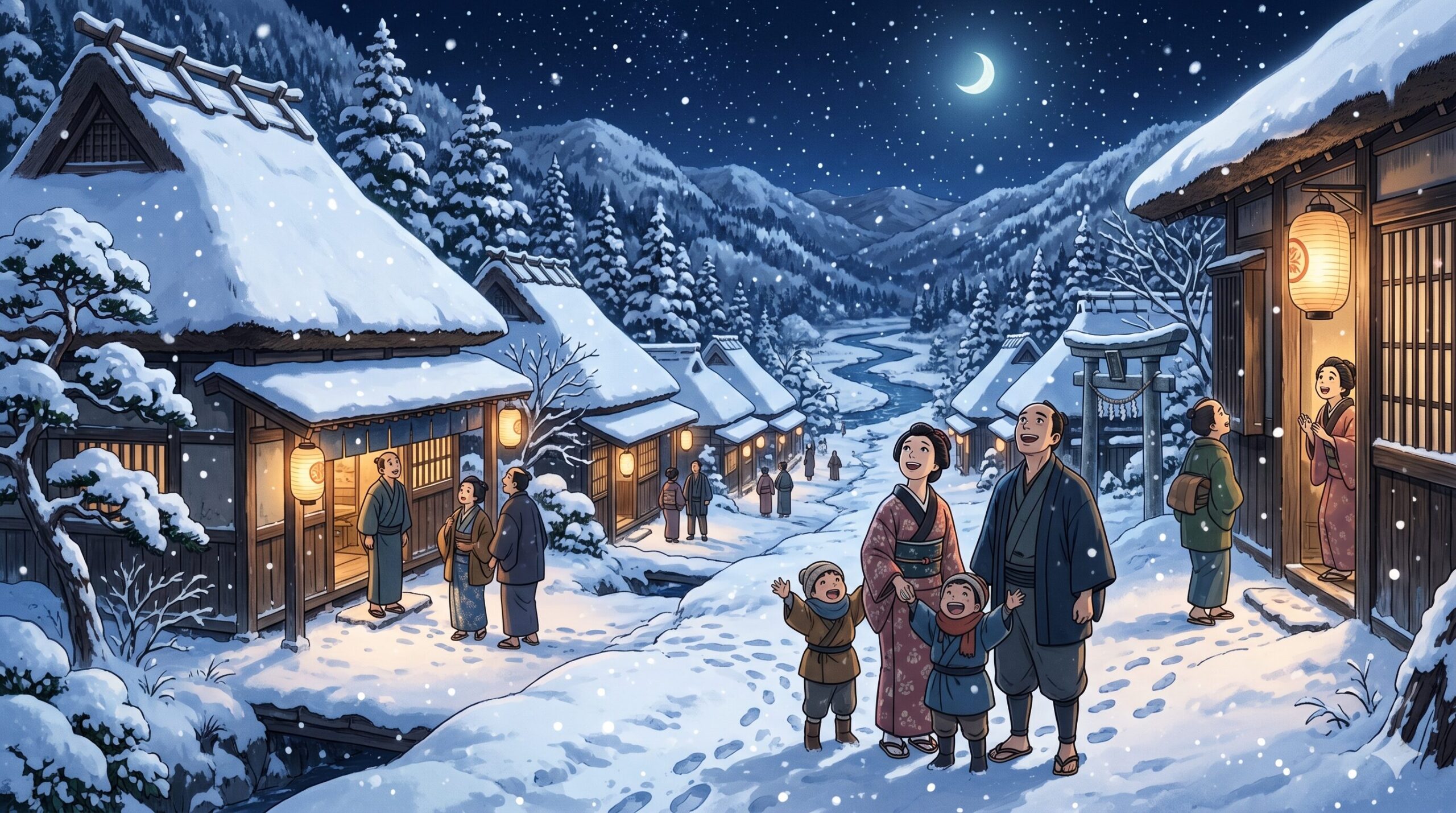
Japan is home to countless folktales that have been passed down through generations. Each story strongly reflects the wisdom of the ancestors, their reverence for nature, and the daily lives of the people of that era. Today, from our Japanese Folktale Series, we introduce a beautiful and mysterious story passed down in the Aizu region of Fukushima Prefecture—an area famous as a “Snow Country.” The tale is called “The First Snowfall” (Hajimete Futta Yuki). Through this story, let’s embark on a journey to explore the depths of Japanese culture and their unique view of nature.
1. The Story of “The First Snowfall”
Long, long ago, the Aizu region in Fukushima Prefecture was a warm and mild place all year round, something unimaginable today. The people there could live peacefully without ever knowing the harshness of winter. In fact, no one in the village had ever seen snow.
However, one day, terrifying news arrived. The strict and unforgiving local lord was suddenly coming to inspect their village. In a neighboring village, the lord had punished the people—throwing them in jail and doubling their taxes—simply because there was a tiny amount of dust on the roadside. Hearing this rumor, the villagers turned pale with terror.
“Our village will be destroyed if we don’t do something!”
The entire village frantically began to sweep and clean the roads and the areas around their houses. But no matter how much they swept, the wind would blow, bringing back dead leaves and dirt, undoing all their hard work. Exhausted from the endless cleaning, the villagers gathered at the local tea house in the evening, completely at their wits’ end.
Just then, a traveling monk wearing an unfamiliar bamboo hat wandered in. When the exhausted villagers offered him tea, the monk quietly sipped it and said:
“Do not worry. These things have a way of working themselves out.”
The villagers couldn’t believe their ears. How could this monk speak so carelessly when they were in such a desperate situation? As the night grew later, their fear and frustration reached a boiling point, and one villager finally snapped.
“I can’t stand that lying monk! I’m going to beat him up!”
Yelling in anger, the man rushed out of the tea house—but at that very moment, he lost his words.
The world outside had transformed into a blinding white wonderland they had never seen before. Countless cold, white, cotton-like flakes were fluttering down from the sky. This was “the first snowfall” in the land of Aizu.
The snow fell heavily throughout the night, beautifully blanketing all the dirt, fallen leaves, and unsightly dust under a pure white coat. When the lord arrived the next morning, he was extremely pleased with the pristine, white, and beautiful scenery of the village. The villagers had safely escaped his wrath.
“This must be what that monk meant!”
The villagers hurried to thank the mysterious traveler, but he was already gone, nowhere to be found. Ever since then, it began to snow every winter in the Aizu region. The snow came to be passed down as a blessing from the heavens, giving birth to the saying, “Heavy snow brings a bountiful harvest.”
2. A Deep Analysis of “The First Snowfall”
This story holds a profound meaning that goes beyond a simple “magical event.” The most crucial point is the theme of “Nature (snow) saving humans from a crisis they cannot resolve themselves.” No matter how hard the villagers tried to clean, the wind—a force of nature—would undo it. After emphasizing the powerlessness of humans, an even greater natural phenomenon—snow—is introduced as the absolute solution.
Furthermore, the presence of the traveling monk is highly symbolic. In Japanese folktales, wandering monks or travelers are often depicted as incarnations of deities, Buddhas, or nature spirits. They possess powers beyond the common sense of the human world and serve the role of bringing miracles to people facing trials. This monk can be interpreted as a personification of nature itself, bringing the cold, harsh “winter” while simultaneously providing the “pure white purification” that saved the village.
3. Connecting the Folktale to “Japanese Culture”
Japan is a “Snow Country” (Yukiguni) boasting some of the heaviest snowfall areas in the world. This folktale vividly illustrates how Japanese people have faced snow and built a unique culture around it.
The phrase at the end of the story, “Heavy snow brings a bountiful harvest” (Taisetsu Housaku), is an essential concept that remains relevant in modern Japanese agriculture. The ancestors learned from experience that a year with heavy snow means abundant meltwater in the spring, which enriches the rice paddies and increases the harvest. While snow can block roads and bring bitter cold, acting as a nuisance, it is also a “sacred blessing” that nurtures life and purifies the world by covering all impurities in white.
Rather than simply fearing harsh natural environments, the Japanese spirit finds beauty and blessings within them and strives to coexist. This is the very essence of Japan’s “Animism” (the belief that spirits dwell in all things) and its philosophy of harmony with nature.
4. What Would You Do?
In this story, the villagers were pushed into an unreasonable situation (the lord’s visit and the endless cleaning) that they could not fix with their own strength. However, in the end, they were saved by the immense power of nature—a “snowfall” they had never even seen before.
If you were to hit a wall that you couldn’t overcome no matter how hard you tried, would you feel panic and anger like these villagers? Or could you trust the monk’s words, “These things have a way of working themselves out,” and surrender to the flow of life?
Perhaps, having a heart full of wonder and gratitude for the unknown, just like the villagers who saw snow for the first time, is what invites unexpected “miracles” into our lives. What did you feel after reading the story of “The First Snowfall”? Please, ask yourself.
*For more detailed information regarding the reference for this article, please visit Manga Nippon Mukashibanashi Database – Hajimete Futta Yuki (Japanese).
【日本の昔話】「はじめて降った雪」が教えてくれる自然の奇跡と日本文化の奥深さ
日本には、古くから語り継がれてきた数多くの昔話が存在します。それぞれの物語には、先人たちの知恵や自然への畏敬の念、そして当時の人々の暮らしぶりが色濃く反映されています。今回は、Japanese Folktale Seriesの中から、雪国として知られる福島県会津地方に伝わる美しくも不思議な物語、「はじめて降った雪」をご紹介します。この物語を通じて、日本の自然観や文化の深層を探る旅に出かけましょう。
1. 昔話「はじめて降った雪」のストーリー
むかしむかし、福島県の会津地方は、今では想像もつかないほど一年中ぽかぽかとした陽気で、冬になっても寒さを知らずに過ごすことができる穏やかな場所でした。人々は雪というものを一度も見たことがなく、豊かな自然の中で平和に暮らしていました。
ところがある日のこと、村に恐ろしい知らせが舞い込みます。非常に厳格で知られる領主様が、突然この村へ見回りに来るというのです。隣の村では、道端にほんの少しのチリが落ちていたというだけの理由で、村人が牢屋に入れられたり、年貢を倍に引き上げられたりといった厳しい罰を受けていました。その噂を聞いていた村人たちは、恐怖で顔を青くしました。
「このままでは村が滅ぼされてしまう!」
村人たちは総出で、道から家々の周りまで必死に掃除を始めました。しかし、どれだけほうきで掃き清めても、ひとたび風が吹けば、枯れ葉や土埃が舞い戻り、また元の木阿弥になってしまいます。何度やっても終わらない掃除に、村人たちは疲れ果て、夕方には村の茶屋に集まって途方に暮れていました。
そこへ、見慣れぬ編み笠を被った旅のお坊さんがふらりと現れました。疲れ切った村人たちがお茶を振る舞うと、そのお坊さんは静かにお茶をすすり、こう言ったのです。
「心配はいらん。こういうことは、何とかなるもんじゃよ」
村人たちは耳を疑いました。これほど窮地に立たされているというのに、このお坊さんは何を呑気なことを言っているのか。夜が更けるにつれ、恐怖と焦りが頂点に達した村人の一人が、ついに怒りを爆発させました。
「あの嘘つき坊主、適当なことばかり言いおって!ぶっ叩いてやる!」
そう叫んで、男が茶屋から外へ飛び出したその瞬間です。男は言葉を失いました。
外は、見たこともない真っ白な世界に変わっていました。空からは、冷たくて白い綿毛のようなものが無数に舞い降りてきます。それが、会津の地に「はじめて降った雪」でした。
雪は一晩中降り積もり、村中の土埃も、落ち葉も、見苦しいチリのすべてを美しく純白の衣で覆い隠してしまいました。翌朝やってきた領主様は、チリ一つない真っ白で美しい村の景色を見て大層ご満悦になり、村人たちは無事に難を逃れることができたのです。
「あのお坊さんの言っていたことは、このことだったのか!」
村人たちが慌ててお礼を言おうと探しましたが、不思議な旅のお坊さんの姿はすでにどこにもありませんでした。それ以来、会津地方には毎年冬になると雪が降るようになり、「大雪豊作(雪がどっさり降った年は穀物の収穫も豊かになる)」という言葉とともに、雪は天からの恵みとして語り継がれるようになったのです。
2. 「はじめて降った雪」の深い考察
この物語は、単なる「不思議な出来事」の枠を超えた深い意味を持っています。最大のポイントは、「人間の力ではどうにもならない危機を、自然(雪)が救う」という構図です。村人たちがどれほど努力して掃除をしても、風が吹けば自然の摂理によって元に戻ってしまいます。人間の無力さが強調された後、絶対的な解決策として「雪」というさらに巨大な自然現象がもたらされます。
また、旅のお坊さんの存在も非常に象徴的です。日本の昔話において、ふらりと現れる僧侶や旅人は、しばしば神仏の化身や自然の精霊として描かれます。彼らは人間界の常識を超えた力を持っており、試練に直面した人々に奇跡をもたらす役割を担います。このお坊さんは、冷たく厳しい「冬」をもたらすと同時に、村を救う「純白の浄化」を与えた自然そのものの擬人化とも読み取れます。
3. この昔話から読み解く「日本文化」との関連性
日本は世界有数の豪雪地帯を抱える「雪国」です。この昔話は、日本人がどのように雪と向き合い、独自の文化を築いてきたかを如実に表しています。
物語の結末にある「大雪豊作(たいせつほうさく)」という言葉は、現代の日本農業にも通じる重要な考え方です。雪が多く降る年は、春になって雪解け水が豊富になり、田畑を潤して米の収穫量が増えるという自然のサイクルを、先人たちは経験から学んでいました。雪は交通を遮断し、厳しい寒さをもたらす「厄介者」であると同時に、生命を育み、汚れをすべて白く覆い隠して浄化してくれる「神聖なる恵み」でもあります。
厳しい自然環境を単に恐れるのではなく、その中にある美しさや恩恵を見出し、共生していく。これこそが、日本の「アニミズム(万物に神が宿るという信仰)」や「自然調和」の精神性そのものなのです。
4. あなたなら、どう生き抜きますか?
この物語の中で、村人たちは自分たちの力ではどうにもならない理不尽な状況(領主の訪問と終わらない掃除)に追い詰められました。しかし、最後に彼らを救ったのは、見たこともない「雪」という大自然の力でした。
もしあなたが、努力しても解決できないような壁にぶつかったとき、この村人たちのように焦りや怒りを感じるでしょうか。それとも、お坊さんが言った「何とかなるもんじゃよ」という言葉を信じて、流れに身を任せることができるでしょうか?
初めて雪を見た村人たちのように、未知のものに対する驚きと感謝の心を持つことが、私たちの人生にも予期せぬ「奇跡」を呼び込むのかもしれません。あなたはこの「はじめて降った雪」の物語を読んで、何を感じましたか?ぜひ、自分の心に問いかけてみてください。
※本記事の参考資料について詳しく知りたい方は、こちらのまんが日本昔ばなし〜データベース〜 – はじめて降った雪をご覧ください。
コメント