- The Mysterious Fish and Eel Fishing: The Brilliant Stories of Kansaku
- Overcoming Crises with Laughter: Deep Insights into the Folktale
- Understanding Japanese Culture: The Spirit of Humor and “Tonchi”
- How Would You Use Kansaku’s Wisdom?
- Reference Links & Related Information
- 不思議な魚とウナギ釣り!勘作の痛快なストーリー
- 笑いでピンチを切り抜ける!昔話の深い考察
- 勘作話から読み解く日本文化:ユーモアと「とんち」の精神
- あなたは勘作の知恵をどう使いますか?
- 参考リンク・関連情報
The Mysterious Fish and Eel Fishing: The Brilliant Stories of Kansaku
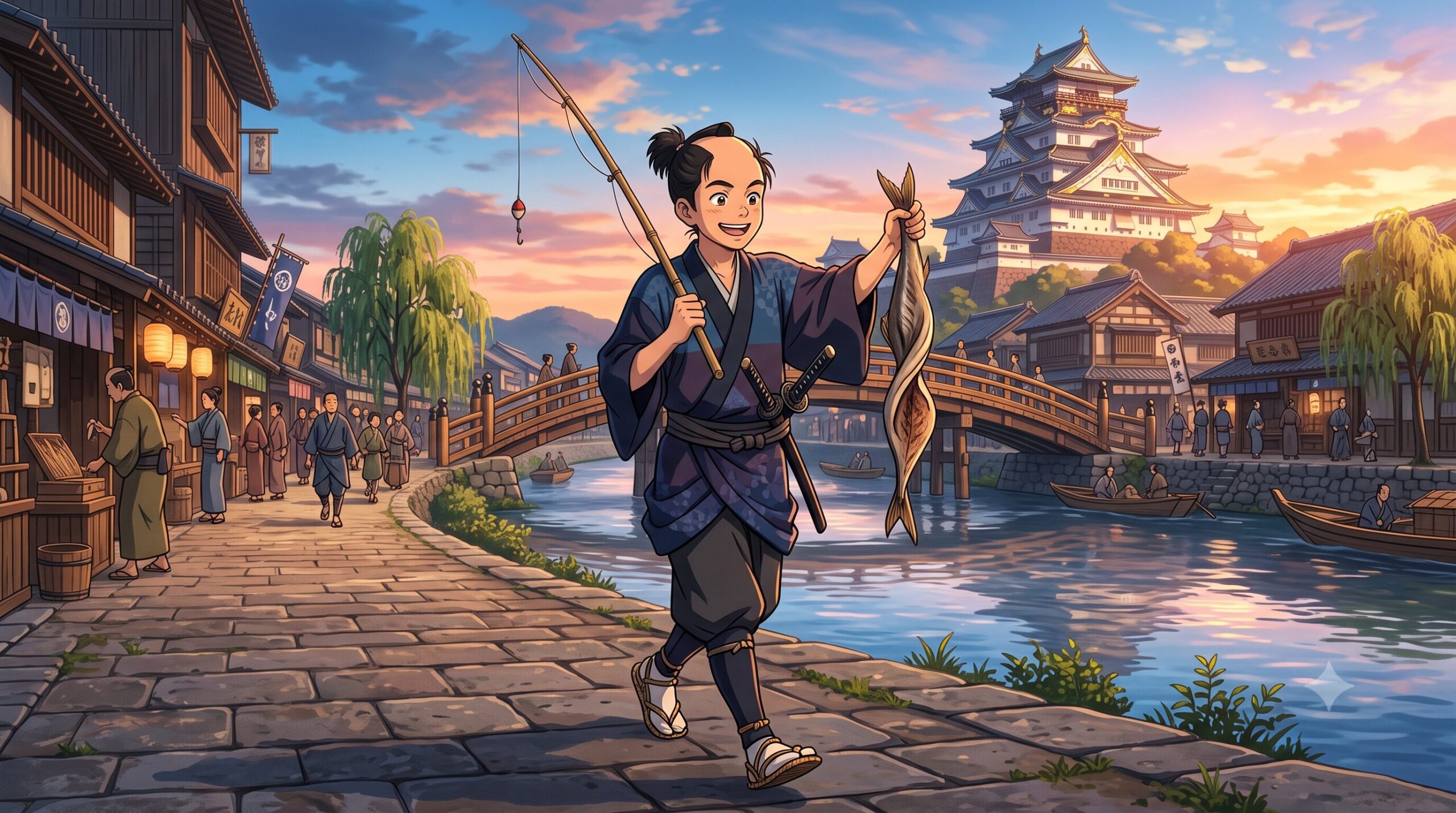
Long ago, in a place called Nippaku in the Omura domain of Hizen Province (present-day Nagasaki Prefecture), there lived a low-ranking samurai (ashigaru) named Nagasawa Kansaku.
Although Kansaku held a very low rank with a meager stipend, he was famous in his village for his incredibly quick wit and intelligence. One day, his feudal lord acquired a strange, long fish that no one had ever seen before. The lord asked his retainers, “What is the name of this fish?” but no one could answer. Kansaku was summoned. Upon seeing the fish, he confidently fabricated a name and declared, “My lord, this is the ‘Kinkirakin’ fish”. The lord was impressed by the unusual name, and the matter was settled.
A few days later, the same fish, now dried, was served to the lord. The lord called Kansaku again and asked, “What is the name of this dried fish?” Without missing a beat, Kansaku replied, “Ah, this is the ‘Chinchirachin'”. The lord became angry and scolded him, “The other day you called it ‘Kinkirakin’! Why has the name changed?” Kansaku answered calmly, “My lord, when a squid (Ika) is dried, its name changes to dried squid (Surume). Naturally, when a Kinkirakin is dried, it becomes a Chinchirachin”. Impressed by this brilliant and humorous logic, the lord burst into laughter and forgave him.
On another occasion during the rainy season, Kansaku sneaked into a river in the neighboring Isahaya domain to fish for eels without permission. Unfortunately, he was caught by an official from Isahaya. Poaching in another domain was a serious crime. The official shouted, “What is a man from Omura doing here?!” Kansaku put on an innocent face and replied, “Well, you see, the heavy rain caused the river to flood, and the eels from the Omura domain fled over here. I am simply selecting the Omura eels and taking them back home”. With that excuse, Kansaku cleverly took only the largest eels back home, leaving the official completely dumbfounded.
Overcoming Crises with Laughter: Deep Insights into the Folktale
The “Kansaku Banashi” is not just a funny gag story; it brilliantly depicts the “wisdom and resilience of commoners” during the Edo period, a time of strict social hierarchies. Kansaku, a low-ranking ashigaru, faces absolute authorities—his feudal lord and strict officials from a neighboring domain. He fights back not with weapons or power, but with words and humor (known as “Tonchi” in Japanese). Seeing Kansaku outsmart his superiors surely provided a sense of catharsis and delight to the common people of that era.
In an age where outright rebellion could cost one their life, Kansaku turns unreasonable situations into laughter through logical twists (like comparing the fish to dried squid). This is a sharp satire against authority, yet it functions as the ultimate survival skill, allowing him to navigate difficulties while maintaining smooth relationships.
Understanding Japanese Culture: The Spirit of Humor and “Tonchi”
Since ancient times, tales of witty masters like Kansaku have existed all over Japan. Famous examples include “Kicchomu-san” in Oita Prefecture and the Muromachi period monk “Ikkyu-san.” What these stories share is the fact that “wisdom” and “humor” have always been highly valued in Japanese culture.
Japanese society has long emphasized group harmony, tending to avoid direct conflict and heated arguments. As a result, “Tonchi”—the ability to solve problems peacefully and playfully—developed as a unique communication skill. The technique of convincing opponents through wordplay and clever analogies connects deeply to advanced cultural arts like Rakugo (comic storytelling), Haiku, and Waka poetry. Kansaku’s story shows modern readers how Japanese people used laughter as a weapon to maintain spiritual freedom within a rigid social structure.
How Would You Use Kansaku’s Wisdom?
Kansaku’s flexible thinking and excellent sense of humor in turning a crisis into an opportunity provide great inspiration for us living in today’s stressful modern society. If you were faced with an unreasonable question from a boss or found yourself in an awkward situation, could you respond with a witty remark that makes everyone chuckle, just like Kansaku did?
What name would you have given to the dried “Kinkirakin” fish? We would love for you to read this story and reflect on your own humorous ideas to navigate life’s challenges.
Reference Links & Related Information
- Japanese Folktale Series
- Manga Nippon Mukashibanashi Database – Kansaku Banashi
- Omura City Official Website (Kansaku’s Hometown)
【長崎の痛快とんち話】勘作話(かんさくばなし)から読み解く日本のユーモアと庶民の知恵
不思議な魚とウナギ釣り!勘作の痛快なストーリー
むかしむかし、肥前の国(現在の長崎県)の大村、日泊(にっぱく)というところに、長沢勘作(ながさわかんさく)という足軽が住んでいました。
勘作はわずか二石とりの低い身分の侍でしたが、頭の回転が非常に速く、村でも評判の「とんち名人」でした。ある日、お殿様が今まで見たこともないような珍しい細長い魚を手に入れました。お殿様は家来たちに「この魚の名前は何というのだ?」と尋ねましたが、誰も答えることができません。そこで勘作が呼ばれました。勘作はその魚を見るなり、堂々とした態度で「これは『キンキラキン』という魚でございます」と適当な名前をでっち上げて答えました。お殿様はその珍しい名前に感心し、その場は丸く収まりました。
数日後、その魚が干物になってお殿様の前に出されました。お殿様は再び勘作を呼び、「この干物になった魚の名前は何だ?」と尋ねました。勘作は少しも慌てず、「はい、これは『チンチラチン』でございます」と答えました。お殿様は怒って、「先日はキンキラキンと言ったではないか!なぜ名前が変わるのだ!」と問い詰めました。すると勘作は涼しい顔で、「お殿様、イカも干せばスルメと名前が変わります。キンキラキンも干せばチンチラチンになるのは当然でございます」と答えました。この見事なとんちに、お殿様も思わず笑ってしまい、勘作を許したのです。
またある梅雨の日のこと。勘作は隣の領地である諫早(いさはや)藩の川へ忍び込み、無断でウナギを釣っていました。すると、運悪く諫早藩の役人に見つかってしまいました。他藩での密漁は重罪です。役人が「大村の者がここで何をしている!」と怒鳴りつけると、勘作はすました顔でこう答えました。「いやいや、大雨で川が増水し、大村藩のウナギがここまで逃げてきてしまったのです。私は大村のウナギだけを選んで釣って連れ帰るところです」。勘作は大きなウナギだけをちゃっかりと持ち帰り、役人はあっけにとられて何も言えませんでした。
笑いでピンチを切り抜ける!昔話の深い考察
この「勘作話」は、単なる面白いギャグストーリーではなく、身分制度が厳しかった江戸時代における「庶民の知恵と強さ」を見事に描いています。足軽という低い身分の勘作が、絶対的な権力を持つお殿様や他藩の厳しい役人を相手に、武力や権力ではなく「言葉」と「ユーモア(とんち)」で対抗し、見事に相手をやり込める姿は、当時の人々の心を大いにスカッとさせたことでしょう。
理不尽な状況や厳しいルールに縛られる中で、真正面から反発すれば命の危険すらある時代。勘作は、相手を怒らせずに論理のすり替え(イカがスルメになる等)を利用し、笑いへと昇華させます。これは、権力者への痛烈な風刺でありながら、人間関係を円滑に保ち、どんな困難も機転を利かせて生き抜くという究極のサバイバル術なのです。
勘作話から読み解く日本文化:ユーモアと「とんち」の精神
日本には古くから、この勘作のような「とんち名人」の物語が全国各地に存在します。大分県の「吉四六(きっちょむ)さん」や、室町時代の僧侶「一休さん」などが有名です。これらの物語に共通しているのは、日本の文化において「知恵」と「ユーモア」が非常に高く評価されてきたという事実です。
日本の社会は古くから集団の和を重んじ、直接的な対立や激しい口論を避ける傾向があります。そのため、角を立てずに問題を解決する「とんち」は、日本独自のコミュニケーション能力として発展しました。言葉遊びや見立て(あるものを別のものになぞらえること)を駆使し、相手を納得させる技術は、日本の落語や俳句、和歌にも通じる高度な文化です。勘作の物語は、日本人がいかにして「笑い」を武器に、厳格な社会構造の中で心の自由を保ってきたかを現代に伝えてくれます。
あなたは勘作の知恵をどう使いますか?
勘作の柔軟な発想と、ピンチをチャンスに変えるユーモアのセンスは、ストレスの多い現代社会に生きる私たちにも大きなヒントを与えてくれます。もしあなたが、理不尽な上司からの質問や、気まずい状況に直面したとき、勘作のようにクスッと笑えるような「とんち」で切り返すことができますか?
あなたなら、干物になったキンキラキンを何と名付けますか?ぜひ、この物語を読んで感じたことや、あなたなりのユーモア溢れるアイデアを思い描いてみてください。

コメント