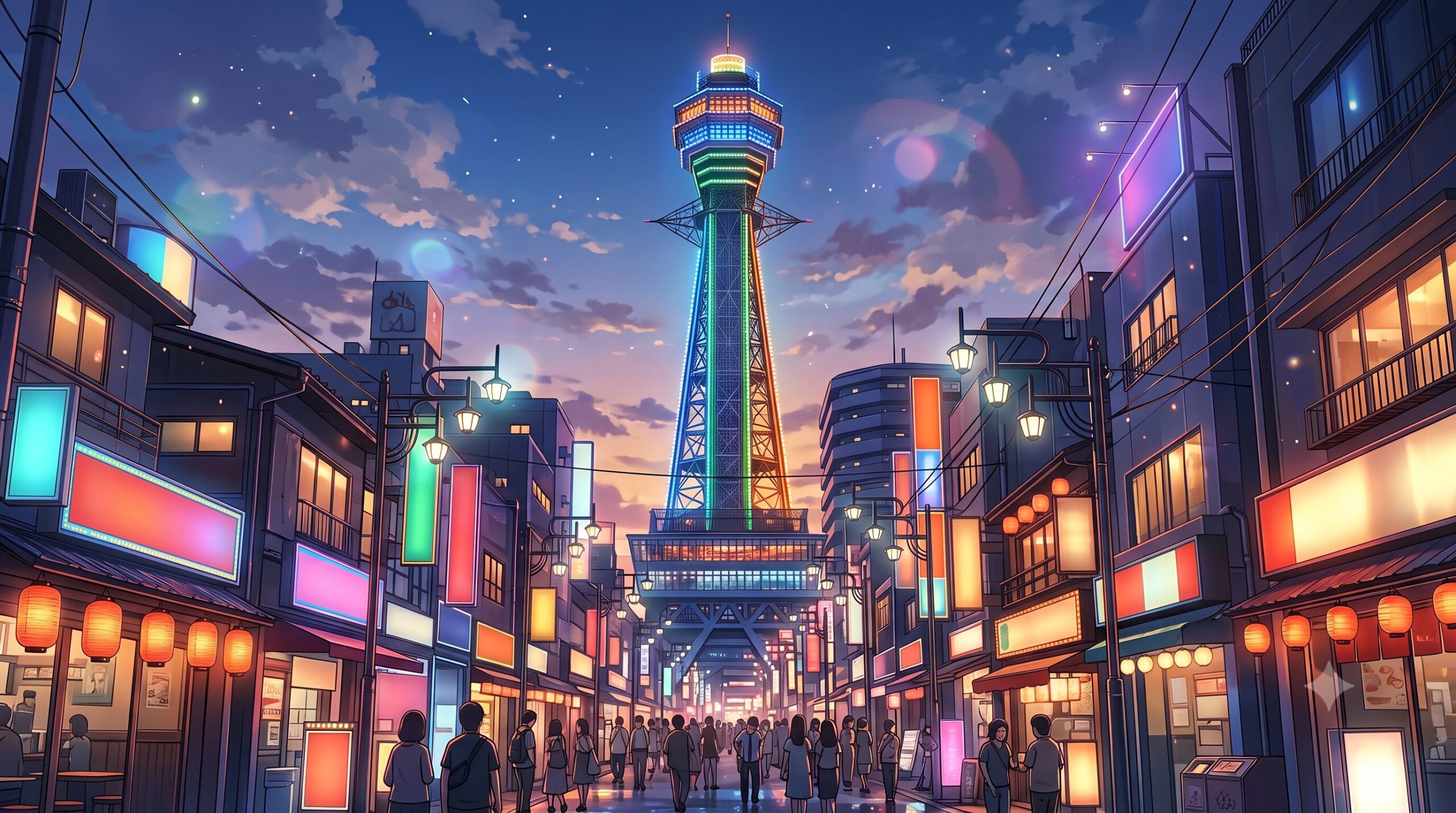
Japan is home to countless anniversaries, but July 3rd holds a profoundly special meaning for the people of the Kansai region, particularly Osaka. On this day in 1912 (Meiji 45), the first “Tsutenkaku” tower was constructed in the “Shinsekai” (New World) district of Osaka. Meaning “a tower reaching to heaven,” Tsutenkaku is far more than a mere tourist attraction; it is a historical monument that symbolizes Japan’s rapid modernization, the devastating losses of war, and the incredible power of grassroots revival.
The Birth of the First Tsutenkaku and the Shinsekai Fever
When the first Tsutenkaku debuted in 1912, it boasted an avant-garde design entirely unprecedented in Japan. Its striking appearance was modeled after the Eiffel Tower built on top of the Arc de Triomphe in Paris. Standing at approximately 64 meters, it was the tallest structure in the Orient at the time.
At the base of the tower lay “Luna Park,” a massive amusement park connected to the tower by an aerial cable car. For the Japanese people of that era, Shinsekai and Tsutenkaku were the embodiment of a “future city.” The area manifested a deep admiration for Western culture mixed with the explosive energy of Japan’s modernization.
Loss Through War and Rebuilding Through Citizens’ Passion
However, the original Tsutenkaku’s fate was cut short. In 1943 (Showa 18), a disastrous fire originating from a nearby movie theater severely damaged the tower. To make matters worse, Japan was in the midst of World War II. Under the government’s metal collection ordinance for weapons production, the remains of the charred tower were completely dismantled and melted down for the war effort.
After the war, in the scorched ruins of Osaka, a strong desire began to bloom among the people: “We want to see our Tsutenkaku one more time.” Remarkably, the push to rebuild did not come from the national government or massive corporations. It was the local merchants of Shinsekai and ordinary citizens who pooled their own money, formed a company, and spearheaded the reconstruction. In 1956, the second and current Tsutenkaku (103 meters tall) was completed. It was designed by Tachu Naito, the renowned “Doctor of Towers” who would later design the famous Tokyo Tower.
Understanding Japanese Culture and Osaka’s “Grit” Through Tsutenkaku
The history of Tsutenkaku perfectly reflects the spiritual essence of Osaka. While Tokyo developed as the sophisticated center of politics and economics, Osaka has historically thrived as a “city of merchants.” It is a culture that prioritizes practicality, human warmth, and above all, humor, rather than strict formality or appearances.
The Shinsekai area, where the tower stands, is packed with Kushikatsu (deep-fried skewers) restaurants and flamboyant, 3D neon signboards. It preserves Japan’s most energetic, slightly chaotic, and “deep” culture. The fact that citizens funded the tower’s resurrection out of their own pockets perfectly demonstrates Osaka’s unique rebellious spirit and “grit”—a community lifting itself up without relying on authorities.
Furthermore, the tower’s observation deck is home to “Billiken,” a mysterious deity of good luck. Originally modeled after a dream experienced by an American artist, Billiken somehow took root in Osaka. Today, it commands massive devotion from locals who believe that rubbing the soles of his feet brings good fortune. The ability to adopt a foreign-born icon, integrate it into local culture, and love it with deep familiarity is another beautiful aspect of Japanese culture.
What is Your Symbol of Revival?
Tsutenkaku, rising from the ashes through the sheer will of the people, continues to illuminate the Osaka night sky with its neon lights, giving vitality to everyone who looks up at it. The way the people of Osaka stand up from despair—never forgetting their humor and passion—provides endless inspiration.
After reading this article, how do you feel about the raw energy of Osaka? Is there a building or a place in your own country or city that symbolizes the passion of people rising from despair? If you ever have the chance to visit Japan, do not just stay among the sleek skyscrapers of Tokyo. Go to Osaka’s Shinsekai, look up at Tsutenkaku, and feel the heat of history and human connection breathing there.
Related Links
Internal Link: What’s Today’s Special Day Series
External Link: Osaka Convention & Tourism Bureau: Tsutenkaku (Official Tourist Information)
7月3日は「通天閣の日」:大阪のシンボルが語る不屈の精神とディープな日本文化
日本には数多くの記念日が存在しますが、7月3日は関西地方、特に大阪の人々にとって非常に特別な意味を持つ日です。1912年(明治45年)のこの日、大阪の「新世界」と呼ばれるエリアに、初代「通天閣」が建設されました。「天に通じる高い建物」という意味を持つこの塔は、単なる観光名所ではなく、日本の近代化、戦争による喪失、そして民衆の力による復興を象徴する歴史的建造物です。
初代通天閣の誕生と「新世界」の熱狂
1912年に誕生した初代通天閣は、当時の日本において前代未聞の斬新なデザインを誇っていました。なんと、パリの凱旋門の上にエッフェル塔を乗せたような奇抜な外観だったのです。高さは約64メートルあり、当時の東洋で最も高い建造物でした。
通天閣の足元には「ルナパーク」という巨大な遊園地が広がり、ロープウェイで塔と結ばれていました。当時の日本人にとって、新世界と通天閣はまさに「未来都市」そのものであり、西洋文化への強い憧れと日本の急速な近代化を体現する夢の空間でした。
戦争による喪失と、市民の情熱による再建
しかし、初代通天閣の運命は長くは続きませんでした。1943年(昭和18年)、足元にあった映画館からの延焼により大火災が発生し、塔は深刻なダメージを受けました。さらに不運なことに、当時は第二次世界大戦の真っ只中であり、兵器生産のための「金属類回収令」によって、焼け残った通天閣の鉄材はすべて国に供出されてしまったのです。
終戦後、焼け野原となった大阪で、人々の心には「もう一度、あの通天閣を見たい」という強い願いが芽生えました。国や大企業が主導したのではなく、地元・新世界の商人や一般市民が資金を出し合い、株式会社を設立して再建に立ち上がったのです。そして1956年(昭和31年)、日本の「塔博士」として知られ、後に東京タワーも手掛ける建築家・内藤多仲(ないとう たちゅう)の設計により、現在私たちが目にしている2代目通天閣(高さ103メートル)が完成しました。
通天閣から読み解く、日本文化と大阪の「ド根性」
通天閣の歴史は、そのまま大阪という街の精神性を表しています。東京が日本の「政治と経済の中心」として洗練されていく一方で、大阪は古くから「商人の街」として独自の文化を築いてきました。格式や見栄よりも、実用性、人情、そして「笑い」を重んじる文化です。
通天閣が立つ新世界エリアは、串カツ屋や派手な立体看板がひしめき合い、エネルギッシュで少し混沌とした、日本随一の「ディープな文化」を保持しています。政府ではなく市民の力でお金を出し合って塔を再建したという事実は、権力に頼らず自分たちの力で街を盛り上げる大阪特有の「反骨精神」と「ド根性」を見事に示しています。
また、通天閣の展望台には「ビリケンさん」という不思議な神様の像が鎮座しています。元々はアメリカの芸術家が夢で見た神様をモデルにしたものですが、いつしか大阪に定着し、「足の裏を撫でると幸運が訪れる」として絶大な信仰を集めています。外国生まれの神様すらも自分たちの文化に取り込み、親しみを持って愛する包容力もまた、日本特有の文化のあり方と言えます。
あなたにとっての「復興のシンボル」は何ですか?
焼け野原から市民の力で立ち上がった通天閣は、現在でもネオンの光で大阪の夜空を照らし、人々に活力を与え続けています。どんなに絶望的な状況に陥っても、ユーモアと情熱を忘れずに立ち上がる大阪の人々の生き様は、私たちに多くのインスピレーションを与えてくれます。
この記事を読んで、あなたは大阪という街のエネルギーをどう感じましたか?あなたの国や街にも、絶望から立ち上がった人々の情熱を象徴するような建造物や場所はありますか?もし日本を訪れる機会があれば、東京の洗練された高層ビル群だけでなく、大阪・新世界で通天閣を見上げ、そこに息づく人情と歴史の熱気を感じてみてください。
関連情報へのリンク
内部リンク:What’s Today’s Special Day Series
外部リンク:Osaka Convention & Tourism Bureau: Tsutenkaku (Official Tourist Information)
コメント