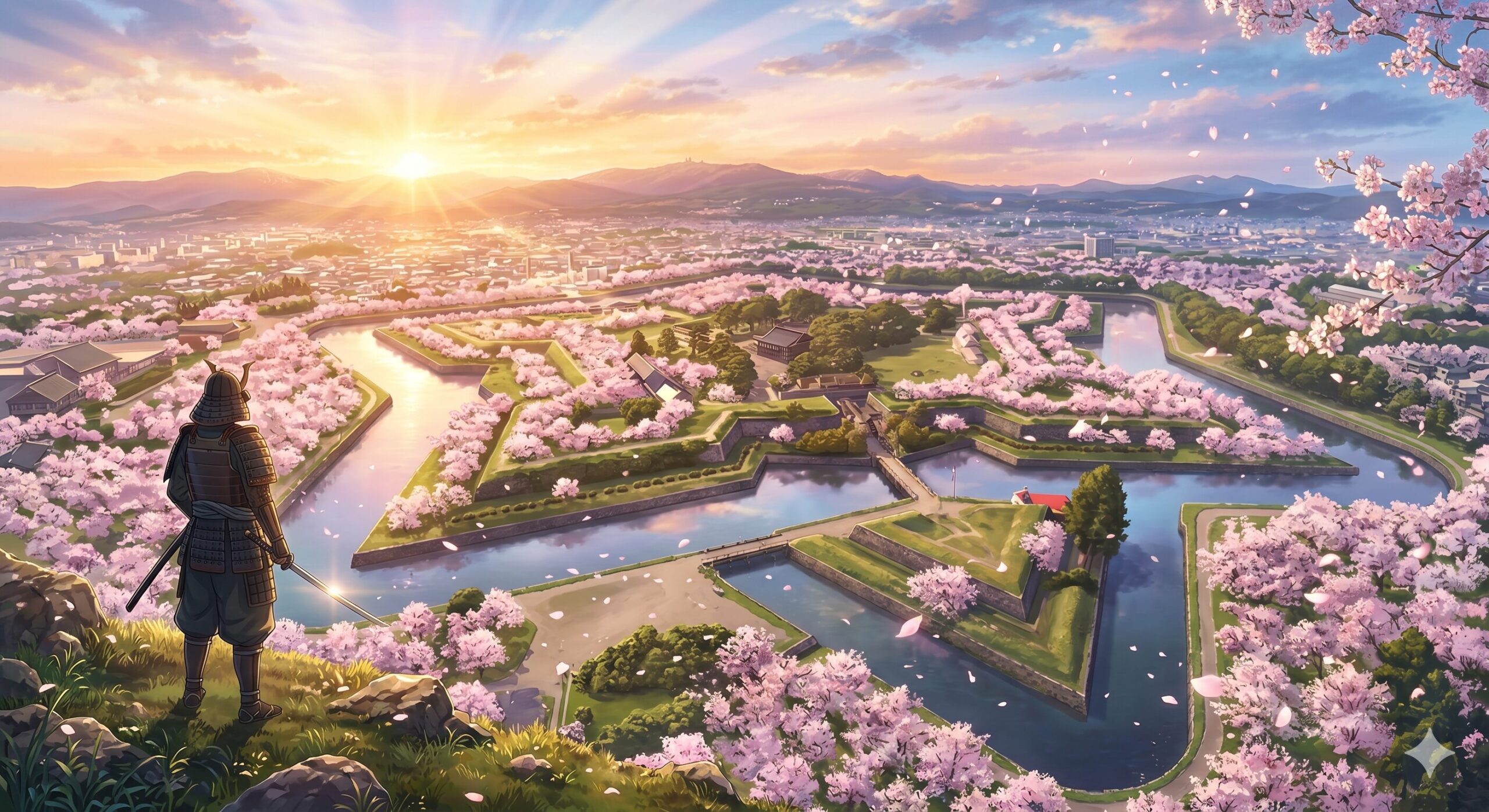
On May 18, 1869 (the 2nd year of the Meiji era), a highly significant and dramatic curtain fell on Japanese history. Enomoto Takeaki, leader of the former Tokugawa shogunate forces, surrendered to the new imperial government at Goryokaku in Hokkaido. This marked the complete and final end of the Boshin War, a civil war that had engulfed all of Japan for a year and a half. This exact day signifies the absolute end of the “Age of the Samurai,” which had ruled Japan for centuries, and the moment a new, modern Japanese nation was born.
The Boshin War and the Final Stronghold: “Goryokaku”
The Boshin War, which began in 1868, was fought between the “former Shogunate forces” (loyal to the Tokugawa family) and the “new Government forces” (aiming to build a new nation centered around the Emperor). The tide of war gradually turned overwhelmingly in favor of the new government, pushing the Shogunate loyalists further and further north. The location they chose for their final stand was Goryokaku in Hakodate, Hokkaido.
Goryokaku was the most modern fortress in Japan at the time, designed and built incorporating the architectural concept of European “star forts.” The fact that men possessing the ancient souls of Japanese warriors barricaded themselves inside a fortress built with the latest Western technology is an irony of history, yet an incredibly romantic scene that continues to fascinate people today.
The Final Moments of Toshizo Hijikata and the Decision of Takeaki Enomoto
When discussing the Hakodate War, it is impossible to omit Toshizo Hijikata, famous as the vice-commander of the Shinsengumi. He stayed true to his conviction to “live as a samurai and die as a samurai to the very end,” and fell to a bullet after a fierce battle in the streets of Hakodate. His heroic way of life is still beloved throughout Japan and serves as the subject of countless movies and anime.
On the other hand, Takeaki Enomoto, the president of the former Shogunate forces, made a different decision. Having studied in the Netherlands, he was a top-tier intellectual with profound knowledge of international law and Western science and technology. Despite voices calling for a fight to the death, Enomoto made the agonizing decision to surrender in order to prevent further unnecessary bloodshed and, above all, to “ensure that capable individuals survive for the future of Japan.”
Decoding the Duality of “Japanese Culture and Bushido”
This historical event provides deep insight into the interpretation of “Bushido” in Japanese culture. Overseas, there might be a strong image of “Bushido = death for honor.” The final moments of Toshizo Hijikata perfectly embody this “aesthetics of destruction,” mirroring the purity of cherry blossoms falling gracefully—a concept traditionally cherished by the Japanese.
However, Takeaki Enomoto’s choice is also another authentic form of “Bushido.” After his surrender, his exceptional talents and knowledge were recognized by the new government. He later served as a minister in the Meiji government and made monumental contributions to the development of modern Japan. The shift from “dying for one’s lord” to “enduring shame to live and work for the nation’s future” highlights a profound flexibility. This adaptability, coupled with the new government’s rationality in employing former enemies based on merit, is the greatest driving force behind why Japan was never colonized by Western powers and modernized at an astonishing speed.
How Would You Choose to Live?
History poses a question to us. If you were at Goryokaku in 1869, what choice would you have made?
Would you, like Toshizo Hijikata, remain loyal to your aesthetics and beliefs, swinging your sword until your last breath? Or would you, like Takeaki Enomoto, swallow your pride, adapt to the new era, and use your knowledge and life to build the future?
For those of us living in today’s rapidly changing modern world, this is by no means a question of the past. Having read this article, what do you feel about the “end of the samurai”? Please share your thoughts and tell me how this compares to the historical values of your own country.
Reference & Related Links
- External Reference: Goryokaku Tower Official Website
- Internal Link: What’s Today’s Special Day Series
1869年5月18日:箱館戦争終結。サムライの時代の終焉と近代日本の夜明け
1869年(明治2年)5月18日、日本の歴史において非常に重要な、そして劇的な幕引きが行われました。旧幕府軍のリーダーである榎本武揚らが、北海道の五稜郭(ごりょうかく)で新政府軍に降伏し、およそ1年半にわたって日本全土を巻き込んだ内戦「戊辰戦争(ぼしんせんそう)」が完全に終結した日です。この日は、何世紀にもわたって日本を支配してきた「サムライの時代」が名実ともに終わりを告げ、近代国家としての新しい日本が産声を上げた瞬間でもあります。
戊辰戦争と最後の砦「五稜郭」
1868年に始まった戊辰戦争は、徳川幕府を支持する「旧幕府軍」と、天皇を中心とした新しい国づくりを目指す「新政府軍」との間で戦われました。戦局は次第に新政府軍の圧倒的な優位となり、旧幕府軍は北へ北へと追いつめられていきます。そして彼らが最後の拠点として選んだのが、北海道(当時の蝦夷地)の箱館にある五稜郭でした。
五稜郭は、ヨーロッパの「星形要塞(稜堡式城郭)」の設計思想を取り入れて造られた、当時日本で最も近代的な城郭でした。西洋の最新技術を用いて建設されたこの要塞に、日本古来の武士の魂を持った男たちが立て籠もったという事実は、歴史の皮肉でありながら、非常にロマンチックな情景として今も多くの人々を惹きつけています。
新選組副長・土方歳三の最期と榎本武揚の決断
この箱館戦争を語る上で欠かせないのが、新選組の副長として知られる土方歳三(ひじかた としぞう)です。彼は「最後まで武士として生き、武士として死ぬ」という信念を貫き、箱館市中での激戦の末に銃弾に倒れました。彼の壮絶な生き様は、今もなお日本中で愛され、多くの映画やアニメの題材となっています。
一方で、旧幕府軍の総裁であった榎本武揚(えのもと たけあき)は異なる決断を下します。彼はオランダへの留学経験があり、国際法や西洋の科学技術に精通した超一流の知識人でした。徹底抗戦を望む声もある中、榎本はこれ以上無用な血が流れることを避けるため、そして何より「日本の未来のために有能な人材を生き残らせる」ために、降伏という苦渋の決断を下したのです。
箱館戦争から読み解く「日本文化と武士道」の二面性
この出来事は、日本文化における「武士道(Bushido)」の解釈に深い洞察を与えてくれます。海外では「武士道=名誉のための死」というイメージが強いかもしれません。土方歳三の最期は、まさにその「滅びの美学」を体現したものであり、日本人が伝統的に愛する「桜のように散る潔さ」そのものです。
しかし、榎本武揚の選択もまた、もう一つの「武士道」の形です。彼は降伏後、その類まれなる才能と知識を新政府に買われ、のちに明治政府の大臣を歴任し、近代日本の発展に多大な貢献をしました。「主君のために死ぬ」ことから「国家の未来のために生き恥をさらし、尽力する」ことへ。この柔軟性と、過去の敵であっても能力を認めて登用する新政府の合理性こそが、日本が西洋列強の植民地にならず、驚異的なスピードで近代化を成し遂げた最大の原動力なのです。
あなたなら、どう生きますか?
歴史は私たちに問いかけます。もしあなたが1869年の五稜郭にいたとしたら、どのような選択をしたでしょうか?
土方歳三のように、自分の美学と信念に殉じて最後まで刀を振るい続けますか?それとも、榎本武揚のように、プライドを捨ててでも新しい時代に順応し、未来のために自分の知識と命を使いますか?
変化の激しい現代を生きる私たちにとっても、この問いは決して過去のものではありません。この記事を読んで、あなたは「サムライの終わり」から何を感じましたか?ぜひ、あなたの考えや国独自の歴史的な価値観と照らし合わせて、どう思うか教えてください。
コメント