- The Desperate Journey of Kansuke, the Courier of the Tokaido Road
- The Sacrifice of the Masterpiece Sword and the Death Struggle with the Giant Octopus
- The Miracle Brought by the Monkeys and the Legendary “Masamune”
- A Deep Analysis of the Folktale “The Ape’s Gratitude”
- The Japanese Cultural Concept of “Ongaeshi” and Religious Syncretism
- Finally: What Would You Do?
- 東海道を駆け抜ける飛脚・勘助の決死の旅
- 名刀の犠牲と大ダコとの死闘
- 猿たちがもたらした奇跡と伝説の「正宗」
- 昔話「猿の恩返し」が示す深い考察
- 日本文化「恩返し」と神仏習合の精神
- 最後に:あなたならどうしますか?
The Desperate Journey of Kansuke, the Courier of the Tokaido Road
Once upon a time, in the Kyushu region of Japan, there was an exceptionally fast courier named Kansuke who served a highly renowned Daimyo (feudal lord). His mission was not a simple delivery of letters. He was entrusted with an incredibly vital, secret order: to safely transport a “peerless, masterpiece sword” as an offering from his lord to the Shogun in Edo (modern-day Tokyo). In Edo-period Japan, damaging—let alone losing—an offering intended for the Shogun was a grave crime that demanded the offender to commit seppuku (ritual suicide) to apologize. Bearing this terrifyingly heavy pressure, Kansuke ran tirelessly along the Tokaido road, day and night.
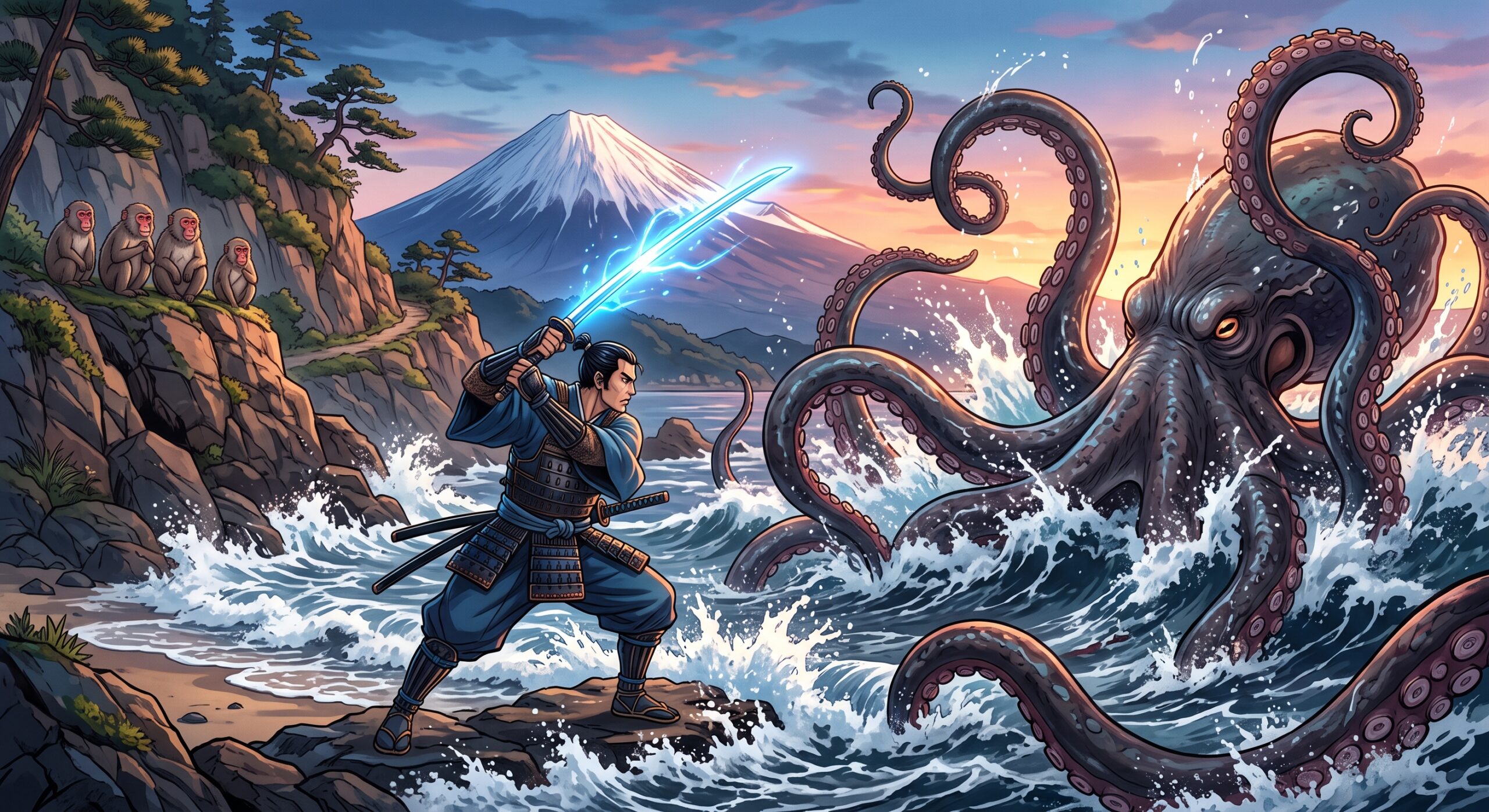
The incident occurred when he passed through the post town of Okitsu in Suruga Province and approached Satta Pass, an area famous for its rugged, breathtaking scenery. Satta Pass was a treacherous transport chokepoint overlooking rough seas, with the sacred Mount Fuji visible in the distance. Suddenly, a blood-curdling sight on the shoreline jumped into Kansuke’s eyes. Emerging from the ocean waves, a monster-like “Giant Octopus” extended its slimy, enormous tentacles and was trying to drag a small monkey into the depths of the sea. The monkey’s heartbreaking screams pierced through the sound of the crashing waves.
The Sacrifice of the Masterpiece Sword and the Death Struggle with the Giant Octopus
Possessing both the pride and compassion of a samurai, Kansuke could not ignore this tragic scene. Without a single moment of hesitation, he rushed down to the beach, drew the wakizashi (short sword) at his waist, and slashed with all his might at the giant octopus’s massive tentacle. However, the octopus’s skin was as hard as steel, and the blade of his wakizashi was completely useless against it. The giant octopus glared at him with eerie, bulging eyes and finally began to dive back into the dark ocean, still clutching the helpless monkey.
In that desperate moment, a decisive thought crossed Kansuke’s mind. He untied the “Sword for the Shogun” strictly bound to his back. It was his lord’s supreme treasure, an item he was absolutely forbidden to draw or use. Yet, Kansuke unsheathed it and, without hesitation, dove headfirst into the raging sea.
Amidst the freezing waves, Kansuke bit directly into the octopus’s leg and swung the masterpiece sword with every ounce of strength he had left. That single strike successfully freed the monkey, but immediately after, an unbelievable, dull sound echoed underwater. “Snap!”—To his absolute horror, the supreme treasure entrusted to him by his lord was blocked by the octopus’s rigid flesh and snapped completely in half. Kansuke had saved the monkey at the risk of his own life, but as he washed up on the beach, clutching the broken blade, he sank into a profound abyss of despair. “My fate as a samurai is over. Now that I have lost the Shogun’s offering, I have no choice but to commit seppuku…” he thought.
The Miracle Brought by the Monkeys and the Legendary “Masamune”
An unbelievable miracle occurred before Kansuke, who had prepared himself for death on that cold sandy beach. The monkey he had rescued returned from deep within the mountains, leading a massive troop of its companions. And in their hands, they held a magnificent katana. Understanding the dire predicament of their savior, the monkeys had searched the mountains and unearthed an ancient, treasured sword hidden away somewhere in the wild.
When Kansuke accepted the sword and drew it from its scabbard, he saw a blade with a beautifully undulating temper line (hamon), exuding an extraordinary, almost mystical aura. “If it is a sword of this unparalleled magnificence, I will feel no shame in presenting it to the Shogun. In fact, he will surely be delighted!” Just as a ray of hope illuminated Kansuke’s heart, the surface of the sea began to bubble violently once more. The monstrous giant octopus, enraged from its earlier defeat, surged from the water to attack Kansuke again.
This time, there was no hesitation. Kansuke took a firm stance with the legendary sword gifted by the monkeys and stepped straight into the path of the approaching, gigantic tentacles. With a single flash—! The sword let out a high-pitched sound that seemed to tear through the air, and in an instant, it sliced the giant octopus’s massive head perfectly in half. Its sharpness was terrifying. Spewing thick black ink, the giant octopus sank away into the ocean depths, never to be seen again.
Kansuke brilliantly reached Edo and presented this sword to the Shogun. Upon appraisal, it was revealed to be a work by the genius swordsmith “Goro Nyudo Masamune,” regarded as the absolute pinnacle of Japanese swords. It is said that the Shogun was deeply moved by this peerless masterpiece and the courageous tale behind it, and he treasured this Masamune sword as a sacred family heirloom of the Tokugawa clan for generations to come.
A Deep Analysis of the Folktale “The Ape’s Gratitude”
This story contains highly dramatic and tension-filled elements that transcend the standard “animal returns a favor” framework. First, we must focus on the existence of the “Giant Octopus.” In Japanese folklore, the sea is often seen as a gateway to the otherworld, and giant octopuses or monstrous fish are depicted as symbols of “the threats of nature” or “incomprehensible terror.” Similar to the giant octopus “Akkorokamui” in Ainu legends, octopuses were sometimes recognized as terrifying Yokai (monsters) that attacked humans.
Next is the profound inner conflict hidden in Kansuke’s actions. In the feudal society of that era, a lord’s orders were absolute, and damaging a tribute meant one’s own death (seppuku). Kansuke made the ultimate decision to throw away his life and his status as a samurai to save the life of a single monkey. This is the result of prioritizing the universal justice (the spirit of Gi) of “saving a life suffering right in front of you” over rigid rules and appearances. This spirit of self-sacrifice is the greatest reason why this story strikes a powerful chord in the hearts of readers.
The Japanese Cultural Concept of “Ongaeshi” and Religious Syncretism
The most important Japanese cultural concept that can be deciphered from this story is “Ongaeshi” (the repayment of a favor or gratitude). In Japan, since ancient times, humans, nature, and animals have been considered equal entities that share the same world and influence one another. In the Shinto worldview, animals are frequently treated as messengers of the gods (Shinshi). It was strongly believed that if you pay respect to nature and perform good deeds, you will inevitably receive a reward (grace) from nature in return.
There is profound significance in the fact that the sword brought by the monkeys was not a mere replacement, but the absolute pinnacle, a “Masamune.” Masamune swords were believed not just to be superior weapons, but to house sacred spiritual power. In other words, we can interpret that the highest praise and reward from Mother Nature (or the gods and Buddhas) for Kansuke’s pure, selfless good deed manifested in the form of this “Masamune.” It can be called a masterpiece that brilliantly fuses the “Righteousness” of Japanese Bushido with “Animism,” Japan’s unique view of nature.
Finally: What Would You Do?
How did you find this story? The courier Kansuke made the ultimate choice to save a small, unknown monkey, even if it meant sacrificing his own life. If you were put in the exact same position as Kansuke—in the middle of a vital job where absolute perfection is demanded, and you encountered an animal on the verge of losing its life—what would you do? Could you make the decision to throw everything away to save it?
This story strongly asks us, living in the modern world, “What is true justice?” and reminds us of “the beauty of unconditional love and gratitude.” Please take a moment to reflect on what you felt after reading this article and consider your own thoughts. Japanese folktales continue to deliver essential messages to our hearts, transcending the boundaries of time.
Reference Links
- Japanese Folktale Series (Read other folktales on our blog here)
- Reference: Manga Nihon Mukashibanashi Database – The Ape’s Gratitude
【日本の昔話】猿の恩返し:武士の誇りと大自然の奇跡
東海道を駆け抜ける飛脚・勘助の決死の旅
昔々、日本の九州地方に名を馳せたある大名の家来に、勘助(かんすけ)という非常に足の速い飛脚がいました。彼の任務は単なる手紙の配達ではありませんでした。主君である大名から、江戸にいる将軍様へと献上される「類まれなる名刀」を無事に届けるという、極めて重大な密命を帯びていたのです。江戸時代の日本において、将軍への献上品に傷をつけること、ましてや紛失することなどは、すなわち自らの命を絶って詫びるべきほどの重罪でした。勘助はその恐ろしいほどの重圧を背負いながら、東海道を不眠不休で走り続けていました。
彼が駿河の国、興津(おきつ)の宿場町を抜け、険しい絶景で知られる薩埵峠(さったとうげ)へと差し掛かった時のことです。薩埵峠は、眼下に荒々しい海が広がり、遠くには霊峰・富士山を望む交通の難所でした。その波打ち際から、突如として身の毛もよだつような光景が勘助の目に飛び込んできました。なんと、海中からヌメヌメとした巨大な腕を伸ばす、化け物のような「大ダコ」が姿を現し、一匹の小さな猿を海の中へと引きずり込もうとしていたのです。猿の悲痛な叫び声が、波の音を切り裂いて響き渡りました。
名刀の犠牲と大ダコとの死闘
武士としての誇りと慈悲の心を持つ勘助は、この惨状を見過ごすことができませんでした。彼は一瞬の躊躇もなく海岸へと駆け下り、腰に差していた自らの脇差(短い刀)を抜き放ち、大ダコの巨大な足に向かって力一杯切りつけました。しかし、大ダコの皮膚はまるで鋼鉄のように硬く、脇差の刃は全く立ちません。大ダコは不気味な目をギョロリと光らせ、ついに猿を抱え込んだまま暗い海の中へと潜り始めました。
絶体絶命の瞬間、勘助の頭を一つの決断がよぎりました。彼は、背中に固く結びつけていた「将軍様への献上品の刀」を解き放ったのです。それは絶対に抜いてはならない、使ってはならない主君の宝でした。しかし、勘助はそれを抜き放ち、ためらうことなく海中へと飛び込みました。
冷たい波の中で、勘助は大ダコの足に直接噛みつき、渾身の力を込めて名刀を振るいました。その一撃で猿は無事に解放されましたが、直後、信じられないような鈍い音が海中に響きました。「ポキン!」——なんと、大名から預かった至宝の刀が、大ダコの硬い肉体に阻まれ、無惨にも真っ二つに折れてしまったのです。命がけで猿を救い出した勘助でしたが、波打ち際に打ち上げられた彼は、折れた刀を握りしめながら深い絶望の淵に沈み込みました。「これで私の武士としての命運も尽きた。将軍様への献上品を失った以上、切腹するほかない……」と。
猿たちがもたらした奇跡と伝説の「正宗」
冷たい砂浜で死を覚悟した勘助の前に、信じられない奇跡が起こります。彼が助けた猿が、山の奥から仲間たちを大勢引き連れて戻ってきたのです。そして、彼らの手には、一本の立派な刀が握られていました。猿たちは、命の恩人である勘助の窮地を理解し、山のどこかに隠されていた古い宝刀を探し出してきたのです。
勘助がその刀を受け取り、鞘から抜いてみると、刃紋は美しく波打ち、ただならぬ妖気を漂わせる見事な名刀でした。「これほどの見事な刀であれば、将軍様に献上しても決して恥ずかしくない。むしろ喜ばれるに違いない!」勘助の心に希望の光が差し込んだその時、海面が再び大きく泡立ちました。先ほど取り逃がした化け物大ダコが、怒り狂って再び勘助に襲いかかってきたのです。
今度は迷いはありませんでした。勘助は猿たちから贈られた名刀を構え、迫り来る巨大な触手に向かって一直線に踏み込みました。そして一閃——! 刀は空気を切り裂くような甲高い音を立て、あっという間に大ダコの巨大な頭を真っ二つに両断してしまいました。恐るべき切れ味でした。大ダコはドクドクと墨を吐き出しながら、海のもくずへと消えていきました。
見事、江戸に辿り着いた勘助がこの刀を将軍様に献上すると、鑑定の結果、それが日本刀の最高峰とされる天才刀匠「五郎入道正宗(ごろうにゅうどうまさむね)」の作であることが判明しました。将軍様はこの類まれなる名刀とその背後にある勇気ある物語に大変感銘を受け、この正宗を徳川家の家宝として末長く大切に扱ったと言われています。
昔話「猿の恩返し」が示す深い考察
この物語は、単なる「動物の恩返し」という枠を超えた、非常にドラマチックで緊張感に満ちた要素を持っています。まず注目すべきは「大ダコ」という存在です。日本の民間伝承において、海は異界への入り口であり、巨大なタコや怪魚は「自然の脅威」や「得体の知れない恐怖」の象徴として描かれます。アイヌの伝承に登場する巨大ダコ「アッコロカムイ」のように、タコは時に人間を襲う恐ろしい妖怪として認知されていました。
次に、勘助の行動に隠された深い葛藤です。当時の封建社会において、主君の命令は絶対であり、献上品を破損することは自身の死(切腹)を意味します。勘助は、一匹の猿の命を救うために、自身の命と武士としての身分を捨てる決断をしました。これは、規則や体面よりも「目の前で苦しむ命を救う」という普遍的な正義(義の心)を優先した結果です。この自己犠牲の精神こそが、読者の心を強く打つ最大の理由です。
日本文化「恩返し」と神仏習合の精神
この物語から読み解ける最も重要な日本文化の概念は、「恩返し(Ongaeshi)」です。日本では古来より、人間と自然、そして動物たちは同じ世界を共有し、互いに影響を与え合う対等な存在であると考えられてきました。神道の世界観では、動物は神の使い(神使)として扱われることが多く、自然に対して敬意を払い、善行を施せば、必ず自然からの見返り(恩寵)があると信じられてきました。
猿たちがもたらした刀が、単なる代用品ではなく、最高峰の「正宗」であったことには大きな意味があります。正宗の刀は、ただ武器として優れているだけでなく、神聖な霊力が宿ると信じられていました。つまり、勘助の純粋で無私の善行に対する大自然(あるいは神仏)からの最高の称賛と報酬が、この「正宗」という形で具現化したのだと解釈できます。日本の武士道における「義」と、日本固有の自然観である「アニミズム」が見事に融合した傑作と言えるでしょう。
最後に:あなたならどうしますか?
いかがでしたでしょうか。飛脚の勘助は、自らの命と引き換えにしてでも、見ず知らずの小さな猿を救うという究極の選択をしました。もし、あなたが勘助と同じ立場に立たされた時、絶対に失敗が許されない重要な仕事の途中で、今まさに命を落とそうとしている動物に出会ったらどうしますか? 自分のすべてを投げ打ってでも、助ける決断ができるでしょうか。
この物語は、現代を生きる私たちに「本当の正義とは何か」「無償の愛と恩義の美しさ」を強く問いかけています。ぜひ、この記事を読んで感じたことや、あなた自身の考えを振り返ってみてください。日本の昔話は、時代を超えて私たちの心に大切なメッセージを届け続けているのです。

コメント