When you hear the phrase “Japanese folktales,” you might imagine heartwarming, moral-driven stories like “Momotaro” (The Peach Boy) or “The Crane’s Return of a Favor.” However, Japanese folklore contains a vast collection of spine-chilling survival horror and psychological thrillers. Among them, “Kajiya no Babaa” (The Blacksmith’s Hag) stands out as a masterpiece of unparalleled tension and a shocking climax. This is not just a ghost story; it is a profound narrative depicting the blurred boundary between humans and nature, and the sheer terror of the wild. Step into the deep, moonless forests of Japan.

- ① The Outbreak of a Death Match: The Story of “The Blacksmith’s Hag”
- ② Deep Analysis: More Than a Ghost Story, a Meticulous Suspense
- ③ Decoding Japanese Culture and Mountain Worship
- ④ Conclusion: Tested in the Dark Forest—What Would You Do?
- 日本の奥深き恐怖の昔話「かじ屋のばばあ」の世界へようこそ
- ① 死闘の幕開け:昔話「かじ屋のばばあ」のストーリー
- ② 昔話を徹底考察:ただの怪談ではない、緻密なサスペンス
- ③ 昔話から読み解く日本文化と山岳信仰
- ④ 最後に:暗闇の森で試される決断、あなたならどうする?
① The Outbreak of a Death Match: The Story of “The Blacksmith’s Hag”
Long ago, deep in the rugged mountains of Shikoku, a courier (hikyaku) was rushing along a gloomy mountain pass at night to deliver an urgent letter. As the sun vanished and pitch-black darkness enveloped the forest, the chilling howls of a wolf pack echoed through the trees.
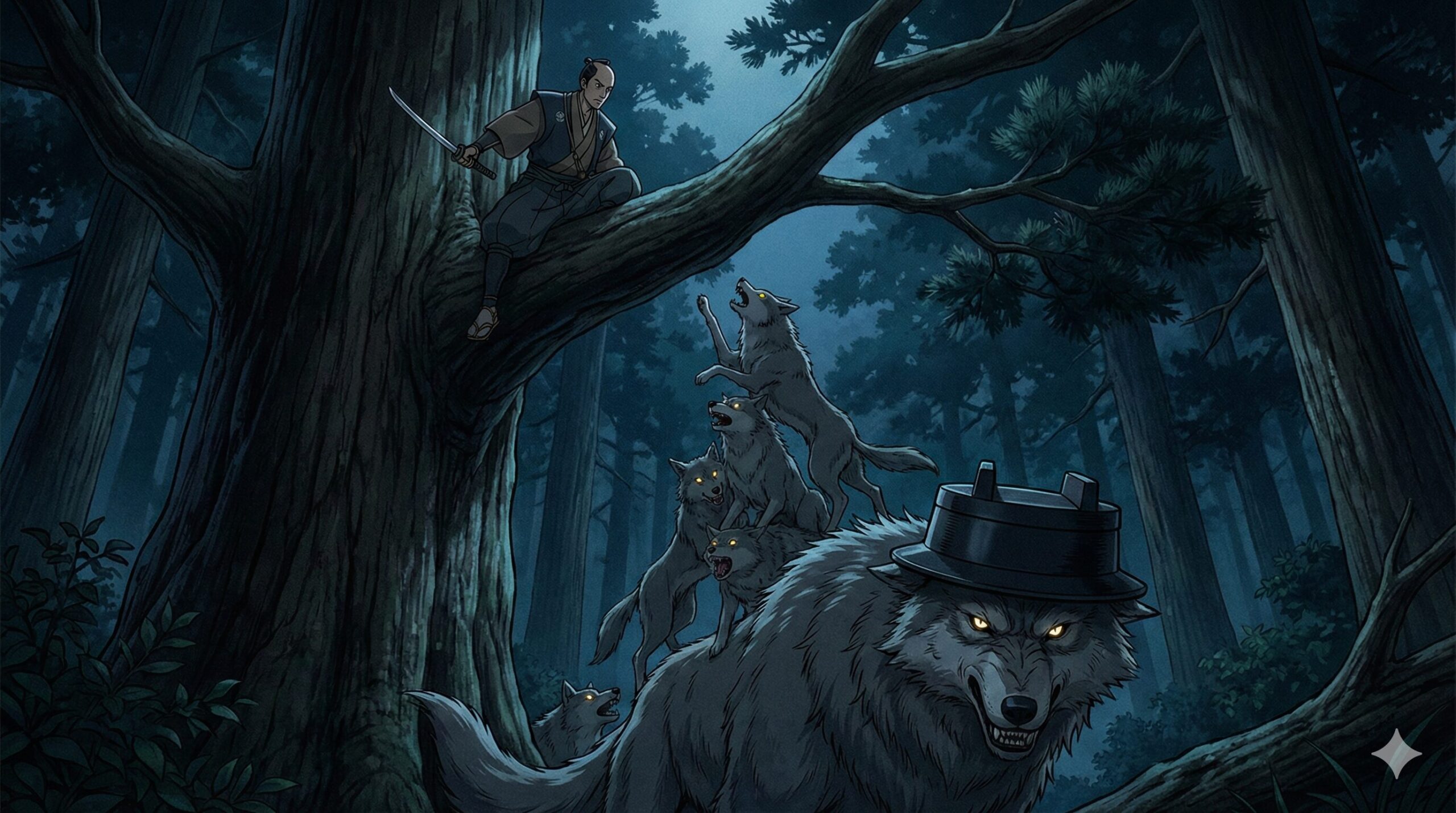
Sensing imminent danger, the courier barely managed to climb a towering ancient cedar tree, seeking refuge on a high branch. But the wolves did not give up. Gathering at the base of the tree, they executed a terrifying strategy. One wolf climbed onto the back of another, and another onto that one, forming a “wolf ladder.” Their razor-sharp fangs crept closer to the courier’s feet.
The courier drew his short sword and slashed at the wolves reaching the top. No matter how many times they were knocked down, the pack rebuilt the ladder. Realizing the human’s fierce resistance, the pack leader howled, “We have no choice! Call the Blacksmith’s Hag!”
Soon after, a monstrous, ancient wolf emerged from the depths of the forest, exuding a bizarre aura. Unbelievably, this giant beast wore a thick, heavy iron pot on its head like a battle helmet. This was the “Blacksmith’s Hag.”
The wolf ladder was formed once more, and this time, the pot-wearing hag climbed to the top. The courier desperately swung his sword, but the hard iron pot violently deflected the blade, sending sparks flying into the night. It was a desperate situation. However, the courier remained calm. With sharp observation, he noticed a tiny gap between the iron pot and the hag’s forehead. Gathering all his strength, he thrust his blade directly into that single weak point.
With an ear-piercing shriek of “Gyaaaah!”, the hag tumbled from the tree. Taking this as a signal, the terrifying pack of wolves scattered into the dark night, completely vanishing.
The next morning, the courier safely descended the mountain and passed by a blacksmith’s shop in the village. Remembering the wolves howling for the “Blacksmith’s Hag,” he asked the old shop owner, “Is your wife home?” The old man sighed and replied, “Actually, last night she slipped at the river while washing an iron pot, severely cut her head, and is now resting in bed.”
Struck by a terrible premonition, the courier asked to look into the back room. Inside the futon, an old woman with a bandaged head glared at him with murderous eyes. In the blink of an eye, the old woman transformed into the giant wolf from the night before and lunged at him with bared claws! But the courier, leaving no opening, swiftly drew his sword and completely defeated the Yokai.
Later, when the villagers dug under the floorboards of the blacksmith’s shop, they found the real old woman’s skeletal remains. The monstrous wolf had eaten her and taken her form, hiding within human society for a long time.
② Deep Analysis: More Than a Ghost Story, a Meticulous Suspense
The true horror of this tale goes far beyond the simple fear of an animal attack. The first point of brilliance is the tactical “wolf ladder.” The sight of wild animals forming a faction and using strategic intellect to corner a human showcases the overwhelming organizational power of nature.
The second point is the concept of “using an iron pot as a helmet.” Normally, wild beasts fear fire and metal. Yet, this wolf used a human-made tool to solidify its physical defense. This represents a thrilling dynamic where the wild absorbs and overcomes human ingenuity.
The ultimate terror, however, is the final twist of the “shapeshifter.” The revelation that the monster had already infiltrated the safe haven of human society and the home is a brilliant plot twist that resonates perfectly with modern psychological horror.
③ Decoding Japanese Culture and Mountain Worship
Since ancient times, Japanese people have referred to wolves as “Okami” (Great Deity), worshipping them as sacred protectors who hunted crop-destroying boars and deer. Yet, they were simultaneously feared as the deadly “rulers of the mountains.” “The Blacksmith’s Hag” vividly reflects this dual nature of awe and pure terror toward nature.
The setting of the “blacksmith” is also deeply symbolic. In Japanese folklore, blacksmiths, who control fire and iron, represent human civilization and possess sacred, evil-warding powers. The fact that the blacksmith’s wife was killed and replaced by a Yokai illustrates a primal fear: no matter how advanced human civilization (iron and fire) becomes, humanity remains powerless against the overwhelming force of nature (Yokai/wolves), and our safe boundaries can easily be breached. Japanese Yokai culture always emerges at the exact boundary between humanity and the natural world.
④ Conclusion: Tested in the Dark Forest—What Would You Do?
Trapped in a tree with nowhere to run, highly intelligent beasts swarming up from below, and a giant monster equipped with impenetrable armor arriving to finish you off. If you were the courier, could you suppress your madness, find the single weak point, and strike back?
Furthermore, how would you react if you realized a monster was perfectly blending into your everyday life? What this Japanese folktale passes down is not just the horror of spirits, but the “courage” and “quick wits” required to survive desperate situations. After reading this story, the way you view Japan’s deep forests and traditional villages has surely changed.
If you want to explore more deep mysteries and Japanese folktales, check out this category:
Japanese Folktale Series
If you want to experience the beautiful nature, culture, and historic landscapes of Kochi Prefecture (Shikoku), the setting of this tale, visit here:
Visit Kochi Japan Official Site
日本の奥深き恐怖の昔話「かじ屋のばばあ」の世界へようこそ
日本の昔話と聞くと、多くの人は「桃太郎」や「鶴の恩返し」のような、教訓的で心温まるストーリーを思い浮かべるでしょう。しかし、日本の民間伝承には、背筋が凍るようなサバイバルホラーや、心理的な恐怖を突く物語が数多く存在します。その中でも、他に類を見ないほどの緊迫感と衝撃的な結末を持つのが「かじ屋のばばあ(鍛冶屋の婆)」という物語です。この物語は、単なる怪談ではなく、人間と自然の境界線、そして野生の脅威を描いた傑作です。さあ、月明かりの届かない日本の深い森の中へ足を踏み入れましょう。
① 死闘の幕開け:昔話「かじ屋のばばあ」のストーリー
むかしむかし、四国の険しい山中でのこと。ある一人の飛脚(現代でいう急便の配達人)が、重要な書状を届けるために、鬱蒼と茂る不気味な峠道を急いでいました。日が完全に落ち、漆黒の闇が森を包み込むと、周囲から獣の遠吠えが響き渡りました。恐ろしいオオカミの群れです。
危険を察知した飛脚は、間一髪でそびえ立つ巨大な杉の木に登り、高い枝の上に避難しました。しかし、オオカミたちは諦めません。彼らは木の根元に集まると、驚くべき行動に出ました。一匹のオオカミの上に別のオオカミが乗り、さらにその上に別のオオカミが乗るという「オオカミ梯子」を作り始めたのです。鋭い牙が、徐々に飛脚の足元へと迫ってきます。
飛脚は腰に帯びていた護身用の小刀を抜き放ち、一番上に登ってきたオオカミを次々と切りつけました。何度切り落とされても梯子を組み直すオオカミたちですが、やがて人間の抵抗が激しいことを悟り、群れのリーダーがこう吠えました。「こうなったら仕方がない、かじ屋のばばあを呼んでこい!」
しばらくすると、森の奥から異様な気配と共に、一際巨大な年老いたオオカミが姿を現しました。信じられないことに、その巨大オオカミの頭には、分厚く硬い鉄の鍋が兜のように被せられていました。これが「かじ屋のばばあ」です。
再びオオカミ梯子が組まれ、一番上には鉄鍋を被ったばばあオオカミが登ってきました。飛脚が必死に小刀を振り下ろしても、硬い鉄鍋が「カーン!」と火花を散らして刃を弾き返します。絶体絶命の窮地。しかし、飛脚は冷静さを失いませんでした。鋭い観察眼で鍋とばばあオオカミの額の間にわずかな隙間を見つけると、全身の力を込めてその一点に刃を突き立てました。
「ギャアアアッ!」という耳をつんざくような悲鳴と共に、ばばあオオカミは木から転げ落ちました。それを合図に、恐ろしいオオカミの群れは蜘蛛の子を散らすように闇夜へと消え去っていきました。
翌朝、無事に山を下りた飛脚は、山の麓にある村の鍛冶屋(鉄を打つ職人の家)の前を通りかかりました。ふと昨夜の「かじ屋のばばあ」という言葉を思い出した飛脚は、店の主人である老人に「お婆さんはご在宅ですか」と尋ねました。主人はため息をつき、「実は昨晩、婆さんが川で鍋を洗っている最中に転んで、額をひどく割って寝込んでいるんですよ」と答えました。
嫌な予感がした飛脚は、主人の許可を得て奥の寝室を覗き込みました。布団の中で頭に包帯を巻いた老婆が、凄まじい眼光で飛脚を睨みつけています。次の瞬間、老婆の姿は昨夜のあの巨大なばばあオオカミへと変貌し、鋭い爪を立てて襲い掛かってきました。しかし、飛脚は一瞬の隙も与えず、素早く小刀を抜き、その妖怪を完全に退治しました。
その後、村人たちと鍛冶屋の床下を掘り起こしてみると、そこには本物の老婆の白骨死体が隠されていました。恐ろしいオオカミは本物の老婆を食い殺し、長い間その姿に化けて人間社会に潜伏していたのです。
② 昔話を徹底考察:ただの怪談ではない、緻密なサスペンス
この物語の真の恐ろしさは、単なる「獣に襲われる恐怖」にとどまらない点にあります。第一のポイントは「オオカミ梯子」という戦術です。野生動物が徒党を組み、知略を用いて人間を追い詰める様子は、自然界が持つ圧倒的な組織力を見せつけています。
第二のポイントは、「鉄鍋を兜にする」という発想です。本来、動物は火や金属を恐れます。しかし、このばばあオオカミは人間の作り出した道具(鍋)を利用して物理的な防御を固めてきました。これは、野生の力が人間の知恵を吸収し、凌駕しようとしている非常にスリリングな展開です。
そして最大の恐怖は、結末の「すり替わり」です。安全であるはずの家の中、そして人間社会の内部に、すでに化け物が入り込んでいたという事実は、現代のサイコロジカル・ホラーにも通じる秀逸などんでん返しです。
③ 昔話から読み解く日本文化と山岳信仰
日本では古来より、オオカミを「大神(おおかみ)」と呼び、田畑を荒らすイノシシやシカを退治してくれる神聖な存在として信仰してきました。しかし同時に、ひとたび牙を剥けば人間の命を奪う「恐るべき山の支配者」でもありました。「かじ屋のばばあ」は、この自然に対する畏敬の念と恐怖心の両面を色濃く反映しています。
また、舞台が「鍛冶屋」であることには深い意味があります。日本の民間伝承において、火と鉄を操る鍛冶屋は、文明の象徴であり、魔除けの力を持つ神聖な職業とされてきました。その鍛冶屋の妻が妖怪に食い殺され、乗っ取られていたという設定は、「どんなに文明(鉄と火)を発展させても、強大な自然(妖怪・オオカミ)の前では人間は無力であり、境界線は容易に突破される」という昔の人々の潜在的な恐怖を表しています。日本の妖怪文化は、常に人間と自然界の境界に発生するものなのです。
④ 最後に:暗闇の森で試される決断、あなたならどうする?
木の上という逃げ場のない空間で、下からは知恵を持った獣たちが結託して迫り上がってくる。さらに、防御不可能な武装をした巨大な怪物が現れる。あなたがもしこの飛脚だったら、恐怖に発狂せずに隙を見極め、反撃の刃を突き立てることができたでしょうか?
そして、人間社会の日常に完璧に溶け込んでいる怪物の存在に気づいたとき、あなたはどう行動しますか?日本の昔話が伝えるのは、幽霊の恐ろしさだけではなく、絶望的な状況下で生き抜く人間の「勇気」と「機転」です。この物語を読んで、あなたが日本の深い森や伝統的な村落を見る目は、確実に変わったはずです。
さらに日本の深いミステリーと昔話の世界を探求したい方は、こちらのカテゴリーをご覧ください:
Japanese Folktale Series(日本の昔話シリーズ)
物語の舞台である四国・高知県の美しい自然や文化、歴史的な風景を実際に体験したい方はこちら:
Visit Kochi Japan 公式サイト

コメント