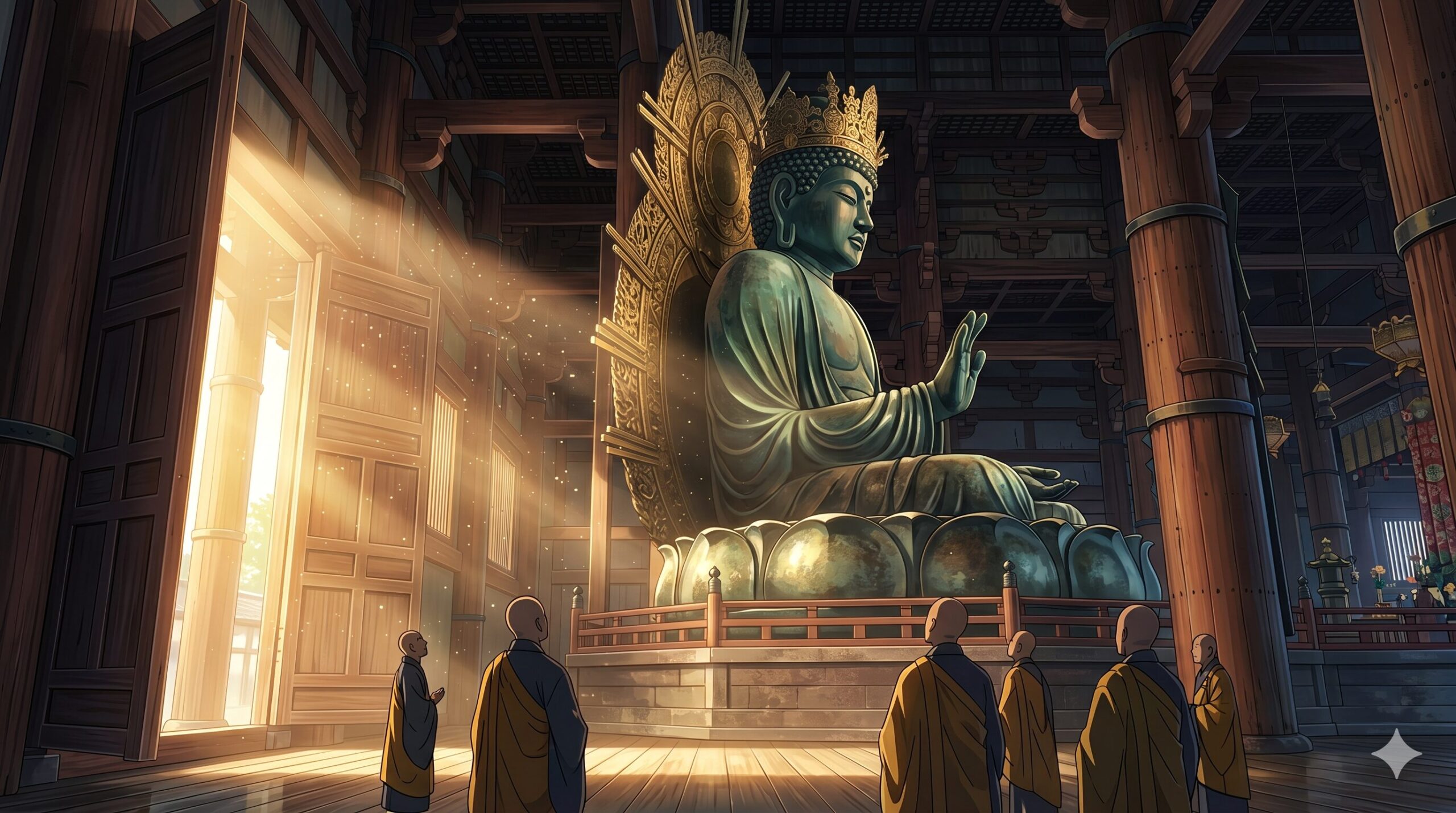
May 26 marks a profoundly significant anniversary in Japanese history and culture. On this day in 752 AD, the magnificent “Kaigen Kuyo” (Eye-Opening Ceremony) for the colossal Vairocana Buddha—affectionately known today as the Great Buddha of Nara—was grandly celebrated at Todai-ji Temple in the ancient capital of Nara.
This historical event was far more than a mere religious ritual. It was a massive national project of early Japan and a moment when highly international culture bloomed at the eastern terminus of the Silk Road. Let’s delve into the historical drama behind the creation of the Great Buddha and the Japanese spirituality embedded within it.
Why Was the Great Buddha Built? Emperor Shomu’s Desperate Wish
Japan in the early 8th century (the Nara period) was anything but peaceful. The Japanese archipelago was struck by political rebellions, repeated natural disasters like major earthquakes and droughts, and most terrifyingly, a massive epidemic of smallpox. Amidst an unprecedented crisis that is said to have wiped out nearly a third of the population, Emperor Shomu, the ruler at the time, was tormented by deep despair and a heavy sense of responsibility.
Driven by an intense desire to overcome the national crisis and create a world where all people could live in peace, Emperor Shomu resolved to pacify the nation through the “power of Buddhism.” In 743, the Emperor issued an edict to construct the Great Buddha. This was a grand declaration of peace, expressing the wish that “all living beings, both animals and plants, may prosper together.” He made an unprecedented appeal to the common people, asking for the cooperation of every single citizen—stating that even a single blade of grass or a handful of dirt contributed with a pure heart would suffice.
May 26, 752: A Spectacular Eye-Opening Ceremony Where the Silk Road Intersected
After about nine years and the involvement of roughly 2.6 million people (about half of Japan’s population at the time), the national project finally reached completion. The “Kaigen Kuyo”—the ritual of painting the eyes on the statue to infuse it with a soul—was held on May 26, 752.
This ceremony was conducted on an unimaginably international scale. The paintbrush used to open the Great Buddha’s eyes was held by Bodhisena, a monk who had traveled all the way from India. Furthermore, approximately 10,000 monks, musicians, and dancers gathered from China (Tang Dynasty), the Korean Peninsula (Silla), and even Vietnam (Champa), offering magnificent music and dance. Nara at the time was the “eastern end of the world” where cultures from across the Eurasian continent washed ashore via the Silk Road. This eye-opening ceremony was truly as glamorous as an ancient Asian Expo.
Understanding Japanese Culture Through the Great Buddha: “Harmony” and “Resilience”
From this event on May 26, we can decipher deep essences of Japanese culture: “Harmony (Wa)” and “Resilience.”
Although Buddhism was a religion introduced from the outside, it did not conflict with Japan’s indigenous Shinto (nature worship) but rather blended beautifully with it (Shinbutsu-shugo, or syncretism). Records show that the construction of the Great Buddha received approval via an oracle from Amaterasu, the supreme deity of Shinto. The “spirit of harmony”—accepting and harmonizing different cultures and philosophies to create something new—is perfectly embodied here.
Furthermore, after its completion, the Great Buddha suffered the tragedy of being burned down twice in wars—during the Genpei War (1180) and the Sengoku period (1567)—causing its head to collapse. However, each time, the Japanese people gathered donations from across the country to repair it. While most of the current statue was restored in the Edo period, the bronze of the pedestal and legs remains from the 8th century. The attitude of never giving up even when destroyed, and connecting people’s prayers to achieve reconstruction, is a symbol of the “resilience” that Japan, a country prone to disasters, has cultivated since ancient times.
Stepping Into a Space of Prayer That Continues into the Future
Even today, when you step into the Great Buddha Hall at Todai-ji, you are left speechless by its overwhelming scale and silence. The gentle gaze looking down from the massive 15-meter-tall statue is born from the prayers of people suffering from epidemics and disasters over 1,200 years ago, and is proof of overcoming numerous wars.
Today, we too face difficulties such as unknown infectious diseases, natural disasters, and global conflicts. For this very reason, the wish embedded in this day in 752—”that all life may prosper together”—resonates strongly with us living in the present.
What Do You Think?
If you visit Nara and stand before this colossal Great Buddha, can you imagine the enthusiasm of the eye-opening ceremony 1,200 years ago and the prayers for peace infused within it? Standing before this magnificent monument that bears the weight of history, what would you pray for? Please share your thoughts.
Reference Links
- Official Website of Todai-ji Temple (English)
- Japan National Tourism Organization: Todai-ji Temple (English)
▶︎ Updated Daily! If you want to know more about special days in Japan, click here: What’s Today’s Special Day? Series
- Why Was the Great Buddha Built? Emperor Shomu’s Desperate Wish
- May 26, 752: A Spectacular Eye-Opening Ceremony Where the Silk Road Intersected
- Understanding Japanese Culture Through the Great Buddha: “Harmony” and “Resilience”
- Stepping Into a Space of Prayer That Continues into the Future
- What Do You Think?
- 5月26日:奈良の大仏が開眼した日。752年の壮大なプロジェクトと日本の祈りの歴史
5月26日:奈良の大仏が開眼した日。752年の壮大なプロジェクトと日本の祈りの歴史
5月26日は、日本の歴史と文化において非常に重要な意味を持つ記念日です。西暦752年のこの日、古都・奈良の東大寺において、巨大な「盧舎那仏像(るしゃなぶつぞう)」——私たちが今日「奈良の大仏」として親しんでいる仏像の「開眼供養(かいげんくよう)」が盛大に行われました。
この歴史的な出来事は、単なる宗教行事にとどまらず、当時の日本の国家的な一大プロジェクトであり、シルクロードの終着点として国際色豊かな文化が花開いた瞬間でもありました。今回は、この大仏造立の背景にある歴史ドラマと、そこに込められた日本人の精神性について深く掘り下げていきます。
なぜ大仏は造られたのか?聖武天皇の切実な願い
8世紀前半の日本(奈良時代)は、決して平穏な時代ではありませんでした。政治的な反乱、度重なる大地震や干ばつなどの自然災害、そして何より恐ろしい天然痘(疫病)の大流行が日本列島を襲いました。人口の約3分の1が失われたとも言われる未曾有の危機の中で、当時の統治者であった聖武天皇(しょうむてんのう)は深い絶望と責任感に苛まれます。
国家の危機を乗り越え、すべての人々が平和に暮らせる世の中を作りたい。その強烈な願いから、聖武天皇は「仏教の力」によって国を鎮めることを決意しました。743年、天皇は「大仏造立の詔(みことのり)」を発布します。これは「動物も植物も、すべての生きとし生けるものが共に栄える世界を作りたい」という壮大な平和宣言でした。権力者の力だけで造るのではなく、一本の草、一握りの土でも良いから、民衆一人ひとりの協力を得て造り上げたいという異例の呼びかけが行われたのです。
752年5月26日:シルクロードが交差した壮大な開眼供養
約9年の歳月と、延べ260万人(当時の日本の人口の約半分)もの人々が関わった国家プロジェクトは、ついに完成の時を迎えます。仏像に目を入れることで魂を宿らせる儀式「開眼供養」は、752年5月26日に執り行われました。
この儀式は、想像を絶する国際的なスケールで開催されました。大仏の目を開く筆を取ったのは、はるばるインドから来日した僧侶・菩提僊那(ぼだいせんな)です。さらに、中国(唐)や朝鮮半島(新羅)、さらにはベトナム(林邑)などから集まった約1万人の僧侶や音楽家、舞踏家が参加し、壮麗な音楽と舞が奉納されました。当時の奈良は、シルクロードを通ってユーラシア大陸のあらゆる文化が流れ着く「世界の東の終着点」であり、この開眼供養はまさに古代のアジア万博とも言える華やかさだったのです。
大仏から読み解く日本文化:「和」と「レジリエンス」
この5月26日の出来事から、私たちは日本文化の深い本質を読み解くことができます。それは「融合(和)」と「レジリエンス(回復力)」です。
日本の仏教は、外から入ってきた宗教でありながら、日本古来の神道(自然崇拝)と対立するのではなく、見事に融合しました(神仏習合)。大仏造立にあたっても、日本の最高神である天照大御神(あまてらすおおみかみ)からのお告げで賛同を得たという記録が残っています。異なる文化や思想を排除せず、調和させながら新しいものを作り上げる「和の精神」がここに表れています。
また、大仏は完成後、源平の争乱(1180年)や戦国時代(1567年)の二度にわたる戦火で焼け落ち、頭部が崩れ落ちるという悲劇に見舞われました。しかし、日本人はその度に全国から寄付を集め、大仏を修復し続けました。現在の大仏の大部分は江戸時代に修復されたものですが、台座や脚部には8世紀当時のままの青銅が残っています。破壊されても決して諦めず、人々の祈りを繋いで復興を遂げる姿勢は、災害大国である日本が古来より培ってきた「レジリエンス」の象徴なのです。
未来へ続く祈りの空間へ
今日でも、東大寺の大仏殿に足を踏み入れると、その圧倒的なスケールと静寂に言葉を失います。高さ約15メートルの巨大な仏像が見下ろす優しい眼差しは、1200年以上前に疫病や災害に苦しんだ人々の祈りから生まれ、幾多の戦火を乗り越えてきた証です。
現代の私たちもまた、未知の感染症や自然災害、世界的な紛争といった困難に直面しています。だからこそ、752年のこの日に込められた「すべての命が共に栄えるように」という願いは、今を生きる私たちに強く響くのではないでしょうか。
あなたはどう感じましたか?
あなたがもし奈良を訪れ、この巨大な大仏の前に立ったとき、1200年前の開眼供養の熱狂や、そこに込められた平和への祈りを想像できるでしょうか?歴史の重みを感じるこの壮大なモニュメントの前で、あなたなら何を祈りますか?ぜひ、あなたの考えをシェアしてください。
参考リンク
▶︎ 毎日更新!日本の特別な日をもっと知りたい方はこちら:What’s Today’s Special Day? シリーズ

コメント