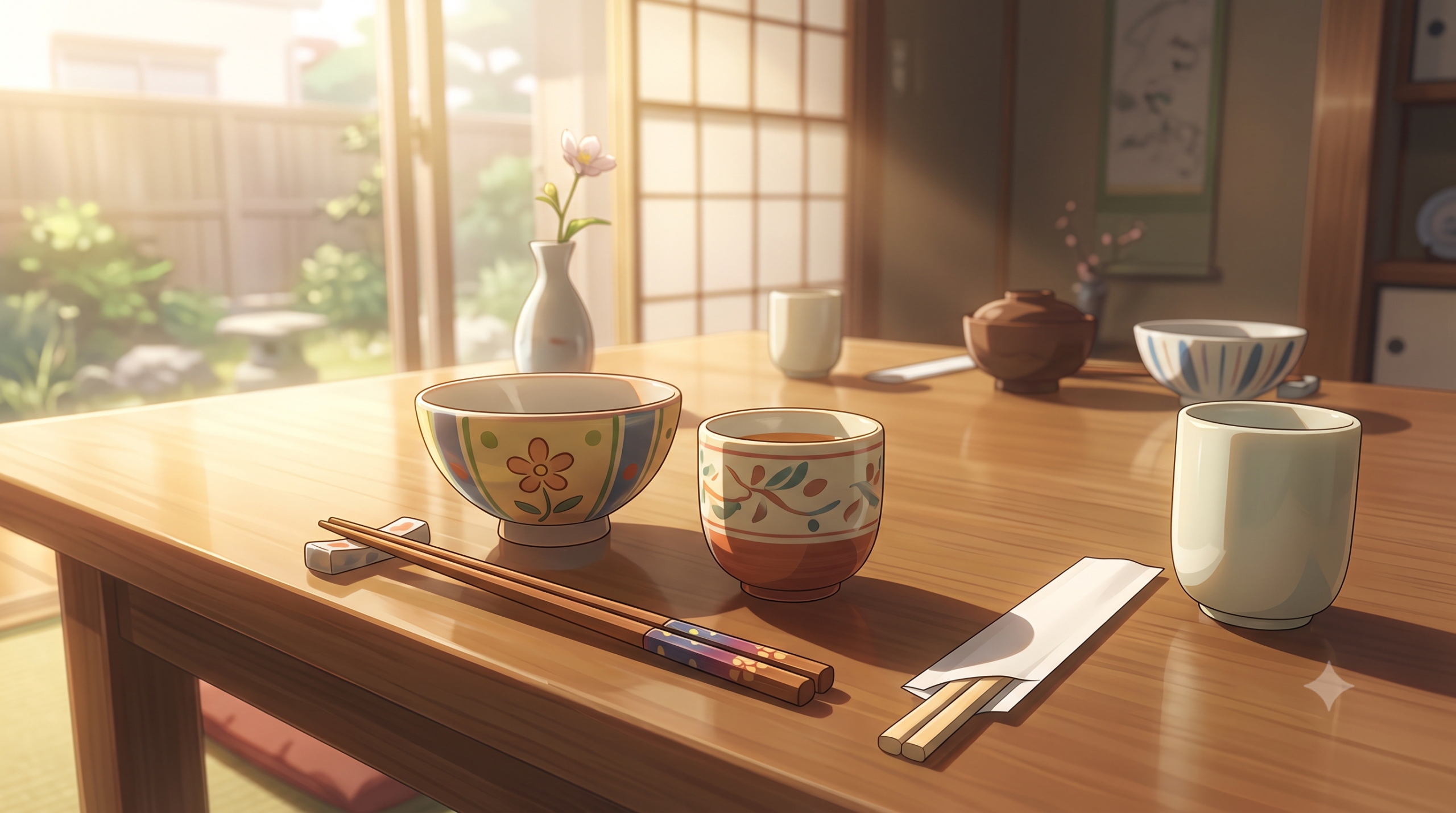
The Japanese dining table operates under a unique set of rules rarely seen elsewhere in the world. The most prominent is the culture of possessing “personal tableware.” Even within a close-knit family, the father has his own rice bowl, the mother her own chopsticks, and the child their own teacup. Sharing or borrowing someone else’s daily tableware is an absolute taboo. In many Western countries, families share identical sets of dishes, using them randomly depending on the meal. In Japan, however, this approach is firmly rejected.
This ingrained habit of having one’s own chopsticks, rice bowl, and teacup stems from more than just hygiene or a desire for ownership. It is deeply rooted in the underlying spirituality and ancient religious beliefs of the Japanese people. Today, we will decode the psychological architecture of the Japanese nation through their fascinating tableware culture.
The Concept of “Zokujinki”: The Soul Resides in the Vessel
In cultural anthropology, tableware used exclusively by a specific individual is called “Zokujinki” (personalized instruments). In Japan, chopsticks, rice bowls, and teacups are the prime examples.
According to ancient Japanese Shinto beliefs, items that a person routinely touches directly with their mouth or hands absorb that person’s “aura” or “soul.” Therefore, your everyday chopsticks and bowls are not merely eating utensils; they become extensions of your very self, avatars of your spirit. Eating with someone else’s chopsticks triggers an unconscious aversion in Japanese people, akin to taking a stranger’s soul into one’s body or having one’s personal sanctuary invaded. This is precisely why Japanese households strictly differentiate and carefully handle individual tableware.
Why Serve Guests with “Disposable Chopsticks”? The Highest Hospitality and “Purity”
This brings us to a profound contradiction. If Japanese people strictly separate their own vessels even among family, why do they serve important guests with “Waribashi”—disposable wooden chopsticks? From a Western perspective, one might expect a guest to be offered the finest silver cutlery or magnificent lacquered chopsticks. Offering disposable wooden utensils might initially seem disrespectful.
However, this is the very essence of unique Japanese hospitality. The primary reason Japanese people offer disposable chopsticks to guests is to prove “absolute purity” (Kegare-naki).
As mentioned earlier, once a person uses a pair of chopsticks, their spirit dwells within them. No matter how thoroughly washed and sterilized, the spiritual “trace of the other” cannot be erased. By presenting wooden chopsticks that must be snapped apart before first use, the host sends a powerful message of ultimate respect: “These chopsticks have never been touched by anyone else’s lips. They are completely pure and prepared solely for you.” The physical act of splitting the chopsticks also holds a sacred meaning, signifying the opening of a divine banquet.
Tracing the history of disposable chopsticks, we find this culture was already firmly established during the Edo period. The modern perception that disposable equals “cheap” is a misunderstanding. High-grade Waribashi, emitting the fragrant scent of cedar or cypress, represents the highest level of welcome in traditional Japanese high-end restaurants (Ryotei).
Respect for the “Individual” Reflected in Design
The culture of personal tableware has caused the diversity of Japanese ceramics and lacquerware to evolve explosively. Even within a family, hand sizes, portion preferences, and aesthetic tastes vary. The father might use a heavy, large ceramic bowl; the mother a light, elegantly painted porcelain one; and the child a small wooden bowl. Consequently, the Japanese dining table features a collection of vessels with entirely different shapes, colors, and textures.
While Western table settings favor the symmetrical beauty of uniform matching sets, the Japanese find profound harmony in the irregularity of disparate vessels gathered together. This aesthetic, which respects individual characteristics while maintaining cohesion as a single dining table, perfectly mirrors the structure of Japanese society and human relationships.
If you want to dive deeper into the rich traditions and aesthetics of Japan, please read more articles on our blog.
Conclusion: The Japanese Mind Seen Through Tableware
Japanese tableware culture demonstrates a delicate sense of distance: maintaining clear boundaries with others while welcoming guests with pristine purity. “My Chopsticks” and “My Bowl” serve as sanctuaries for one’s own soul, while the “Waribashi” offered to guests is a testament to unwavering respect and cleanliness.
The next time you visit an authentic Japanese restaurant or are invited to a Japanese home, pay attention to the “silent messages” embedded in the vessels and chopsticks placed before you. Beyond words, a profound spiritual exchange is taking place.
日本の食卓に隠された「魂」の在り処:自分専用の器と客人の割り箸
日本の食卓には、世界でも類を見ない独特のルールが存在します。それは「自分専用の食器」を持つという文化です。家族であっても、父親の茶碗、母親の箸、子供の湯飲みと、それぞれが専用の器を持ち、他人の器を使い回すことは絶対にありません。欧米をはじめとする多くの国では、家族全員が同じデザインの食器を共有し、その日の気分や配膳の都合でランダムに使用します。しかし、日本においてそれはタブーとされています。
この「自分だけの箸、飯茶碗、湯飲み」を持つ習慣は、単なる衛生概念や所有欲から生まれたものではありません。そこには、日本人の根底に流れる深い精神性と、古代から続く宗教観が息づいています。今回は、日本の食器文化を通じて、日本人という民族の精神構造を解き明かします。
「属人器」という概念:器には持ち主の魂が宿る
特定の個人だけが使用する食器を、文化人類学の用語で「属人器(ぞくじんき)」と呼びます。日本では、箸、飯茶碗、湯飲みがこの代表格です。
古代日本の神道(Shinto)の考え方では、人が日常的に口をつけるもの、手で直接触れるものには、その人の「霊気」や「魂」が宿ると信じられてきました。つまり、毎日使う自分の箸や茶碗は、単なる食事の道具ではなく、自分自身の分身となるのです。他人の箸でご飯を食べるということは、他人の魂を体内に取り込んでしまう、あるいは自分の領域を侵されるという無意識の忌避感を日本人に引き起こします。だからこそ、日本の家庭では個人の器を明確に区別し、大切に扱うのです。
客人にはなぜ「割り箸」を出すのか?最高級のおもてなしと「清浄」
ここで一つの疑問が生じます。家族でさえ自分専用の器を厳格に分ける日本人が、なぜ大切な客人に対しては、使い捨てである「割り箸(Waribashi)」を出すのでしょうか。海外の感覚からすれば、ゲストには最も高価で美しい銀のナイフやフォーク、あるいは立派な漆塗りの箸を出すべきだと考えるかもしれません。使い捨ての木箸を出すことは、一見すると失礼にあたるように思えます。
しかし、これこそが日本独自のおもてなしの神髄です。日本人が客人に割り箸を出す最大の理由は、「清浄(けがれがないこと)」を証明するためです。
前述の通り、誰かが使った箸にはその人の魂が宿ります。いくら綺麗に洗って殺菌したとしても、精神的な意味での「他人の痕跡」は消えません。客人に対して「この箸は、まだ誰も口をつけていない、完全に清らかなものです。あなたのためだけに用意しました」という最大限の敬意を示すために、木を割って初めて完成する「割り箸」を提供するのです。割るという行為自体に、神聖な食事の場を開くという意味が込められています。
割り箸の歴史を辿ると、江戸時代にはすでにこの文化が定着していたことがわかります。使い捨て=安物という認識は誤りであり、杉や檜の香りが漂う高級な割り箸は、日本の料亭において最高級の歓迎を意味します。
デザインに現れる「個」の尊重
自分専用の器を持つ文化は、日本の陶磁器や漆器の多様性を爆発的に進化させました。家族であっても、手の大きさや食べる量、好みのデザインは異なります。父親には重厚で大きめの陶器、母親には軽く華やかな磁器、子供には小さな木のお椀というように、食卓には全く異なる色や形の器が並びます。
セットで統一されたシンメトリーな美しさを好む西洋のテーブルコーディネートに対し、日本はバラバラの器が並ぶ不規則性の中に調和を見出します。それぞれの個性を尊重しつつ、一つの食卓としてまとまりを持たせるこの美意識は、日本の社会構造や人間関係のあり方をそのまま映し出していると言えます。
さらに日本の伝統文化や美意識について深く知りたい方は、当ブログの他の記事もぜひご覧ください。
結論:器を通して見る日本人の心
日本の食器文化は、他者との境界を明確に保ちながらも、客人に対しては無垢な清らかさをもって歓迎するという、日本人の繊細な距離感を示しています。「My箸」や「My茶碗」は自己の魂の拠り所であり、客人への「割り箸」は敬意と清浄の証です。
次に日本料理店を訪れる際、あるいは日本人の家庭に招かれた際は、出された器や割り箸に込められた「無言のメッセージ」を感じ取ってみてください。そこには、言葉を超えた深い精神的交流が存在しています。

コメント