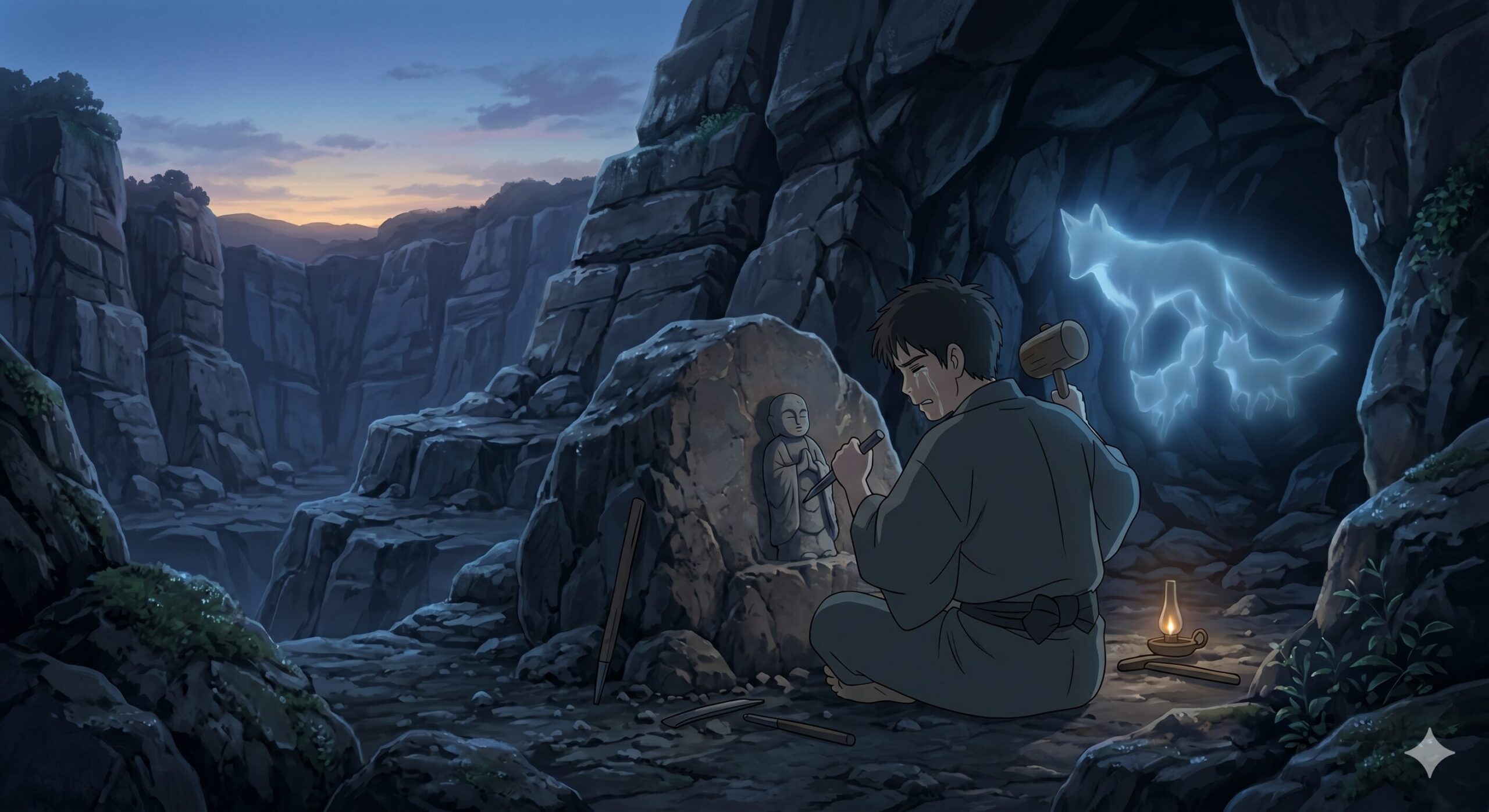
In Japan, there are countless “folktales” that have been passed down orally since ancient times. They are not merely fairy tales for children, but strongly reflect the moral lessons, religious beliefs, and sometimes cruel realities of people living in harsh natural environments. Today, I will introduce a story called “The Fox’s Escort” (Kitsune no Michiokuri), which is quietly handed down in Kumamoto Prefecture, in the Kyushu region of Japan. This tale is a heartbreaking record of a life tossed about by the boundaries between humans and wild animals, and the strict rules of a closed village community.
1. The Story of the Japanese Folktale “The Fox’s Escort”
Once upon a time, in a village called Osaka in Yamaga City, Kumamoto Prefecture, there was a desolate stone quarry called “Osenjo.” During the day, the sound of cutting stones echoed, but at night, it was a creepy place where no one passed by. It was rumored that a fox, known for bewitching and deceiving people, lived in the rocky caves of this “Osenjo.”
One night, a man named Yone-san, who lived in the village, was on his way home in high spirits after receiving a lot of delicious food as gifts in the town. He had to pass through “Osenjo” on his way back. Just as the moon hid behind the clouds and it became pitch dark…
“Pata-pata, pata-pata…”
He heard someone’s footsteps from behind. He turned around, but no one was there. However, when he started walking again, the footsteps followed him. Yone-san was struck by a chilling terror and ran frantically. Stumbling all the way home, he looked at the wrapping cloth he was supposed to be holding, only to find that the delicious food inside was completely gone, replaced by stones and leaves. He had been tricked by the fox and robbed of his food.
On another day, an energetic old woman from the village passed by “Osenjo” on her way back from buying a lot of groceries in the town. Then again, the footsteps followed her. The old woman shouted loudly to shake off her fear:
“Hey, you fox! I won’t be fooled! I absolutely won’t give you my food!”
However, the opponent was a fox with mysterious powers. By the time the old woman arrived home, all the food she had been carrying on her back had vanished.
With these repeated incidents, the villagers’ anger reached its peak. A village assembly was held, and the village chief raised his voice.
“I can’t stand that fox anymore. Let’s make steamed buns mixed with poison, put them in the middle of the road, and get rid of that fox.”
While the villagers agreed one after another, only one person, a kind-hearted young man named Sadasuke, voiced his opposition.
“Please wait! Even if it steals food, poisoning it is too pitiful. The fox might just be desperate to survive. Please, don’t take its life!”
However, Sadasuke’s words did not reach the ears of the villagers, who were burning with anger and whose livelihoods were threatened. As the rule of the village, the poisoning of the fox was decided. That night, the villagers placed the poisoned buns on the path leading to “Osenjo.”
The next morning, feeling an uneasy premonition, Sadasuke ran to the rocks of “Osenjo” at the crack of dawn. When he got close to the fox’s den, a heartbreaking sight unfolded before him.
The mother fox was dead, her body cold. And in her arms, she held two tiny baby foxes whose eyes hadn’t even opened yet. The mother fox had been stealing the villagers’ food to feed her babies. She had eaten the poisoned bun herself, and even while suffering, she died holding her babies tightly, trying to protect them until the very end.
“Oh… what a tragedy…”
Sadasuke broke down crying on the spot. Despairing of his own powerlessness and the cruelty of the villagers, Sadasuke stopped speaking to the villagers from that day on. Every day, without exchanging a word with anyone, he began going to the rocks of “Osenjo” with a chisel and a hammer.
A few months later, when a villager passed by “Osenjo,” they found a magnificent “Jizo” statue carved into the rock face, with an incredibly gentle and compassionate expression. It was undoubtedly carved by Sadasuke for the fox mother and her babies who had lost their lives.
However, from that day on, no one in the village ever saw Sadasuke again. No one knows where he disappeared to. Only the Jizo statue comforting the souls of the foxes remains quietly in that lonely rocky area today.
2. Analyzing the Folktale: Why Did the Tragedy Occur?
The greatest tragedy of this story lies in “misunderstanding” and “ignorance.” For the villagers, the fox was an “evil” that stole their precious food and a target of fear. In old Japan, food was not as easily obtainable as it is today, and losing it was a matter of life and death. It can be said that the villagers’ attempt to eliminate the fox was a defensive instinct to protect their own lives.
On the other hand, from the fox’s perspective, it was a desperate act to keep her young children from starving in a wild environment where food was scarce. For the fox, stealing the villagers’ food was not “malice” but “survival.”
Sadasuke was a man with a rare empathy who could intuitively understand both positions. However, in a village dominated by group psychology, individual compassion was powerless. The reason Sadasuke left the village was probably not only due to his guilt over failing to save the foxes, but also because of his deep despair toward “human society itself,” which could not sympathize with the pain of others.
3. Deep Connections to Japanese Culture
This story of “The Fox’s Escort” deeply engraves the traditional culture and spirituality of Japan.
The Spirituality and Awe of the Fox (Kitsune)
In Japanese folk beliefs, foxes are not just animals. Sometimes they are worshipped as messengers of the gods (Inari deities), and sometimes they are feared as Yokai (monsters) who bewitch and deceive people. Attributing the unidentified footsteps heard in the dark to the “work of a fox” is a manifestation of Japanese “animism” (nature worship), which gives reasons to incomprehensible phenomena in nature and holds them in awe.
Village Ostracism and Community Rules
In ancient Japanese agricultural societies, the decisions of the village were absolute. In order to survive in harsh nature, everyone had to unite, and opinions that disturbed the harmony tended to be excluded. Behind the fact that Sadasuke could not overturn the village’s decision, there is such a strong “rule of village society.”
The Prayer of the Jizo Statue
The “Jizo” (Ksitigarbha Bodhisattva) that appears at the end of the story is a Buddhist deity that can be seen anywhere in Japan. Jizo is widely worshipped as an existence that saves those who suffer, and especially protects children, animals, and the vulnerable. Sadasuke’s act of carving a Buddhist statue for the foxes beautifully expresses the Japanese spirit of “Onshin-Byodo” (memorializing both friends and foes equally) and the Buddhist view of life and death that every life has a soul.
4. To Our Readers: What Would You Do?
What emotions came to your mind after reading this story?
Can you entirely blame the villagers who made the decision to kill the fox to protect the village’s food? Or do you sympathize with the deep sorrow of Sadasuke, who threw everything away to carve a Jizo statue and disappeared?
If you were a resident of this village and had attended that assembly, would you have been able to stand up with Sadasuke? Or would you have kept silent?
What is justice, and what is the weight of life? This old Japanese story poses very difficult and important questions to us living in the modern world. Please, let us know your thoughts.
For those who want to know more about Japanese folktales:
Read the Japanese Folktale Series
References and Related Links:
Manga Nippon Mukashibanashi Database: The Fox’s Escort
日本の失われた風景と語り継がれる記憶
日本には、古くから口承で伝えられてきた数多くの「昔話」が存在します。それらは単なる子供向けのおとぎ話ではなく、厳しい自然環境の中で生きた人々の教訓、信仰、そして時に残酷なまでの現実が色濃く反映されています。今回ご紹介するのは、日本の九州地方、熊本県にひっそりと伝わる「キツネの道送り」という物語です。この物語は、人間と野生動物との境界線、そして村という閉鎖的な共同体の掟に翻弄された、ひとつの哀しい命の記録です。
① 日本昔話「キツネの道送り」のストーリー
むかしむかし、熊本県山鹿市の小坂という村に、「お仙じょ」と呼ばれる寂しい岩切り場がありました。昼間は石を切り出す音が響いていましたが、夜になると人っ子一人通らない不気味な場所でした。そして、この「お仙じょ」の岩穴には、人を化かして騙すというキツネが住み着いていると噂されていました。
ある夜のことです。村に住む米(よね)さんという男が、町でたくさんのご馳走をお土産にもらい、意気揚々と家路についていました。帰り道にはどうしても「お仙じょ」を通らなければなりません。月が雲に隠れ、辺りが真っ暗になったその時です。
「パタパタ、パタパタ……」
背後から、誰かの足音が聞こえてきました。振り返っても誰もいません。しかし歩き出すと、また「パタパタ」と足音がついてきます。米さんは背筋が凍るような恐怖に襲われ、無我夢中で走り出しました。転ぶようにして家に帰り着き、ふと手に持っていたはずの風呂敷包みを見ると、中身のご馳走はすっかり消え失せ、石ころや葉っぱに変わっていました。キツネに化かされ、ご馳走を奪われてしまったのです。
また別の日、今度は村の威勢のいいお婆さんが、町でたくさんの食材を買い込んだ帰りに「お仙じょ」を通りかかりました。するとまた、「パタパタ」と足音がついてきます。お婆さんは恐怖を振り払うように大声で怒鳴りました。
「ええい、キツネめ!わしゃあ騙されんぞ!絶対に食い物は渡さん!」
しかし、相手は不思議な力を持つキツネです。お婆さんが家に着く頃には、背負っていたはずの食材はすべて消え去っていました。
こうした被害が重なり、村人たちの怒りは頂点に達しました。村の集会が開かれ、村長が声を荒らげました。
「あのキツネにはもう我慢ならん。毒を混ぜたまんじゅうを作って道の真ん中に置き、あのキツネを退治してしまおう」
村人たちが次々と賛成する中、ただ一人、心優しい青年である定助(さだすけ)だけが反対の声を上げました。
「待ってください!いくら食べ物を盗むからといって、毒殺するのはあまりに可哀想です。キツネだって生きるために必死なだけかもしれません。どうか命を奪うのだけはやめてください!」
しかし、怒りに燃え、生活を脅かされている村人たちの耳には、定助の言葉は届きませんでした。村の掟として、キツネの毒殺が決定されてしまったのです。その夜、村人たちは「お仙じょ」へ続く道に、毒入りのまんじゅうを置きました。
翌朝、胸騒ぎを覚えた定助は、夜明けとともに一番で「お仙じょ」の岩場へと走りました。キツネの巣穴の近くまで行くと、そこには痛ましい光景が広がっていました。
母親のキツネが、冷たくなって息絶えていました。そしてその腕の中には、まだ目も開かないような二匹の小さな子ギツネが抱き抱えられていました。母親キツネは、子ギツネに食べさせるために村人の食べ物を盗んでいたのです。そして、毒まんじゅうを自分で食べ、苦しみながらも最後まで我が子を守ろうと抱きしめたまま死んでいったのでした。
「ああ……なんということだ……」
定助はその場に泣き崩れました。自分の無力さと、村人たちの残酷さに絶望した定助は、その日を境に村人たちと一切口を利かなくなりました。そして、毎日誰とも言葉を交わさず、ノミと槌を持って「お仙じょ」の岩場へ通うようになりました。
それから数ヶ月が経ったある日、村人が「お仙じょ」を通りかかると、岩の壁面に、それはそれは優しく、慈愛に満ちた表情の立派な「お地蔵様」が彫り込まれていました。それは間違いなく定助が、命を落としたキツネの親子のために彫ったものでした。
しかし、その日から定助の姿を村で見た者は誰もいませんでした。彼がどこへ消えたのか、誰も知りません。ただ、キツネの魂を慰めるお地蔵様だけが、今もその寂しい岩場にひっそりと残っているのです。
② 昔話を考察する:なぜ悲劇は起きたのか
この物語の最大の悲劇は、「すれ違い」と「無知」にあります。村人たちにとって、キツネは自分たちの貴重な食料を奪う「悪」であり、恐怖の対象でした。かつての日本では、食料は現代のように簡単に手に入るものではなく、それを失うことは死活問題でした。村人たちがキツネを排除しようとしたのも、自分たちの生活を守るための防衛本能だったと言えます。
一方で、キツネの視点に立てば、野生の環境で食料が不足する中、幼い子どもを飢えさせないための必死の行動でした。キツネにとって、村人の食べ物を奪うことは「悪意」ではなく「生存」だったのです。
定助は、その両方の立場を直感的に理解できる、稀有な共感力を持った人物でした。しかし、集団心理に支配された村の中で、個人の思いやりは無力でした。定助が村を去った理由は、キツネを救えなかった自分への罪悪感だけでなく、他者の痛みに寄り添うことのできない「人間社会そのもの」に対する深い絶望があったからではないでしょうか。
③ 昔話から読み解く日本文化との関連
この「キツネの道送り」には、日本の伝統的な文化や精神性が深く刻み込まれています。
キツネ(Kitsune)の霊性と畏怖
日本の民間信仰において、キツネは単なる動物ではありません。時には神(稲荷神)の使いとして崇められ、時には人を化かして騙す妖怪として恐れられました。暗闇の中で聞こえる正体不明の足音を「キツネの仕業」とするのは、自然界の不可解な現象に理由を与え、恐れ敬う日本の「アニミズム(自然崇拝)」の表れです。
村八分と共同体の掟
昔の日本の農村社会では、村の決定は絶対でした。厳しい自然の中で生き残るためには、全員が団結しなければならず、和を乱す意見は排除される傾向がありました。定助が村の決定を覆せなかった背景には、このような強固な「村社会の掟」が存在しています。
お地蔵様(Jizo)の祈り
物語の結末に登場する「お地蔵様(地蔵菩薩)」は、日本中どこにでも見られる仏様です。お地蔵様は、苦しむ者を救い、特に子供や動物、弱い立場の者を守る存在として広く信仰されています。定助がキツネのために仏像を彫ったという行為は、日本の「怨親平等(おんしんびょうどう:味方も敵も分け隔てなく供養する精神)」や、すべての命には魂が宿るという仏教的な死生観を美しく表現しています。
④ 読者の皆様へ:あなたなら、どうしますか?
この物語を読んで、あなたの心にはどのような感情が浮かびましたか?
村の食料を守るためにキツネを殺す決断を下した村人たちを、あなたは完全に責めることができるでしょうか。それとも、すべてを捨ててお地蔵様を彫り、姿を消した定助の深い哀しみに共感するでしょうか。
もし、あなたがこの村の住人であり、あの集会に参加していたなら、あなたは定助と共に立ち上がることができたでしょうか。それとも、沈黙を守ったでしょうか。
正義とは何か、命の重さとは何か。この古い日本の物語は、現代を生きる私たちに、とても難しく、そして大切な問いを投げかけています。ぜひ、あなたの考えを教えてください。
さらに日本の昔話を知りたい方はこちら:
Japanese Folktale Series を読む
参考および関連リンク:
まんが日本昔ばなしデータベース:キツネの道送り

コメント