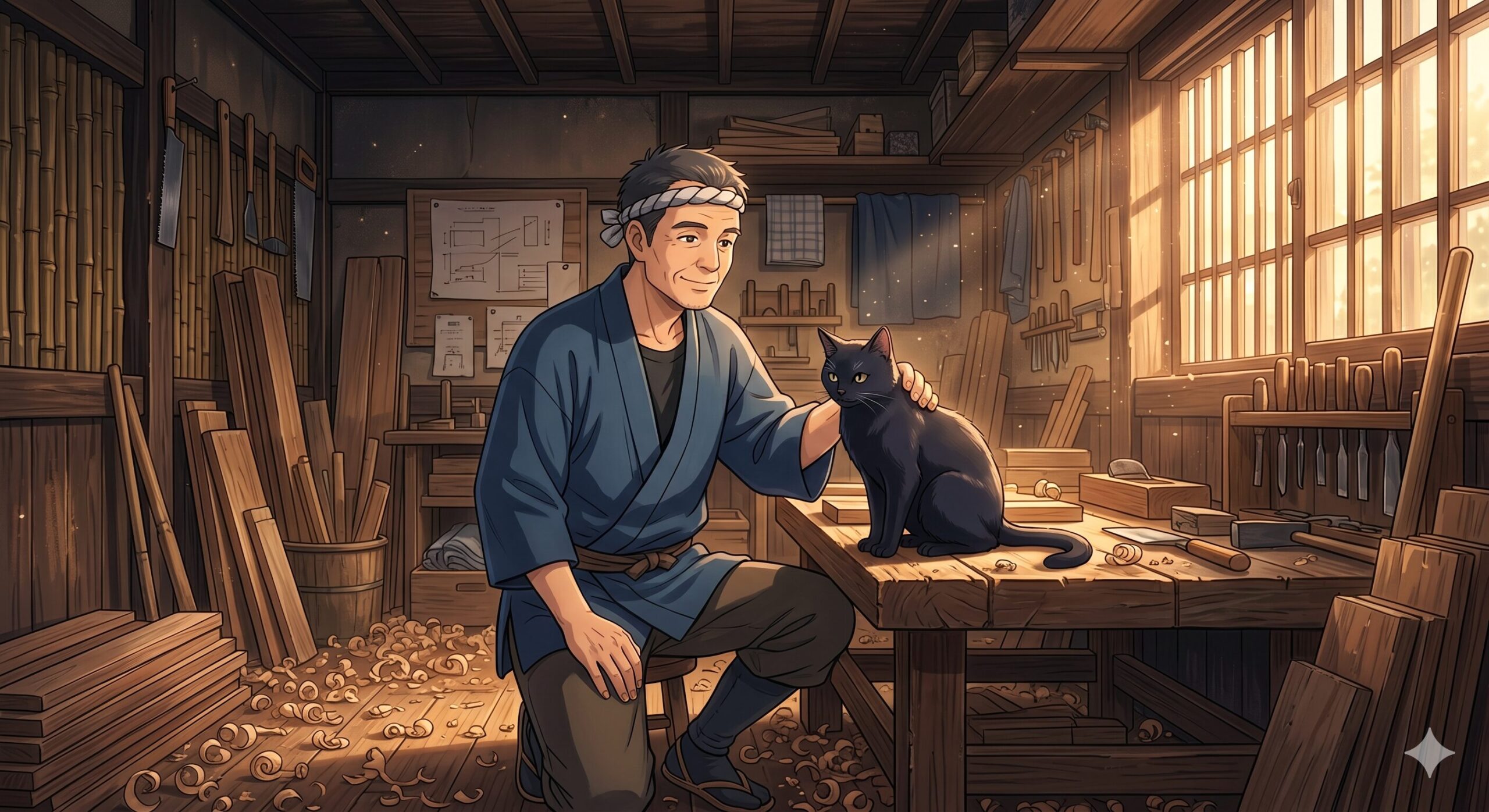
A Tale of a Kind Artisan and a Mysterious Black Cat
Once upon a time in the bustling city of Edo, there lived a highly skilled but impoverished carpenter named Seibei. Seibei possessed the ultimate technique of a “Takumi” (master craftsman), able to plane wood so smoothly it seemed as if he were conversing with the timber, and capable of constructing incredibly sturdy buildings without using a single nail. However, because he was almost too honest and uncompromising in his work, he struggled commercially and lived a meager life in a simple row house.
One freezing, rainy evening, as Seibei returned home from a grueling day of work, he found a skeletal black cat shivering under the eaves of his house. Without hesitation, Seibei took half of his own dinner—a single grilled fish—and offered it to the cat. “From today, you are ‘Kuro’ (Black). You can live here with me,” he welcomed the creature with a gentle smile. From that day on, Kuro settled into Seibei’s workshop, quietly watching over him as he carved wood. The rhythmic sound of Seibei’s hand plane and the gentle purring of Kuro became the heartwarming daily soundtrack of the workshop.
One day, Seibei received the opportunity of a lifetime. He was commissioned to build the “Sanmon” (main gate) for the largest temple in the city, an enormous task that included carving a magnificent guardian dragon for the facade. Forgetting to eat or sleep, Seibei poured his soul into drawing the blueprints and selecting the finest timber. However, the day before the framework was to be erected, a terrifying tragedy struck. A rival carpenter, consumed by jealousy, sneaked into the workshop during the night and sawed off exactly one shaku (about 30 centimeters) from the main pillar—the most critical support of the temple gate.
The next morning, upon discovering the shortened pillar, Seibei was plunged into the depths of despair. There was no time to procure replacement timber of such high quality. His reputation as a carpenter would be ruined, and he would bring immense shame to the temple. Cursing his misfortune, Seibei resolved that the only way to apologize was to take his own life. Just as he reached for his carving knife, Kuro let out a sharp cry and leaped at Seibei’s feet. Kuro tugged frantically at the hem of Seibei’s kimono, leading him to a pile of scrap wood in the corner of the workshop.
With its small paws, Kuro dexterously nudged and flipped the scrap pieces, arranging them together like a complex puzzle. Seeing this, a strike of lightning flashed through Seibei’s mind. “That’s it…! ‘Tokyo’ (Masugumi / wooden brackets)!” Seibei realized that by constructing an intricate, interlocking decorative bracket on top of the shortened pillar, he could not only compensate for the lost height but also create a magnificent and structurally sound gate far more beautiful than his original design.
Seibei hugged Kuro with tears in his eyes and immediately set to work. Working through the night, he carved and assembled the complex brackets, and the temple gate was successfully completed. The gate, distinguished by the breathtaking beauty and precise calculation of the wooden brackets, became a masterpiece admired by everyone in Edo. Seibei’s reputation as a master carpenter became unshakeable. However, from the night the gate was finished, Kuro was nowhere to be found. Instead, resting neatly by Seibei’s pillow, was a tiny, perfectly carved wooden black cat made from the very scrap wood Seibei had cut. Seibei cherished this carving as an amulet for the rest of his life, leaving a legacy as the greatest shrine carpenter in Japan.
Deep Analysis of the Tale: The Power to Turn Despair into Hope
The story of “The Carpenter and the Cat” transcends the classic trope of an animal returning a favor; it is a profound human drama depicting a craftsman’s tenacity and the power of flexible thinking. Seibei faced a fatal crisis when his main pillar was cut short. If he had stubbornly adhered to standard architectural methods, it would have been an absolute failure. However, the cat’s action of “combining scrap wood” provided the inspiration for a new architectural technique (decoration and reinforcement through interlocking brackets).
This carries a powerful message regarding the “shortages” or “losses” we face in life. Instead of lamenting what is lost, the story asks: how can we combine and elevate what we currently have (the scraps)? This folktale brilliantly illustrates that moments of extreme crisis are often the very catalysts for history-making innovation. Furthermore, the presence of Kuro can be interpreted as the physical manifestation of Seibei’s own subconscious intuition and inspiration as an artisan.
The Connection Between Japanese Culture and “The Carpenter and the Cat”
This tale strongly reflects unique aspects of Japanese culture and spirituality. First is the “Spirit of Takumi” (master craftsmanship). Traditional Japanese wooden architecture employs highly advanced techniques like “Kigumi” (joining wood without nails), unparalleled anywhere in the world. Seibei represents the iconic Japanese artisan who brings out the maximum potential of natural materials, pouring his very soul into his creations.
Second is the philosophy of “Yaoyorozu no Kami” (eight million gods) and “Ongaeshi” (repayment of kindness). Japan has a deep-rooted animistic belief that spirits reside in all things of nature—animals, plants, and even old tools. The small act of compassion—Seibei sharing half of his fish—resulted in a miracle through the spirit’s (Kuro’s) gratitude. As seen in the Japanese belief in the “Maneki-neko” (beckoning cat), cats have long been cherished as spiritual animals capable of warding off evil and inviting good fortune.
What Would You Do?
On the brink of despair, Seibei found the hint for a miracle in the small actions of his beloved cat. If you are currently facing an insurmountable wall of failure or despair, what are the “scrap pieces” around you? By rearranging them, a new door might open. Furthermore, what kind of messages do you think your cherished pets or the tools you use every day are sending you? I invite you to deeply reflect on what you felt after reading this story and consider your own experiences of “miracles”.
Reference Links
- Learn more about traditional Japanese woodworking: Japanese carpentry (Wikipedia)
- Discover the culture of Japanese lucky cats: Maneki-neko (Wikipedia)
- Read more Japanese folktales: Back to Japanese Folktale Series
日本の魅力的な昔話:大工とねこ(The Carpenter and the Cat)
心優しき職人と不思議な黒猫の物語
むかしむかし、江戸の町に清兵衛(せいべえ)という、腕は立つものの貧しい大工が住んでいました。清兵衛は、木と対話するように滑らかな鉋(かんな)をかけ、釘を一本も使わずに頑丈な建物を造り上げる「匠(たくみ)」の技を持っていました。しかし、彼はあまりに正直で不器用な性格であったため、商売がうまくいかず、長屋で質素な生活を送っていました。
ある冷たい雨の降る晩、清兵衛が仕事から帰ると、軒下にやせ細った一匹の黒猫が震えていました。清兵衛は自分の夕食であった焼き魚の半分を惜しげもなく猫に与え、「今日からお前は『クロ』だ。ここで一緒に暮らすといい」と優しく迎え入れました。それ以来、クロは清兵衛の工房に居着き、彼が木を彫る姿を静かに見守るようになりました。清兵衛が鉋をかけるリズミカルな音と、クロが喉を鳴らす音は、工房の温かな日常となりました。
そんなある日、清兵衛に千載一遇の仕事が舞い込みます。町で一番大きな寺院の「山門」を建立し、その正面に守護神となる見事な龍の彫刻を施すという大役です。清兵衛は寝食を忘れ、精魂込めて設計図を引き、最高の木材を厳選しました。しかし、棟上げの前日、恐ろしい悲劇が起こります。清兵衛を妬んだ別の職人が夜の間に忍び込み、山門を支える最も重要な「大黒柱」の木材を、一尺(約30センチ)も短く切り落としてしまったのです。
翌朝、短くされた柱を見た清兵衛は絶望のどん底に突き落とされました。代わりの木材を調達する時間はありません。大工としての信用は失墜し、寺院にも多大な迷惑をかけてしまいます。清兵衛は己の不運を呪い、自ら命を絶って詫びるしかないと覚悟を決めました。彼が小刀を手に取ったその時、クロが鋭く鳴きながら清兵衛の足元に飛び込んできました。クロは清兵衛の着物の裾を咥えて引っ張り、工房の隅に積まれていた端材(余った木材)の山へと彼を導きました。
クロは小さな前足で端材を器用に弾き飛ばし、いくつかの木片をパズルのように組み合わせ始めました。それを見た清兵衛の目に、稲妻のような閃きが走りました。「そうか…!『斗栱(ときょう・ますぐみ)』だ!」清兵衛は、短い柱の上に複雑に組み上げた木材の装飾(組物)を継ぎ足すことで、柱の長さを補うだけでなく、かつてないほど美しく荘厳な山門を造り上げる手法を思いついたのです。
清兵衛は泣きながらクロを抱きしめ、すぐさま作業に取り掛かりました。夜を徹して複雑な組物を彫り上げ、見事に山門は完成しました。その山門は、緻密に計算された斗栱の美しさが際立ち、江戸中の人々が感嘆する傑作となりました。清兵衛の大工としての名声は揺るぎないものとなりました。しかし、山門が完成したその夜から、クロの姿はどこにもありませんでした。代わりに清兵衛の枕元には、彼が切り落とした端材で作られた、小さな黒猫の木彫りが一つ、ちょこんと置かれていました。清兵衛はその木彫りをお守りとして生涯大切にし、日本一の宮大工として名を残したのです。
物語の深い考察:絶望を希望に変える力
この「大工とねこ」の物語は、単なる動物の恩返しの枠を超え、職人の執念と柔軟な発想の転換を描いた深い人間ドラマです。清兵衛は、大黒柱が短く切られるという致命的な絶望に直面しました。伝統的な建築手法に固執していれば、それは「失敗」でしかありません。しかし、猫のクロが示した「端材を組み合わせる」という行動が、新しい建築技術(組物による装飾と補強)の着想を与えました。
これは、人生において私たちが直面する「不足」や「欠損」に対する強力なメッセージです。失われたものを嘆くのではなく、今あるもの(端材)をどのように組み合わせ、昇華させるか。危機的状況こそが、歴史に残るようなイノベーションを生み出すきっかけになるということを、この昔話は見事に表現しています。また、クロという存在は、清兵衛の無意識下にあった職人としての「直感」や「インスピレーション」が具現化した姿であるとも読み取ることができます。
日本文化と「大工とねこ」の関連性
この物語には、日本独特の文化や精神性が色濃く反映されています。第一に、「匠(たくみ)の精神」です。日本の木造建築は、世界でも類を見ない高度な技術「木組み(釘を使わずに木と木を噛み合わせる技術)」を持っています。清兵衛の姿は、自然の素材を極限まで活かし、魂を込めて物作りに向き合う日本の職人の象徴です。
第二に、「八百万の神(やおよろずのかみ)」と「恩返し(Ongaeshi)」の思想です。日本には、自然界のすべてのもの、動物や植物、さらには古い道具にまで魂が宿るというアニミズムの信仰があります。清兵衛が与えた半分の魚という小さな慈悲が、精霊(クロ)の恩返しという形で奇跡を起こしました。日本の招き猫(Maneki-neko)信仰にも見られるように、猫は古くから魔を払い、福を招く霊的な力を持つ動物として愛されてきました。
あなたならどうしますか?
清兵衛は絶望の淵で、愛する猫の小さな行動から奇跡のヒントを得ました。もしあなたが今、取り返しのつかない失敗や絶望の壁にぶつかっているとしたら、あなたの周りにある「小さな端材」は何でしょうか? それを組み合わせることで、新しい扉が開くかもしれません。また、あなたの大切なペットや、普段何気なく使っている道具たちは、あなたにどんなメッセージを送っていると思いますか? ぜひ、この物語を読んで感じたことや、あなた自身の「奇跡の経験」について深く考えてみてください。
参考リンク集
- 日本の伝統的な木造建築技術について:Japanese carpentry (Wikipedia)
- 福を招く日本の猫の文化について:Maneki-neko (Wikipedia)
- その他の日本昔話はこちら:Japanese Folktale Series 一覧へ


コメント