Japan is home to countless folktales that have been passed down through generations. These stories encapsulate the rich nature of Japan, the spirituality of its people, and a deep love for all living things. Today, I am thrilled to introduce you to a poignant and heartwarming Japanese folktale called “Saienji’s Tanuki Bayashi” (The Raccoon Dog’s Belly-Drumming at Saienji Temple). This story, which depicts love, the sorrow of war, and a strong bond with animals, carries a profound message that resonates strongly with us in the modern world.
The Story of “Saienji’s Tanuki Bayashi”
Once upon a time, during an era when wars were constant across Japan, there was an old temple named Saienji located on Omijima, a beautiful island in the Sea of Japan. Near this temple, in a quiet inlet, a kind-hearted young girl named Oshizu lived a peaceful, modest life with her elderly father.
One day, while Oshizu and her father were walking along the beach, they encountered a strange hunter. It was extremely rare to see a hunter in this peaceful village. Curious, Oshizu approached him and noticed a tiny baby Tanuki (Japanese raccoon dog) tightly bound with rope to a thick wooden stick the hunter was carrying.
The baby Tanuki’s large, round eyes were brimming with tears, and it stared at Oshizu while trembling in fear. Seeing this, Oshizu’s heart ached. “Father, please! We must save this little Tanuki!” she desperately pleaded. Deeply moved by his daughter’s pure and compassionate heart, the father turned to the hunter and said, “I have very little money, but will you trade this Tanuki for what I have?” The hunter, who was not a bad man, liked Oshizu’s kindness and gladly handed over the Tanuki for a few coins.
When Oshizu released the freed Tanuki at the entrance of the mountain, it turned back again and again, bowing just like a human, and happily wagged its tail as it disappeared into the deep forest.
Over ten years passed. The young girl who saved the baby Tanuki had grown into a remarkably beautiful young woman. One day, while Oshizu was walking on the beach as usual, she found a young samurai collapsed and covered in blood. He had been defeated in a fierce battle and washed ashore on this island to escape his enemies. He was severely wounded and barely breathing.
The kind-hearted father and daughter could not abandon this samurai. To hide him from the eyes of his enemies, they secretly carried him into their home. From that night on, Oshizu nursed him with total devotion. Before dawn every day, she would venture into the rugged mountains to gather medicinal herbs, brew them, and apply them to the samurai’s wounds. Her father also prepared warm meals and cared for him as if he were his own son.
Thanks to their dedicated care, the young samurai’s wounds healed day by day. During the time they spent together, a deep love blossomed between Oshizu and the young man. Eventually, they became husband and wife, hoping to live out their days in eternal peace on this quiet island.
However, their happy times did not last long. One day, the enemies seeking the samurai’s life finally landed on Omijima. Sensing the immediate danger, the father rushed to the couple with a pale face and declared, “It is no longer safe here. You two must cross the sea and flee far away to Kyushu.”
Oshizu broke down in tears, crying, “Father, come with us!” But the father quietly shook his head. “I will only slow you down. My only wish is for you two to survive and find happiness.” The father placed his beloved daughter and son-in-law on a small boat and stood on the beach, watching until their figures disappeared beyond the horizon.
After the couple left, the father’s life became dark and lonely. One evening, as he returned home from the beach, almost losing his will to live, he saw a familiar figure waiting in front of his house. It was the very same Tanuki that Oshizu had saved ten years ago. The Tanuki had grown magnificently, but its gentle eyes remained exactly the same. As if to comfort the lonely father, the Tanuki began visiting the house every single day. Eventually, it even started helping with chores, actively fetching firewood and cleaning the house.
Five more years passed as the Tanuki and the father lived peacefully together. On an autumn night, unexpected visitors arrived. It was Oshizu and her husband, who had successfully escaped to Kyushu. Having established a safe life, they had come to bring the father back with them. “Father, let’s live together as a family again. Please come with us to Kyushu.” Touched by the profound love of his daughter and her husband, the father finally made the decision to leave the island.
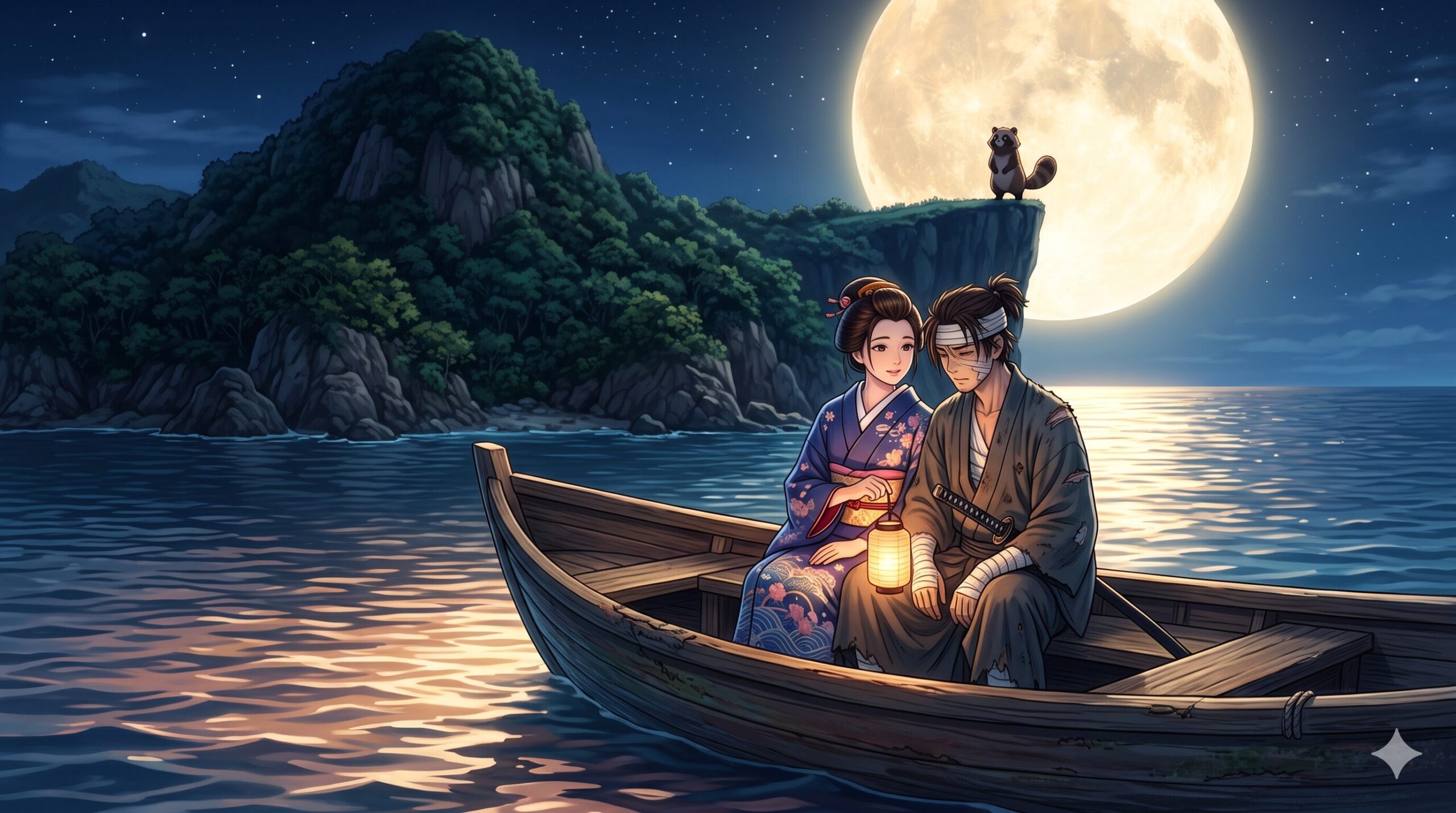
On the night of their departure, a magnificent full moon shone in the sky. The three of them boarded a small boat and quietly set sail from the island. Suddenly, a rhythmic and somewhat sorrowful sound echoed from the mountain behind Saienji Temple. *Pon-poko-pon, pon-poko-pon.* It was the sound of the Tanuki, left behind on the island, beating its belly under the moonlight as a reluctant farewell. It is said that the Tanuki continued to beat its belly throughout the entire night to celebrate the happy departure of its benefactors, while simultaneously mourning their eternal separation.
Even today, the inlet near Saienji Temple is called “Shizugaura” (Shizu’s Inlet). It is said that this name was given in memory of Oshizu and her family’s legendary tale.
Analysis of the Tale: Why Did the Tanuki Beat Its Belly?
The most striking element of this story is the sound of the Tanuki’s belly-drumming at the very end. In Japanese folklore, a Tanuki’s belly-drumming (Tanuki Bayashi) is often depicted as a festive activity or a yokai’s (monster’s) playful prank, but in this story, it holds a completely different meaning.
The Tanuki had spent five years living with the human father, connecting on a soul level even without words. The daughter’s return to pick up her father was the ultimate happiness for the old man. The Tanuki held conflicting emotions: genuine joy for the benefactor’s happiness and the overwhelming loneliness and sorrow of being left behind. Unable to find an outlet for these immense feelings, the Tanuki chose “belly-drumming” as its greatest form of self-expression. We can conclude that the sound was not merely an animal habit, but a cry of the soul mixed with gratitude, blessing, and mourning.
Deep Connection to Japanese Culture: Repayment of Kindness and Impermanence
Through “Saienji’s Tanuki Bayashi,” we can deeply understand unique Japanese cultural values.
1. Animals Returning Favors (Irui Ho-on)
Japanese folktales frequently feature the motif of non-human entities returning favors received from humans, such as in “The Grateful Crane” or “Kasa Jizo.” This is based on the Buddhist concept of “Karmic Retribution,” which teaches that humans, nature, and animals all possess equal souls, and good deeds will always be rewarded. The Tanuki, who stood by the lonely father for five years to repay a ten-year-old debt of gratitude, perfectly projects the traditional Japanese virtues of “Giri and Ninjo” (duty and compassion) onto an animal.
2. The Sorrow of War and Impermanence (Mujo)
The backdrop of this story is “war.” Encounters with loved ones are brought about by war, and simultaneously torn apart by it. The depiction of people tossed about by waves of destiny beyond their individual control reflects the traditional Japanese philosophy of “Mujo” (Impermanence)—the idea that everything is constantly changing and nothing lasts forever.
3. Family Bonds and Self-Sacrifice
The father’s decision to remain on the island to let his daughter and her husband escape is an act of ultimate self-sacrifice. In Japanese history, preserving the “family” and wishing for the happiness of the next generation has been considered an absolute virtue. It was the father’s selfless love that ultimately brought about their happy ending (the family’s reunion).
Conclusion: What Would You Do?
“Saienji’s Tanuki Bayashi” is not just an animal fable; it is a profound story that questions love, self-sacrifice, and our bond with nature.
If you were in the father’s position, would you have fled the island with your daughter and her husband? Or would you have made the painful decision to stay behind for their safety?
Also, if you were the Tanuki left behind, what kind of feelings would you have while watching the boat of your beloved benefactors sail away?
Japanese folktales teach us important lessons that transcend time. I would be incredibly happy if this story allowed you to touch the heart and culture of Japan, even just a little.
If you want to know more about Japanese folktales, please check out other wonderful stories from this category!
Internal Link: Japanese Folktale Series
For detailed information regarding the original source of this story, please visit the link below.
External Link: Original Source: Saienji’s Tanuki Bayashi
魅惑の日本昔話「西円寺の狸ばやし」:愛と恩返しの物語
日本には、古くから語り継がれてきた数多くの昔話が存在します。それらの物語には、日本の豊かな自然、人々の精神性、そして生きとし生けるものへの深い愛情が込められています。今回は、数ある日本の昔話の中でも、切なくも心温まる物語「西円寺の狸ばやし」を皆様にご紹介します。愛、戦争の悲哀、そして動物との強い絆を描いたこの物語は、現代を生きる私たちの心にも強く響くメッセージを持っています。
昔話「西円寺の狸ばやし」のストーリー
昔々、日本のあちこちで戦乱が絶えなかった時代のお話です。日本海に浮かぶ美しい島、青海島(おおみじま)という場所に、西円寺(さいえんじ)という古いお寺がありました。そのお寺の近くの静かな入り江に、「おしず」という心優しい娘が、年老いた父親と二人でひっそりと暮らしていました。
ある日のこと、おしずと父親が浜辺を歩いていると、一人の見慣れぬ狩人に出会いました。この平和な村に狩人が現れるのは非常に珍しいことでした。不思議に思ったおしずが近づいてみると、狩人が持つ太い棒に、一匹の小さな子狸がぐるぐると縄で縛り付けられていたのです。
子狸は、大きな丸い目に涙をいっぱいに溜め、震えながらおしずを見つめていました。その姿を見たおしずは胸が締め付けられるような思いになり、「お父さん、どうかあの子狸を助けてあげて!」と必死に頼み込みました。娘の純粋で優しい心に打たれた父親は、狩人に向かって「なけなしの金だが、これでその狸を譲ってくれないか」と頼みました。狩人も決して悪い人間ではなく、おしずの優しさを気に入り、わずかな銭で快く子狸を譲ってくれました。
自由になった子狸をおしずが山の入り口で放してやると、子狸は何度も何度も振り返り、人間のようにお辞儀をして、嬉しそうに尻尾を振りながら深い森の奥へと帰っていきました。
それから十年余りの歳月が流れました。子狸を助けたあの少女は、見違えるほど美しい大人の女性へと成長していました。ある日、おしずがいつものように浜辺を歩いていると、そこに血だらけになって倒れている若い侍を見つけました。彼は過酷な戦に敗れ、敵の追手から逃れてこの島に流れ着いたのです。体中には深い傷を負い、虫の息でした。
心優しい親子は、この侍を見捨てることなどできませんでした。敵の目をごまかすため、人目を避けて彼を密かに自宅へ運び込みました。その夜から、おしずの懸命な看病が始まりました。おしずは毎日、夜明け前から険しい山に入り、傷に効く薬草を摘んで煎じ、侍の傷口に塗りました。父親もまた、温かい食事を作り、彼を我が子のように介抱しました。
親子の献身的な看病のおかげで、若き侍の傷は日に日に回復していきました。そして、共に過ごす時間の中で、おしずと若者の間には深い愛情が芽生えました。二人はいつしか夫婦となり、この静かな島で永遠の平和が続くことを願いながら暮らすようになりました。
しかし、幸せな時間は長くは続きませんでした。ある日、侍の命を狙う敵の追手が、ついにこの青海島にも上陸したのです。危険を察知した父親は、血相を変えて二人の元へ走り、「ここはもう危ない。お前たち二人は、海を渡って遠く九州へと逃げなさい」と告げました。
おしずは「お父さんも一緒に来て!」と泣き崩れましたが、父親は静かに首を振りました。「私は足手まといになる。お前たち二人が生きて幸せになってくれることこそが、私の願いなのだ」と。父親は、最愛の娘と夫を小舟に乗せ、二人の姿が水平線の彼方に消えるまで、いつまでも浜辺で立ち尽くしていました。
娘夫婦が去った後、父親の生活は暗く寂しいものとなりました。生きる希望を失いかけていたある日の夕暮れ、父親が力なく浜から帰宅すると、家の前に見覚えのある姿がありました。それは、十年前におしずが助けたあの狸だったのです。狸は立派に成長していましたが、その優しい瞳は昔のままでした。狸は、寂しく暮らす父親を慰めるかのように、毎日毎日家を訪ねてくるようになりました。やがて、薪を運んだり、掃除を手伝ったりと、父親の身の回りの世話まで甲斐甲斐しく焼くようになったのです。
狸と父親の穏やかな共同生活が始まってから、さらに五年の月日が流れました。ある秋の夜、思いがけない訪問者が現れました。それは、九州へと逃げ延びていたおしずと夫でした。二人は安全な暮らしを手に入れ、父親を迎えに来たのです。「お父さん、もう一度三人で一緒に暮らしましょう。九州へ来てください」と熱心に説得する娘夫婦の愛に触れ、父親はようやく島を離れる決心をしました。
出発の夜、空には見事な満月が輝いていました。親子三人は小舟に乗り込み、静かに島を離れていきました。その時です。西円寺の裏山から、ポンポコポン、ポンポコポンと、リズミカルでどこか切ない音が響いてきました。それは、島に残されたあの狸が、月明かりの下で別れを惜しみ、腹鼓を打っている音でした。狸は、恩人である親子の幸せな門出を祝い、そして永遠の別れを悲しむように、夜通し腹鼓を打ち続けたと伝えられています。
現在でも、西円寺の入り江近くは「静が裏(しずがうら)」と呼ばれています。これは、おしずと家族の物語を偲んで名付けられたと語り継がれています。
物語の考察:なぜ狸は腹鼓を打ったのか?
この物語の中で最も印象的なのは、最後に狸が打つ腹鼓の音です。日本の伝承において、狸の腹鼓は「お祭り」や「妖怪のいたずら」として描かれることが多いですが、この物語においては全く異なる意味を持っています。
狸は人間である父親と共に五年もの歳月を過ごし、言葉は通じなくとも心を通わせていました。娘夫婦が迎えに来たことは、父親にとって最高の幸せです。狸は、恩人の幸せを心から祝福する気持ちと、自分を置いて旅立ってしまう圧倒的な孤独と悲しみを抱えていました。感情のやり場を失った狸が、最大の自己表現として選んだのが「腹鼓」だったのです。その音は、ただの動物の習性ではなく、感謝、祝福、そして哀悼の念が入り混じった、魂の叫びであったと考察できます。
日本文化との深い繋がり:恩返しと無常観
この「西円寺の狸ばやし」からは、日本独自の文化や価値観を深く読み解くことができます。
1. 動物の恩返し(異類報恩)
日本の昔話には、「鶴の恩返し」や「笠地蔵」など、人間から受けた恩を人間以外の存在が返すというモチーフが頻繁に登場します。これは、人間と自然、動物が対等な魂を持っており、善行は必ず自分に返ってくるという仏教的な「因果応報」の教えに基づいています。十年越し、さらには五年間にわたって恩人の孤独に寄り添い続けた狸の姿は、日本人が古来より大切にしてきた「義理と人情」を動物に投影したものです。
2. 戦の悲哀と無常観
物語の背景には「戦(戦争)」があります。愛する者との出会いが戦によってもたらされ、同時に戦によって引き裂かれます。個人の力ではどうにもならない運命の波に翻弄される人々の姿は、日本の伝統的な「無常観(すべてのものは常に変化し、永遠に続くものはないという思想)」を表しています。
3. 家族の絆と自己犠牲
娘夫婦を逃がすために島に残った父親の決断は、究極の自己犠牲です。日本の歴史において、「家」や「血筋」を残すこと、次世代の幸せを願うことは絶対的な美徳とされてきました。父親の愛が、最終的にハッピーエンド(家族の再会)を引き寄せたのです。
終わりに:あなたならどうしますか?
「西円寺の狸ばやし」は、単なる動物の昔話ではなく、愛情や自己犠牲、そして自然との絆を問いかける深い物語です。
もし、あなたがこの父親の立場だったなら、娘夫婦と一緒に島から逃げたでしょうか?それとも、彼らの安全のために一人島に残る決断をしたでしょうか。
また、あなたが島に残された狸だったなら、去っていく恩人の船をどのような思いで見送ったでしょうか。
日本の昔話は、時代を超えて私たちに大切なことを教えてくれます。この物語を通じて、皆様が日本の心や文化に少しでも触れることができたなら幸いです。
もっと日本の昔話を知りたい方は、こちらのカテゴリーから他の素晴らしい物語もぜひご覧ください。
内部リンク:Japanese Folktale Series(日本の昔話シリーズ)
今回の物語の原典に関する詳細な情報は、以下のリンクよりご確認いただけます。
外部リンク:西円寺の狸ばやし 原典参考
コメント