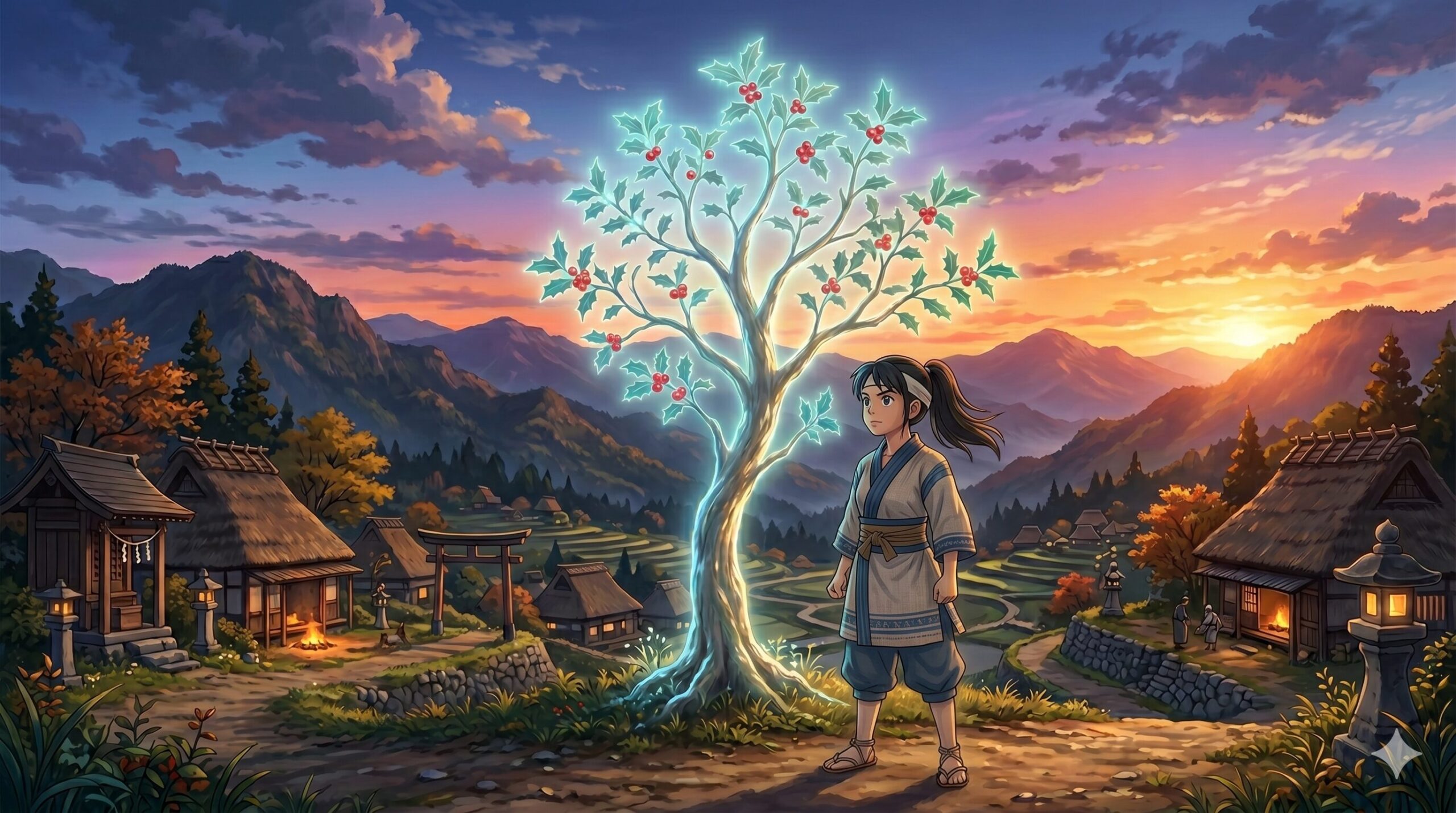
Japan is home to countless fascinating folktales, but “The Oni and the Little Girl” (Oni to Komusume), passed down in the Bizen Plain of Okayama Prefecture, is a masterpiece that portrays humanity standing up to overwhelming violence using wisdom and the power of nature. In this article, we will introduce the full scope of this powerful and beautiful story, unraveling the deep layers of Japanese culture and its unique relationship with nature hidden within.
The Birth of the Bizen Plain and the Origin of Kani Hachiman
Long, long ago, the ocean receded far to the south, finally revealing the vast Bizen Plain. The ancestors of the Kibi region descended from the mountains, following the Sasagase River to build a village in this new land. However, the area was an endless expanse of reed fields, and the people were entirely at a loss as to where they should establish the center of their new settlement.
Suddenly, a single crab appeared before them. Curiously, as the crab walked across the ground, it drew a perfect rectangle measuring 15 meters long and 10 meters wide. Astonishingly, these dimensions exactly matched the size of the shrine the people had been planning to build. Believing this to be a divine sign, they erected a magnificent shrine on that exact spot, making it the foundation of their village. This is the origin of the “Kani Hachiman” (Crab Shrine) that still exists today.
The Price of Prosperity: The Terrifying Oni Attacks
The land cleared from the reed fields was incredibly fertile, and the village quickly began to yield abundant harvests. The people’s lives became comfortable, and the village seemed to be heading toward the peak of prosperity. However, evil is often drawn to abundance. As if lured by the village’s success, a terrifying demon known as an “Oni” began to appear.
The Oni attacked the village, not only destroying crops but also systematically kidnapping the most beautiful and hardworking young women. The villagers trembled in fear; no one had the power to face the monster. The village, once overflowing with joy, was plunged into the depths of despair.
A Young Girl’s Resolve and a Seven-Day Journey
Amidst this universal despair, one little girl took a stand. “If this continues, I will eventually be taken by the Oni too. The only way to save the village is to exploit the monster’s weakness,” she reasoned. Knowing the ancient lore that Oni despise the sharp, prickly leaves of the “Hiiragi” (Japanese Holly) tree, she sneaked out of her house alone late one night.
The girl continued walking north through rugged mountain paths. Despite facing dangerous beasts and harsh elements, she never stopped. Finally, on the seventh day of her journey, in the forest of Ose in Hisatsune, Mimasaka Province, she found a massive Hiiragi tree so large it seemed to cover the sky. She carefully dug up a healthy sapling from its base, held it tightly to her chest, and brought it all the way back to her village. She planted it right in the center of the settlement. Miraculously, from the day the Hiiragi was planted, the Oni that had terrorized the village vanished completely.
The Oni’s Wrath and Scars Left on the Earth
Peace returned to the village, but the story does not end there. The Oni had not given up; he waited patiently deep in the mountains for the despised Hiiragi to wither and die. However, the tree planted by the girl did not die. Instead, it grew stronger and larger with each passing day.
Losing his patience, the furious Oni decided to crush the Hiiragi using sheer brute force. He lifted an unimaginably massive boulder, measuring 30 meters long and 10 meters wide. Planting his left foot firmly on Mount Nodoro and his right foot on Mount Hanajiri, he hurled the colossal rock with all his might toward the Hiiragi tree in the village.
However, the Oni used too much force. The massive boulder flew straight over the Hiiragi tree and crashed violently into a rice paddy in Imabo, creating a gigantic crater. The rock then bounced from the impact and landed on the summit of Mount Takao, a whole kilometer away.
The giant crater in the rice paddy became what is now known as “Hachiman Swamp,” and the rock that landed on the mountain peak remains there today, known as “Eboshi Rock.” Furthermore, the deep footprints the Oni left when he braced himself can still be clearly seen on Mount Nodoro and Mount Hanajiri.
- The Birth of the Bizen Plain and the Origin of Kani Hachiman
- The Price of Prosperity: The Terrifying Oni Attacks
- A Young Girl’s Resolve and a Seven-Day Journey
- The Oni’s Wrath and Scars Left on the Earth
- In-Depth Analysis: The Triumph of Wisdom Over Brute Force
- Connection to Japanese Culture: Hiiragi as a Ward Against Evil
- A Question for Us in the Modern World
- 鬼と小娘:知恵と勇気がもたらした奇跡の伝説
- 「鬼と小娘」の深い考察:力に対する知恵の勝利
- 日本文化への繋がり:魔除けとしての柊(ひいらぎ)
- 現代を生きる私たちへの問いかけ
In-Depth Analysis: The Triumph of Wisdom Over Brute Force
This tale is not merely a simple story of good versus evil. It explores the universal theme of how humanity confronts overwhelming violence (represented by the Oni). What makes this story exceptional is that the young heroine does not attempt to defeat the Oni using “physical strength” or “weapons.” Her ultimate weapons are “knowledge” (knowing the Oni hates Hiiragi) and “action” (her grueling seven-day journey).
On the other hand, the Oni relies entirely on his immense physical power, which leads to his own downfall when he fails to control it. The story delivers a powerful moral: those who rely solely on force will eventually be ruined by it. The little girl’s actions offer a highly sophisticated solution—overcoming violence through wisdom and living in harmony with nature.
Connection to Japanese Culture: Hiiragi as a Ward Against Evil
This folktale is deeply intertwined with traditional Japanese beliefs and customs. In Japan, it has long been believed that sharp objects or strong odors can repel evil spirits and misfortune. The Hiiragi (Japanese Holly) is a prime example of this.
Even in modern Japan, during the “Setsubun” festival in early February, families practice the custom of hanging a baked sardine head skewered on a Hiiragi branch (called “Hiiragi Iwashi”) at the entrances of their homes. This acts as a magical barrier to prevent Oni (representing bad luck or disease) from entering.
The legend of “The Oni and the Little Girl” serves a vital role in the Okayama region by explaining the origins of decorating gates with Hiiragi branches. It profoundly reflects the ancient Japanese spirit of “animism”—finding sacred power in natural plants and utilizing it to protect human life.
A Question for Us in the Modern World
A seemingly powerless young girl walked for seven days to save her entire village and successfully restored peace. Legend says the Oni is still hiding deep in the mountains, waiting for the Hiiragi tree to wither. This is an undeniable message that as long as we respect nature and pass down the wisdom of our ancestors, our peaceful lives will be protected.
I pose a question to you, the reader. If your beloved town or family faced an impossibly immense threat, could you, like this young girl, bravely set out on a journey to find a solution? Perhaps, instead of countering force with force, we need to re-examine how to overcome hardships by borrowing ancient wisdom and the power of nature. What kind of “Hiiragi” would you seek out?
References & Related Links:
- Manga Nippon Mukashibanashi Database: “The Oni and the Little Girl” (Japanese)
- Read more from the Japanese Folktale Series
鬼と小娘:知恵と勇気がもたらした奇跡の伝説
日本には数多くの魅力的な昔話が存在しますが、岡山県の備前平野に伝わる「鬼と小娘」は、圧倒的な暴力に対して、知恵と自然の力で立ち向かった人間の姿を描く傑作です。本記事では、この力強くも美しい物語の全貌をご紹介し、そこに隠された日本独自の自然観や文化の深層を紐解いていきます。
備前平野の誕生と蟹八幡の始まり
今からずっと昔、海がはるか南へと退き、広大な備前平野がようやくその姿を現した頃の物語です。吉備の祖先たちは、この新天地に村を築くため、笹ヶ瀬川を下って山から降りてきました。しかし、辺り一面は果てしなく続く葦原であり、どこを村の中心とすべきか人々は途方に暮れていました。
その時、一匹の蟹が人々の前に姿を現しました。蟹は不思議なことに、地面を歩きながら縦15メートル、横10メートルほどの正確な四角形を描いたのです。驚くべきことに、その寸法は人々が建てようと考えていたお宮の大きさと完全に一致していました。人々はこれを神の導きと確信し、その場所に立派なお宮を建立して村の基盤としました。これが現在も残る「蟹八幡」の起源です。
豊かさの代償:恐ろしい鬼の襲来
葦原を開拓した土地は非常に肥沃で、村はまたたく間に豊かな実りをもたらすようになりました。人々の暮らしは潤い、村は繁栄の頂点に向かっているかに見えました。しかし、豊かな土地には魔が寄り付くものです。村の繁栄に引き寄せられるように、恐ろしい「鬼」が姿を現すようになりました。
鬼は村を襲い、農作物を荒らすだけでなく、決まってきれいで働き盛りの若い娘たちを次々とさらっていきました。村人たちは恐怖に震え、誰も鬼に立ち向かうことができません。繁栄に沸いていた村は、一転して絶望の淵に立たされました。
小娘の決意と七日間の旅
誰もが絶望する中、一人の小娘が立ち上がりました。「このままでは、いずれ私も鬼にさらわれてしまう。村を救うには、鬼の弱点を突くしかない」と彼女は確信していました。鬼が鋭いトゲを持つ「柊(ひいらぎ)」を極端に嫌うという伝承を知っていた娘は、ある夜、家族にも内緒で一人家を抜け出します。
娘は険しい山道を北へ北へと歩き続けました。危険な獣や過酷な自然に晒されながらも、彼女の歩みは決して止まりません。そして旅を始めて7日目、ついに美作の国の久常(ひさつね)にある「おおせの森」で、空を覆うほどの巨大な柊の大木を発見したのです。娘はその根元にあった元気な子株を丁寧に掘り起こし、大切に胸に抱えて村へと持ち帰りました。そして、村のど真ん中にその柊を植えたのです。するとどうでしょう。柊が植えられたその日から、あれほど村を恐怖に陥れていた鬼は、ぱったりと姿を現さなくなりました。
鬼の怒りと大地に刻まれた爪痕
村に平和が戻りましたが、物語はこれで終わりません。鬼は決して諦めておらず、忌々しい柊が枯れるのを山の中でじっと待っていました。しかし、娘が植えた柊は枯れるどころか、日を追うごとに力強く成長し、立派な木へと育っていきました。
業を煮やした鬼は、力技で柊を押し潰そうと決意します。長さ30メートル、幅10メートルもある規格外の大岩を持ち上げると、左足をのどろ山に、右足を花尻山(はなじりやま)に踏ん張り、村の柊めがけて全力で大岩を投げつけました。
ところが、鬼の力が余りすぎたため、大岩は柊の木を遥かに飛び越えてしまいました。大岩は今保(いまぼう)の田んぼの中に激突し、その衝撃で巨大なくぼみを作りました。さらに大岩はそこから跳ね上がり、1キロも離れた高尾の山の頂上に乗っかりました。
田んぼにできた巨大なくぼみは現在の「八幡沼」となり、山の頂上に乗った岩は「烏帽子岩(えぼしいわ)」として今もその姿をとどめています。そして、鬼が力強く踏ん張ったのどろ山と花尻山には、現在でも巨大な鬼の足跡がはっきりと残されているのです。
「鬼と小娘」の深い考察:力に対する知恵の勝利
この物語は、単なる勧善懲悪の昔話ではありません。圧倒的な暴力(鬼)に対して、人間がいかにして対抗するかという普遍的なテーマを描いています。特筆すべきは、主人公の小娘が「腕力」や「武器」で鬼を倒そうとはしなかった点です。彼女は「知識(鬼は柊を嫌う)」と「行動力(7日間の過酷な旅)」を武器にしました。
一方の鬼は、己の巨大な力に頼り切った結果、その力の制御を誤り、自滅に近い形で敗北を喫します。武力や暴力に頼る者は、最終的にその力そのものに振り回されるという強烈な教訓がここにあります。小娘の行動は、暴力には知恵と自然との共生で打ち勝つという、極めて洗練された解決策を提示しています。
日本文化への繋がり:魔除けとしての柊(ひいらぎ)
この昔話は、日本の伝統的な信仰や風習と密接に結びついています。日本では古くから、尖ったものや臭いの強いものが魔や厄災を退けると信じられてきました。その代表格が「柊(ひいらぎ)」です。
現代の日本でも、毎年2月の「節分」の時期になると、柊の枝に焼いた鰯(いわし)の頭を刺した「柊鰯(ひいらぎいわし)」を家の入り口に飾る風習が残っています。これはまさに、鬼(邪気や疫病)が家の中に入り込むのを防ぐための結界です。
この「鬼と小娘」の伝説は、岡山県周辺において、なぜ柊を魔除けとして門口に飾るのかという風習の起源を説明する重要な役割を果たしています。自然の植物に神聖な力を見出し、それを利用して生活の安全を守るという、日本古来の「アニミズム(精霊信仰)」と「自然との共生」の精神が色濃く反映された物語と言えます。
現代を生きる私たちへの問いかけ
一人の無力に見える少女が、村全体を救うために7日間も歩き続け、見事に平和を取り戻しました。鬼は今でも柊が枯れるのを山の奥で待っていると言われています。それは、私たちが自然を敬い、先人たちの知恵を継承し続ける限り、平穏な生活が守られるというメッセージに他なりません。
この記事を読んでいるあなたに問いかけます。もし、あなたの愛する町や家族が、到底敵わないような巨大な脅威に直面したとき、あなたはこの少女のように、恐れずに解決策を探す旅に出ることができますか?力には力で対抗するのではなく、古の知恵や自然の力を借りて困難を乗り越える方法を、私たちはもう一度見直す必要があるのではないでしょうか。あなたなら、どのような「柊」を見つけ出しますか?
参考資料・関連リンク:

コメント