① The Story of “The Rice Ball and the Mountain Ascetic”
Long ago, on the western outskirts of a certain village, there was a place known as the “West Mountain,” a paradise for wild birds. The children of this village played energetically every day. One day, they made a plan: “Let’s all go exploring in the West Mountain tomorrow!”
The next morning, the children’s mothers made them delicious “nigirimeshi” (rice balls) filled with love, which the children tied securely to their waists. As they departed, one boy’s mother issued a stern, serious warning: “I hear that a terrifying Yamabushi (mountain ascetic) lives in the West Mountain. You must never go too deep into the forest.”
The children headed for the West Mountain with high spirits. The sky was clear, and the view was breathtaking. They ran around the mountain with bird-catching poles in hand, trying to catch the small birds. However, the birds were quick and elusive. Completely absorbed in chasing the birds, the children entirely forgot their mother’s warning and, before they knew it, wandered into the deep, dense, and shadowy heart of the mountain.
Exhausted and hungry, the children found a massive, flat monolith—a rare sight in the mountains—and decided to have their lunch there. However, when they reached for their waists, the “nigirimeshi” they had brought for everyone had vanished without a trace! There were no holes in their bags, nor any signs of dropping them.
“Why? Our rice balls are gone!” Just as the children began to panic, a loud voice echoing like an earthquake roared from above.
“This is no place for humans like you to come. This is our playground!”
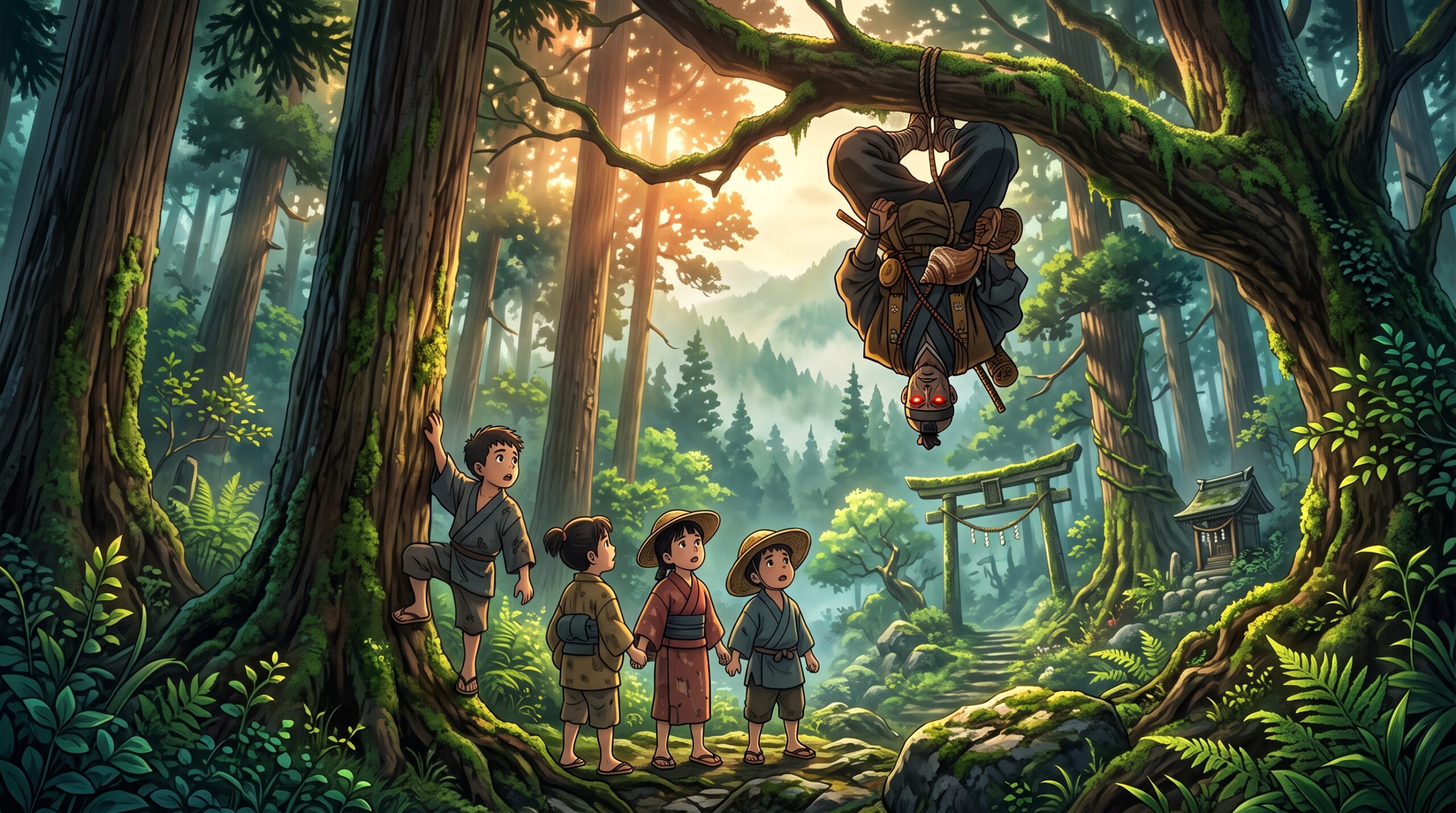
Looking up in shock, they saw an enormous “Yamabushi” in bizarre attire hanging upside down from a thick branch of a massive tree, glaring at them with piercing eyes. The Yamabushi threatened them: “Hurry up, climb down the mountain, and go home!”
Paralyzed with fear, one boy desperately pleaded in a trembling voice, “Even if you tell us to go home, we are too hungry to move…”
At this, the Yamabushi’s expression suddenly softened. “If that’s the case, eat this,” he said, producing a large amount of nigirimeshi from out of nowhere and offering it to the children. When the children looked closely, they realized that it was the exact same “nigirimeshi” their mothers had made for them, the ones hanging from their waists just moments ago.
“This Yamabushi is not human…!” Utterly terrified, the children couldn’t even accept the rice balls. They screamed and fled as fast as their legs could carry them. They could hear the voice calling from behind, “Hey, you lot, eat this!” but no one looked back. They scrambled frantically down the mountain.
By the time they finally reached the foot of the mountain, the sky was already dyed in the colors of the sunset. Coming to their senses, they looked at the bags on their waists and discovered, to their astonishment, that all the “nigirimeshi” that had vanished were completely restored. From that day on, the depths of the West Mountain returned to being a quiet sanctuary solely for the birds, and humans never set foot there again.
② Analysis: What is the True Identity of the Yamabushi?
The greatest mystery in this tale is the identity of the “Yamabushi” and the true intent behind his actions. Originally, a Yamabushi refers to a practitioner of Shugendo, an ascetic religion involving rigorous training in the mountains. However, the Yamabushi in this story is clearly not an ordinary human. He possesses supernatural powers, such as hanging upside down from a tree branch and instantly stealing and returning the children’s rice balls.
From a Japanese folkloric perspective, the true identity of this Yamabushi is likely a “Tengu” (a legendary mythical creature) or a “Kami” (Mountain God) itself. Tengu often appear in Japanese folklore as yokai or spirits dressed as Yamabushi. They are the strict guardians who maintain the order of the mountains.
What is highly intriguing is the fact that this Yamabushi did not “harm” the children. He warned and intimidated them by saying, “This is our playground,” but he did not take their lives. Instead, he tried to offer food (albeit what he had stolen) to the hungry children. This perfectly expresses the duality of nature: its “overwhelming terror” and its occasional “nurturing kindness.” The Yamabushi was not an evil spirit trying to spirit the children away, but a strict guardian teaching them the boundary of the realm where humans simply do not belong.
③ Connection to Japanese Culture: Awe of Nature and the Boundary of the Spirit World
The most important message to decipher from this folktale is the traditional Japanese view of nature, characterized by “Animism” and the concept of deities residing in all things. Since ancient times, Japanese people have believed that gods dwell in every aspect of nature—mountains, rivers, rocks, and trees. The “deep mountains,” in particular, have been regarded as the “otherworld” (Higan), where gods and spirits reside, strictly distinct from the human world (Shigan).
In the story, what the children crossed was not just a physical distance, but the invisible “boundary line” separating the mundane world from the spiritual otherworld. The massive monolith served exactly as a mystical barrier marking that boundary. The mother’s prior warning “not to go deep into the mountains” is a symbol of the unspoken rule Japanese people have shared since ancient times: “Do not invade the sanctuary of nature.”
Today, we tend to fall under the illusion that we can control nature through technological advancement. However, this story teaches us that there are forces in the natural world far beyond human comprehension, and we must never forget our “respect and awe” for nature. This wisdom of coexisting with nature, or maintaining an appropriate distance, is a virtue that flows deeply at the roots of Japanese culture.
④ What Would You Do? Standing Before the Door to the Otherworld
If you were in the shoes of these children, what would you have done? Driven by curiosity for the unknown world, would you have ignored the warnings and pushed forward? Or would you have felt the terrifying silence of the deep forest and turned back before it was too late?
And when a massive Yamabushi hanging upside down right before your eyes offered you the very rice ball that had mysteriously disappeared from your bag, would you have been able to accept it and eat it?
Even in our daily lives, a boundary to the “otherworld” might be hiding in unexpected moments. After reading this story, we invite you to think deeply about how you perceive the invisible forces and the profound nature of Japan.
Related Information and Links
- Internal Link: Japanese Folktale Series
- External Link: Shugendo (Wikipedia) – Learn about the history and culture of Yamabushi
- ① The Story of “The Rice Ball and the Mountain Ascetic”
- ② Analysis: What is the True Identity of the Yamabushi?
- ③ Connection to Japanese Culture: Awe of Nature and the Boundary of the Spirit World
- ④ What Would You Do? Standing Before the Door to the Otherworld
- Related Information and Links
- 謎多き日本の昔話『にぎりめしと山伏』が教える自然への畏怖と異界の境界線
謎多き日本の昔話『にぎりめしと山伏』が教える自然への畏怖と異界の境界線
① 昔話『にぎりめしと山伏』の物語
昔々、ある村の西のはずれに「西の山」と呼ばれる小鳥たちの楽園がありました。この村の子供たちは毎日元気に遊び回っており、ある日「明日、みんなで西の山へ探検に行こう!」と計画を立てました。
翌朝、子供たちは母親に愛情たっぷりの「にぎりめし(おにぎり)」を作ってもらい、腰にしっかりとくくりつけました。出発の際、一人の少年の母親が真剣な顔でこう警告しました。「西の山には恐ろしい山伏(やまぶし)が住んでいると聞いている。決して山の奥深くまで入ってはいけないよ」
子供たちは元気よく西の山へ向かいました。空は晴れ渡り、見晴らしも最高です。彼らは小鳥を捕まえようと、鳥もち竿を手に山を駆け回りました。しかし、小鳥たちはすばしっこく、なかなか捕まりません。夢中になって小鳥を追いかけるうちに、子供たちは母親の警告をすっかり忘れ、いつの間にか鬱蒼とした深い山奥へと迷い込んでしまいました。
歩き疲れてお腹が空いた子供たちは、山の中には珍しい、巨大で平らな一枚岩を見つけ、そこで昼食にすることにしました。ところが、腰に手をやると、あるはずの「にぎりめし」が全員分、綺麗さっぱり消え失せていたのです。袋に穴が開いたわけでもなく、落とした跡もありません。
「どうして?おらたちのにぎりめしがない!」と子供たちがパニックになっていると、頭上から突然、地響きのような大きな声が響きました。
「ここはお前たち人間が来るような場所ではない。俺たちの遊び場だ!」
驚いて見上げると、大木の太い枝に、異様な身なりをした大男の「山伏」が逆さまにぶら下がり、こちらを鋭い眼光で睨みつけていました。山伏は「早く山を下りて帰れ!」と凄みます。
恐怖で足がすくむ中、一人の少年が震える声で必死に訴えました。「帰れと言われても、おらたちは腹が減って動けないんだ……」
すると山伏は、ふっと表情を変え、「それなら、これを食え」と、どこからともなく大量のにぎりめしを取り出し、子供たちに差し出しました。子供たちがそれを見ると、なんとそれは、自分たちが母親に作ってもらい、先ほどまで腰に下げていたはずの「にぎりめし」そのものでした。
「この山伏は人間じゃない……!」完全に恐ろしくなった子供たちは、にぎりめしを受け取ることもできず、悲鳴を上げて一目散に逃げ出しました。背後から「おい、お前たち、これを食え!」という声が聞こえましたが、誰も振り返りません。転がるようにして必死に山を駆け下りました。
ようやく山のふもとにたどり着いた時、空はすでに夕焼けに染まっていました。ふと我に返り、自分たちの腰の袋を見ると、不思議なことに、消えていたはずの「にぎりめし」が全て元通りに戻っていたのです。それ以来、西の山の奥深くは再び小鳥たちだけの静かな住処となり、人間が立ち入ることは二度とありませんでした。
② 昔話の考察:山伏の真の正体とは?
この物語における最大の謎は、「山伏」の正体とその行動の真意です。山伏とは本来、山中で厳しい修行を行う修験道(しゅげんどう)の行者のことを指します。しかし、この物語に登場する山伏は、明らかに普通の人間ではありません。木の枝に逆さまにぶら下がり、子供たちのにぎりめしを一瞬にして奪い、そして再び元に戻すという超常的な力を持っています。
日本の民俗学的な視点から見ると、この山伏の正体は「天狗(てんぐ)」、あるいは「山の神」そのものであると考えられます。天狗はしばしば山伏の格好をして現れる妖怪、もしくは神霊として日本の伝承に登場します。彼らは山の秩序を守る守護者なのです。
興味深いのは、この山伏が子供たちを「傷つけていない」という事実です。彼は「ここは俺たちの遊び場だ」と警告し、威嚇しましたが、命を奪うようなことはしませんでした。むしろ、空腹を訴える子供に(奪ったものとはいえ)食料を差し出そうとしています。これは、自然界の持つ「圧倒的な恐怖」と、時に恵みを与える「優しさ」の二面性を表現しています。山伏は、子供たちを神隠しに遭わせる悪霊ではなく、人間が立ち入るべきではない領域の境界線を教える、厳格な番人だったのです。
③ 日本文化との関連:自然への畏怖と「異界」の境界線
この昔話から読み解くことができる最も重要なメッセージは、日本の伝統的な自然観である「アニミズム(精霊信仰)」と「神羅万象」の概念です。古来より日本人は、山、川、岩、木など、あらゆる自然物に神が宿ると信じてきました。特に「深い山」は、人間の住む「此岸(現世)」とは異なる、神々や精霊が住む「彼岸(異界)」であるとされてきました。
物語の中で、子供たちが超えてしまったのは物理的な距離だけでなく、日常の世界と精神的な異界を隔てる「境界線」です。巨大な一枚岩は、まさにその境界線を示す結界の役割を果たしていました。母親が事前に「山奥まで行ってはならない」と警告したのは、日本人が古くから共有してきた「自然の領域を侵してはならない」という暗黙のルールの象徴です。
現代の私たちは、科学技術の発達により自然をコントロールできると錯覚しがちです。しかし、この物語は、自然界には人間の理解を超えた大いなる力が存在し、私たちは常に自然に対する「畏敬の念(リスペクト)」を忘れてはならないということを教えてくれます。この自然との共存、あるいは適切な距離感を保つ知恵こそが、日本文化の根底に流れる美徳なのです。
④ あなたならどうする?異界への扉を前にして
もしあなたがこの子供たちの立場だったら、どうしていたでしょうか?未知の世界への好奇心に駆られ、親の警告を無視して進んでしまいますか?それとも、深い森の静寂に恐怖を感じて引き返すでしょうか。
そして、目の前に逆さまにぶら下がる山伏が現れ、消えたはずの自分のおにぎりを差し出してきた時、あなたならそれを受け取って食べることができますか?
私たちの日常の中にも、ふとした瞬間に「異界」への境界線が潜んでいるかもしれません。この物語を読んで、あなたが日本の自然や目に見えない力についてどう感じたか、ぜひ考えてみてください。


コメント