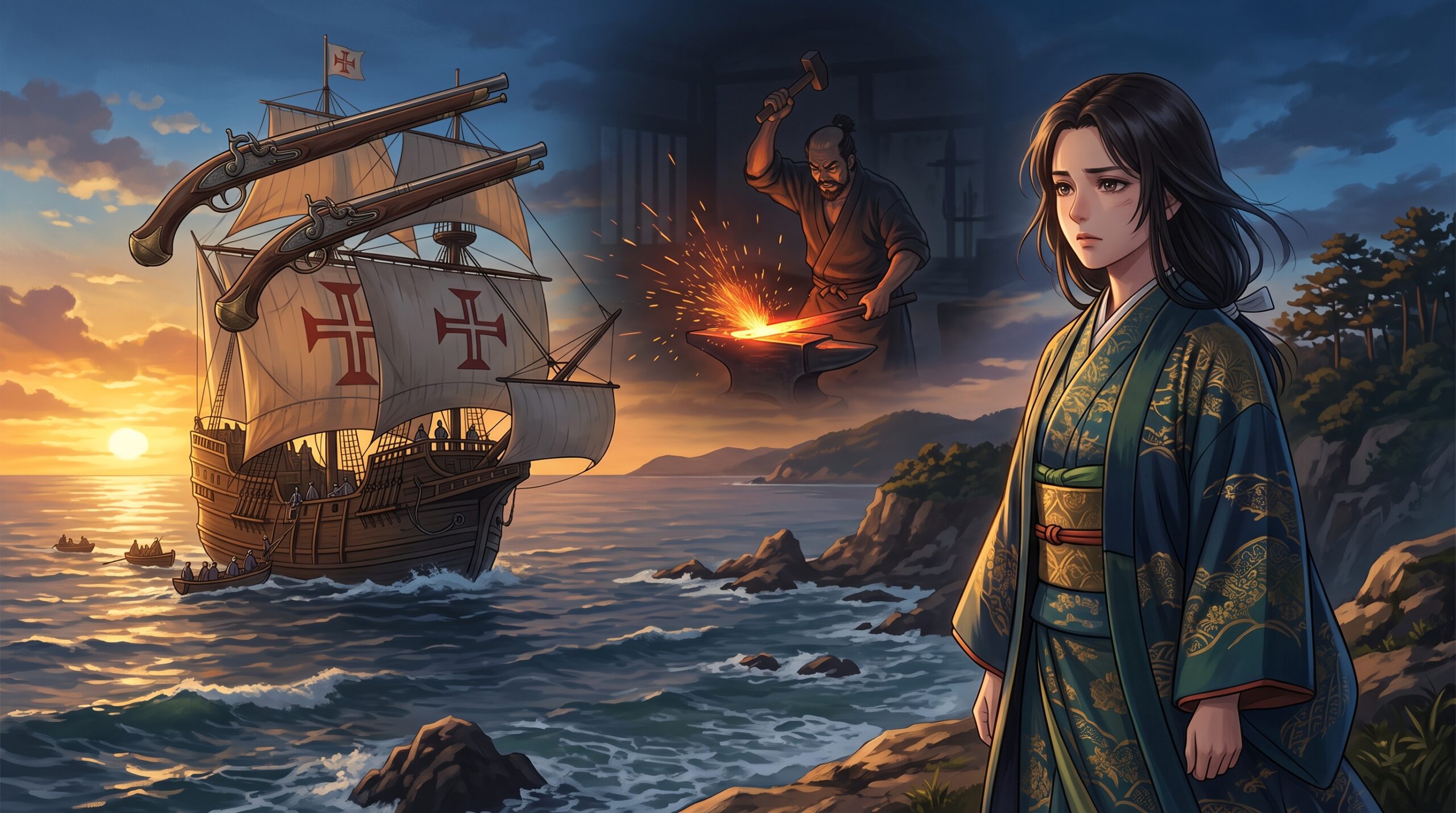
On August 25, 1543, an event occurred that fundamentally overturned Japanese history. A foreign ship drifted ashore on Tanegashima, a small island located south of Kyushu. Aboard were Portuguese merchants, holding what appeared to the Japanese of the time to be magical weapons: matchlock guns. While this day universally appears in Japanese history textbooks as the “Introduction of Firearms,” hidden behind it is a heartbreaking tale of a young girl’s fierce self-sacrifice.
A Turning Point in History: The Portuguese Ship and a Young Lord’s Decision
When the Portuguese, traveling on a Ming Chinese vessel, washed ashore at Cape Kadokura on Tanegashima, the 14th lord of the island, Tanegashima Tokitaka, was only 16 years old. He was deeply shocked by a demonstration of the matchlock’s power—the deafening roar and the destructive force that shattered its target. Tokitaka immediately paid a vast fortune, said to be worth millions of dollars in today’s currency, to purchase two of these matchlocks.
However, Tokitaka’s true goal wasn’t just to buy weapons. He planned for domestic mass production. He ordered the island’s most skilled swordsmith, Yaita Kinbei Kiyosada, to reverse-engineer and replicate this unknown weapon. Thus began the grueling battle of Japanese craftsmen.
The Hidden Truth: The Secret of the “Screw” and the Tragedy of Wakasa
Kinbei, a master swordsmith, successfully forged the barrel using his existing techniques. However, there was a wall he simply could not overcome: the breech plug, which required an internal thread (a screw mechanism). At the time, the very concept of a “screw” did not exist in Japan. No matter how many prototypes he made, the bottom of the barrel would blow out upon firing the gunpowder, driving Kinbei to the brink of despair.
Seeing her father pushed into a corner and even preparing to commit ritual suicide out of shame, Kinbei’s beautiful 16-year-old daughter, Wakasa, felt a deep ache in her heart. According to legend, the Portuguese captain presented a condition to Kinbei, who desperately wanted the secret of the screw: “I will teach you if you give me your daughter as my wife.” To save her father’s life, his honor, and the future of her domain, Wakasa resolved to marry the foreign merchant.
Through Wakasa’s sacrifice, the secret of the internal thread was finally obtained, and in 1544, the first successfully domestic matchlock was completed. Her destiny, however, was tragic. Folklore suggests she either departed for a foreign land with the Portuguese or fell ill and died young, leaving behind a poignant poem expressing her deep longing for her homeland. Her grave still remains on Tanegashima today.
Fusion with Japanese Culture: The Astounding “Monozukuri” Spirit
The domestic matchlock, born from a girl’s sacrifice and a swordsmith’s sheer willpower, spread across Japan in the blink of an eye. What is truly astonishing is the technological absorption and speed of refinement of the Japanese people at the time. Applying their highly advanced iron-making and forging techniques honed through centuries of katana crafting, Japanese smiths transformed the nation into the world’s largest gun-owning country in just a few decades. Regions like Sakai and Kunitomo became major production hubs, completely altering the nature of warfare during the Sengoku (Warring States) period.
This historical event is far more than the mere introduction of a weapon. It represents the very origin of Japan’s legendary “Monozukuri” (craftsmanship) spirit—a cultural trait still seen in today’s automotive and electronics industries, where foreign technology is rapidly absorbed, adapted, and perfected into something of even higher quality.
What Would You Do?
The story of Wakasa’s self-sacrifice strongly reflects traditional Japanese values of filial piety and loyalty to one’s domain. If you were in Wakasa’s position, could you have made the decision to sacrifice your own life’s happiness for the sake of your loved ones and your country’s future? Furthermore, how do you view the sacrifices of such unnamed individuals behind the rapid march of technological progress?
We would love to hear your thoughts in the comments below.
There are many more fascinating dates and bizarre twists of fate in Japanese history. Please enjoy other stories in our What’s Today’s Special Day Series.
Reference: Wakasa Graveyard – Furusato Tanegashima (Japanese)
【8月25日】鉄砲伝来(1543年)ー日本を変えた二丁の火縄銃と、歴史に隠された一人の少女の悲劇の物語
1543年(天文12年)8月25日、日本の歴史を根本から覆す出来事が起こりました。九州の南に位置する小さな島、種子島に一隻の異国船が漂着したのです。乗っていたのはポルトガル人の商人たち。そして彼らが手にしていたのが、当時の日本人が見たこともない魔法のような武器、「火縄銃」でした。この日は「鉄砲伝来の日」として日本の歴史教科書に必ず登場しますが、その背後には、涙なしには語れない一人の少女の壮絶な自己犠牲の物語が隠されています。
歴史の転換点:種子島に漂着した南蛮船と若き島主の決断
明国(現在の中国)の船に乗ったポルトガル人が種子島の門倉岬に漂着したとき、第14代島主であった種子島時尭(たねがしま ときたか)は、わずか16歳の若者でした。彼はポルトガル人が実演した火縄銃の威力——轟音とともに的を粉砕する破壊力——に衝撃を受けます。時尭は即座に、現在の価値で数億円とも言われる二千両という莫大な大金を支払い、二丁の火縄銃を買い取りました。
しかし、時尭の真の目的は単なる武器の購入ではありませんでした。彼は自国での大量生産を目論んだのです。時尭は島で最も優秀な刀鍛冶であった八板金兵衛清定(やいた きんべえ きよさだ)に、この未知の武器の複製を命じました。ここから、日本の技術者たちの壮絶な戦いが始まります。
隠された真実:「ネジ」の秘密と若狭姫の悲劇
優秀な刀鍛冶であった金兵衛は、持ち前の技術で銃身(筒の部分)を鍛造することには成功しました。しかし、どうしても超えられない壁がありました。それが銃の底を塞ぐための「尾栓(びせん)」、つまり「雌ネジ」の技術です。当時の日本には「ネジ」という概念そのものが存在していませんでした。何度試作しても、火薬を爆発させると底が吹き飛んでしまい、金兵衛は絶望の淵に立たされます。
追い詰められ、切腹すら覚悟した父の姿を見て胸を痛めたのが、金兵衛の16歳になる美しい娘、若狭(わかさ)でした。伝説によると、ネジの製法をどうしても聞き出したい金兵衛に対し、ポルトガル人は「娘を嫁にくれるなら教える」という条件を突きつけました。若狭は父の命と名誉、そして国の未来を救うため、自ら異国の商人への嫁入りを決意したと言われています。
若狭の犠牲によってついに雌ネジの秘密はもたらされ、1544年、見事に国産初の火縄銃が完成しました。しかし、若狭の運命は悲劇的なものでした。彼女はポルトガル人とともに異国へ旅立ったとも、病に倒れ若くしてこの世を去ったとも伝えられています。種子島には今も若狭の墓があり、彼女が詠んだとされる望郷の歌が残されています。
日本文化との融合:驚異的な「モノづくり」精神と技術の進化
一人の少女の犠牲と刀鍛冶の執念によって誕生した国産火縄銃は、瞬く間に日本全国へ広がりました。驚くべきは、当時の日本人の「技術吸収力」と「改良スピード」です。刀鍛冶たちは長年培った高度な製鉄・鍛造技術を応用し、たった数十年で日本を世界最大の銃器保有国へと変貌させました。堺や国友といった地域は鉄砲の二大生産地となり、戦国時代の戦のあり方を完全に変えてしまったのです(織田信長による長篠の戦いがその代表例です)。
この歴史的出来事は、単なる武器の伝来ではありません。未知の海外技術を取り入れ、独自の工夫を加えてさらに高品質なものへと昇華させる、現代の自動車産業やエレクトロニクス産業にも通じる日本の「モノづくり(Monozukuri)」精神の原点が、この1543年の鉄砲伝来にあるのです。
あなたならどうしますか?
若狭姫の自己犠牲の物語は、日本の伝統的な「家族への孝行」や「国への忠義」という価値観を色濃く反映しています。もしあなたが若狭の立場だったなら、愛する家族や国の未来のために、自分の人生を捧げる決断ができたでしょうか?また、技術の進歩の裏にある、こうした名もなき人々の犠牲についてどう考えますか?
ぜひ、コメント欄であなたの考えを聞かせてください。
日本が歩んできた数奇な運命と、その日ごとの歴史的エピソードは、まだまだたくさんあります。What’s Today’s Special Day Seriesの他の記事もぜひお楽しみください。

コメント