1. The Story of “The Magic Pearl”
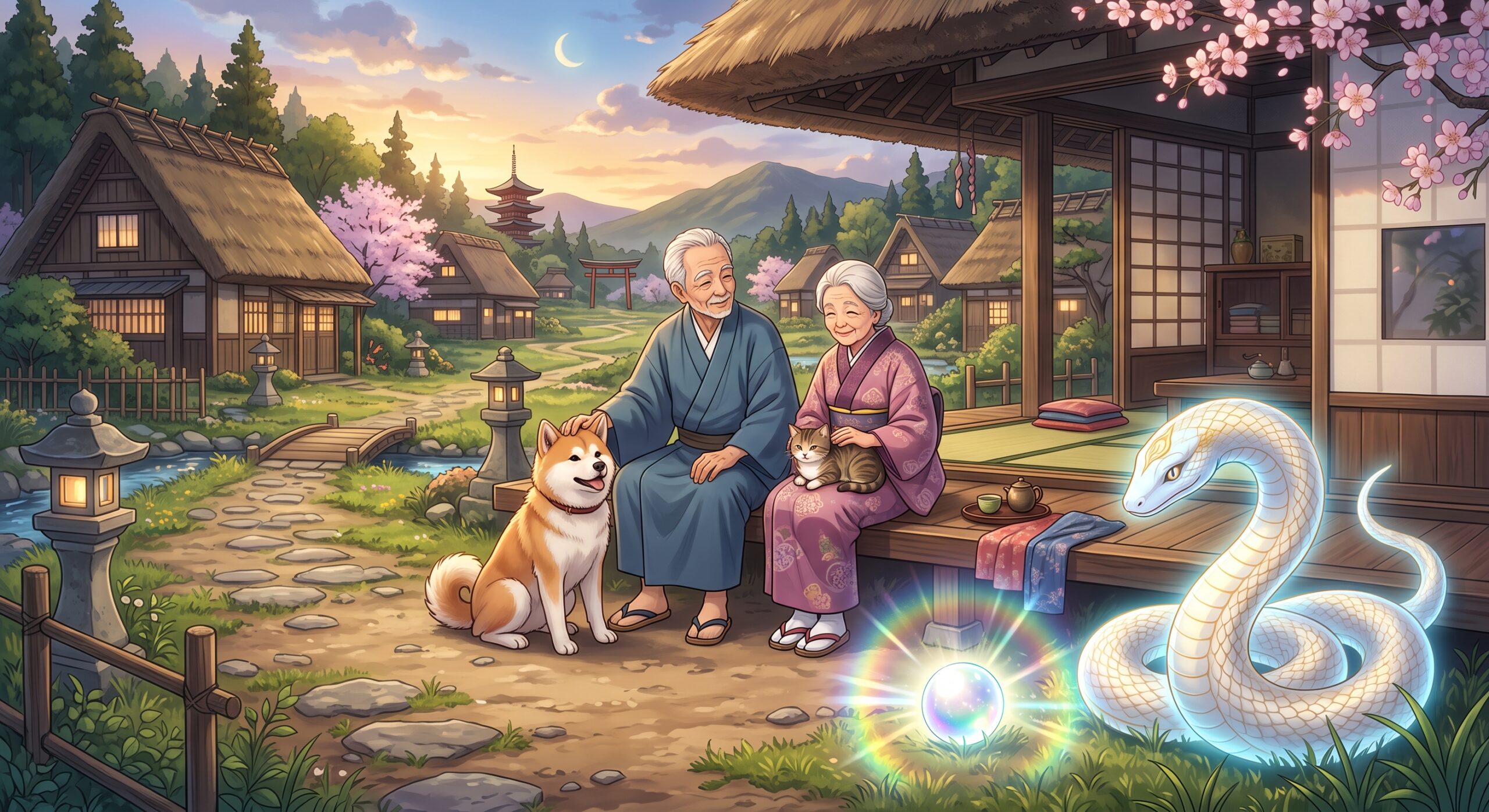
Once upon a time in a remote village in the Tohoku region of Japan, there lived a quiet old man and his wife. Having no children of their own, they sought to fill the loneliness in their hearts by keeping a dog named Ongoro and a cat named Nengoro. The elderly couple deeply loved the animals, raising them with the exact same affection they would give to their own children. Ongoro and Nengoro reciprocated this deep affection, and the four of them lived peaceful, happy days as a true family.
One day, while the old man was working in the fields, he discovered a cute, tiny snake hiding in the grass. Unable to leave the fragile creature alone, he brought it home. The couple named the snake “Noro” and began to raise it with overflowing love, just as they did with Ongoro and Nengoro. Basking in their affection, Noro grew rapidly.
However, Noro’s growth far exceeded the couple’s expectations. As months passed, Noro transformed into an unfathomably massive giant serpent. Terrified by its sheer size, the villagers panicked and strongly protested to the couple, demanding, “We cannot have such a terrifying monster in our village!” The old man and woman did not want to let go of their beloved Noro, but in order to quell the villagers’ fear and anger, they were forced to make the agonizing decision to return Noro to the deep mountains.
On the day of their parting, the old couple shed tears as they guided Noro into the wild. In response, as if to show deep gratitude for having been raised like a true child, Noro left behind a single, beautifully glowing pearl. It was a “Magic Pearl” capable of granting exactly one wish.
Gazing at the pearl they brought home, the old woman voiced a single desire: “Let us ask this pearl to give us a fine human boy of seventeen or eighteen.” For the old woman, who had dreamed of embracing a human child for many years, it was an irresistible temptation. The pearl flashed brightly, and a young man appeared before them. The couple rejoiced, believing they had finally obtained a human son.
Tragically, this son was a tremendous disappointment—a lazy, violent young man who completely betrayed their expectations. He refused to help with any chores, hurled verbal abuse at the elderly couple, and acted with absolute selfishness. Then, one day, waiting for a brief moment when the old couple was out of the house, the son stole the “Magic Pearl” and vanished to some distant land.
The ungrateful son’s betrayal left the old couple in absolute despair and profound sorrow. Watching their beloved owners weep, Ongoro and Nengoro made a resolute decision: they would embark on a long, treacherous journey to retrieve the pearl and bring the smiles back to the old man and woman’s faces. It was an unimaginably harsh journey for the small bodies of a dog and a cat, walking endlessly through unknown territories.
Through rain and wind, the two loyal animals continued their trek until they finally tracked down the lazy son, who was living a life of luxury. Risking their lives, they snuck close to him and successfully snatched the Magic Pearl back. However, their trials were not over. On their journey home, while crossing a river, they dropped the pearl into the water, and a large fish swallowed it whole. Even then, the two animals never gave up. Using all their wits and desperate effort, they managed to retrieve the pearl from the fish.
Covered in mud, their paws wounded, and gasping for breath, Ongoro and Nengoro finally arrived back at their nostalgic home. They gently placed the glowing Magic Pearl at the feet of the old man and woman. “Now, Grandpa and Grandma can be happy again.” A clear sense of accomplishment resided in the eyes of the two animals.
But having exhausted every ounce of their strength, immediately after delivering the pearl to the old couple, Ongoro and Nengoro collapsed on the spot and never moved again. It was a proud yet deeply tragic end, sacrificing their lives for the owners they loved so dearly.
2. In-Depth Analysis of “The Magic Pearl”
This story is not merely a tale of magical adventure; it is a profound tragedy that vividly contrasts the fundamental “foolishness of human greed” with the “unconditional love” of animals.
The greatest point of analysis lies in the question: “Why couldn’t the old couple use the pearl correctly?” If any wish could be granted, they could have simply wished for the giant snake Noro to return to his original small size, allowing them all to live peacefully together again. Alternatively, the moment they realized their new human son was violent and cruel, they could have wished for him to be transformed into a kind-hearted young man. Even at the very end, when Ongoro and Nengoro died, they had the chance to wish for their beloved pets to be brought back to life.
However, the old couple was blinded by the pearl’s power and lost sight of essential happiness. Their obsession with “wanting a human son” completely overshadowed the true happiness they already possessed—the warm family bond they shared with their animals. The human imperfection of lacking the wisdom to effectively use a miraculous power, and simply being swept away by fate, gives this story a powerful moral lesson. It strikes at the truth that obtaining a “Magic Pearl” (representing absolute power or immense wealth) will only invite ruin if the person wielding it lacks the character and wisdom to match.
3. Japanese Culture and the Lessons of Folktales
From this folktale, we can clearly decipher two foundational aspects of traditional Japanese spirituality: the culture of “Animism” (nature worship) and “Ongaesh” (repaying a debt of gratitude).
Since ancient times in Japan, it has been believed that animals and nature possess sacred souls. The snake (Noro) is heavily revered in Japanese folk belief, often seen as a messenger of the gods or an incarnation of a water deity. The “Magic Pearl” that Noro left behind was, in essence, a gift from the divine—and simultaneously a test from the natural world.
Furthermore, the self-sacrifice of Ongoro (the dog) and Nengoro (the cat) represents the ultimate form of “Chugi” (loyalty) and “Ongi” (debt of gratitude), which are highly esteemed virtues in Japan. Their willingness to forfeit their own lives to repay the old couple who raised them like their own children mirrors the spirit of self-sacrifice found in Bushido (the way of the samurai). Though they could not speak human words, they possessed a “humanity” and purity far deeper than that of the human son.
This story challenges us to ask, “What is a true treasure?” It contains a warning deeply rooted in Japanese culture: we must not sacrifice unconditional love and the modest, everyday happiness close at hand because we are trapped by the pursuit of visible material wealth or social appearances (such as having a human heir).
4. What Would You Do?
The “Magic Pearl” that grants exactly one wish. If this pearl were in the palm of your hand, what on earth would you wish for?
Would you, like the old couple in the story, seek something new to fill a void in your life? Or would you use that power to protect and nurture the love and bonds that already exist around you? What Ongoro and Nengoro risked their lives to retrieve was not simply a magical orb, but the “proof of their love for their family.”
After reading this sad yet beautiful folktale, how do you feel about human desires and the unconditional love of animals? Please take a moment to deeply consider the answer that arises in your heart.
■ References & External Links
Manga Nippon Mukashibanashi Database: Fushigi na Tama
■ Explore more Japanese Folktales here:
Japanese Folktale Series
哀しき奇跡と動物たちの深い忠義:日本昔話「ふしぎな玉」
① 昔話「ふしぎな玉」の物語
むかしむかし、東北地方のある村に、子どものいないおじいさんとおばあさんがひっそりと暮らしていました。二人は子どもがいない寂しさを埋めるように、「オンゴロ」という名の犬と、「ネンゴロ」という名の猫を飼い、まるで自分たちの本当の子どものように深く愛し、大切に育てていました。オンゴロとネンゴロもまた、心優しい老夫婦に深い愛情を抱き、家族として穏やかで幸せな日々を過ごしていました。
そんなある日のこと、おじいさんが畑に出かけて農作業をしていると、草むらの影に一匹のかわいらしい小さな蛇を見つけました。おじいさんはその小さな命を放っておくことができず、家に連れ帰ることにしました。夫婦はその蛇に「ノロ」という名前を付け、オンゴロやネンゴロと同じように、溢れんばかりの愛情を注いで育て始めました。ノロは夫婦の愛情を一身に受け、すくすくと成長していきました。
しかし、ノロの成長は夫婦の想像を遥かに超えていました。月日が経つにつれ、ノロはとてつもなく巨大な大蛇へと姿を変えてしまったのです。その恐ろしい巨体を見た近所の人々はパニックに陥り、「あんな恐ろしい大蛇を村に置いておくわけにはいかない」と夫婦に強く抗議しました。おじいさんとおばあさんは、愛するノロを手放したくはありませんでしたが、村人たちの恐怖と怒りを鎮めるためには、ノロを深い山へ返すという苦渋の決断を下すしかありませんでした。
別れの日、老夫婦は涙を流しながらノロを山へと導きました。するとノロは、自分をこれまで本当の子どものように大切に育ててくれたことへの深い感謝を示すように、光り輝く美しい玉を一つ、ぽつりと置いていきました。それは「どんな願い事でも一つだけ叶えてくれるふしぎな玉」でした。
家に持ち帰った玉を見つめながら、おばあさんは一つの願いを口にしました。「この玉に頼んで、十七、八歳の立派な人間の男の子を出してもらおう」。長年、人間の我が子を抱くことを夢見ていたおばあさんにとって、それは抗いがたい誘惑でした。玉は眩く光り、夫婦の目の前に若者が現れました。夫婦はついに人間の息子を手に入れたと歓喜しました。
ところが、この息子は夫婦の期待を裏切る、とんでもない怠け者で乱暴者でした。家の手伝いを一切せず、老夫婦に暴言を吐き、わがままの限りを尽くしました。そしてある日、老夫婦が少し家を空けた隙を狙い、息子はあの「ふしぎな玉」を盗み出し、どこか遠くへと姿をくらましてしまったのです。
恩知らずな息子の裏切りに、老夫婦は絶望し、深い悲しみに暮れました。その姿をそばで見ていたオンゴロとネンゴロは、愛するおじいさんとおばあさんの笑顔を取り戻すため、玉を取り返す長く険しい旅に出る決意をしました。犬と猫の小さな体で、見知らぬ土地を何日も何日も歩き続ける、想像を絶する過酷な旅です。
雨の日も風の日も歩き続け、ついに二匹はあの怠け者の息子が豪遊している場所を突き止めました。そして命がけで息子に近づき、見事にふしぎな玉を奪い返すことに成功しました。しかし、試練はそれだけでは終わりませんでした。故郷への帰路、川を渡る際に玉を水中に落としてしまい、大きな魚に玉を飲み込まれてしまったのです。それでも二匹は決して諦めず、知恵を絞り、必死の思いで魚から玉を取り戻しました。
泥だらけになり、足は傷つき、息も絶え絶えになりながら、オンゴロとネンゴロはついに懐かしい我が家へとたどり着きました。そして、おじいさんとおばあさんの足元に、光り輝くふしぎな玉をそっと置きました。「これでまた、おじいさんとおばあさんが幸せになれる」。二匹の目には、そんな確かな達成感が宿っていました。
しかし、力を使い果たしたオンゴロとネンゴロは、老夫婦に玉を届けた直後、その場に崩れ落ち、二度と動くことはありませんでした。愛する飼い主のために命を懸けた、誇り高くも悲しい最期でした。
② 「ふしぎな玉」を深く考察する
この物語は、単なる不思議な冒険譚ではなく、人間の根源的な「欲望の愚かさ」と、動物たちの「無償の愛」という残酷なまでの対比を描いた深い悲劇です。
最大の考察ポイントは、「なぜ老夫婦は、その玉を正しく使えなかったのか」という点にあります。どんな願いでも叶うのであれば、大きくなりすぎた蛇のノロを元の小さな姿に戻し、再び全員で平和に暮らすこともできたはずです。あるいは、現れた人間の息子が乱暴者だと分かった時点で、彼を心優しい青年に変えてもらうことも可能でした。最後にオンゴロとネンゴロが命を落とした時でさえ、二人を生き返らせてほしいと願うチャンスがあったのです。
しかし、老夫婦は玉の力に翻弄され、本質的な幸せを見失っていました。「人間の息子が欲しい」という執着が、すでに目の前にあった「動物たちとの温かい家族の絆」という真の幸福を覆い隠してしまったのです。手に入れた奇跡の力を有効に使う知恵を持たず、ただ運命に流される人間の不完全さが、この物語に強い教訓を与えています。手に入れた「ふしぎな玉(=絶大な力や富)」は、それを使う人間の器量が伴わなければ、かえって破滅を招くという真理を突いており、読む者の胸を強く締め付けます。
③ 日本文化と昔話の教訓
この昔話からは、日本の伝統的な精神性である「アニミズム(自然崇拝)」と「恩返し」の文化を鮮明に読み解くことができます。
日本では古来より、動物や自然には神聖な魂が宿っていると信じられてきました。蛇(ノロ)は日本の民間信仰において、神の使いや水神の化身として神聖視されることが多い生き物です。ノロが残した「ふしぎな玉」は、いわば神仏からの贈り物であり、自然界からの試練でもありました。
また、オンゴロ(犬)とネンゴロ(猫)の自己犠牲は、日本人が美徳とする「忠義」と「恩義」の究極の形です。自分たちを我が子のように育ててくれた老夫婦への恩に報いるため、己の命すら惜しまない姿は、武士道にも通じる自己犠牲の精神を表しています。彼らは言葉を話すことはありませんでしたが、人間の息子よりも遥かに深く、純粋な「人情」を持っていました。
この物語は、私たちに「真の宝物とは何か」を問いかけています。目に見える物質的な豊かさや、世間体(人間の跡継ぎがいること)に囚われるあまり、本当に大切にすべき無償の愛や、身近にあるささやかな幸せを犠牲にしてはならないという、日本文化に根付く戒めが込められているのです。
④ あなたならどうしますか?
どんな願いでも一つだけ叶えてくれる「ふしぎな玉」。もしこの玉があなたの手の中にあったなら、あなたは一体何を願うでしょうか?
この物語の老夫婦のように、自分に欠けているものを埋めるために、新しい何かを求めますか?それとも、今すでにあなたの周りにある愛や絆を守り、育むためにその力を使いますか?オンゴロとネンゴロが命を懸けて取り戻したものは、単なる魔法の玉ではなく、「家族への愛の証明」でした。
この悲しくも美しい昔話を読んで、あなたは人間の欲望と動物たちの無償の愛についてどう感じましたか?ぜひ、あなたの心に浮かんだ答えをじっくりと考えてみてください。
■ 参考文献・外部リンク
まんが日本昔ばなし〜データベース〜 ふしぎな玉
■ 関連する日本の昔話はこちら
Japanese Folktale Series(日本昔話シリーズ)
コメント