1. The Story of “Goshogai”
Long, long ago, deep in the mountains of Echigo Province (modern-day Niigata Prefecture), there lived a very honest and kind-hearted old man and his wife. Though they were poor, they worked hard in their fields every day and lived a peaceful, happy life, always caring for one another.
One day, the old man suddenly thought about his age. “I have grown quite old. It is time I secure our Gosho (passage to paradise in the afterlife),” he decided. Being utterly pure-hearted and somewhat naive about how the world worked, he firmly convinced himself, “If I go to the town, I will surely be able to buy an afterlife with money!” He took the little money they had saved and headed off to the distant, bustling town.
Upon arriving in the lively town, the old man walked down the street shouting loudly:
“Will someone sell me an afterlife? Do you have an afterlife for sale?”
The townspeople avoided the old man, giving him puzzled looks. However, the owner of a doll shop heard these strange words and found the old man highly amusing. Deciding to play a trick on him, the doll maker called out,
“Old man, I will sell you a wonderful afterlife.”
The shopkeeper brought out a wooden doll standing straight up from the back of the store and said:
“Listen carefully. You must face this doll and chant repeatedly, ‘Nokkiri de gozatta ka, Nokkiri de gozatta ka’ (Were you standing straight up?). That is the sacred magic spell to pray for the afterlife.”
Then, he brought out another doll that was sitting down and added:
“And to this doll, you must chant, ‘Haitsuboko de gozatta ka, Haitsuboko de gozatta ka’ (Were you sitting crouched down?). Do this every night without fail, and your journey to paradise is guaranteed.”
Completely believing the doll maker’s nonsense, the old man joyfully paid all his precious money, carefully held the two dolls, and returned home. His wife, waiting at home, did not doubt his story for a second. From that night on, the two of them eagerly began chanting the bizarre spells to the dolls.
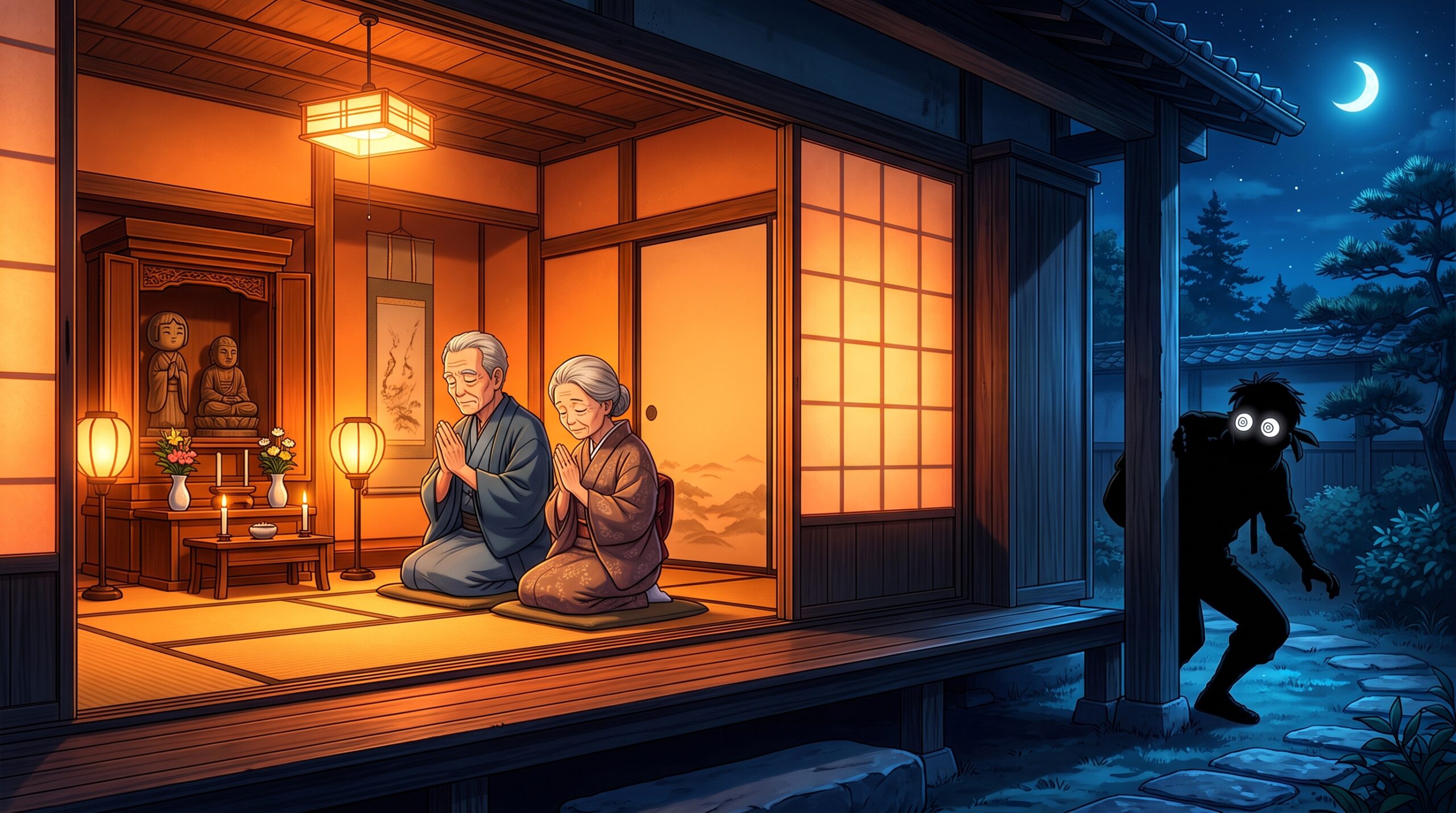
Late that very night, unfortunately for him, a thief sneaked into the old couple’s property. Moving silently, the thief stood completely still (nokkiri) outside the shoji (paper sliding door), peering into the room to check the situation.
Exactly at that moment, the old man woke up and began chanting his daily prayer for the afterlife.
“Nokkiri de gozatta ka, Nokkiri de gozatta ka” (Were you standing straight up?)
The thief standing outside gasped in shock.
“They spotted me! They know exactly that I am standing here watching them!”
In a panic, the thief quickly lowered his posture and crouched down flat on the ground to hide.
Just then, the old woman, awakened by her husband’s voice, started chanting her part of the spell next to him.
“Haitsuboko de gozatta ka, Haitsuboko de gozatta ka” (Were you crouching flat on the ground?)
Hearing this, the thief trembled in absolute terror.
“They even know that I crouched down! There must be a god or a monster with terrifying clairvoyant powers in this house!”
Completely frightened out of his wits, the thief ran down the mountain at full speed and never came near the house again. The old man and woman, completely unaware that their pure prayers had driven away a criminal, continued their nightly prayers to the dolls, living happily and peacefully for the rest of their days.
2. Deep Analysis of “Goshogai”
This story follows a classic pattern widely seen in Japanese folklore where a “coincidental match of words saves people from a crisis.” It shares the same lineage as the famous tale “Nezumi Kyo” (The Mouse Sutra). The most fascinating and humorous aspect is that the meaningless local dialect words randomly uttered by the mischievous doll maker (Nokkiri, Haitsuboko) functioned as a powerful, impenetrable shield protecting the old couple.
The thief mistakenly believes his actions are being narrated live and runs away. This perfectly illustrates the psychology of someone with malicious intent; their own guilt and bad conscience amplify their fear. Meanwhile, the elderly couple remains entirely ignorant and pure throughout. The story carries a gentle, humorous lesson typical of Japanese folktales: knowledge, cleverness, or physical strength do not always win; an “innocent heart and pure faith” is often the greatest defense against evil.
3. Connection to Japanese Culture: Buddhism and “Kotodama”
A crucial element of Japanese culture to decode from this story is the Buddhist view of life and death represented by the word “Gosho.” In Japan before the Edo period, avoiding hell and reaching the Pure Land (paradise) after death was the greatest concern and desire of the common people. The old man’s attempt to buy the intangible “afterlife” with coins in a town is depicted comically, but it realistically reflects just how deeply the people of that era craved peace in the next world.
Furthermore, we can clearly observe the ancient Japanese belief in “Kotodama” (the spiritual power of words). This is the belief that words have souls and mystical powers. Even though the phrases were merely local dialects describing “standing” and “sitting,” by treating them as sacred prayers and chanting them sincerely, they ultimately gained the tangible power to exorcise evil (the thief). The Japanese spiritual concept that values “sincere, pure prayer from the heart” over formal correctness or strict dogma flows powerfully at the base of this comical tale.
4. What is Your “Kotodama” Experience?
How did you feel reading this exhilarating story where a pure heart caused a miracle and repelled evil?
If you were the doll maker, what words would you have given to the old man looking to buy an afterlife? Also, have you ever experienced a situation in your own daily life where a slight misunderstanding or coincidental words unexpectedly saved you?
Please share your thoughts and episodes in the comments section below!
5. Related Links
- If you want to dive deeper into the world of Japanese folktales, please read this detailed explanation of Japanese folktales (Wikipedia).
- You can read all of the other fascinating folktales on our blog in the Japanese Folktale Series category.
【日本昔話】「後生買い」無垢な心が悪を退ける!笑いと教訓の痛快ストーリー
① 昔話「後生買い(ごしょうがい)」のストーリー
むかしむかし、越後の国(現在の新潟県)の深い山の奥に、とても正直で心優しいお爺さんとお婆さんが住んでいました。二人は貧しいながらも、毎日畑仕事に精を出し、お互いを思いやりながら平穏で幸せな日々を過ごしていました。
ある日のこと、お爺さんはふと自分の年齢を考えました。「わしもすっかり年を取った。そろそろ自分たちの『後生(ごしょう:死後に極楽浄土へ行くこと)』をお願いしておかなければならないな」と思い立ったのです。とても純粋で世間知らずなお爺さんは、「町へ行けば、お金で後生を買うことができるに違いない」と固く信じ込み、なけなしの小銭を握りしめて、遠く離れた町へと出かけていきました。
賑やかな町に到着したお爺さんは、通りを歩きながら大声で尋ね回りました。
「誰か、後生を売ってくださらんか!後生はありませんか!」
町の人々は不思議そうな顔をしてお爺さんを避けていきましたが、ある一軒の人形屋の主人が、このおかしな言葉を聞きつけて面白がりました。「これはからかってやろう」と悪知恵を働かせた人形屋は、お爺さんに声をかけました。
「お爺さん、私が素晴らしい後生を売ってあげよう」
人形屋は店の奥から、まっすぐに立った姿の木彫りの人形を一つ持ってきて言いました。
「いいかい、この人形に向かって『ノッキリ(にょっきり)でござったか、ノッキリでござったか』と何度も唱えなさい。それが後生を願うありがたい呪文だ」
続けて、ちょこんと座っている別の人形を持ってきて言いました。
「そして、こっちの人形には『ハイツボコ(座っている)でござったか、ハイツボコでござったか』と唱えるんだ。これを毎晩欠かさずやれば、極楽行きは間違いないよ」
人形屋の出鱈目な言葉を完全に信じ切ったお爺さんは、大喜びで大切なお金を全額支払い、二つの人形を大事に抱えて家へと帰りました。家で待っていたお婆さんもお爺さんの話を微塵も疑わず、二人はその夜から人形に向かって熱心に奇妙な呪文を唱え始めました。
さて、その日の深夜のことです。お爺さんとお婆さんの家に、運悪く一人の泥棒が忍び込みました。泥棒は足音を殺して家に近づき、障子の外に「ノッキリ」と立ったまま、部屋の中の様子をうかがっていました。
ちょうどその時、ふと目を覚ましたお爺さんが、日課である後生を願うための呪文を唱え始めました。
「ノッキリでござったか、ノッキリでござったか(立っていたか、立っていたか)」
外に立っていた泥棒はギクリとしました。
「ば、ばれている!自分が立って様子をうかがっているのを完全に見透かされているぞ!」
泥棒は慌てて姿勢を低くし、地面に這いつくばって身を隠しました。
すると今度は、お爺さんの声で目を覚ましたお婆さんが、隣で呪文を唱え始めました。
「ハイツボコでござったか、ハイツボコでござったか(這いつくばったか、這いつくばったか)」
これを聞いた泥棒は震え上がりました。
「俺が身を低くして這いつくばったことまでお見通しだ!この家には恐ろしい神通力を持つ神か化け物がいるに違いない!」
完全に怯えきった泥棒は、一目散に山を駆け下り、二度とその家に近づくことはありませんでした。お爺さんとお婆さんは、自分たちの純粋な祈りが泥棒を追い払ったことなど露知らず、その後も人形への祈りを続け、幸せに安心して暮らし続けました。
② 昔話「後生買い」の深い考察
この物語は、日本の民話に広く見られる「言葉の偶然の一致が危機を救う」という王道のパターンを踏襲しています。有名な「ねずみ経」と同系統の物語ですが、最も興味深くユーモラスな点は、人形屋が適当に発した無意味な方言(ノッキリ、ハイツボコ)が、結果的にお爺さんとお婆さんの身を守る強力な防壁として機能したことです。
泥棒は「自分の行動が逐一実況されている」と勘違いして逃げ出しますが、これは悪意や後ろめたさを持った人間が、勝手に恐怖を増幅させていく心理を的確に描いています。一方で、老人たちは終始無知で純粋なままです。知識や知恵、腕力が必ずしも勝利するわけではなく、「無垢な心と純粋な信仰心」こそが最大の防御になるという、日本の民話特有の優しい教訓が込められています。
③ 日本文化との関連:仏教観と「言霊(ことだま)」の力
この物語から読み解ける日本文化の重要な要素は、「後生(ごしょう)」という仏教的な死生観です。江戸時代以前の日本では、死後に地獄へ落ちず極楽浄土へ行くことが、庶民の最大の関心事であり願いでした。形のない「後生」を町で買おうとするお爺さんの行動は滑稽に描かれていますが、当時の人々がどれほど来世の安寧を渇望していたかをリアルに表しています。
また、日本古来の「言霊(ことだま)」の信仰も顕著に表れています。発した言葉には霊的な力が宿るという考え方です。本来はただの「立ち姿」「座り姿」を表す方言であっても、それを神聖な祈りの言葉として真摯に唱えることで、結果的に邪悪なもの(泥棒)を祓う確かな力を持ったのです。形式や作法よりも「心からの純粋な祈り」を重んじる日本の精神性が、このコミカルな物語の底に力強く流れています。
④ あなたの「言霊」の経験は?
純粋な心が奇跡を起こし、悪を退けたこの痛快な物語を読んで、あなたはどう感じましたか?
もしあなたが人形屋だったら、後生を買いに来たお爺さんにどのような言葉をかけますか?また、あなた自身の日常で、ちょっとした勘違いや偶然発した言葉が、思いがけず自分を助けてくれた経験はありませんか?
ぜひ、あなたの考えやエピソードをコメント欄で聞かせてください。
⑤ 関連リンク
- 日本昔話のさらなる深い世界を知りたい方は、こちらの日本昔話に関する詳しい解説(Wikipedia)をご覧ください。
- 当ブログの他の魅力的な昔話は、Japanese Folktale Series カテゴリーからすべてお読みいただけます。

コメント