August 12 marks “Kimigayo Memorial Day” in Japan. It originates from this day in 1893 (Meiji 26), when Japan’s Ministry of Education officially promulgated the “Holiday and Festival Songs,” which included “Kimigayo.” Today, you often hear this song as Japan’s national anthem at global ceremonies and international sporting events. However, its roots are incredibly ancient, hiding a “romantic secret” that even many modern Japanese people are unaware of.
Today, for our overseas readers, we will unravel the true essence of “Kimigayo,” a song that perfectly encapsulates Japanese history and spirituality.
History and Culture: A Song of Blessing Born from the “Kokin Wakashu”
Many national anthems around the world are born from a history of revolution, independence, or battle, featuring brave, powerful melodies and lyrics. However, Japan’s “Kimigayo” is completely different. There is absolutely no scent of war or blood in this song.
The lyrics first appeared over 1,000 years ago in the Kokin Wakashu (Collection of Ancient and Modern Japanese Poetry), compiled during the Heian period in 905 AD. Astonishingly, the author is “Anonymous.” It was not commissioned by a specific person of power; rather, it consists of words passed down by nameless everyday people.
Originally, it was born as a “celebratory song wishing for longevity.” It was a Waka poem praying for the deep happiness and peace of another person, meaning: “May your life last for a thousand, nay, eight thousand years, until tiny pebbles grow into massive boulders and become covered with lush green moss.”
Interpretation and Japanese Culture: “Eternal Bonds” Hidden in the Word “Kimi”
As time passed, “Kimigayo” strengthened its connotation as a song praising the Emperor’s reign. However, deep within Japanese culture, another beautiful interpretation exists. It is hidden in the etymology of the word “Kimi” (You).
In Japanese mythology, the first male and female deities are Izanaki and Izanami. In ancient Japanese, “Ki” represents a male and “Mi” represents a female. Therefore, “Ki-Mi” signifies the “perfect union of man and woman.” According to this interpretation, “Kimigayo” transforms into the ultimate love song: “May the peaceful world where men and women prosper together and love one another continue for eternity.”
In fact, from the Edo period to the Meiji period, “Kimigayo” was widely sung among the common people across Japan at celebratory occasions, especially as a wedding song.
[A Summer Wedding: A Waka Pledging Eternity]
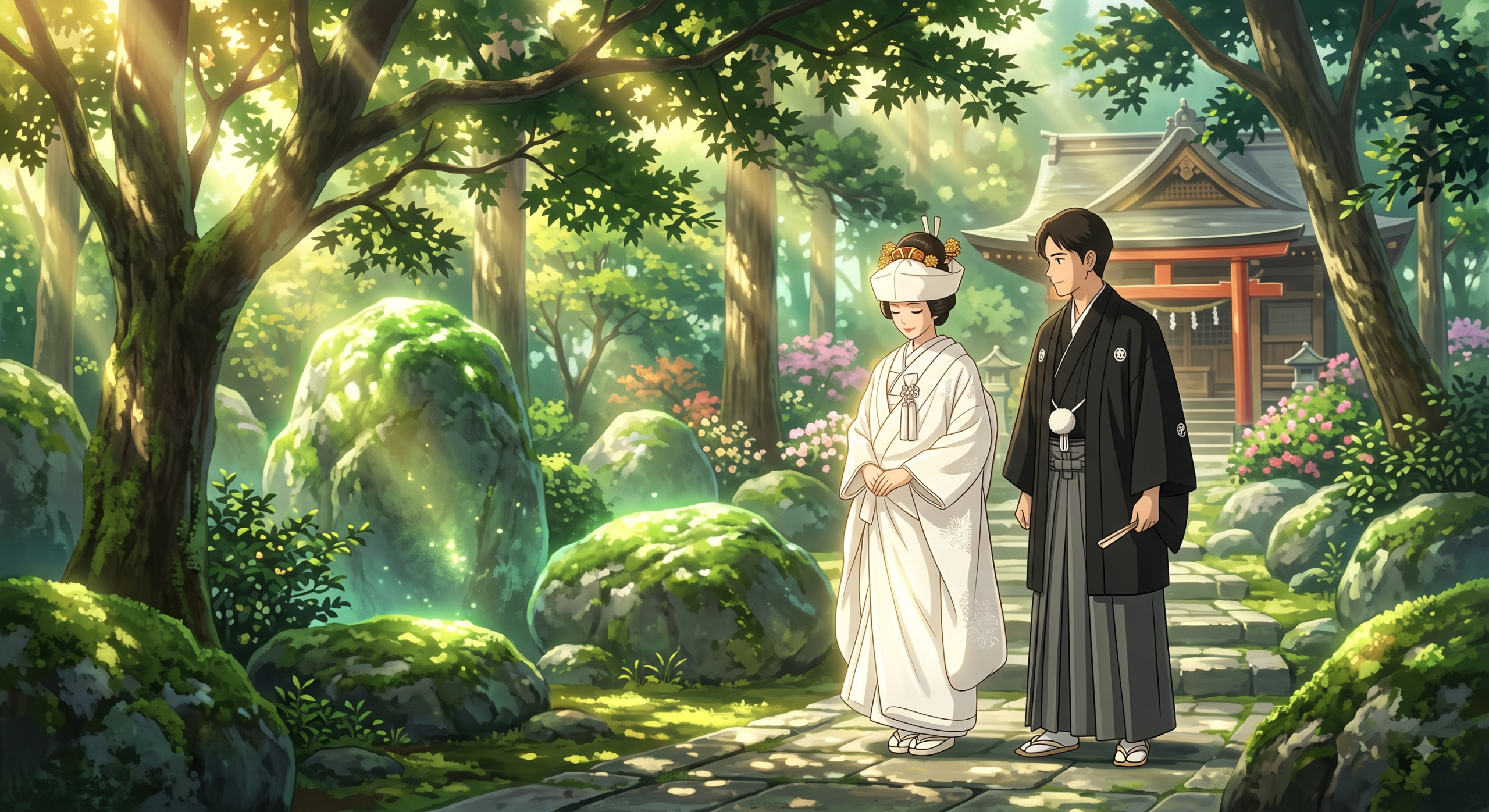
A traditional Japanese shrine. Amidst the August tranquility echoing with the sound of cicadas, a bride in a Shiromuku (traditional pure white wedding kimono) and a groom in a Montsuki Hakama exchange nuptial sake cups. Emma, a guest visiting from overseas, was captivated by the ancient song chanted quietly to the melody of Gagaku court music in the solemn atmosphere.
“What is that beautiful melody?” she asked the friend beside her. Her friend smiled and replied.
“That is ‘Kimigayo’. It’s Japan’s current national anthem, but originally, it’s a prayer song that has been sung at weddings for over a thousand years, meaning ‘May the love between these two last forever until moss grows on boulders.'”
Emma was astonished. The song that symbolized a nation was actually a love song blessing the eternal chain of life and love of the couple right before her eyes. She was deeply moved by the romantic aesthetic of “eternity” held by the Japanese people, and finally understood the meaning behind the single tear rolling down the bride’s cheek.
What Does “Eternity” Mean to You?
Japan is a country that passes down a national anthem not of military might or victory, but of the “quiet workings of nature”—tiny stones becoming boulders and growing moss—and the “eternal bonds with loved ones.” The words left by an anonymous poet 1,000 years ago still live on in the modern world, having transformed their shape.
After reading this article, has your image of the Japanese national anthem changed? If you were to give words praying for “eternity” to someone precious to you, what natural scenery would you compare it to? Please share the beautiful poetry of your country, or the thoughts in your heart, in the comments section below!
Series Article List (Internal Link):
What’s Today’s Special Day Series
8月12日は「君が代記念日」:世界で最も短く、最も古い歌詞を持つ国歌の秘密
8月12日は日本の「君が代記念日」です。1893年(明治26年)のこの日、日本の文部省が「君が代」を含めた『祝日大祭日唱歌』を公布したことに由来しています。現在、日本の国歌として世界中の式典やスポーツの国際大会で耳にするこの曲ですが、そのルーツは驚くほど古く、そして現代の多くの人が知らない「ロマンチックな秘密」が隠されています。
今回は、海外の皆様へ向けて、日本の歴史と精神性が凝縮された「君が代」の真の姿を紐解いていきます。
歴史と文化:『古今和歌集』から生まれた祝福の歌
世界中の国歌の多くは、革命、独立、あるいは戦いの歴史を背景に作られており、勇ましく力強いメロディーと歌詞を持っています。しかし、日本の「君が代」は全く異なります。この歌には、戦いや血の匂いは一切ありません。
歌詞の初出は、今から1000年以上前の平安時代(905年)に編纂された『古今和歌集(Kokin Wakashu)』です。しかも、驚くべきことに作者は「詠み人知らず(Anonymous)」、つまり誰が書いたのか分からないのです。特定の権力者が作らせたものではなく、名もなき人々によって語り継がれてきた言葉でした。
もともとは「長寿を祝うおめでたい歌」として生まれました。「あなたの命が、小さな石が長い年月をかけて大きな岩となり、そこに苔が生えるまで、千年も万年も長く長く続きますように」という、相手の深い幸せと平和を祈る和歌だったのです。
読み解きと日本文化:君(きみ)に隠された「男女の永遠の絆」
時代が下るにつれ、「君が代」は天皇の治世を賛美する歌としての意味合いを強めていきました。しかし、日本文化の深層において、この歌にはもう一つの美しい解釈が存在します。それは「君(きみ)」という言葉の語源に隠されています。
日本の神話に登場する最初の男女の神、伊邪那岐(イザナキ)と伊邪那美(イザナミ)。この「キ」は男性を、「ミ」は女性を表す古い言葉です。つまり、「キ・ミ」とは「完璧な男女の結びつき」を意味します。この解釈によれば、「君が代」は「男性と女性が共に栄え、愛し合う平和な世界が永遠に続きますように」という、究極のラブソングになるのです。
実際に、江戸時代から明治時代にかけて、「君が代」はおめでたい席、特に結婚式の祝い唄として日本全国の庶民の間で広く歌われていました。
【ある夏の日の結婚式:永遠を誓う和歌】
日本の伝統的な神社。蝉の声が響く8月の静寂の中、白無垢(伝統的な婚礼衣装)に身を包んだ花嫁と、紋付袴姿の花婿が三々九度の盃を交わしています。参列していた海外からのゲスト、エマは、厳粛な空気の中で雅楽の調べと共に静かに詠み上げられた古い歌に心を奪われました。
「あの美しいメロディーは何?」と彼女が隣の友人に尋ねると、友人は微笑んで答えました。
「あれは『君が代』。今の日本の国歌だけれど、元々は千年以上前から結婚式で歌われてきた『二人の愛が苔のむすまで永遠に続きますように』という祈りの歌なのよ」
エマは驚きました。国家の象徴である歌が、目の前にいる二人の愛と命の連鎖を祝福するラブソングだったからです。彼女は、日本人が持つ「永遠」へのロマンチックな美意識に深く感動し、花嫁の流した一筋の涙の意味を理解したのでした。
あなたにとっての「永遠」とは?
武力や勝利ではなく、小さな石が岩になり苔が生えるという「自然の静かな営み」と「愛する人との永遠の絆」を国歌として歌い継ぐ国、日本。1000年前の無名の詩人が残した言葉は、今も形を変えて現代に生きています。
この記事を読んで、あなたは日本の国歌に対するイメージが変わりましたか?もしあなたが大切な人に「永遠」を祈る言葉を贈るとしたら、どんな自然の風景に例えますか?ぜひ、あなたの国の美しい詩や、あなたの心にある想いをコメント欄で教えてください。
シリーズ記事一覧(内部リンク):
What’s Today’s Special Day Series

コメント