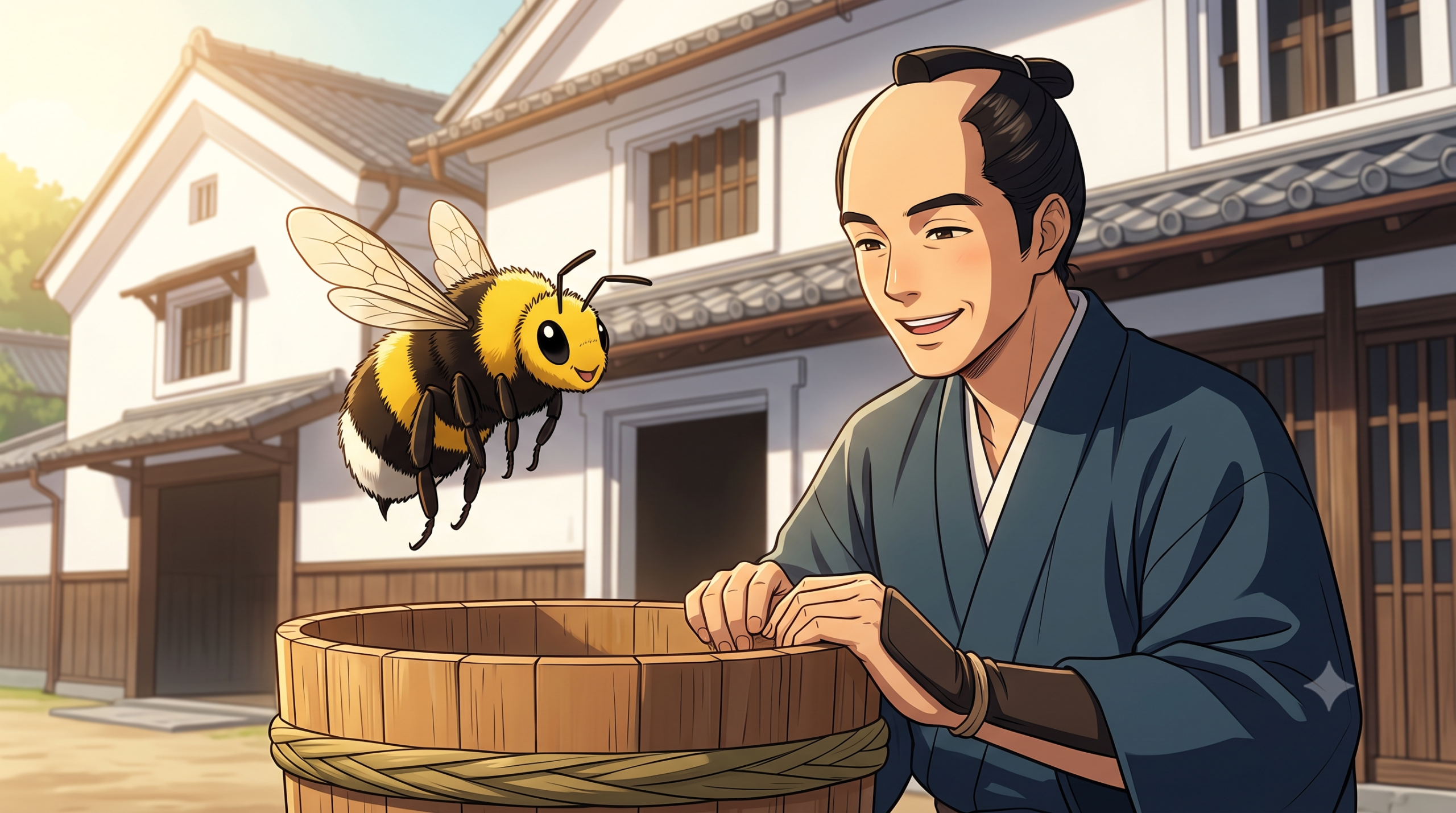
1. The Story: Rokubee and the Bumblebee
Once upon a time, in the Fushimi area of Kyoto, Japan’s ancient capital, there lived a master sake brewer named Rokubee. Fushimi has long been celebrated throughout Japan for its abundant, pure underground water, making it a legendary region for brewing the finest sake. In Rokubee’s brewery, craftsmen poured their hearts into making exquisite sake every single day.
Rokubee was an incredibly honest and gentle man who treated everyone with kindness and equality. Because of his excellent character, his sake became highly renowned, and his business flourished greatly.
One day, a large bumblebee began building a nest right under the eaves of Rokubee’s sake brewery. Hearing the loud, heavy buzzing of the bees, the brewery workers panicked. “If we get stung by those huge bees, it will be a disaster! It’s dangerous, so let’s knock the nest down and destroy them right now,” they said in alarm.
However, Rokubee stopped them with a gentle smile. “No, no, wait. As long as we do not harm them, the bees will never sting us. Leave them be,” he instructed.
Following Rokubee’s words, the bumblebee nest was left untouched. Soon, a strange thing began to happen. The bumblebees gathered around the wooden sake barrels and happily started drinking the sake Rokubee had brewed. Seeing the bees freely drinking their painstakingly crafted sake, the workers grew angry once again. But Rokubee just laughed and said, “The amount those tiny bees can drink is nothing. It is no big deal. Let them drink as much as they please.”
One summer day, Rokubee and his workers loaded up their horses with many barrels of sake and set off to deliver them to a distant village. Just as they reached a path deep within the rugged mountains, terrifying bandits suddenly leaped out from the bushes and attacked the group.
Unarmed, Rokubee and his men scattered and fled for their lives. Fortunately, everyone survived, but their precious horses and all the carefully brewed sake barrels were stolen by the bandits. As Rokubee and his men watched in despair from a distance, a loud, thunderous buzzing sound echoed from the sky.
Incredibly, a massive swarm of the very bumblebees that lived at the brewery came rushing in! The swarm charged at lightning speed into the cave where the bandits had taken the sake. The bumblebees relentlessly chased the bandits around, stinging them fiercely all over their bodies. Unable to withstand the sudden, overwhelming attack by the bees, the bandits screamed in terror and fled, leaving the horses and sake behind.
Thanks to the magnificent rescue by the bumblebees, Rokubee safely recovered both his horses and his sake. The bees had beautifully returned the favor to the kind Rokubee, who had never chased them away and had always shared his delicious sake with them.
2. Analysis of the Tale: The Nature of Bumblebees and Fushimi’s Background
What makes this story deeply fascinating is the choice of the “Bumblebee” (Kumanbachi in Japanese). Bumblebees are large and produce a low, intimidating buzzing sound, making them seem ferocious and scary at first glance. However, their true nature is extremely docile. Unless their nest is threatened or they are directly harmed, they rarely sting humans. Furthermore, male bumblebees do not even possess a stinger.
Rokubee’s words, “As long as we do not harm them, they will not sting,” demonstrate not just mere kindness, but a profound insight and respect for the true nature of wildlife.
The setting of “Fushimi, Kyoto” is also crucial. Fushimi is one of Japan’s most famous sake-producing regions, blessed with high-quality spring water. Rokubee, an artisan who relies on the blessings of nature (water) to craft his sake, shows tolerance toward another part of nature (the bees). This beautifully symbolizes the traditional Japanese craftsman’s dedication to living in harmony with the natural world.
3. Connection to Japanese Culture: “Ongaeshi” (Repaying Kindness) and Animism
The most important Japanese cultural concepts to decode from this tale are “Ongaeshi” (Karma/Repaying Kindness) and “Kyosei” (Coexistence).
In Japanese folklore, themes of animals or inanimate objects returning favors for a human’s kindness appear frequently, such as in “The Grateful Crane” (Tsuru no Ongaeshi). This is deeply rooted in traditional Shinto beliefs and Animism—the idea that spirits reside in all things, and that humans are not rulers of nature, but merely a part of it.
Instead of eliminating the bees as “pests,” Rokubee accepted them as “fellow inhabitants.” By sharing a little bit of human blessings (sake) with nature, he was ultimately saved from a massive crisis. This story strongly reflects the Japanese moral philosophy of “Nasake wa hito no tame narazu” (Kindness is never wasted; a good deed will eventually return to you).
4. To Our Readers: What Would You Do?
How did you feel about the story of Rokubee and the Bumblebee? In modern society, we often rush to eliminate things that are even slightly inconvenient or misunderstood.
If a scary-looking bee built a nest at your home, could you watch over it gently like Rokubee did? Do we have the emotional space to share a little of what we value with others without expecting anything in return?
This tale challenges us to think about our respect for nature and the immense power of small acts of kindness. If there is something you felt while reading this story, or a “small act of kindness” you want to try in your own life, please take a moment to reflect on it.
References and Related Links
- Reference (Japanese): Manga Nippon Mukashibanashi Database
- Read more tales on our blog: Japanese Folktale Series
六兵衛とクマンバチ:自然との共生と恩返しの物語
① 昔話のストーリー:六兵衛とクマンバチ
昔々、日本の都である京都の伏見(ふしみ)に、六兵衛(ろくべえ)という酒造りの名人がおりました。伏見といえば、古くから豊かな名水に恵まれ、極上の酒が造られる土地として日本中で知られています。六兵衛の酒蔵でも、職人たちが丹精を込めて日々素晴らしい酒を仕込んでいました。
六兵衛は非常に正直者で、誰に対しても優しく接する人柄の持ち主でした。そのため、彼の造る酒は瞬く間に評判を呼び、商売は大変に繁盛していました。
ある日のこと、六兵衛の酒蔵の軒先に、大きなクマンバチが巣を作り始めました。羽音を立てて飛び回る蜂たちを見て、酒蔵の使用人たちは慌てふためきました。「あんな大きな蜂に刺されたら大変だ。危ないから、今のうちに巣をたたき落としてやっつけてしまおう」と口々に言いました。
しかし、六兵衛は穏やかな笑顔で彼らを制止しました。「いやいや、待ちなさい。こっちから何かしなければ、蜂だって決して人を刺したりはしないものだ。そのままにしておいてやりなさい」
六兵衛の言葉に従い、クマンバチの巣はそのままにされました。やがて、不思議なことが起こり始めます。クマンバチたちが、酒樽の周りに集まり、六兵衛の造った酒を美味しそうに飲み始めたのです。丹精込めた酒を勝手に飲む蜂たちを見て、使用人たちは再び腹を立てました。しかし、六兵衛はまたしても笑って言いました。「蜂の小さな体で飲む量など、たかが知れている。大したことではない。好きなだけ飲ませてあげなさい」
ある夏の日、六兵衛と使用人たちはいつものように馬の背にたくさんの酒樽を載せ、遠くの村まで配達に出かけました。険しく深い山の中の道に差し掛かったその時です。突然、茂みから恐ろしい山賊たちが飛び出してきて、一行に襲いかかりました。
丸腰だった六兵衛たちは、命からがら一人ずつバラバラに逃げ出しました。全員なんとか無事でしたが、大切な馬と、丹精込めて造った酒樽はすべて山賊たちに奪われてしまいました。六兵衛たちが遠くから絶望的な気持ちで様子を見ていると、空の彼方から「ブーン」という轟音が響いてきました。
なんと、あの酒蔵に住み着いていたクマンバチの大群が押し寄せてきたのです。蜂の大群は、山賊たちが酒を運び込んだ洞窟の中へ猛スピードで突撃していきました。クマンバチたちは山賊たちをさんざんに追い回し、容赦なく全身を刺しました。突然の蜂の大群による猛攻撃に耐えきれず、山賊たちは悲鳴を上げ、馬も酒樽も放り出してどこかへ逃げ去ってしまいました。
クマンバチたちの見事な活躍のおかげで、六兵衛は無事に大切な馬も酒も取り戻すことができました。蜂たちは、いつも自分たちを追い払わず、美味しいお酒を飲ませてくれた優しい六兵衛に、立派な「恩返し」をしたのでした。
② 昔話の考察:クマンバチの生態と伏見の背景
この物語が非常に興味深いのは、「クマンバチ(熊蜂)」という昆虫が選ばれている点です。クマンバチは体が大きく、羽音も低く重厚なため、一見すると非常に凶暴で恐ろしい昆虫に思われがちです。しかし、実際のクマンバチの生態は非常に温厚であり、メスは巣を脅かされたり、直接危害を加えられたりしない限り、自ら人を刺すことは滅多にありません。また、オスに至ってはそもそも針を持っていません。
六兵衛の「こっちから何かしなければ、刺さない」というセリフは、単なる優しさだけでなく、自然界の生き物の性質を正しく理解し、尊重する深い洞察力を示しています。
また、舞台が「京都の伏見」であることも重要です。伏見は日本有数の酒どころであり、良質な地下水(伏水)が湧き出る場所です。豊かな自然の恵みである水を使って酒を造る六兵衛が、同じく自然の一部である蜂に対して寛容であったことは、自然との調和を重んじる職人の姿を象徴していると言えるでしょう。
③ 日本文化との関連:「恩返し」と「共生(アニミズム)」
この物語から読み解くべき最も重要な日本文化の概念は、「恩返し(Ongaeshi)」と「共生(Kyosei)」です。
日本の昔話には、「鶴の恩返し」や「笠地蔵」など、人間が動物や無機物に施した親切が、後に大きな報いとなって返ってくるというテーマが頻繁に登場します。これは、古来から日本に根付く「アニミズム(万物に魂が宿るという考え方)」や神道の精神と深く結びついています。人間は自然を支配する存在ではなく、自然界の一部に過ぎないという謙虚な姿勢です。
六兵衛は、蜂を「害虫」として排除するのではなく、「同じ場所に生きる仲間」として許容しました。酒という人間の恵みを少しだけ自然(蜂)におすそ分けすることで、最終的に強大な困難(山賊)から救われるという因果応報のストーリーは、「情けは人の為ならず(他者への親切は、巡り巡って自分に返ってくる)」という日本人の道徳観を色濃く反映しています。
④ 読者の皆様へ:あなたならどうしますか?
六兵衛とクマンバチの物語、いかがでしたでしょうか? 現代社会において、私たちは少しでも自分にとって不都合なものや、理解できないものをすぐに排除しようとしてしまいがちです。
もしあなたの家に恐ろしい見た目の蜂が巣を作ったら、六兵衛のように優しく見守ることができるでしょうか? 大切なものを少しだけ、見返りを求めずに他者に分け与える心の余裕を持てているでしょうか?
この物語は、自然に対する敬意と、小さな親切が持つ大きな力を私たちに問いかけています。あなたがこの物語を読んで感じたことや、自分自身の生活の中で実践してみたい「小さな親切」があれば、ぜひ深く考えてみてください。
参考リンク・関連記事
- 外部参考元:まんが日本昔ばなしデータベース「六兵衛とクマンバチ」
- 当ブログの他の昔話も読む:Japanese Folktale Series

コメント