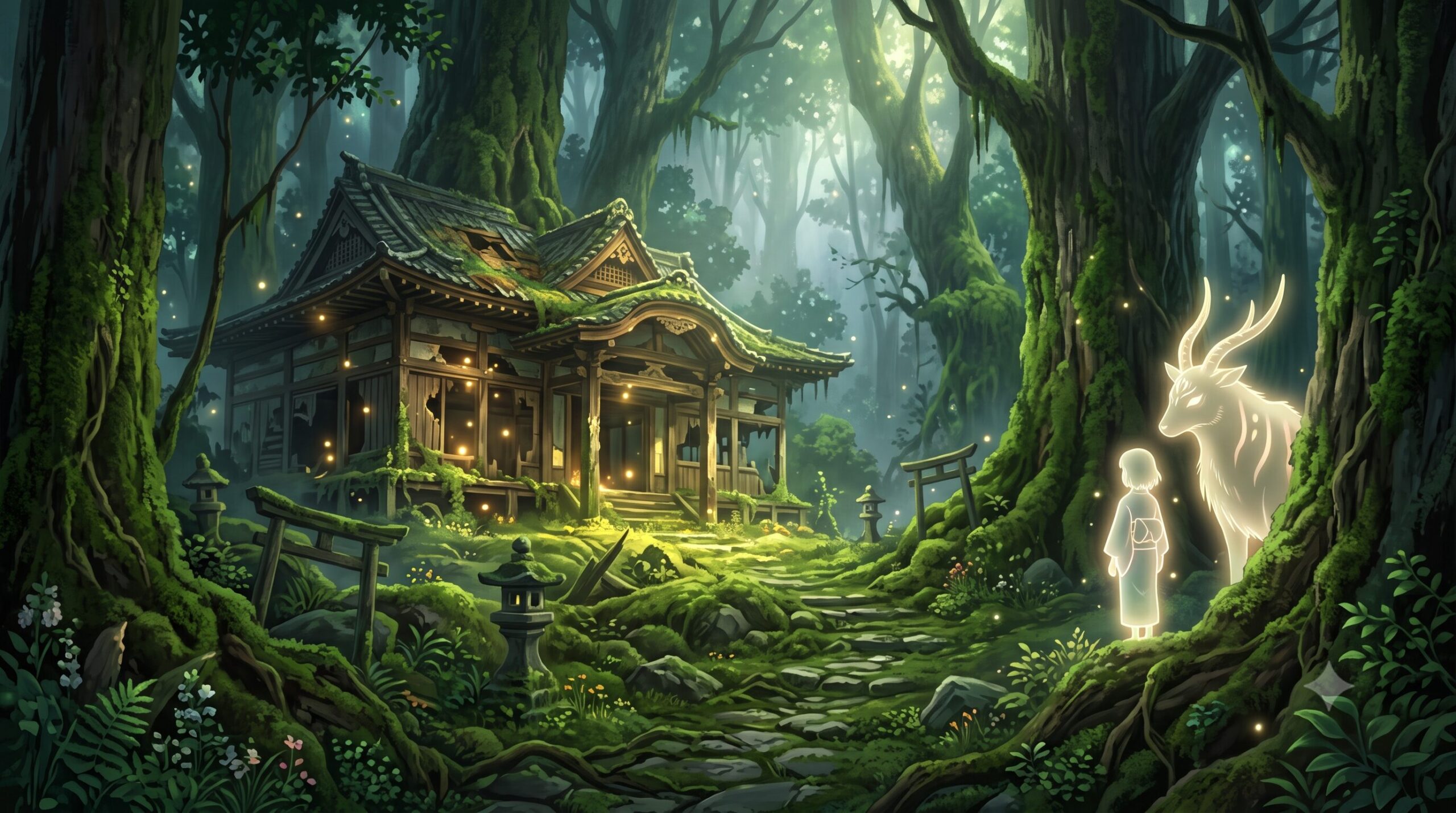
In Japan, folktales are rarely just simple bedtime stories for children. Many are profound narratives that ruthlessly expose human nature and the harsh realities of the natural world. Today, we delve into the terrifying yet deeply educational folktale from Yamaguchi Prefecture: “Choja-ga-mori” (The Millionaire’s Forest). This story vividly depicts how humans, after acquiring immense wealth through divine blessing, can plummet into absolute ruin through their own arrogance. Let us deeply analyze the nature of Japanese gods and the philosophy underlying Japanese culture through this haunting tale.
1. The Story of “Choja-ga-mori”
A Promise Forged in the Deep Mountains
Long ago, deep in the mountains of Yamaguchi Prefecture, there lived two neighboring families of charcoal burners. They lived in extreme poverty, barely surviving through grueling labor in the forest. However, a glimmer of joy arrived when both families welcomed a child at the exact same time—one family had a boy, and the other a girl. Overjoyed by this miraculous coincidence, the parents made a firm promise: “When these children grow up, we must absolutely have them marry each other.”
The Girl with the Golden Touch
Time passed, and the children turned six. The girl’s parents were constantly lamenting their harsh reality, sighing that no matter how much charcoal they burned, they never had enough money to live comfortably. Hearing this, the little girl simply said, “I will go to the mountain and pick up some money,” and ventured off into the deep woods alone. Miraculously, this young girl had been blessed by the “Mountain God of Fortune”. Whenever she touched a fallen leaf or an ordinary stone, it instantly transformed into genuine gold and silver coins. Thanks to this divine intervention, her family rapidly amassed unimaginable wealth, becoming the most prominent millionaires in the region.
The Promised Marriage and Supreme Prosperity
When the boy and girl reached marriageable age, the boy’s parents visited the wealthy family, asking them to honor the old promise and take their son as a groom. The kind-hearted parents of the girl gladly accepted, and the two were happily married. In their early days, the young couple worked diligently together. Supported by the continuing blessings of the Mountain God, they became the absolute wealthiest family in the entire area. They built a massive estate, and their storehouses overflowed with endless treasures.
The Night of Arrogance and Ruin
However, infinite wealth inevitably began to corrupt the husband’s mind. He completely stopped working and developed a severe habit of laziness. Worse, he started descending to the village every single night, squandering money on alcohol and endless partying. Then, the fateful night arrived.
Returning home in a foul mood after a night of heavy drinking, the husband looked at the warm, carefully prepared meal his wife had set out for him. Instead of eating, he screamed, “Who would eat this garbage!” and violently hurled the food out into the garden. In that single moment, he committed the ultimate, unforgivable sin: he disrespected the life-giving essence of food.
The Wrath of the Gods and the Swarm of Bugs
Immediately, a spine-chilling phenomenon occurred. Every single piece of gold, treasure, and bale of rice locked inside their massive storehouses spontaneously transformed into millions of kokuzoumushi (rice weevils). The massive swarm of black insects crawled out of the storehouses in a terrifying wave, disappearing into the dark forest. The Mountain God had abandoned them. Having lost absolutely everything overnight, the couple fell into total ruin. No matter what they tried thereafter, they failed. Their grand estate eventually rotted away, swallowed by the deep woods. To this day, that very location is known as “Choja-ga-mori” (The Millionaire’s Forest).
2. Deep Analysis of “Choja-ga-mori”
What is the Ultimate Unforgivable Sin?
The pivotal turning point in this story is the husband’s act of throwing away the meal. His continuous partying and laziness were bad, but they were not the direct trigger for their downfall. The climax of divine wrath occurred the exact moment he became so arrogant that he desecrated “food,” the very source of life. The transformation of their wealth into rice weevils is heavily symbolic. To the ancient Japanese, who were fundamentally an agricultural society, the rice weevil was a symbol of starvation and horror. The folktale delivers a stark warning: wealth is not eternal. By the mere whim of the gods, fortunes can instantly turn into worthless, destructive pests.
The Tragedy of the Innocent Wife
From a modern perspective, the ending seems incredibly unfair to the wife. She worked hard, prepared the meal, and was the original bearer of the god’s blessing. Yet, she lost everything alongside her husband. This reflects the ancient Japanese concept of the “household” (Ie) over the “individual.” The gods judged the entire family unit. The wife, unable to stop her husband’s arrogance, shared in the collective punishment. This merciless judgment perfectly mirrors the nature of natural disasters in Japan—they do not discriminate between the good and the bad. It showcases the terrifying, unsentimental power of nature itself.
3. Connection to Japanese Culture: “Mottainai” and Shinto Gods
Respect for Food and the Spirit of “Mottainai”
Flowing deeply through the core of this story is the traditional Japanese philosophy of “Mottainai”. Food is never viewed as a mere object; it is a living part of nature, representing the hard work of farmers and the profound blessings of the gods. To waste it is considered a direct rebellion against the order of the universe. Even today, Japanese children are taught that “there are seven gods living inside a single grain of rice.” Choja-ga-mori serves as the ultimate educational tool to demonstrate the catastrophic fate awaiting those who forget the spirit of Mottainai.
Animism and Nature as an Object of Awe
The gods of Japan (Yaoyorozu no Kami) are vastly different from the concept of absolute benevolent deities in the West. Because they are the deification of nature itself, they grant immeasurable blessings (like turning leaves into gold) as long as they are respected and feared. But cross the line, and they will display devastating destructive power. The Mountain God did not just punish them; the god silently left, taking the life force of their wealth with it. This perfectly encapsulates the Japanese view of nature: “Blessings are never a given right; they are always a temporary loan from nature.”
4. What Would You Do?
If you were blessed by a god and could turn stones and leaves into pure gold, how would you use that wealth? After acquiring immense fortune, would you still be able to appreciate a simple daily meal and maintain a humble heart? Human greed and arrogance are universal challenges that transcend time and borders. After reading the dark tale of “Choja-ga-mori,” how do you feel about your own lifestyle and the way you treat the things around you? Please share your thoughts and opinions in the comments below!
Related Links
If you want to discover more deep, fascinating, and dark Japanese folktales, please check out our dedicated category here:
Japanese Folktale Series
日本の恐ろしくも深い昔話「長者ヶ森」〜神の恵みと傲慢の代償〜
日本には、単なる子供向けの「おとぎ話」という枠を越え、人間の本性や自然界の厳しさを容赦なく突きつける物語が数多く存在します。今回紐解くのは、山口県に伝わる恐ろしくも教訓に満ちた昔話「長者ヶ森(ちょうじゃがもり)」です。この物語は、神の恩恵によって莫大な富を手に入れた人間が、どのようにして破滅へと向かうのかを鮮明に描いています。日本の神々の性質、そして日本文化の根底に流れる哲学を、この物語から深く読み解いていきましょう。
① 昔話「長者ヶ森」のストーリー
山で交わされた親たちの約束
昔々、山口県の深い山の奥に、隣同士で暮らす二軒の炭焼きの家がありました。山での過酷な労働によって細々と生計を立てる貧しい暮らしでしたが、ある時、両方の家で同時期に子供が誕生しました。一軒の家には元気な男の子が、もう一軒の家には可愛らしい女の子が生まれました。親たちはこの奇跡的な偶然を喜び、「この子たちが大きくなったら、必ず夫婦にしよう」と固い約束を交わしました。
黄金を生み出す少女と山の福の神
子供たちが6歳になった頃のことです。女の子の両親は、毎日真っ黒になって炭を焼いても一向に生活が楽にならない現実を嘆いていました。その様子を見ていた女の子は、ふと「私が山へ行って、銭を拾ってくる」と言い残し、一人で深い山の中へ入っていきました。驚くべきことに、この女の子には「山の福の神」が憑いていたのです。山に入った女の子が落ち葉や石ころに触れると、それらは次々と本物の銭(お金)に変わっていきました。この神の恩恵により、女の子の家はみるみるうちに裕福になり、誰もが羨む大長者へと成長しました。
約束の結婚と繁栄
やがて二人が年頃になると、男の子の親はかつての約束通り、息子を婿養子として迎えてほしいと願い出ます。人の良い女の子の両親はこれを快諾し、二人は晴れて夫婦となりました。結婚当初、夫婦は力を合わせて真面目に働き、山の福の神の加護も手伝って、その辺り一帯で右に出る者のいない大長者(大富豪)となりました。巨大な屋敷を構え、蔵には数え切れないほどの財宝が積み上げられました。
傲慢と破滅の夜
しかし、尽きることのない富は、夫の心を確実に狂わせていきました。彼は働くことをやめ、極度の怠け癖がつきました。そればかりか、毎晩のように村へ降りては酒と遊びに明け暮れる放蕩生活を送るようになったのです。そして運命の夜が訪れます。
ある夜、夜遊びを終えて不機嫌な様子で帰宅した夫は、妻が心を込めて用意した温かい食事を見るなり、「こんな粗末なものが食えるか!」と怒鳴り散らし、食事を庭へ投げ捨ててしまいました。食べ物を粗末に扱うという、最も犯してはならない罪を犯した瞬間でした。
神の怒りと虫の群れ
その直後、背筋が凍るような異変が起こります。屋敷の巨大な蔵に納められていたすべての財産、黄金や米俵が、突如として無数の「コクゾウムシ(穀物を食い荒らす害虫)」へと姿を変えたのです。何百万という虫の群れが一斉に蔵から這い出し、黒い波となって闇の中へ消えていきました。山の福の神は彼らを見限ったのです。一夜にしてすべての財産を失った夫婦は没落し、その後は何をやっても失敗続きとなりました。やがて彼らの巨大な屋敷は朽ち果てて深い森に飲み込まれ、現在でもその場所は「長者ヶ森」と呼ばれています。
② 昔話「長者ヶ森」の徹底考察
許されざる最大の罪とは何か
この物語の最大の分岐点は、夫が「食事を投げ捨てた」という行為にあります。彼が遊興に耽っていたこと自体が直接の破滅の引き金ではありません。富に胡坐をかき、生命の源である「食」を冒涜した瞬間に、神の怒りが頂点に達したのです。財産がコクゾウムシに変わるという描写は極めて象徴的です。コクゾウムシは米を食い荒らす虫であり、農耕民族である日本人にとって「食糧の喪失」を直接的に意味する最も恐ろしい存在でした。富は決して永遠の物質ではなく、神の意思一つで害虫という「無価値どころか害悪なもの」に変わってしまうという強烈な警告です。
連帯責任を負わされた妻の悲劇
現代の視点から見ると、真面目に食事を用意していた妻までもがすべてを失う結末は理不尽に映ります。元々福の神を呼んだのは彼女であり、彼女自身が罪を犯したわけではありません。しかし、古代日本の神々は「個」ではなく「家」や「共同体」単位で吉凶を判断します。夫の暴挙を止められなかった、あるいは同じ家を構成する運命共同体として、神の容赦ない裁きが家全体に下されたのです。自然の脅威(災害など)が善人悪人を問わずすべてを奪い去るのと同じく、日本の神々の持つ「自然現象としての非情さ」がここに表れています。
③ 日本文化との関連:「もったいない」と八百万の神
食への敬意と「もったいない」の精神
この物語の根底には、日本に古くから根付く「もったいない(Mottainai)」という精神が強く流れています。食べ物は単なる物質ではなく、自然界の命であり、それらを育てた人々の労力と神々の恵みの結晶です。それを粗末に扱うことは、宇宙の秩序に対する反逆を意味します。日本の家庭では今でも「お米一粒には七人の神様がいる」と教えられます。「長者ヶ森」は、この「もったいない」の精神を忘れた者がどのような末路を辿るのかを示す、究極の教育的機能を持っていたのです。
アニミズムと畏怖の対象としての自然
日本の神(八百万の神)は、西洋の絶対的な善の神とは異なります。自然そのものを神格化した存在であるため、畏れ敬い、感謝している間は計り知れない恵み(落ち葉を銭に変えるような奇跡)をもたらしますが、一度掟を破れば、文字通りすべてを無に帰す破壊的な力を見せつけます。長者ヶ森の神も、罰を与えるだけでなく、静かに去っていくことで彼らを破滅させました。「恵みは当然のものではなく、常に自然からの借り物である」という日本特有の自然観が、この物語には見事に凝縮されています。
④ あなたならどうしますか?
もしあなたが、落ち葉や石を黄金に変えられる神の加護を得たら、その富をどのように使いますか?莫大な財産を手にした後でも、毎日の質素な食事に感謝し、謙虚な心を保ち続けることができるでしょうか。人間の欲望と傲慢さは、時代や国境を越えた普遍的な課題です。この「長者ヶ森」の物語を読んで、あなたは現在の自分の生活や、身の回りのものへの接し方をどう感じましたか?ぜひ、あなたの考えや意見をコメントで教えてください。
関連リンク
もっと日本の深く魅力的な昔話を知りたい方は、こちらのカテゴリーをご覧ください。
Japanese Folktale Series(日本の昔話シリーズ)

コメント