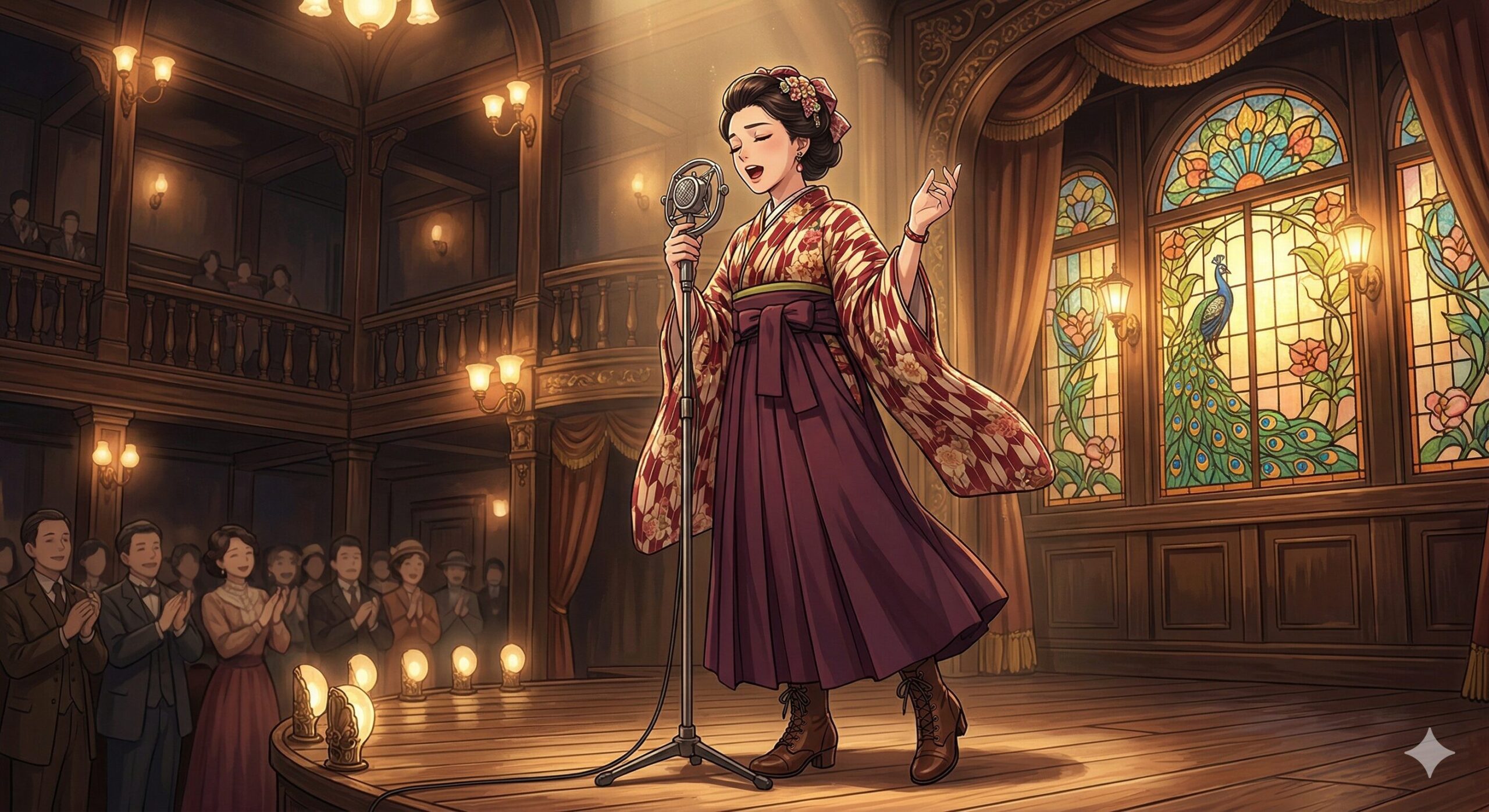
Do you know when the “very first moment” occurred in Japanese music history that united the hearts of the masses? March 26, 1914. This is the fateful day when the history of Japanese music and entertainment changed forever. The theatrical company “Geijutsuza,” led by Hogetsu Shimamura and Sumako Matsui, premiered a stage adaptation of Russian literary giant Leo Tolstoy’s masterpiece, Resurrection. The song sung during the play, “Katyusha’s Song,” recorded an unprecedented smash hit as Japan’s very first popular song (Kayokyoku). To commemorate this day, let us delve deep into the history of Japan’s modernization and the dawn of its pop culture.
The Impact of “Geijutsuza” and Tolstoy’s Resurrection
Japan in the 1910s was experiencing the “Taisho Roman” era, a glamorous fusion of Western culture and traditional Japanese aesthetics. Intellectuals were eagerly absorbing Western philosophy and literature, and among them, Hogetsu Shimamura set his sights on Tolstoy’s Resurrection. This story, with its universal themes of love across social classes, sin, and redemption, delivered a profound shock not only to the Japanese intellectual elite but also to the general public.
Playing the heroine, Katyusha, was Sumako Matsui, renowned as Japan’s first modern actress. She radiated overwhelming charisma on stage as a symbol of the new, liberated woman, unconstrained by old conventions. Her very existence was a major key that opened the door to women’s social advancement and self-expression in Japan at the time.
Japan’s First Explosive Hit! The Magic of “Katyusha’s Song”
The biggest factor that elevated this stage play from a mere theatrical success to a full-blown social phenomenon was “Katyusha’s Song.” The lyrics were written by Hogetsu Shimamura and Gyofu Soma, while the music was composed by Shinpei Nakayama, who would later be called the father of Japanese popular music. The record of this song, sung by Sumako Matsui, sold an astonishing 20,000 copies—an unbelievable number for an era when gramophones were still luxury items. It was an absolute frenzy.
Why did this song strike such a chord with the Japanese people? The secret lies in a compositional technique called the “Yonanuki Scale.” By removing the 4th (Fa) and 7th (Ti) notes from the Western seven-note major scale, this scale creates a sound closely resembling traditional Japanese folk songs and nursery rhymes. By laying a nostalgic melody deeply carved into the Japanese DNA over modern Western instruments and rhythms, Shinpei Nakayama invented an entirely new genre: “Japanese Popular Music.”
Interpreting the Taisho Roman: The Beautiful Fusion of West and East
The hit of “Katyusha’s Song” was not just a passing musical trend. It represents one of the most successful examples of “Wayo Secchu” (the blending of Japanese and Western styles) in Japan’s modernization. Although based on Western literature (Tolstoy) and recorded using Western technology (the gramophone), the core emotions and melodies were deeply Japanese. From this era onward, Japan began to demonstrate its unique talent—not simply mimicking the West, but absorbing foreign cultures through its own interpretation to create entirely new, original cultures, a trait still evident in modern J-POP and anime.
Furthermore, the popularity of this song rooted “record culture” firmly in Japan. People no longer had to go to a theater to hear music; they could share the same songs at home or on street corners. It was the exact moment when mass culture was truly born in Japan.
The DNA Connecting to Modern J-POP
If you trace the origins of all Japanese popular music that we enjoy today—from J-POP to Anime songs and City Pop—you will eventually arrive at “Katyusha’s Song” in 1914. The melody, which holds a certain strength even within its sorrow, and the media-mix strategy of tying a song to a narrative (like a drama or anime) to create a hit, were already perfected in this era. The fact that an event from over a century ago serves as the blueprint for current Japanese entertainment is nothing short of astounding.
To Our Readers: The Power of Music Across Time
This is “Katyusha’s Song,” the very origin of Japanese pop culture. How do you feel knowing that we share the exact same musical roots as people from over a century ago? Is there a song deeply tied to a story that is etched into your heart, transcending time and borders? If it were up to you, what kind of new expression would you create by fusing different cultures? Please share your thoughts and the stories behind your favorite songs.
【Reference Links】
- For historical audio and literature: National Diet Library Digital Collections
- Read other anniversary articles on this blog: What’s Today’s Special Day Series
3月26日は「カチューシャの唄の日」!日本のポップカルチャーの夜明けを紐解く
日本の音楽史において、大衆の心を一つにした「最初の瞬間」がいつだったかをご存知でしょうか。1914年(大正3年)3月26日。この日は、日本の音楽とエンターテインメントの歴史が永遠に変わった運命の日です。島村抱月と松井須磨子が率いる劇団「芸術座」が、ロシアの文豪レフ・トルストイの名作『復活』を初演しました。そして、その劇中で歌われた「カチューシャの唄」が、日本初の歌謡曲として空前の大ヒットを記録したのです。今日という日を記念し、日本の近代化とポップカルチャーの幕開けの歴史を深く掘り下げていきましょう。
劇団「芸術座」とトルストイ『復活』の衝撃
1910年代の日本は「大正ロマン」と呼ばれる、西洋文化と日本独自の美意識が華麗に融合した時代でした。知識人たちはこぞって西洋の思想や文学を吸収しており、その中で島村抱月はトルストイの『復活』に目をつけました。身分違いの恋、罪と贖罪という普遍的なテーマを持つこの物語は、当時の日本の知識階級だけでなく、一般大衆の心にも強烈な衝撃を与えました。
ヒロインであるカチューシャを演じたのは、日本初の近代女優として名高い松井須磨子です。彼女は古い因習にとらわれない新しい女性の象徴として、舞台上で圧倒的なカリスマ性を放ちました。彼女の存在そのものが、当時の日本における女性の社会進出や自己表現の扉を開く大きな鍵となったのです。
日本初の爆発的ヒット!「カチューシャの唄」の魔法
この舞台を単なる演劇の成功から、社会現象へと押し上げた最大の要因が「カチューシャの唄」です。作詞は島村抱月と相馬御風、作曲は後に日本の大衆音楽の父と呼ばれる中山晋平が担当しました。松井須磨子が歌うこの曲のレコードは、当時としては驚異的な2万枚以上を売り上げました。蓄音機がまだ高級品だった時代にこの数字は、まさに異常事態とも言える大熱狂です。
なぜこの曲はそれほどまでに日本人の心を打ったのでしょうか。その秘密は「ヨナ抜き音階」と呼ばれる作曲技法にあります。西洋の七音階から第4音(ファ)と第7音(シ)を抜いたこの音階は、日本の伝統的な民謡や童謡に近い響きを持っています。中山晋平は、西洋のモダンな楽器やリズムに、日本人のDNAに深く刻まれたノスタルジックな旋律を乗せることで、全く新しい「日本の歌謡曲」を発明したのです。
大正ロマンから読み解く、西洋と日本文化の美しい融合
「カチューシャの唄」のヒットは、単なる音楽の流行ではありません。それは日本の近代化における「和洋折衷」の最も成功した例の一つです。西洋の文学(トルストイ)を題材にし、西洋の技術(レコード)で録音されながらも、その中心にある感情やメロディーは極めて日本的でした。この時代から、日本は単に西洋の真似をするのではなく、海外の文化を独自の解釈で吸収し、全く新しいオリジナルな文化を生み出すという、現代のJ-POPやアニメにも通じる特技を発揮し始めたのです。
また、この曲の流行は「レコード文化」を日本に根付かせました。人々は劇場に行かなくても、家や街角で同じ音楽を共有できるようになり、日本における「大衆文化(マス・カルチャー)」が本格的に産声を上げた瞬間でもありました。
現代のJ-POPへと繋がるDNA
私たちが現在楽しんでいるJ-POP、アニソン、そしてシティポップに至るまで、すべての日本の大衆音楽の源流をたどると、この1914年の「カチューシャの唄」にたどり着きます。悲しみの中にもどこか力強さを持つメロディー、そして物語(ドラマやアニメ)と結びついてヒットするというメディアミックスの手法は、すでにこの時代に完成されていました。100年以上前の出来事が、現在の日本のエンターテインメントの設計図となっている事実は、驚き以外の何物でもありません。
読者の皆様へ:時代を超える音楽の力
日本のポップカルチャーの原点である「カチューシャの唄」。1世紀以上前の人々と私たちが、同じ音楽のルーツを共有しているという事実に、あなたはどのような感情を抱きましたか?時代や国境を越えて、あなたの心に深く刻まれている「物語と結びついた曲」はありますか?もしあなたなら、異なる文化を融合させて、どのような新しい表現を生み出したいですか?ぜひ、あなたの考えや、お気に入りの曲にまつわるエピソードを教えてください。
【参考リンク】
- 歴史的な音源や文献についてはこちら:国立国会図書館 デジタルコレクション
- 本ブログの他の記念日記事はこちら:今日は何の日シリーズ一覧
コメント