Within Japan’s rich natural landscapes, numerous “folktales” have been passed down since ancient times. These stories are not merely entertainment for children; they are crystallized pieces of culture packed with the lifestyles of the people, their awe of nature, and plenty of humor.
Today, we introduce a slightly creepy but ultimately hilarious folktale from the nature-rich Kumamoto Prefecture in southern Japan, called “The Eight-Eyed Monster of Akaiwa Abyss (Akaiwanbuchi no Yatsume)“. Let’s dive into the depths of Japanese history and culture through this story.
① The Story of “The Eight-Eyed Monster of Akaiwa Abyss”
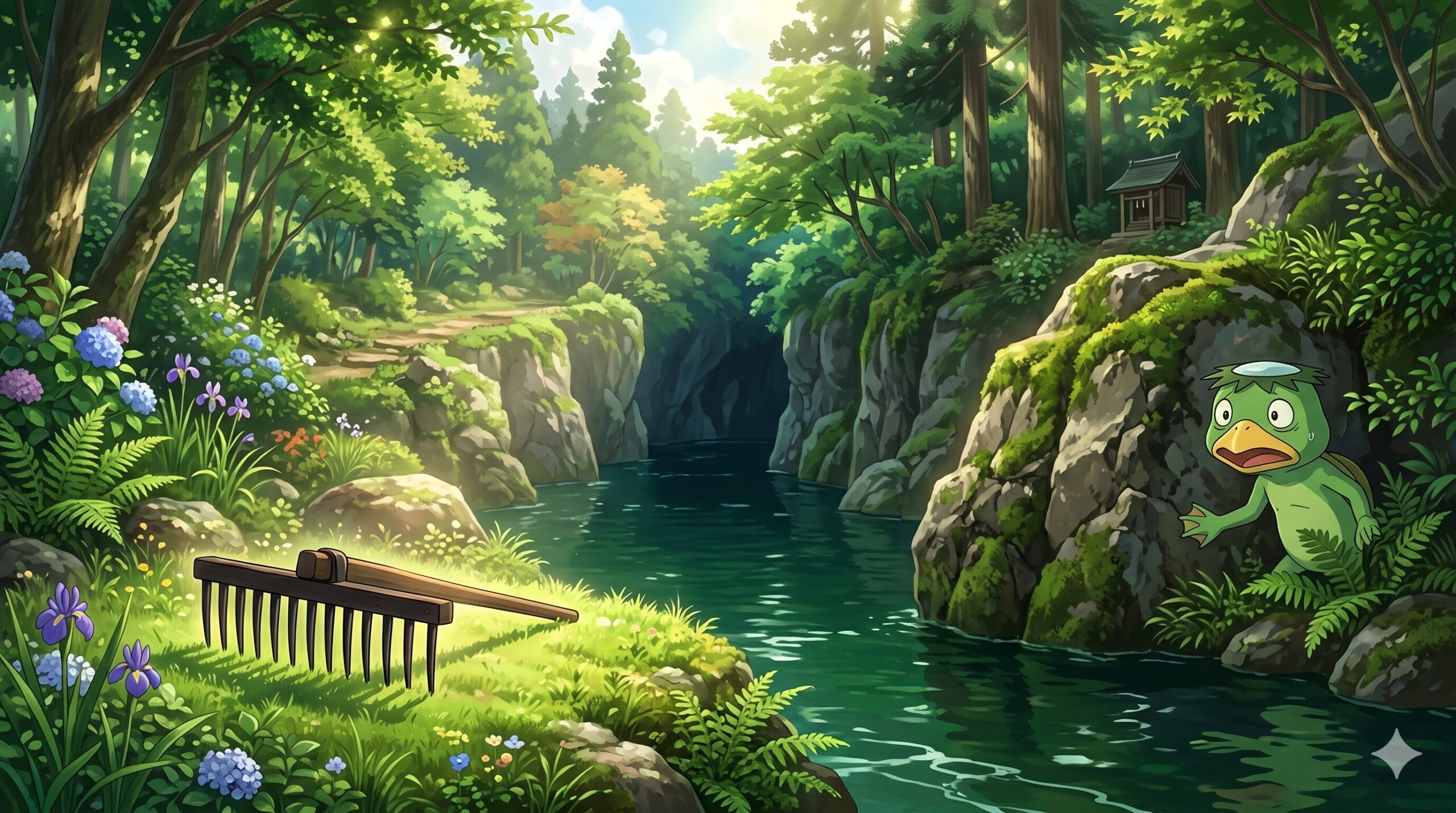
Once upon a time, near the village of Yuge along the Shirakawa River in Kumamoto Prefecture, there was a deep, dark river abyss known as “Akaiwanbuchi.” Even in broad daylight, it was dim and exuded a bottomless, eerie atmosphere. Every year, a terrifying occurrence took place there.
While the children of the village were playing in the river, they would suddenly be dragged underwater and drown. The villagers were stricken with grief and fear, whispering, “This must be the work of a Kappa. It’s pulling out their ‘Shiridama’ (a mythical organ believed to exist inside the human body).” A Kappa is a legendary, green-skinned Yokai (monster) said to dwell in Japan’s watersides.
One sunny day, as villagers were walking near the abyss, they spotted a Kappa taking a comfortable nap on a rock! To avenge their daily grievances, the villagers sneaked up, captured the Kappa, and punished it severely.
Shedding tears, the Kappa pleaded with the villagers:
“Please, spare my life! If you let me go, and defeat the ‘Eight-Eyed Monster’ living at the bottom of the abyss, I promise I will never take the children’s Shiridama again!”
What on earth was this “Eight-Eyed Monster” that even a Kappa feared? Though terrified, the villagers stood up to protect their children. They gathered the strongest young men in the village, took a small boat, and rowed to the center of the abyss.
One brave young man made up his mind, dove into the water, and searched the dark bottom… and sure enough, there lay a bizarre monster with countless eyes. He quickly tied a thick rope around it and signaled the surface. The young men on the boat pulled the rope with all their might, shouting, “Heave-ho! Heave-ho!”
Splashing out of the water emerged the “Eight-Eyed Monster.” But when the villagers saw it, they were dumbfounded. Its true identity was an old “Senbakoki”—a traditional Japanese farming tool made of aligned iron teeth used for threshing rice. Someone had dropped it in the river long ago, and its numerous iron teeth simply looked like eerie “eight eyes” in the dark depths.
However, when the Kappa saw the sharp iron teeth of the Senbakoki pulled from the water, they trembled in fear, screaming, “A terrifying monster has come ashore!” and fled as fast as they could deep into Mount Tatsuda. From that day on, not a single child drowned in the village of Yuge, and peace returned to the village.
② A Deep Analysis: Why Was the Kappa Afraid of a Farming Tool?
The greatest charm of this story is that it begins as a frightening ghost story but ends with a humorous punchline: “The monster was just a farming tool.” But if we look a little deeper, a very interesting fact emerges.
Why did a supernatural Yokai fear a human-made tool?
In Japanese folklore, the metal “iron” has long been believed to possess warding powers against evil. There is a common motif that supernatural beings, like Yokai and spirits, detest “iron,” the symbol of modern technology. The “Senbakoki” was an innovative iron farming tool popularized in the Edo period, symbolizing human technological innovation. The imagery of a dark Yokai fleeing in terror from a sharp iron tool created by humans makes perfect logical sense in folklore.
③ Gateway to Japanese Culture: Awe of Nature and Human Wisdom
From this folktale, we can decode the Japanese perspective on nature and culture.
First, there is the entity known as the “Kappa.” It is said that Kappa are fallen gods of rivers and swamps. Abundant water nurtures life, but at the same time, it is a terrifying force that takes lives through floods and water accidents. The Japanese personified the unpredictable and dangerous threats of nature into the Yokai known as “Kappa,” teaching children the lesson: “Do not go too close to the river.”
Furthermore, the appearance of the “Senbakoki” can be interpreted as symbolizing the process by which humans overcome the threats of nature (the Kappa) through human wisdom and technology (the farming tool). The balance between “awe” toward nature and the “wisdom” to live alongside it is the very essence of traditional Japanese spirituality.
④ To Our Readers: What Would You Do?
What did you think of the story? The villagers must have been incredibly surprised to find that the dark depths they believed harbored a terrifying monster actually just held one of their everyday tools.
If you were a young person in this village, would you have had the courage to dive into an eerie abyss where an unidentified “Eight-Eyed Monster” lurks? Also, in our modern society, are we sometimes frightened by “intangible fears”? Once we learn their true identity, they might turn out to be just like the “Senbakoki”—nothing to be afraid of at all.
Please let us know in the comments how this story made you feel, and what you think a modern-day “Eight-Eyed Monster” might be!
[Related Links]
- Read more fascinating Japanese folktales: Japanese Folktale Series (Blog Category)
- Learn more about Japanese Yokai and Kappa: Kappa – Wikipedia
【日本の不思議な昔話】赤岩ん淵の八つ目〜伝説の妖怪「河童」が恐れた正体とは?〜
日本の豊かな自然の中には、古くから語り継がれる数多くの「昔話」が存在します。それらの物語は、単なる子供向けのエンターテイメントではなく、当時の人々の生活、自然への畏怖、そしてユーモアがたっぷりと詰め込まれた文化の結晶です。
今回は、日本の南部に位置する自然豊かな熊本県に伝わる、少し不気味で、最後にはクスッと笑える昔話「赤岩ん淵の八つ目(あかいわんぶちのやつめ)」をご紹介します。この物語を通じて、日本の歴史と文化の深淵に触れてみましょう。
① 昔話「赤岩ん淵の八つ目」のストーリー
むかしむかし、熊本県を流れる白川(しらかわ)の弓削(ゆげ)という村の近くに、「赤岩ん淵(あかいわんぶち)」と呼ばれる、深く暗い川の淵がありました。昼間でも薄暗く、底知れぬ不気味な雰囲気を漂わせるその場所では、毎年恐ろしい事件が起きていました。
村の子供たちが川遊びをしていると、突然水の中に引きずり込まれ、溺れ死んでしまうのです。村人たちは口々に「これは河童(かっぱ)の仕業だ。尻子玉(しりこだま:人間の体内にあると信じられていた架空の臓器)を抜かれているに違いない」と恐れ、悲しみに暮れていました。河童とは、日本の水辺に住むとされる緑色の体をした伝説の妖怪です。
ある晴れた日のこと。村人たちが淵の近くを歩いていると、なんと岩の上で一匹の河童が気持ちよさそうに昼寝をしているではありませんか。日頃の恨みを晴らすため、村人たちはこっそりと近づき、河童を捕まえ、厳しく懲らしめました。
すると河童は涙を流し、村人たちにこう懇願しました。
「どうか命ばかりはお助けください!その代わり、淵の底に住んでいる『八つ目の化け物』を退治してくれたら、もう二度と子供たちの尻子玉は抜きません!」
河童すら恐れる「八つ目の化け物」とは一体何なのか?村人たちは恐怖を抱きつつも、子供たちを守るために立ち上がりました。村中の力自慢の若者たちを集め、小舟を出して淵の中央へと向かいます。
一人の若者が意を決して水中に飛び込み、暗い淵の底を探ると……確かに、無数の目を持つ奇妙な化け物が沈んでいました。若者は急いでそれに太い縄をくくりつけ、水面へと合図を送ります。船の上の若者たちが「そーれ!そーれ!」と力いっぱい縄を引き上げました。
水しぶきを上げて姿を現した「八つ目の化け物」。しかし、それを見た村人たちはあっけにとられました。なんとその正体は、古びた「千歯こき(せんばこき:稲穂から籾を落とすための鉄の歯が並んだ農機具)」だったのです。誰かが川に落とした農機具の無数の鉄の歯が、水底で不気味な「八つの目」に見えていただけでした。
しかし、水から引き揚げられた千歯こきの鋭い鉄の歯を見た河童たちは、「恐ろしい化け物が陸に上がった!」と震え上がり、一目散に立田山(たつだやま)の奥深くへと逃げていきました。それ以来、弓削の村で川に溺れる子供は一人もいなくなり、村に平和が戻ったということです。
② 物語の深い考察:なぜ河童は「千歯こき」を恐れたのか?
この物語の最大の魅力は、恐ろしい怪談として始まりながら、結末で「化け物の正体はただの農機具だった」というユーモア溢れるオチを迎える点です。しかし、少し深く考察すると、非常に興味深い事実が浮かび上がってきます。
なぜ妖怪である河童が、人間の作った道具を恐れたのでしょうか?
実は日本の民俗学において、「鉄」という金属は、古くから魔除けの力を持つと信じられていました。妖怪や精霊などの超自然的な存在は、近代的な技術の象徴である「鉄」を忌み嫌うという共通のモチーフがあります。「千歯こき」は江戸時代に普及した画期的な鉄製の農機具であり、人間の技術革新の象徴です。闇の底に潜む妖怪が、人間の生み出した鋭い鉄の道具に恐れをなして逃げていくこの構図は、非常に理にかなっているのです。
③ 日本文化への扉:自然への畏怖と人間の知恵
この昔話から、私たちは日本人の「自然観」と「文化」を読み解くことができます。
まず、「河童」という存在です。河童は川や沼の神様が零落した姿とも言われています。命を育む豊かな水は、同時に洪水や水難事故という形で人々の命を奪う恐ろしい存在でもありました。日本人は、予測不能で危険な自然の脅威を「河童」という妖怪の姿に具現化し、「川には近づきすぎてはいけない」という教訓を子供たちに伝えていたのです。
そして、「千歯こき」の登場は、人間が自然の脅威(河童)を、人間の知恵と技術(農機具)によって克服していく過程を象徴しているとも解釈できます。自然に対する「畏怖」と、共に生きていくための「知恵」。このバランスこそが、日本の伝統的な精神性そのものなのです。
④ 読者の皆様へ:あなたならどうしますか?
いかがでしたでしょうか?恐ろしい怪物がいると信じ込んでいた暗い水の底に、まさか自分たちの日常の道具が沈んでいたとは、村人たちも驚いたことでしょう。
もしあなたがこの村の若者だったら、正体不明の「八つ目の化け物」が潜む不気味な淵に飛び込む勇気はありましたか?また、現代社会において、私たちが「実体のない恐怖」に怯えていることはないでしょうか?正体を知ってしまえば、実はただの「千歯こき」のように、恐れるに足らないものかもしれません。
ぜひ、この物語を読んであなたがどう感じたか、現代の「八つ目の化け物」とは何だと思うか、コメント欄で教えてください!
【関連リンク】
- 他の魅力的な日本の昔話を読む:Japanese Folktale Series(当ブログのカテゴリー)
- 日本の妖怪や河童についてもっと知る:河童 – Wikipedia

コメント