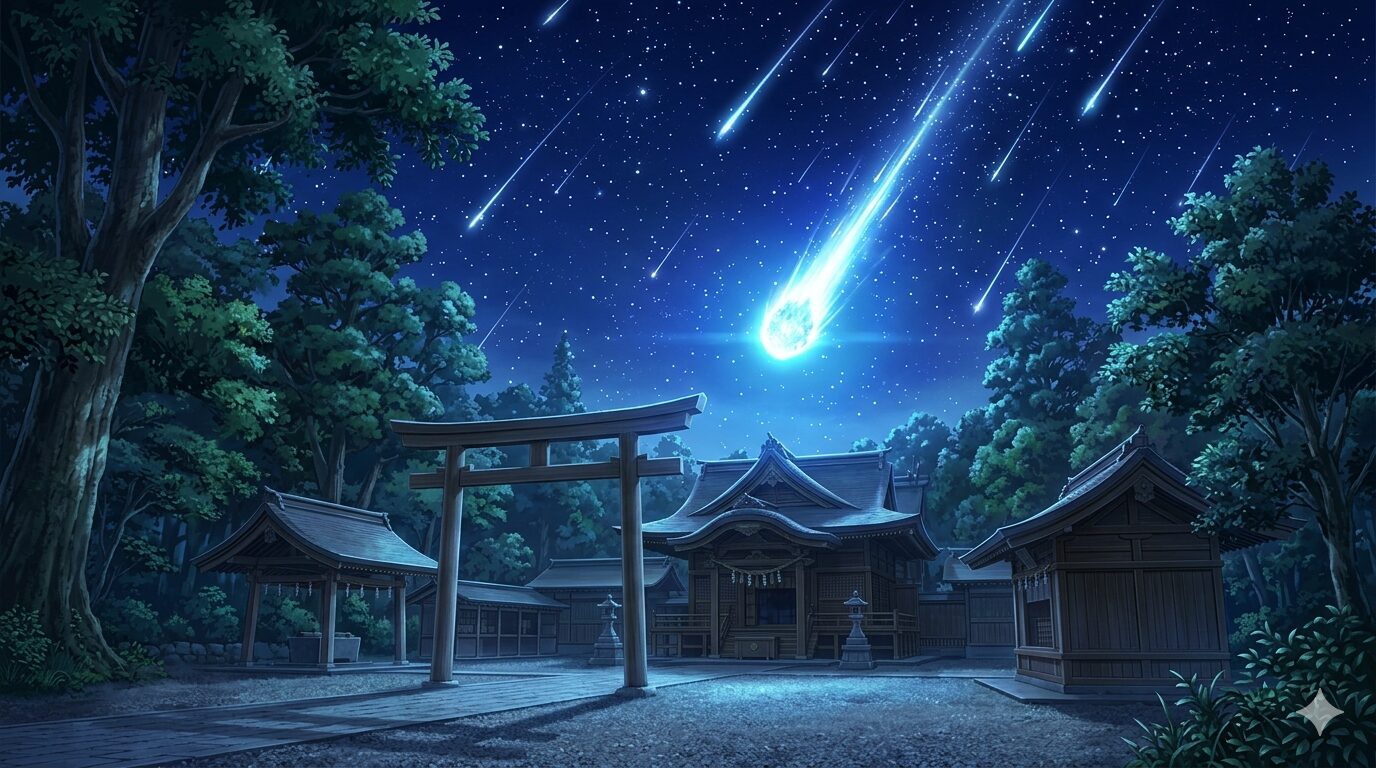
Looking up at the night sky and making a wish upon a shooting star is a universal human experience. However, in ancient Japan, a star falling from the sky was perceived not merely as an astronomical phenomenon, but as a sacred message from the divine. The “Nogata Meteorite,” which is said to have fallen in present-day Nogata City, Fukuoka Prefecture, on May 19, 861 (the 3rd year of the Jogan era), holds extraordinary significance in human history. This is because it is officially recognized by modern scientists as the “oldest meteorite in the world with a witnessed record of its fall.”
A Flash of Light and Roar Tearing Through the Heian Night Sky
The era was the early Heian period, during the Jogan years. This was a time in Japan marked by frequent natural disasters, including the great Jogan eruption of Mount Fuji and the devastating Jogan earthquake. On May 19, 861, as people lived in awe and fear of nature’s fury, an intense flash of light suddenly tore through the night sky, accompanied by a tremendous roar that shook the earth, as a single stone descended to the ground. Tradition holds that the impact site was within the sacred precincts of Suga Shrine, located in what is now Nogata City.
The Shinto priests of the shrine deeply revered this pitch-black stone that had fallen from the heavens. They never discarded it as something ominous. Instead, they carefully placed it in a magnificent wooden box made of paulownia, accurately recorded the date of its fall, and preserved it at the shrine as a “Tobi-ishi” (flying stone). The fact that such an accurate record was kept in that era, and that the physical object itself has been preserved to the present day, can only be described as a global miracle. The “Ensisheim Meteorite” in France, long considered the oldest witnessed meteorite fall in Europe, fell in 1492. The Nogata Meteorite predates it by more than 600 years.
It was not until 1922 (the 11th year of the Taisho era), over a millennium after its fall, that this stone was scientifically proven to be a genuine meteorite. Following a request by a coal mining engineer in Chikuho, experts in Tokyo investigated and identified it as a stony meteorite known as an L6 chondrite. The object of faith protected by Heian period priests had transformed into a precious scientific legacy for understanding the origins of the universe.
Japanese Animism and the Spirituality of Worshipping the “Stars”
The most crucial element to decipher from the story of the Nogata Meteorite is the spirituality of ancient Japanese “Animism” and “Shinto.” In Western history, there are many instances where stones falling from the sky were abhorred as the “work of the devil” and were subsequently destroyed or thrown into rivers. The Japanese, however, reacted entirely differently.
Since ancient times, Japan has embraced the concept of “Yaoyorozu no Kami” (the eight million gods). It was believed that deities dwelled in everything: mountains, rivers, rocks, trees, and of course, the stars shining in the night sky. The people of the Heian period, upon seeing this strange stone that fell into the shrine grounds, intuitively perceived it as a “messenger from heaven” or a “Goshintai” (an object of worship housing a spirit) in which a god had manifested. Rather than rejecting unknown phenomena and natural forces beyond their comprehension as “terrifying,” they accepted them as “awe-inspiring” and enshrined them. This receptivity and profound respect for nature are the very beauty that flows at the foundation of Japanese culture.
Furthermore, the importance of written records (archiving) emerges from this event. It was precisely because of the objective fact—the date written in ink on the wooden box—that it led to a major scientific discovery across 1,000 years. The fact that faith, record-keeping, and science—elements that might seem contradictory at first glance—coexist without conflict within Japan’s long history provides profound insights for us living in the modern age.
What is the “Unknown” to You?
The people of the Heian period carefully placed an unknown stone that fell from the sky into a box, treating it as a “god.” If, tonight, an unknown object from the far reaches of the universe were to descend right before your eyes, what would you do?
In modern times, we attempt to rationally explain all phenomena using the power of science. But is analyzing and quantifying everything the only way to approach the truth of the world? Perhaps having the “mental space” to humbly bow to things beyond human understanding and simply accept their existence, much like the priests who protected the Nogata Meteorite, is also a wisdom necessary for living a rich life. I hope this article provides you with a new perspective the next time you look up at the night sky. Who would you like to pass this miraculous story of a falling star on to?
[Internal Category Link]
5月19日:世界最古の目撃記録を持つ「直方隕石」の落下と日本の宇宙観
夜空を見上げ、流れ星に願いを込めるという行為は、世界中で普遍的に見られる人間の営みです。しかし、はるか昔の日本において、空から落ちてきた星は単なる天文現象を超えた、神聖なる神からのメッセージとして受け止められていました。861年(貞観3年)5月19日、現在の福岡県直方市に落下したとされる「直方隕石(のおがたいんせき)」は、人類の歴史において極めて重要な意味を持っています。なぜなら、この隕石は「落下の目撃記録が残っている世界最古の隕石」として、現代の科学者たちによって公式に認められているからです。
平安の夜空を切り裂いた閃光と轟音
時代は平安時代前期、貞観(じょうがん)年間。この時期の日本は、富士山の貞観大噴火や貞観地震など、天変地異が相次いだ時代でした。人々が自然の猛威に対する畏怖の念を抱えて生きていた861年の5月19日、突如として夜空を強烈な閃光が切り裂き、大地を揺るがすような大音響とともに一つの石が地上へと降り立ちました。落下地点は、現在の福岡県直方市にある須賀神社の境内であったと伝えられています。
神社の神官たちは、この空から降ってきた真っ黒な石を畏れ敬いました。彼らはそれを忌まわしいものとして捨てることは決してせず、立派な桐の箱に納め、落下した日付を正確に記録し、「飛石(とびいし)」として神社で大切に保管し続けたのです。この時代にこれほど正確な記録が残され、かつ物質そのものが現代まで保存されてきたことは、世界的に見ても奇跡と言わざるを得ません。ヨーロッパにおいて長らく最古の落下目撃隕石とされてきたフランスの「エンシスハイム隕石」の落下が1492年ですから、直方隕石はそれよりもさらに600年以上も古い記録を持っていることになります。
この石が真の隕石であると科学的に証明されたのは、落下から1000年以上が経過した1922年(大正11年)のことです。筑豊の炭鉱技師の依頼により、東京の専門家が調査を行った結果、L6コンドライトと呼ばれる石質隕石であることが判明しました。平安時代の神官たちが守り抜いた信仰の対象は、宇宙の起源を知るための貴重な科学的遺産へと姿を変えたのです。
「星」を祀る日本のアニミズムと精神性
この直方隕石の物語から読み解くべき最も重要な要素は、日本古来の「アニミズム(精霊信仰)」と「神道(しんとう)」の精神性です。西洋の歴史においては、空から降ってきた石は「悪魔の仕業」として忌み嫌われ、破壊されたり川に捨てられたりした事例も少なくありません。しかし、日本人は全く異なる反応を示しました。
日本には古くから「八百万の神(やおよろずのかみ)」という思想があります。山、川、岩、木、そしてもちろん夜空に輝く星々にも、すべてに神が宿ると考えられてきました。神社の境内に落下したこの奇妙な石を見た平安の人々は、それを「天からの使い」、あるいは神そのものが形を変えて現れた「ご神体」であると直感したのです。未知なる現象、理解を超えた自然の力を「恐ろしいもの」として排除するのではなく、「畏れ多いもの」として受け入れ、祀り上げる。この受容性と自然への深い敬意こそが、日本文化の根底に流れる美しさです。
また、文字による記録(アーカイブ)の重要性も、この出来事から浮かび上がります。木箱に墨で記された日付という客観的な事実が伴っていたからこそ、1000年の時を超えて科学的な大発見へと繋がりました。信仰と記録、そして科学。一見すると相反するこれらの要素が、日本の長い歴史のなかで矛盾することなく同居しているという事実は、現代を生きる私たちに多くの示唆を与えてくれます。
あなたにとって「未知なるもの」とは何ですか?
平安時代の人々は、空から降ってきた未知の石を「神」として大切に箱に納めました。では、もし今夜、あなたの目の前に宇宙の彼方から未知の物体が舞い降りてきたとしたら、あなたはどうするでしょうか?
現代の私たちは、科学の力であらゆる現象を合理的に説明しようとします。しかし、すべてを分析し、数値化することだけが世界の真理に近づく方法なのでしょうか。直方隕石を守り抜いた神官たちのように、人知を超えたものに対して謙虚に頭を下げ、その存在をただ静かに受け入れる「心の余白」を持つことも、また豊かな人生を生きるための知恵なのかもしれません。この記事を通じて、あなたが夜空を見上げる際の気持ちに、少しでも新しい視点が生まれれば幸いです。あなたなら、この星降る奇跡の物語を、誰に語り継ぎたいですか?
【関連カテゴリー】

コメント